
 Worksheets
EOC Biology Review
Total questions: 94
Worksheet time: 3hrs 55mins
Place the stages in the correct order of the cell cycle?
S
What are the stages of mitosis?
Prophase
Metaphase
Anaphase
Telophase
What phases of the cell cycle make up interphase? Pick all that are correct.
G1
Mitosis
G2
S
Cellular respiration = (a) + (b) -> (c) + (d) + (e) (alphabetical order)
Place the steps of photosynthesis in order
Carbon Dioxide
Water
Sunlight->
Glucose
Oxygen
Oxygen
02
Water
H20
Glucose
C6H12O6
Carbon Dioxide
CO2
Adenosine Triphosphate
ATP
Match the following macromolecule with the monomer.
Nucleic Acid
Nucleotide
Protein
Amino Acid
Carbohydrate
Monosaccaride
Lipid
Fatty Acid and Glycerol
Match the following organelle with its function
Chloroplast
use the suns energy to produce glucose through photosynthesis
Golgi Body
package and distribute materials in and out of the cell.
Lysosome
Digests excess products and food particles
Mitochondria
Transform energy through respiration. Break down glucose for ATP
Nucleus
Contains DNA which controls cellular activities
Match the following organelle with the function
Ribosome
protein synthesis
Vacuole
Store water and other materials
Cell/plasma membrane
phospholipid bilayer, protects the cell and allows materials to go in and out.
Cell wall
rigid layer that protects and encloses plant, fungi, and some bacteria cells.
Cytoplasm
Fluid like substance that contains various structures that have various functions.
Match the following organelle with function
rough endoplasmic reticulum
contains ribosomes and site of chemical reactions
smooth endoplasmic reticulum
site of chemical reactions and lipid production
Cytoskeleton
provides internal structures
Cytoskeleton - microfilaments
fibers
cytoskeleton - microtubles
cylinders
Enzymes are (a) that regulate nearly every biochemical reaction. They typically end in (b) . Enzymes can become (c) if they get to hot or the pH changes.
(a) does (b) require energy. (c) (d) require energy.
(a) (b) and (c) are all types of (d)
(a) , (b) , and (c) are both types of active transport. Active transport moves materials (d) the concentration gradient.
hypotonic
water moves in and cell bursts (lyse)
hypertonic
water moves out of cell and cell shrivels
isotonic
no net movement, cell maintains equilibrium
(a) , Kingdom, (b) , (c) , order, family, (d) (e)
What are the two parts of a scientific name?
Genus
Domain
Class
Phylum
Species
Match the following kingdom with its example
Archaebacteria
Thermophiles
Eubacteria
Ecoli
Fungi
Yeast
Plantae
Live Oak
Animalia
Bombardier Beetle
Which of the following characteristics of living things do viruses not have?
Contains Genetic Material
Cells
Grow and Develop
Reproduction without host
Evolve
Match the following animal adaptation with example.
behavioral
migration
physiological
venom
structural
wing shape
Match the following plant adaptation with example
Structural
Flower color
Behavioral
Tropism
Physiological
Blooming at night
Match the tropism (plant response toward or away from stimuli).
Geotropism or gravitropism
response to gravity
phototropism
response to light
hydrotropism
response to water (roots)
Thigmotropism
response to touch
chemotropism
response to chemicals
(a) states that some (b) cell organelles, such as (c) and (d) evolved from free-living (e) .
Analogous Structures
structures that serve identical functions but have different internal anatomy
Homologous Structures
Organ or bone that is derived from a common ancestor.
vestigial structures
unused organs or bones in an organism
adaptation
adjustment of an organism due to their environment that gives them a great chance of survival.
speciation
the forming of a new species due to isolation
Coevolution
When both species adapted at the same time because of another species
Divergent Evolution
One species develops into two different species due to isolation or change in environment.
Binomial Nomenclature
Two part naming system, organisms named by genus and species
Dichotomous key
tool that uses two step questions to classify based on characteristics.
Central Dogma (idea or principle) of Biology is (a) to (b) to (c)
Which of the following describe DNA?
Single Strand
Double Strand
Ribose Sugar
Deoxyribose Sugar
Thymine
Which of the following describe RNA
Single Strand
Double Strand
Ribose Sugar
Deoxyribose Sugar
Thymine
DNA replication is (a) . Each side is used as a (b) . DNA (c) so when (d) takes places each new cell as an (e) copy.
Match the parts of replication with their jobs.
Helicase
Unwinds/unzips
Topoisomerase
Holds Strands apart
RNA primer
adds short strands of RNA to start the process
DNA polymerase
builds a new strand with complementary nucleotides
DNA Ligase
Glues Okazaki fragments on lagging strand.
Chromosomes are (a) DNA that is (b) around (c)
(a) are (b) of DNA on a (c) . The (d) of the bases determines the order of (e) .
Match the following sources of genetic variation.
Crossing Over
Occurs in Prophase I, genes from homologous chromosomes pair up and exchange information.
Random assortment
alleles separate and sort randomly during meiosis resulting in many different phenotypes
Nondisjunction
when chromosome do not separate properly which leads to trisomy and monosomy.
Genetic mutation
change in DNA leads to a change in protein
Gene regulation
the expression of genes is regulated by turning off and on genes.
Match the mutation information
Point mutation
one base is changed, may or may not change protein (inversion or substitution)
Frameshift mutation
addition or deletion of a nitrogenous base. causes change to protein.
Mutation in sex cells (germ cells)
Can be passed on to offspring.
Mutagens
radiation, chemicals, virus... anything that causes a mutation.
Which of the following are chromosome mutations?
Frameshift
Translocation
Deletion
addition
substution
Chromosome mutations are worse than DNA mutations.
True
False
(a) , (b) , and (c) make up a nucleotide.
Replication
Making an exact copy of DNA
Transcription
mRNA is made of a section of DNA in the nucleus.
Translation
mRNA codons match with tRNA and the code is translated into a protein at a ribosome (rRNA).
mRNA
Messenger RNA
tRNA
transfer RNA
transgenic crops
plants that have been genetically modified using recombinant DNA
gel electrophoresis
uses gel and electric charge to separate fragments of DNA into a fingerprint.
Gene Therapy
a virus can be used as a vector to deliver a working gene to patients
restriction enzyme
enzyme in bacteria that are used to cut DNA into fragments- used to cut genes of interest
selective breeding
breeding organisms to produce a desirable trait.
Inbreeding
breeding to increase the purity of certain traits, closely related organisms.
Human Genome Project
sequence of all human DNA
Reproductive Cloning
making identical copy of an organism. Uses nuclear transfer.
Therapeutic cloning
making stem cells, similar to reproductive cloning except no egg is implanted
recombinant dna
DNA from 2 sources that is spliced together
(a) is a branching diagram showing relationships among groups of clades while a (b) is a branching diagram that shows the inferred relationships between various species.

What is the closest relative of humans shown in this diagram?
horse
turtle
monkey
dog

According to this diagram, is the pig more closely related to the dog or kangaroo?
(a)

What organism on this diagram would have DNA most similar to the penguin?
(a)

Which species are extinct? (Check all that apply.)
A
D
E
H
J
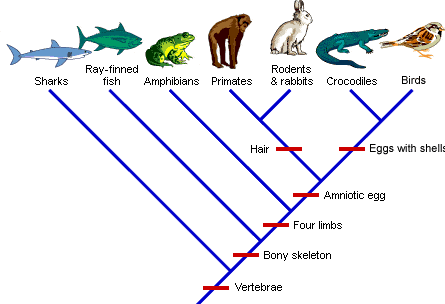
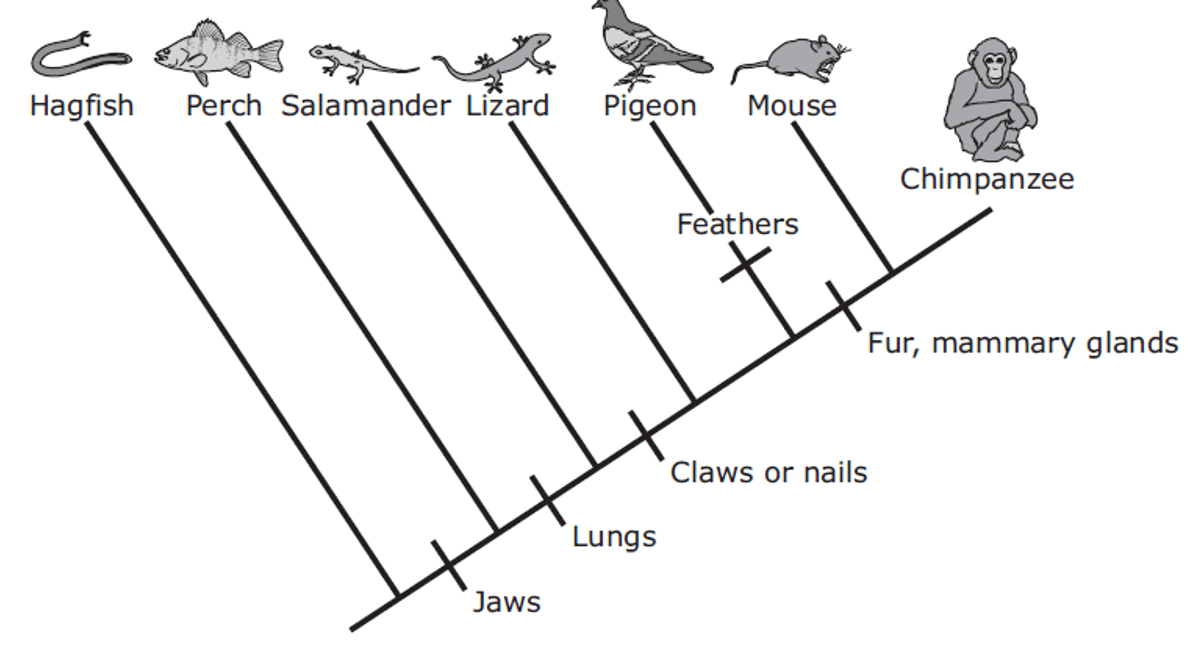
All the animals to the right of the salamander would have the common characteristic of...
Fur
Claws or nails
Lungs
Jaws


The diagram below represents possible genetic relationships between groups of organisms.
Which statement is a valid conclusion that can be drawn from the diagram?
Insects are more complex than mammals.
Earthworms and sea stars have a common ancestor.
Snails appeared on Earth before corals.
Sponges were the last new species to appear on Earth.
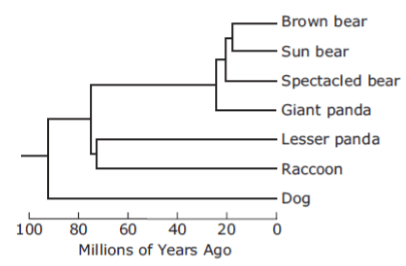
Based on this phylogenetic tree, which statement is true?
Lesser pandas are more genetically similar to giant pandas than they are to raccoons
Brown bears are more genetically similar to giant pandas than they are to sun bears
Lesser pandas are more genetically similar to raccoons than they are to giant pandas
The bear species are all more genetically similar to dogs than they are to giant pandas

What number is the common ancestor of C and D
1
2
3
4

What is the common ancestor of Letters A, B, C, D, E?
1
2
3
4

Who is most closely related to Taxidea taxus?
Lutra lutra
Panthera pardus
Canis latrans
Canis lupus
Which of the following correctly identify parts of mitosis?
2 identical cells
4 identical cells
2 nonidentical cells
4 nonidentical cells
Somatic cells undergo (a) . The ending result is (b) (c) (d) cells.
Gametic cells undergo (a) . The ending result is (b) (c) (d) cells.
Match the purpose of each
Mitosis
growth and repair
meiosis
sex cells
interphase
growth, metabolism, and preparation for division
(a) respiration requires (b) . (c) respiration does (d) require oxygen. Anaerobic respiration is often called (e) .
how much ATP is required to start glycolysis?
1
3
4
2
what happens after glycolysis?
goes into aerobic respiration if oxygen is present and anaerobic if not
glycolysis starts over again
ATP from glycolysis begins to help begin photosynthesis
nothing
Glycolysis happens in the (blank).
(a)
Which is a product of glycolysis?
2 molecules of pyruvic acid
1 molecule of glucose
NAD+
oxygen

The first step of photosynthesis is:
Light dependent
Light independent
The calvin cycle
Glycolysis
The light dependent step occurs in the:
Thylakoid membranes
Stroma fluid
Cytoplasm
Double membrane
Chlorophyll is important in which step?
Light dependent step
Light independent step
The Light Independent step occurs in the:
Thylakoid membranes
Stroma fluid
Double membrane
Cytoplasm
The first step of cellular respiration is
ATP synthesis
aerobic
glycolysis
in the mitochondria
Which stage(s) of cellular respiration is/are ANAEROBIC.
(check all that apply)
glycolysis
formation of acetyl CoA
citric acid cycle
electron transport chain

In this diagram of a mitochondrion, #1 is pointing to the
matrix
inner membrane
outer membrane
intermembrane space
Which of the following do at least one stage of cellular respiration
plants
animals
bacteria
fungi
Match Mendel's Laws
Law of Dominance
the dominant allele will prevent the recessive allele from being expressed
Law of segregation
gene pairs separate when gametes are formed
Law of independent assortment
different pairs of genes separate independently of each other when gametes are formed.
(a) contains 4 boxes and looks at (b) trait. Heterozygous crosses show a (c) genotype ratio and a (d) phenotype ratio.
(a) contains (b) boxes and it crosses (c) traits. A cross between two heterozygous parents would revel a (d) phenotype ratio in the offspring.
What is the phenotype ratio of two heterozygous individuals in a dihybrid cross?
(a) : (b) : 3 : (c)
sex linked traits
traits that are inherited on X chromosomes.
Linked Traits
genes on the same chromosome are inherited together
multiple alleles
presence of more than two alleles for a trait.
polygenic inheritance
one trait controlled by many genes
(a) have both alleles equally expressed, while (b) has an intermediate between the two parents, neither trait is dominant.
homozygous recessive
aa
homozygous dominant
HH
heterozygous
Gg
Match the following Blood types with their genotype.
O
OO
AB
AB
A
AO
B
BO
A (Homozygous)
AA
Exponential growth is represented by a (a) . Logistical growth is represented by an (b) .
Bacteria exhibit (a) growth due to rapid reproduction. Animals have (b) due to slower reproduction. In an ecosystem the (c) is the maximum number of organisms an ecosystem can support. (d) determine the carrying capacity.
Biotic
living or once living
abiotic
never living
density dependent
limit populations when density becomes high - predation, competition)
density independent
limit the population size regardless of density - natural disasters - fire, flood, drought
Reorder the following into the proper ecological structure (smallest to largest)
Organism
Population
Community
Ecosystem
Biome
Reorder the following for a ecological pyramid
producer
primary consumer
secondary consumer
tertiary consumer
decomposer
producer
autotroph
primary consumer
herbivore - heterotroph
secondary consumer
omnivore- hetertroph
tertiary consumer
typically carnivore - heterotroph
decomposer
return nutrients back to the environment - bacteria and fungi
What percent of energy is passed on to the next trophic level?
(a)
Phosphorus cycle
weathering of rock
carbon/oxygen cycle
photosynthesis removes CO2 and cellular respiration releases CO2
Nitrogen cycle
bacteria is needed to help complete this cycle.
Nitrogen fixation
bacteria changing nitrogen into usable forms for the plant.
Organic
Carbon Containing
(a) succession begins on (b) . (c) succession starts after a natural or human disaster and there is (d) on the ground.
pioneer species
species that are the first to colonize an area in succesion
aquatic habitats
fill with sediment over time during successiong
estuary
aquatic area with a mix of fresh and salt water
terrestrial environments
areas on land that are replaced by the largest plants for that biome
climax community
final stable community and highest biodiversity
Keystone species
species in an ecosystem on which other species depend
symbiosis
relationship between organisms
biomagnification
increase in toxins at higher levels on the food chain
greenhouse gas
increased that trap heat in the atmosphere
eutrophication
nutrient pollution in water that leads to algal blooms
invasive species
species not native to the area. Has few natural predators
Niche
an organisms particular role in an ecosystem
mutualism
both organisms benefit
commensalism
one organism benefits and one is unaffected
parasitism
one organism benefits and one is harmed

