wayground logo

Free Printable Worksheets

Font size

S
M
L
XL
Worksheets

24-25 Environmental Midterm Review

Total questions: 96

Worksheet time: 48mins
Name
Class
Date
1.
1. Population density is calculated by:
a)
a. Counting the number of animals in a space.
b)
b. Knowing the area of that space.
c)
c. Dividing the number of individuals by the area they occupy.
2.
2. A high population density suggests that:
a)
a. The area is underpopulated.
b)
b. The area is overpopulated.
c)
c. The species is endangered.
d)
d. The habitat is expansive.
3.
3. What does a uniform population dispersion indicate about a species?
a)
a. Low competition over resources.
b)
b. High competition over resources .
c)
c. An aquatic habitat.
d)
d. A migratory pattern.
4.
4. Which type of dispersion is characterized by randomness and solitary living?
a)
a. Uniform
b)
b. Random
c)
c. Clumped
d)
d. Stratified
5.
5. Clumped dispersion is often an adaptation against:
a)
a. Predation.
b)
b. Overpopulation.
c)
c. Disease.
d)
d. Inbreeding.
6.
6. What does an organism's reproductive potential mean?
a)
a. Its birth rate.
b)
b. Its death rate.
c)
c. The maximum number of offspring it can produce.
d)
d. Its likelihood of becoming extinct.
7.
7. Linear growth in a population is characterized by:
a)
a. A constant amount of increase.
b)
b. A doubling pattern.
c)
c. A decrease over time.
d)
d. Fluctuations based on seasons.
8.
8. Exponential growth in a population is characterized by:
a)
a. A constant amount of increase.
b)
b. A doubling pattern.
c)
c. A decrease over time.
d)
d. Fluctuations based on seasons.
9.
9. Limiting factors in an ecosystem:
a)
a. Always increase the population size.
b)
b. Are only abiotic factors like temperature and weather.
c)
c. Can be biotic or abiotic and determine the carrying capacity.
d)
d. Have no effect on population growth.
10.
10. What is the significance of a population's carrying capacity?
a)
a. It's the point where population growth stops.
b)
b. It's the maximum population an ecosystem can support indefinitely.
c)
c. It's the total number of species in an ecosystem.
d)
d. It's the amount of area available for colonization.
11.
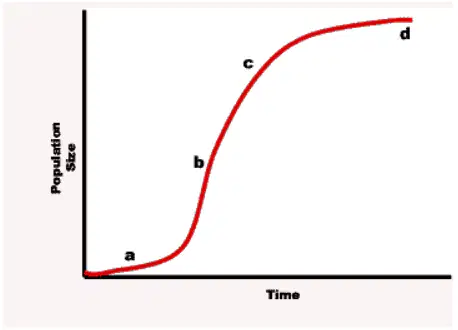
11. Which letter shows the exponential population growth?
a)
a. letter a
b)
b. letter b
c)
c. letter c
d)
d. letter d
12.
12. According to the age pyramid above, Germany’s population is -
a)
a. Growing
b)
b. getting smaller
c)
c. no growth
13.
13. A population pyramid is used to show:
a)
a. The distribution of resources in an ecosystem.
b)
b. The age and gender structure of a population.
c)
c. The territorial boundaries of different species.
d)
d. The biodiversity within a specific habitat.
14.
14. Real-life connection: How has urban development affected animal populations in metropolitan areas?
a)
a. By increasing their genetic diversity.
b)
b. By reducing available habitat and resources.
c)
c. By promoting migration to cities.
d)
d. By having no significant impact.
15.
15. Real-life connection: Which factor can cause a sudden decrease in population due to a non-selective disaster?
a)
a. A density-dependent factor like predation.
b)
b. A density-independent factor like a hurricane.
c)
c. A biotic factor like competition.
d)
d. A social factor like tourism.
16.
16. Real-life connection: What are the consequences of high birth rates on a country's economy?
a)
a. Increased labor force.
b)
b. Strain on educational and healthcare systems.
c)
c. Immediate economic growth.
d)
d. More efficient resource use.
17.
17. Real-life connection: Why is understanding population growth rates important for public health planning?
a)
a. To ensure the population stays within the carrying capacity.
b)
b. To predict and manage resource needs for healthcare services.
c)
c. To enforce immigration laws.
d)
d. To monitor the birth and death rates only.
18.
18. Real-life connection: In agriculture, how do monocultures affect the carrying capacity for pests?
a)
a. Decrease the carrying capacity due to lack of food variety.
b)
b. Increase the carrying capacity by providing ample food resources .
c)
c. No effect as pests are not influenced by monocultures.
d)
d. Monocultures diversify pest species, increasing carrying capacity.
19.
19. Real-life connection: How can invasive species impact the population dynamics of native species?
a)
a. By decreasing the native species' reproductive potential.
b)
b. By introducing new diseases to which native species have no immunity.
c)
c. By altering the native habitat, affecting the carrying capacity.
d)
d. All of the above.
20.
20. Real-life connection: The overuse of antibiotics in livestock can lead to what population-level effect in bacteria?
a)
a. Decreased mutation rate.
b)
b. Increased genetic uniformity.
c)
c. Increased resistance in bacterial populations.
d)
d. No significant change.
21.
21. Real-life connection: What effect does the destruction of coral reefs have on fish populations?
a)
a. Increases the carrying capacity for fish.
b)
b. Decreases the fish population due to habitat loss.
c)
c. No effect, as fish can adapt quickly to new habitats.
d)
d. Increases biodiversity by forcing fish to migrate.
22.
22. Real-life connection: How does climate change affect the distribution of species across different altitudes and latitudes?
a)
a. Species distribution remains unchanged.
b)
b. Species may shift to higher altitudes and latitudes seeking cooler environments.
c)
c. Species diversity decreases at higher altitudes.
d)
d. Climate change mainly affects aquatic species' distribution.
23.
23. Real-life connection: Considering the impact of global warming, what could be a potential effect on animal and plant populations in the Arctic?
a)
a. Decreased population due to ice melt.
b)
b. Increased population due to longer growing seasons.
c)
c. No change, as Arctic species are adapted to cold environments.
d)
d. Shifts in population dynamics due to changes in prey and predator relationships
24.
What is a species?
a)
A single organism that can reproduce under natural conditions.
b)
A population of organisms that can interbreed and reproduce under natural conditions.
c)
A group of similar plants.
d)
A collection of diverse animals.
25.
Which is an immediate sign that a species is endangered?
a)
It's widespread and abundant.
b)
It is in immediate jeopardy of extinction throughout a large portion of its range.
c)
It has a large gene pool.
d)
It has been introduced to a new habitat.
26.
What can cause extinction?
a)
Habitat creation.
b)
Pollution reduction.
c)
Over-exploitation.
d)
Disease eradication.
27.
What is speciation?
a)
The loss of a species.
b)
The evolution of a new species.
c)
The migration of a species.
d)
The conservation of a species.
28.
What can result from geographic isolation?
a)
Increased trade between populations.
b)
A decrease in species diversity
c)
Speciation.
d)
Immediate extinction.
29.
How does interspecific competition influence species?
a)
It ensures all species have equal resources.
b)
It can lead to the dominance of one species over another.
c)
It prevents species from adapting to new habitats.
d)
It guarantees peaceful coexistence.
30.
Which is a TRUE statement about biodiversity?
a)
It refers only to the number of species.
b)
It includes species, genetic, and ecological diversity.
c)
It is unrelated to the health of ecosystems.
d)
It is always enhanced by introducing non-native species.
31.
How is a biodiversity index calculated?
a)
Total number of individuals ÷ number of species.
b)
Number of species ÷ total number of individuals.
c)
Total biomass of all species ÷ area of the habitat.
d)
Total number of habitats ÷ number of species.
32.
What does a line transect help to measure?
a)
The length of a habitat.
b)
The biodiversity in a specific location.
c)
The number of predators in an area.
d)
The migration patterns of species.
33.
How do invasive species affect biodiversity?
a)
They increase genetic diversity.
b)
They generally have limited impact.
c)
They can decrease biodiversity by outcompeting native species.
d)
They enhance the native species' ability to adapt.
34.
The Endangered Species Act of 1973 is significant because it:
a)
Eliminates all non-native species.
b)
Protects species at risk by placing trade restrictions.
c)
Guarantees funding for habitat restoration.
d)
Provides unlimited protection for all species.
35.
What is an example of mechanical isolation?
a)
Species separated by a river.
b)
Species that mate in different seasons.
c)
Species whose reproductive organs are incompatible.
d)
Species that prefer different types of food.
36.
Temporal isolation occurs when:
a)
Species live in different habitats.
b)
Species reproduce at different times.
c)
Species have different predators.
d)
Species vary in size and shape.
37.
Which statement best represents the principle of competitive exclusion?
a)
All species have an equal chance of survival.
b)
Two species can coexist without competition.
c)
One species will outcompete another when resources are limited.
d)
Cooperation between species enhances biodiversity.
38.
Real-life connection: What species is invasive to the everglades section of Florida?
a)
Burmese pythons.
b)
Kangaroos.
c)
Rabbits.
d)
Alligators.
39.
Real-life connection: Which action by humans can lead to habitat loss and degradation?
a)
Conservation efforts.
b)
Urban development.
c)
Recycling programs
d)
Wildlife documentaries.
40.
Real-life connection: What role does the Endangered Species Act play in real estate development?
a)
It restricts development in critical habitats.
b)
It promotes the building of more housing projects.
c)
It has no impact on real estate.
d)
It encourages developers to import non-native species.
41.
Real-life connection: How does climate change potentially affect speciation?
a)
It has no known effect.
b)
It accelerates the process.
c)
It can lead to the merging of species.
d)
It may increase geographic isolation leading to speciation.
42.
Real-life connection: How might a decrease in genetic biodiversity affect agriculture?
a)
It can lead to more robust crop varieties.
b)
It may result in crops that are more susceptible to disease.
c)
It will have no effect on crop production.
d)
It will increase the nutritional value of crops.
43.
Real-life connection: What effect do invasive species often have on water ecosystems?
a)
They clarify water by consuming algae.
b)
They typically increase fish populations.
c)
They can alter food webs and reduce native species' populations.
d)
They have no significant impact.
44.
Rain carries soil into a nearby pond. This is an interaction between which two "spheres" of the earth?
a)
Hydrosphere & Atmosphere
b)
Atmosphere & Biosphere
c)
Geosphere & Hydrosphere
d)
Atmosphere & Geosphere
45.
The unique role a species plays in its environment is its...
a)
abiotic factor
b)
niche
c)
trophic level
d)
community
46.
Many species together in one place is called ____________ .
a)
a niche
b)
a community
c)
a population
d)
mutualism
47.
Which level of any energy pyramid is most likely to have the highest number of organisms?
a)
Producers
b)
Primary consumers
c)
Secondary consumers
d)
Tertiary consumers
48.
Two types of organisms consumer dead and decaying matter. The difference between these two types of organisms is that _______________ are consumers that feed on dead animals, while _________________ break down plants and animals into simpler molecules.
a)
decomposers; producers
b)
scavengers; decomposers
c)
producers; decomposers
d)
decomposers; scavengers
49.
We know that energy from the sun is transferred into an organism because of __________________ .
a)
the 1st law of thermodynamics
b)
the 2nd law of thermodynamics
c)
the 3rd law of thermodynamics
50.
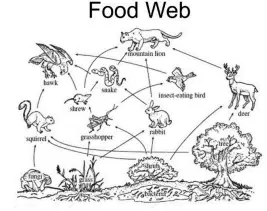
The arrows on a food web or food chain represent _______________.
a)
the direction in which energy is being transferred
b)
how far away one species is from another
c)
the organism that is being eaten
d)
nothing
51.
A tiny filter-feeding barnacle sticks to a whale. The whale is unaffected by this new stowaway. What type of relationship is this?
a)
mutualism
b)
commensalism
c)
amensalism
d)
neutralism
e)
parasitism
52.

Cowbirds are known to lay their eggs in nests of other birds. Mother birds will feed the new chicks and their own, which sometimes means not every chick gets enough food. This is an example of ___________.
a)
mutualism
b)
commensalism
c)
amensalism
d)
neutralism
e)
parasitism
53.
Which sphere of the earth is named using the Greek root meaning "ground"?
a)
Hydrosphere
b)
Atmosphere
c)
Biosphere
d)
Geosphere
54.
Which of these is NOT an example of an abiotic factor?
a)
Soil
b)
Temperature
c)
Bacteria
d)
Rainfall
55.
Which kind of niche takes competition between organisms into account?
a)
Realized niche
b)
Unique niche
c)
Fundamental niche
d)
Competitive niche
56.
How much chemical energy is transferred from the producer level to the secondary consumer level in a food chain?
a)
1/10
b)
1/20
c)
1/100
d)
1/1000
57.
Organisms that eat both plants and meat are called ____________.
a)
omnivores
b)
herbivores
c)
autotrophs
d)
carnivores
58.
In this picture, the grasshopper is considered a ________________ .
a)
primary consumer
b)
secondary consumer
c)
tertiary consumer
d)
producer
59.
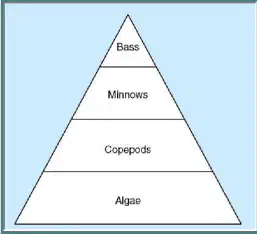
If algae has 1800kJ of energy, how much energy will minnows obtain from the copepods?
a)
1800 kJ
b)
180 kJ
c)
18 kJ
d)
1.8 kJ
60.
An unidentified ecosystem is discovered. It is cold, treeless and permanently frozen. Which type of biome would this ecosystem belong to?
a)
Tundra
b)
Taiga
c)
Alpine
d)
Chapparal
61.
Which of the following statements is an example of climate?
a)
There is a cold front coming in this weekend.
b)
A snowstorm is forecasted to his the northeast US this week.
c)
It is usually hot in Texas in July and August.
d)
It rained 4 inches yesterday in Seattle, WA.
62.
An organism has been introduced into a thriving ecosystem and it reproduces quickly because a predator does not recognize it as prey. The organism is most like a(n) ___________________ .
a)
transect species
b)
invasive species
c)
pioneer species
d)
primary species
63.
The climatogram below is an example of what type of biome?
a)
Taiga
b)
Tundra
c)
Tropical Rainforest
d)
Desert
64.
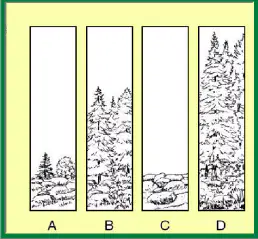
Using the picture, which one is an example of climax community?
a)
Picture A
b)
Picture B
c)
Picture C
d)
Picture D
65.
Which two measurements are found on a climatogram?
a)
Temperature in Celsius and Temperature in Fahrenheit
b)
Rainfall and vegetation types
c)
Temperature and number of species
d)
Rainfall and temperature
66.
How many terrestrial biomes are there?
a)
8
b)
9
c)
7
d)
6
67.
What are the four characteristics define a biome?
a)
Temperature
b)
Soil
c)
Amount of water
d)
Amount of light
e)
The amount of humans
68.

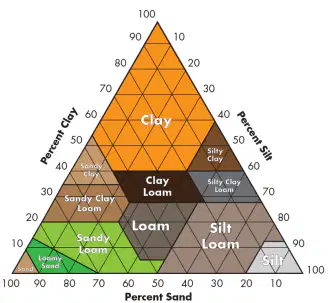
A soil samples contains 20% SAND, 20% CLAY, and 60% SILT. What is the texture of this soil?

a)

Clay Loam

b)

Silty Clay

c)

Silt Loam

d)

Loam

69.

A soil sample contains 70% SAND, 15% CLAY, and 15% SILT. What is the texture of this soil?

a)

Sandy Loam

b)

Loamy Sand

c)

Sand

d)

Fine Sand

70.

A soil sample contains 10% SAND, 30% CLAY, and 60% SILT. What is the texture of this soil?

a)

Silty Clay Loam

b)

Silty Loam

c)

Clay Loam

d)

Loam

71.

A soil sample contains 50% SAND, 30% CLAY, and 20% SILT. What is the texture of this soil?

a)

Sandy Clay Loam

b)

Sandy Loam

c)

Clay Loam

d)

Loam

72.

A soil sample contains 45% SAND, 35% CLAY, and 20% SILT. What is the texture of this soil?

a)

Clay

b)

Clay Loam

c)

Silty Clay

d)

Silty Clay Loam

73.

A soil sample contains 30% SAND, 30% CLAY, and 40% SILT. What is the texture of this soil?

a)

Loam

b)

Clay Loam

c)

Silt Loam

d)

Sandy Loam

74.

How is soil formed?

a)

Decomposition of plants

b)

Accumulation of water

c)

Weathering of parent material (rock)

d)

Collection of animal remains

75.

What are TWO major ways weathering can occur? (Select two answers)

a)

Chemical

b)

Biological

c)

Physical

d)

Mechanical

76.

What is a cross-section of soil is called?

a)

Soil Sample

b)

Soil Profile

c)

Soil Layer

d)

Soil Slice

77.

What causes soil to become unable to grow crops due to the accumulation of salts?

a)

Overfertilization

b)

Acid Rain

c)

Salinization

d)

Eutrophication

78.

What process removes valuable topsoil through wind and water?

a)

Filtration

b)

Erosion

c)

Compaction

d)

Salinization

79.

Which of the following is a type of wind erosion?

a)

Creep

b)

Rill

c)

Gully

d)

Streambank

80.

How does the size of a mineral crystal relate to the cooling speed of magma?

a)

Larger crystals form from slower cooling

b)

Smaller crystals form from slower cooling

c)

Crystal size is unrelated to cooling speed

d)

Only medium crystals form from slow cooling

81.

What does a mineral's cleavage refer to?

a)

The color of its powder

b)

Its ability to reflect light

c)

Its ability to resist scratching

d)

The way it breaks along certain lines

82.

What scale is used to measure the hardness of a mineral?

a)

Richter Scale

b)

Mohs Hardness Scale

c)

Saffir-Simpson Scale

d)

Beaufort Scale

83.

A natural resource that is used at the same rate that it is replenish is called a _____ resource.

a)

Renewable

b)

Nonrenewable

c)

Ecological

d)

Sustainable

84.

Which of the following is never considered a renewable resource?

a)

Fresh water

b)

Natural gas

c)

Soil

d)

Sunlight

85.

You learned in elementary school that all birds have feathers. You see an animal you've never seen before and it has feathers, so you assume it must be a bird. This is an example of...

a)

The scientific method

b)

Inductive reasoning

c)

A controlled experiement

d)

Deductive reasoning

86.

The information collected from an experiment is called...

a)

the data

b)

the hypothesis

c)

the research

d)

the conclusion

87.

The new house your parents are building is on a lot the contains a rare species of lizards. The individuals concerned about protecting this lizards would likely have what type of ethical worldview?

a)

Anthropocentric

b)

Biocentric

c)

Ecocentric

88.

Most of the United States' early environmental policies involved restrictions enforced by the government. These are known as....

a)

Incentives

b)

Cap-and-trade policies

c)

Tax breaks

d)

Regulations

89.

Greenhouse gas emissions from industries have a total upper allowed limit and permits that can be sold to other nations if the limit is not met. This is an example of....

a)

Incentives

b)

Cap-and-trade policies

c)

Tax breaks

d)

Regulations

90.

Which type of environmental policy is often the most expensive because it requires significant governmental enforcement?

a)

Incentives

b)

Cap-and-trade policies

c)

Tax breaks

d)

Regulations

91.

You are going kayaking with some friends this weekend on your nearby river. What type of ecosystem service are you taking advantage of?

a)

Provisioning

b)

Regulating

c)

Cultural

d)

Supporting

92.

Which of the following is true about nations that have the largest ecological footprints?

a)

They have the largest populations

b)

They use the most fossil fuels

c)

They have the highest amount of natural resources

d)

They have the fewest number of environmental laws

93.

You are collecting information on the number of moose in a particular location, so you put out a motion-activated game camera to capture pictures of the moose that pass. When you are finished, you tally the number of moose photographed per day. What type of information is this?

a)

Qualitative

b)

Quantitative

c)

Descriptive

d)

Theorectical

94.

Shawn and Rhonda are going camping and can only pack a total of 22 kg of equipment. Shawn brought 8927 g of equipment and Rhonda brought 16793 g. How many kg over their limit are they? [1 kg = 1000 g]

a)

2.79 kg

b)

3.14 kg

c)

4.11 kg

d)

3.75 kg

95.

Marissa bought 8.9 feet of rope. She need 7/10 of this for her experiment. What length of rope does she need?

a)

0.623 ft

b)

6.23 ft

c)

62.3 ft

d)

623 ft

96.

Which of the following is NOT part of the peer-review process?

a)

Peers checking for possibly inaccurate conclusions.

b)

Sharing conclusions with peers.

c)

Peers checking the experimental procedures for flaws.

d)

Peers analyzing the possible ethical impacts of the conclusions.