
 Worksheets
Behavior of Gases - KMT
Total questions: 82
Worksheet time: 2hrs 45mins
Pressure is caused by:
Gas molecules colliding with surfaces
Gas molecules reacting with each other
Gas molecules colliding with each other
Gravity
"STP" in chemistry is the abbreviation for:
Stone Temple Pilots
Standard Temperature and Pressure
Scientifically Treated Petroleum
Space Test Program
Who discovered the barometer?
Baron Von Meter
Blaise Pascal
Daniel Gabriel Fahrenheit
Evangelista Torricelli

The measure of the average kinetic energy of the particles in a substance is the
temperature
heat
thermal energy
kinetic energy

The force of a gas's outward push divided by the area of the walls of the container is the gas's:
pressure
voulume
temperature
surface tension

At a constant pressure, if the temperature is increased, what happens to the volume?
Increases
decreases
stays the same


Which of the following is NOT a part of the kinetic molecular theory of gases?
Gases move in random, constant, straight-line motion
Gases are separared by great distances
Gases are attracted to each other
Gases transfer energy when they collide
Which of the following is NOT a part of the kinetic molecular theory?
Gas particles are separated by large distances relative to their size
Gas particle move in random and stright-line motion
Gas particles have no attractive forces
Gas particles stay close together and collide often
Which of the following is NOT a unit for temperature?
Kelvin, K
Celsius, C
Grams, g
Farenheit, F
Which of the following measures the kinetic energy of particles?
pressure
temperature
volume
density
Which of the following measures the amount of space a substance takes up?
pressure
temperature
volume
density

Convert 100 C to Kelvin (K).
273 K
373 K
173 K
100 K

Convert 30 C to Kelvin (K).
103 K
203 K
303 K
403 K

Convert 293 K to Celsius (C).
20 C
10 C
-20 C
-10 C

Convert 473 K to Celsius (C).
73 C
173 C
273 C
200 C
According to the kinetic molecular theory, a gas consists of molecules in constant fixed motion.
True
False
According to kinetic molecular theory-Gas molecules influence each other only by collision; they exert no other forces on each other.
True
False
According to the kinetic molecular theory, all collisions between gas molecules are inelastic; all kinetic energy is lost.
True
False
According to the kinetic molecular theory, the volume actually occupied by the molecules of a gas is negligibly small; the vast majority of the volume of the gas is empty space through which the gas molecules are moving.
True
False
In the KMT, pressure is the force exerted against the wall of a container by the continual collision of molecules against it.
True
False
The total kinetic energy of a collection of gas molecules is inversely proportional to the absolute temperature of the gas.
True
False
Real gases (in real life), like to have high temperatures and low pressures. They like to be warm and free flowing.
True
False
Gases like to be in very cold conditions and highly pressurized (just like you).
True
False
The first postulate of the KMT is that all matter is made up of
tiny particles
molecules
cells
mass
According the KMT, the particles are in
different states
organized patterns
constant motion
various containers
According to the KMT, increasing the temperature of particles will
give off energy
increase motion
decrease volume
increase pressure
According to the KMT, the particles of the different states of matter differ in what two key aspects?
volume and mass
density and extention of interactions
temperature and freedom of motion
freedom of motion and extent of interactions
In a solid, what keeps each particle trapped in the same small volume and with the same surrounding particles.
strong attractions between particles
ionic bonds
lack of particle motion
low temperatures
What does increasing the temperatureof a solid lead to?
increased mass of particles
decreased space between particles
decreased velocity of particles
increased velocity of particles
What is happening when a solid is becoming a liquid?
The particles decrease in motion, collapsing the organized structure.
The increased movement of particles pushes them completely out of position, collapsing the organized structure.
The particles increase in motion, causing the organized structure to flatten into a smaller shape.
A particle party!
How doe the particles in a liquid behave?
Neatly organized without any movement.
Move around trapped in a small volume and with the same surrounding particles.
Move fast enough to break attractions and pushing other particles out of the way.
Move freely in a straight line until they collide with another particle.
How doe the particles in a gas behave?
Neatly organized without any movement.
Move around trapped in a small volume and with the same surrounding particles.
Move fast enough to break attractions and pushing other particles out of the way.
Move freely in a straight line until they collide with another particle.
If the particles are moving fast enough to complete break the attraction pulling it back towards other particles, what process is occuring?
sublimation
melting
freezing
evaporation
When particles in a gas collide, they change
direction and velocity
velocity and temperature
direction and volume
volume and temperature
In which state of matter are the particles the farthest apart?
gas
liquid
solid
A syringe is filled with air to 60 mL at 1 atmosphere. Then the syringe is sealed and compressed to 20 mL. What is most likely to happen?
Syringe warms up
Volume is increasing
Pressure is increasing
Pressure is decreasing
A flask filled with CO2 is heated from 10°C to 40°C. The starting pressure was 98 kPa. What is the most possible behavior of the gas?
Pressure increases
Pressure decreases
Volume increases
Volume decreases
A balloon is filled with 1,5 L of air at 20°C, then placed in a freezer until it reaches a temperature of 5°C. What is the most possible result of this?
Volume reduces
Volume increases
Pressure reduces
Pressure increases
Which is a fundamental assumption of the kinetic molecular theory?
All atoms are composed of subatomic particles
The particles of matter move in predictable paths
No energy is lost when particles collide with one another
Particles of matter never come into contact with one another

Which relationship is shown in the graph?
Boyle's Law
Charles' law
kinetic molecular theory
definition of thermal energy

Gases have...
A definite shape and volume
A definite shape but no definite volume
No definite shape but a definite volume
No definite shape or volume

1. What is the name given to a gas whose particles follow the three assumptions of the kinetic molecular theory?
Real Gas
Noble gas
Ideal gas
Diatomic gas

The first postulate of the KMT is that all matter is made up of
tiny particles
molecules
cells
mass

As volume of the gas in this container increases, pressure will
decrease.
remain the same.
increase.
I don’t know

What temperature scale must all temperature measurements be converted to?
Celsius
Fahrenheit
Kelvin
Does not matter
Which of the following measures the kinetic energy of particles?
pressure
temperature
volume
density
Which of the following measures the amount of space a substance takes up?
pressure
temperature
volume
density

You forgot to bring your basketball inside after playing a game with your friends. When the sun went down, the temperature dropped and it got cold outside. What do you think happened to the pressure of the air inside the ball?
It increased
It decreased
It stayed the same


When Martin pushes down on the handle of his bicycle pump, the air pressure within the pump _______.
increases
decreases
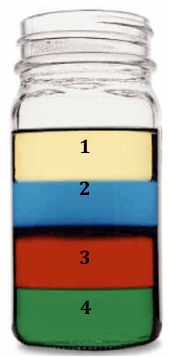


A container holds a mixture of two different gases. The oxygen in a container exerts 80 mmHg of pressure on the inside of the container. The total pressure inside the container is 120 mmHg. What is the pressure of the other gas in the container?
200 mmHg
80 mmHg
40 mmHg
120 mmHg
What is the total pressure of a mixture of gases where the pressure of gas 1 is 2.0 atm, the pressure of gas 2 is 1.0 atm, and the pressure of gas 3 is 0.5 atm?
2.5 atm
3.5 atm
0.5 atm
4 atm
The total pressure of a mixture of oxygen and nitrogen gas is 400.0 kPa. What is the partial pressure of nitrogen if the pressure of oxygen is 150.0 kPa?
400.0 kPa
550.0 kPa
250.0 kPa
101.3 kPa

