
 Worksheets
Bonds and Electronegativity
Total questions: 77
Worksheet time: 3hrs 35mins

How many atoms are in Zinc acetate?
12
15
20
14
How many atoms total are in AlPO4?
4
5
6
7
How many atoms total are in NaOH?
1
2
3
4


Which term represents the attraction one atom has for the electrons in a bond with another atom?
(1) electronegativity
(2) electrical conductivity
(3) first ionization energy
(4) mechanical energy
In a bond between an atom of carbon and an atom of fluorine, the fluorine atom has a
(1) weaker attraction for electrons
(2) stronger attraction for electrons
(3) smaller number of first-shell electrons
(4) larger number of first-shell electrons
Which element has an atom with the greatest tendency to attract electrons in a chemical bond?
carbon
chlorine
silicon
sulfur
Use your knowledge and electronegativity sheet to predict what type of bond would form between phosphorus and flourine
Ionic
Polar Covalent
Non polar Covalent
Metallic
Use your knowledge and electronegativity sheet to predict what type of bond would form between calcium and bromide?
Non polar Covalent
Polar Covalent
Ionic
Metallic
Electronegativity is a measurement of the ability of a nucleus to_____________.
attract bonding electrons
attract other nuclei
attract electrons in the non valence energy
Which of the following formulas represents a polar molecules?
CO2
CCl4
H2
H2O
In covalent bonds, electrons are ___________________
shared
gained
transferred
lost
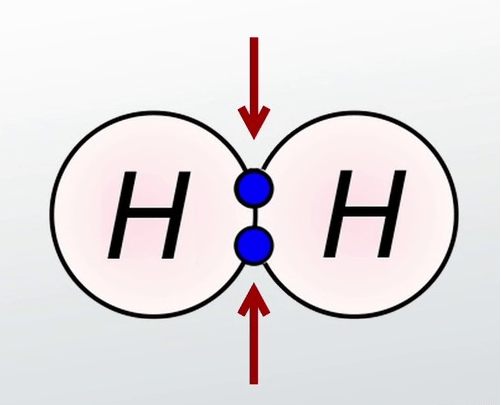

Is this molecule polar or non-polar?
Polar
Non-polar




What type of bonding does this picture show?
Ionic
Covalent

What type of bonding does this picture show?
Ionic
Covalent
The chemical bond between a non-metal and another non-metal will be a ________ bond.
metal
ionic
covalent
polar

Which bond type is associated with a large difference in electronegativity?
Ionic bond
Covalent bond
Metallic bond
Hydrogen bond
What is the main characteristic of a covalent bond?
Electron transfer
Electron sharing
Proton transfer
Neutron sharing
Which type of bond involves the sharing of electrons?
Ionic Bonds
Covalent Bonds
Metallic Bonds
Hydrogen Bonds
Covalent compounds usually do not:
Dissolve in water
Conduct electricity
React with acids
Form gases
Which of the following is an example of a covalent compound?
Sodium chloride (NaCl)
Water (H2O)
Magnesium oxide (MgO)
Calcium carbonate (CaCO3)
What is a characteristic of ionic compounds regarding their melting and boiling points?
Low melting and boiling points
High melting and boiling points
No melting and boiling points
Variable melting and boiling points
What is the key characteristic of the ions formed in ionic bonds?
They are neutral
They are oppositely charged
They are positively charged only
They are negatively charged only
What is Covalent Bonding?
Bonding that is the result of two nonmetals sharing electrons
Bonding between two metals
Bonding that is the result of a nonmetal and a metal exchanging electrons
Bonding between more than two elements
In metallic bonds electrons are:
shared
move around the nuclei randomly
transferred
Malleability and ductility are characteristics of compounds with
covalent bonds
metallic bonds
ionic bonds
alloy bonds
Why are metals good conductors?
they have mobile electrons
they have mobile atoms
they have crystal structures that can rearrange
they have mobile protons
Malleability means
the ability to be drawn into a wire
the electrons of metals are mobile
the ability to be hammered into a shape
the ability to be a conductor of electricity
Why do metals conduct heat and electricity?
They are shiny
The electrons are held tightly within the lattice
The electrons are delocalised and able to freely move (in the sea)
The electrons are shared between two metal ions
able to be shaped
will break easily
can be used for wire
is shiny
CHECK ALL THAT APPLY:
Electronegative atoms that are often involved in Hydrogen Bonds.
Nitrogen
Carbon
Oxygen
Fluorine
Calcium
Why don't noble gases form bonds?
They all have a full octet
Noble gases do form bonds
They only bond when with eachother
none of these answers are correct
The octet rules states that most elements want to have _____ valence electrons.
2
4
6
8
Why do elements bond?
To be friends
To create a new element
To become stable
To get bigger


Which is the correct molecular structure for carbon dioxide?


1
Which formula is for phosphorus trichloride?
KCl3
PCl3
K3Cl
P3Cl
Silicon dioxide is the compound in sand. What is its formula?
SO2
NaO2
SiO2
SiO

Examine the image: How many bonds are formed looking at the model of the compound? And also indetify what type of bond is formed.
2 bonds; covalent
4 bonds; metallic
2 bonds; ionic
4 bonds; covalent
a type of covalent bond that shares two pairs of electron
single bond
double bond
triple bond
Which particle is responsible for bonding?
Electrons
Protons
Nucleus
Neutrons
Which element is most likely to form 2 bonds?
Carbon
Fluorine
Nitrogen
Sulfur
Which of the following is a characteristic property of ionic compounds?
They form crystalline solids and have low melting points.
Form solids and gases at room temperature.
They form hard crystals with high melting points.
They are generally gases with extremely high boiling points.
What kind of bond would form between 2 oxygen atoms
Ionic
Polar Covalent
Metallic
Nonpolar Covalent

Match the three types of chemical bonds.
A
Ionic
B
Covalent
C
Metallic

What element is more positive in the models given for water and ammonia?
Oxygen
Nitrogen
Hydrogen

What is shared in covalent bonds?
Electrons
Metals
Nonmetals
Protons
Neutrons

Match the following
A
Ionic Bond
B
Polar Covalent Bond
C
Nonpolar Covalent Bond

What bond type do the molecules circled have?
Ionic
Polar Covalent
Nonpolar Covalent
Metallic

What bond type do the molecules circled have?
Ionic
Metallic
Polar Covalent
Nonpolar Covalent

Match the model with its bond type.
Ionic Bond
c
Nonpolar Covalent Bond
a
Polar Covalent Bond
b

What type of bond does water have? Select TWO.
Nonpolar
Polar
Covalent
Ionic
Metallic

What does this picture illustrate? (Select all that apply)
Sharing valence electrons
Covalent bonding
transferring valence electrons
ionic bonding
two nonmetals
How do covalent bonds form?
Donating & receiving valence electrons between atoms
Oppositely charged ions attract each other & form bonds
Scientists are still not sure how they form
Sharing valence electrons between atoms

How many covalent bonds are created in a single water molecule?
0
1
2
3
4
How many covalent bonds are created in a single ammonia molecule?
0
1
2
3
4
How many pairs of valence electrons are being shared in a single water molecule?
0 pair - 0 valence electrons
1 pair - 2 valence electrons
2 pair - 4 valence electrons
3 pair - 6 valence electrons
Match the covalent bond types.

Single Bond

Double Bond

Triple Bond

