
 Worksheets
Chemistry: Matter, Atoms, and States
Total questions: 88
Worksheet time: 1hrs 9mins
Name
Class
Date
1.
What are the three states of matter?
a)
solid, volume, mass
b)
density, volume, mass
c)
solid, liquid, gas
d)
density, gas, volume
2.
A state of matter that has a definite volume and shape.
a)
solid
b)
liquid
c)
gas
d)
matter
3.
Something that takes up space and has mass.
a)
volume
b)
matter
c)
mass
d)
density
4.
A measure of how much mass is contained in a given unit of volume.
a)
mass
b)
density
c)
volume
d)
matter
5.
The amount of space something takes up
a)
density
b)
volume
c)
mass
d)
matter
6.
A watermelon has more matter than a grape, so it has more
a)
mass
b)
eat
c)
solid
d)
greater
7.
You can measure ______ with grams.
a)
mass
b)
volume
c)
conductivity
d)
melting point
8.
The ability of a metal to allow heat or electricity to pass through it.
a)
conductivity
b)
insulator
c)
mass
d)
density
9.
At 32 degrees Fahrenheit, water _________.
a)
evaporates
b)
boils
c)
freezes
d)
remains the same
10.
Water in the form of a gas is called _________.
a)
water vapor
b)
gasoline
c)
ice
d)
liquid
11.
Solids have a definite _______________.
a)
smell
b)
shape
c)
picture
d)
sound
12.
Liquid matter takes the shape of _______.
a)
a gas
b)
water
c)
a pet
d)
Its container
13.
Water in its solid form is _____________.
a)
a vapor
b)
ice
c)
a liquid
d)
boiling
14.
At 212 degrees Fahrenheit, water __________________.
a)
freezes
b)
stays the same
c)
boils
d)
turns to Coke
15.
When a solid is turned into a liquid, the solid _______________.
a)
melts
b)
freezes
c)
turns into a gas
d)
floats
16.
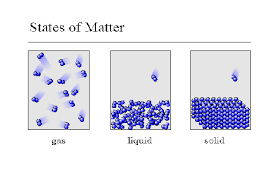
At higher temperatures
a)
particles in an object have less energy
b)
particles in an object move faster
c)
a gas contracts
17.
Freezing
a)
Solid to gas
b)
Liquid to solid
c)
Gas to solid
d)
Liquid to gas
18.
Boiling
a)
liquid to gas
b)
gas to solid
c)
gas to liquid
d)
solid to liquid
19.
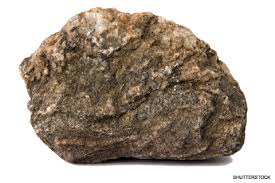
Which state of matter has tightly packed molecules?
a)
solid
b)
liquid
c)
gas
20.
What is happening when my ice cream changes from a solid to a liquid?
a)
freezing
b)
melting
c)
burning
d)
evaporation
21.
Particles (molecules) in a ______________________ have more energy than the other states of matter.
a)
gas
b)
solid
c)
liquid
22.
Particles of a liquid
a)
are tightly packed together and stay in a fixed position.
b)
have no viscosity.
c)
decrease in volume with increasing temperature.
d)
are free to move around one another but still touch.
23.
What term describes a solid changing to a gas?
a)
Deposition
b)
Sublimation
c)
Evaporation
d)
Freezing
24.
The slower the particles in a substance move,
a)
the colder it is.
b)
the warmer it is.
c)
the more energy it has.
d)
the less energy it has.
25.
Thermal energy is...
a)
heat energy.
b)
the energy of motion
c)
energy of nuclear processes.
d)
an indication of physical change.
26.
True or False: Matter can changes states by adding heat or cooling.
a)
True
b)
False
27.
all matter is made of what
a)
energy
b)
atoms
c)
electrons
d)
compounds
28.
The positive particles of an atom are
a)
electrons
b)
positrons
c)
neutrons
d)
protons
29.
the central region of an atom where its neutrons and protons are is its
a)
nucleus
b)
electron cloud
c)
core
d)
center
30.
In the modern periodic table elements are arranged by:
a)
atomic mass
b)
atomic number
c)
valence electrons
d)
number of isotopes
31.

What does the 1.00794 stand for?
a)
Hydrogen
b)
atomic number
c)
atomic mass
d)
atomic explosion
32.
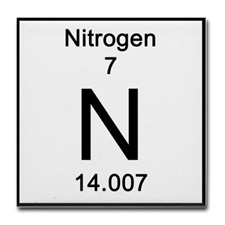
What is the number of protons that the element in this image contain?
a)
14
b)
7
c)
15
d)
18
33.
Where are electrons of an atom found?
a)
Nucleus
b)
Electron Cloud
c)
Some are in the nucleus and some in the electron cloud.
d)
They are moving everywhere.
34.
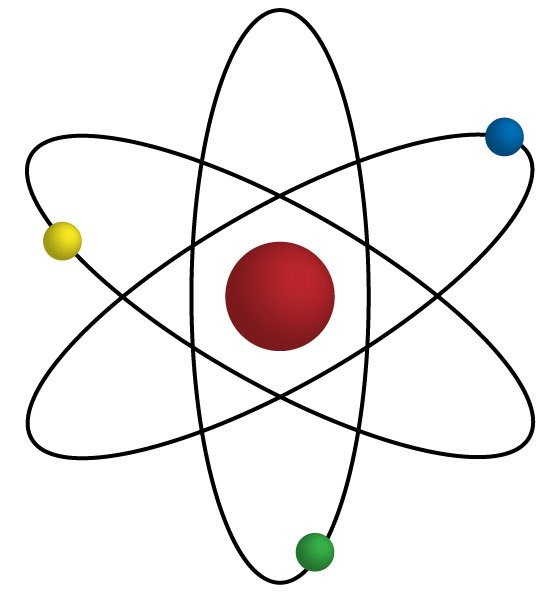
What are the 3 particles that make-up the atom?
a)
protons, neutrons, and isotopes
b)
neutrons, isotopes, and electrons
c)
positives, negatives, and electrons
d)
protons, neutrons, and electrons
35.
What is the mass number?
a)
the number of protons
b)
the number of protons and neutrons
c)
the number of neutrons
d)
the number of protons and electrons
36.
Atoms are mostly filled with?
a)
electrons
b)
empty space
c)
protons
37.
The smallest particle of any particular type of matter is known by which of the following terms?
a)
Compound
b)
Atom
c)
Chemical
d)
Element
38.
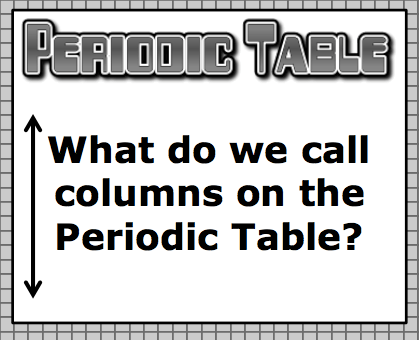
a)
Periods
b)
Groups
39.
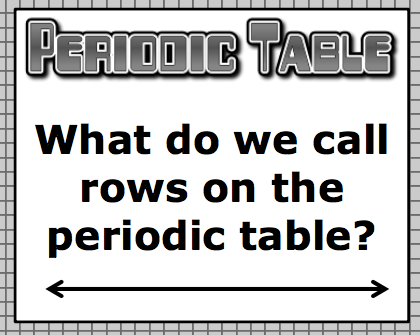
a)
Periods
b)
Groups
40.
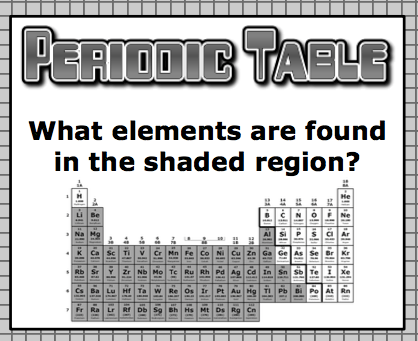
a)
Metals
b)
Nonmetals
c)
Metalloids
41.
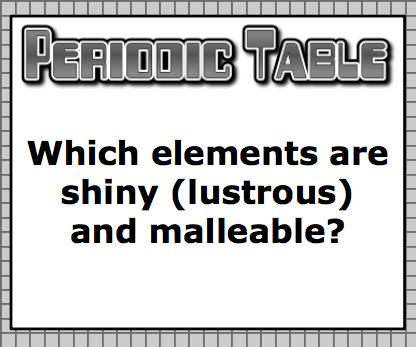
a)
Metals
b)
Nonmetals
c)
Metalloids
42.

How did Mendeleev arrange the elements?
a)
alphabetical
b)
density
c)
melting point
d)
atomic mass
43.
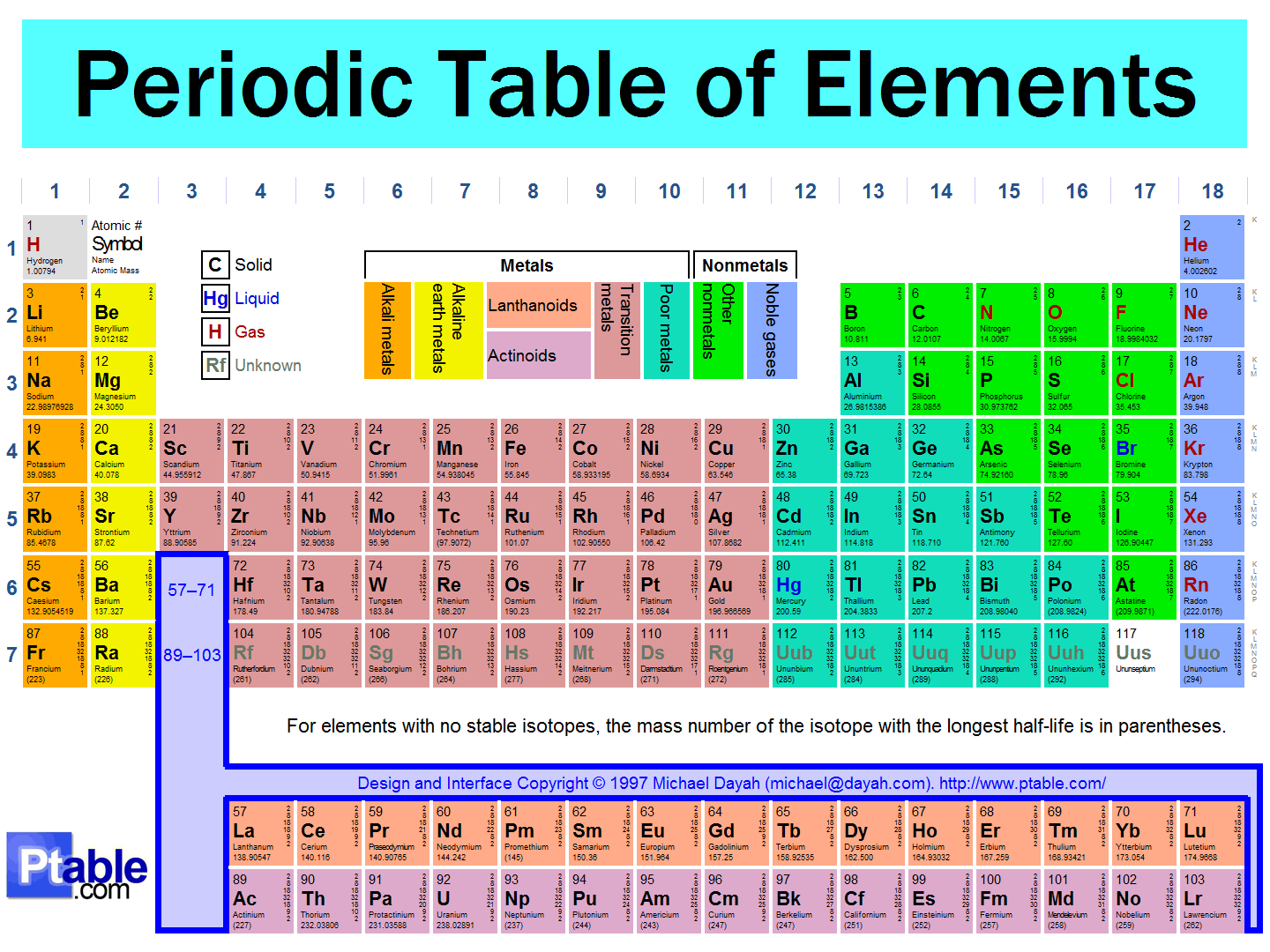
The horizontal row on the periodic table is called a
a)
group
b)
family
c)
period
d)
atomic number
44.
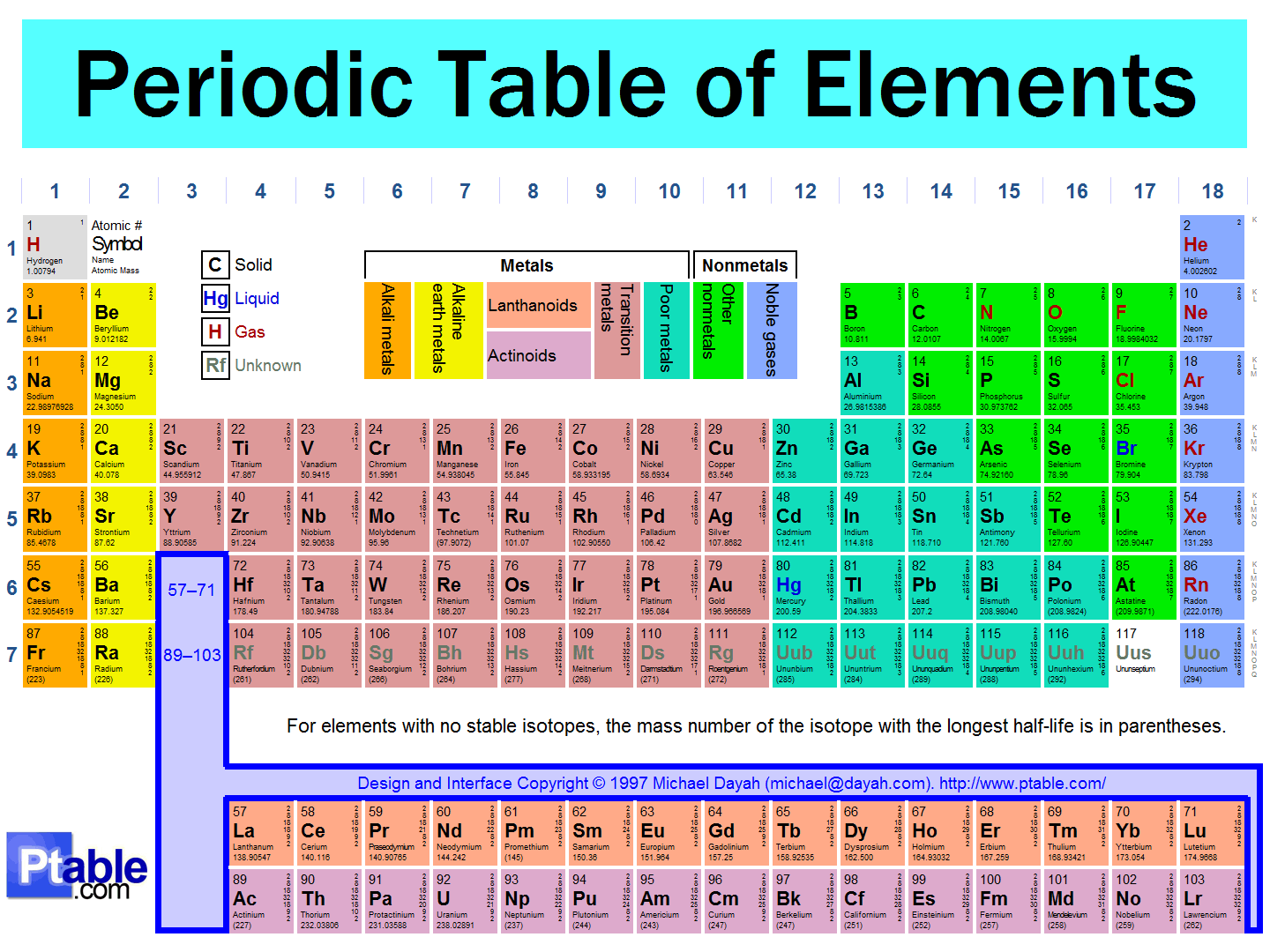
A vertical column is called...
a)
group
b)
tower
c)
period
d)
crew
45.

Most of the elements on the periodic table are classified as _____.
a)
Metals
b)
Nonmetals
c)
Metalloids
d)
Periods
46.
Are the atoms more stable when they are bonded together or when they are apart?
a)
Bonded Together
b)
Apart
47.
Ionic Bonding involves...
a)
The transfer of protons
b)
The transfer of nuetrons
c)
The transfer of electrons
d)
None Of the above
48.
What do atoms that form positive ions tend to do?
a)
Tend to lose electrons
b)
Tend to lose protons
c)
Tend to gain electrons
d)
Tend to gain protons
49.
What usually forms the positive ion?
a)
Metal
b)
Non Metals
c)
None
50.
What usually forms the positive ion?
a)
Metal
b)
Non Metals
c)
None
51.
What happens when the sodium atom loses an electron?
a)
It become negatively charged
b)
It become positively charged
c)
none
52.
What usually forms the negative ion?
a)
nonmetals
b)
metal
c)
none
53.
What two types of atoms make a covalent bond?
a)
2 Nonmetals
b)
1 Nonmetal and 1 Metal
c)
2 Metals
d)
2 Noble Gases
54.
Covalent compounds
a)
Share electrons
b)
transfer electrons
c)
contain a sea of electrons
d)
conduct electricity
55.
What happens when an atom loses an electron?
a)
Neutral (no charge)
b)
Positive charge
c)
Negative charge
56.

What elements generally make an ionic bond?
a)
metal and nonmetal
b)
2 or more nonmetals
c)
metal
d)
none of the above
57.

What elements generally make a covalent bond?
a)
metal and nonmetal
b)
2 or more nonmetals
c)
metal
d)
none of the above
58.
What is the number of valence electrons for Silicon?
a)
1
b)
2
c)
6
d)
4
59.
What is the number of valence electrons for Beryillum?
a)
1
b)
4
c)
2
d)
7
60.
What is the number of valence electrons for Neon?
a)
6
b)
7
c)
8
d)
9
61.
Predict the bond that will form between Sr and S.
a)
Ionic
b)
Covalent
62.
Predict the bond that will form between Se and Cl.
a)
Ionic
b)
Covalent
63.

How many valence electrons in this structure?
a)
6
b)
5
c)
4
d)
7
64.
Particles in an atom that are neutral and have no charge are
a)
negatrons
b)
electrons
c)
neutrons
d)
protons
65.
If the number of protons equal the number of _____, the atom will have no charge
a)
protons
b)
neutrons
c)
electrons
d)
nucleus
66.
The subatomic particle with a negative charge is the
a)
electron
b)
proton
c)
neutron
d)
nucleus
67.
What is the atomic number?
a)
the number of protons
b)
the number of protons and neutrons
c)
the number of neutrons
d)
the number of protons and electrons
68.
What is the mass number?
a)
the number of protons
b)
the number of protons and neutrons
c)
the number of neutrons
d)
the number of protons and electrons
69.
Thermal energy refers to....
a)
Heat energy
b)
Light energy
c)
Potential Energy
d)
Rotational energy
70.
The state of matter that takes the shape of its container is....
a)
Gas
b)
Solid
c)
Liquid
d)
None of these
71.
Vertical (up and down) columns in the periodic table are called _________ of elements and have similar properties.
a)
groups
b)
periods
72.
Density is...
a)
the amount of mass in an object
b)
the amount of space an object takes up
c)
the amount of mass in a given space
d)
the weight of an object
73.
How many protons does Carbon have?
a)
3
b)
4
c)
5
d)
6
74.
Mixing salt and water
a)
Chemical Change
b)
Physical Change
75.
Burning a piece of paper
a)
Chemical Change
b)
Physical Change
76.
Melting Ice
a)
Chemical Change
b)
Physical Change
77.
Milk turning sour
a)
Chemical Change
b)
Physical Change
78.
Elements with similar properties
a)
Periods
b)
Groups
79.
When becoming an ion, an element with 6 valence (outer) electrons would have a charge of...
a)
2-
b)
2+
c)
6-
d)
6+
80.

To what family of elements do the elements helium, neon, and argon belong to?
a)
Halogens
b)
Actinides
c)
Noble gases
d)
Transition metals
81.
Particles in an atom that are neutral and have no charge are
a)
negatrons
b)
electrons
c)
neutrons
d)
protons
82.
A compound always has the same ___________ in the same proportions (ratio).
a)
elements
b)
carbons
c)
mixtures
d)
ions
83.

Is the Bohr Model for the element Selenium (Se) correct?
a)
yes
b)
no
84.

Is this a correct representation of the Bohr Model for Sodium (Na)?
a)
no
b)
yes
85.

?
a)
Boron
b)
Carbon
c)
Nitrogen
d)
Lithium
86.

?
a)
Helium
b)
Oxygen
c)
Sodium
d)
Phosphorous
87.

?
a)
Beryllium
b)
Boron
c)
Barium
d)
Bromine
88.

The period for Bromine is ___________.
a)
3
b)
2
c)
4
100 %

