wayground logo

Free Printable Worksheets

Font size

S
M
L
XL
Worksheets

Waves Review

Total questions: 95

Worksheet time: 3hrs 10mins

Name
Class
Date
1.

The distance in between two waves.

a)

wave speed

b)

frequency

c)

wavelength

2.

Frequency is always measured in _________

a)

kilometers

b)

Hertz

c)

centimeters

3.

the number of waves that pass a certain point.

a)

wave speed

b)

frequency

4.

when a wave hits a barrier and bounces

a)

diffraction

b)

reflection

5.

When two waves overlap each other, this behavior is known as _______.

a)

interference

b)

refraction

c)

frequency

6.

If the amplitude increases during interference, this is __________

a)

destructive interference

b)

constructive interference

7.

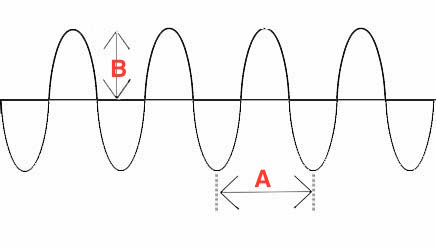
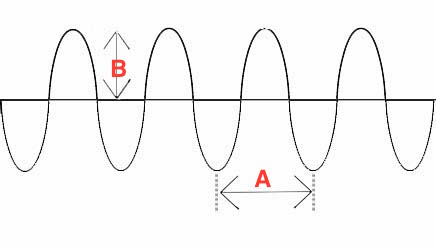
This is a high frequency wave. Which part of the wave is "B"

a)

crest/peak

b)

wavelength

c)

trough

8.

Look at this wave. "A" is which part of a wave?

a)

Crest/Peak

b)

Wave Speed

c)

Resting Point

9.

Which wave has the longest wave length?

a)

top wave

b)

bottom wave

10.
Waves that require a medium are called 
a)
mechanical waves
b)
transverse waves
c)
light waves
d)
gamma rays
11.
What happens when you increase the amplitude of a sound?
a)
it makes the sound louder
b)
it makes the sound travel faster
c)
it increases the wavelength of the sound
d)
it increases the frequency of the sound
12.

What kind of wave is pictured below?

a)

compressional wave

b)

transverse wave

c)

sound wave

d)

mechanical wave

13.
What can electromagnetic waves travel through?
a)
mediums
b)
empty space
c)
solely solids
d)
both mediums and empty space
14.
What property of this wave is represented by the letter "A"
a)
amplitude
b)
crest
c)
trough
d)
wavelength
15.
What property of the wave is represented by the letter "B"?
a)
amplitude
b)
crest
c)
trough
d)
wavelength
16.
What do waves carry from place to place?
a)
Energy, but not matter or particles
b)
Energy and matter or particles
c)
Matter or particles but not energy
d)
Neither energy nor matter or particles
17.
Which wave is pictured?
a)
Transverse
b)
Longitudinal
c)
Both
d)
Neither
18.
A wave carries...?
a)
energy only
b)
matter only
c)
energy and matter
d)
neither
19.
What type of wave move a slinky back and forth?
a)
longitudinal
b)
transverse
20.
Which vocabulary term is used to identify the distance between points C & G?
a)
Amplitude
b)
Crest
c)
Frequency
d)
Wavelength
21.
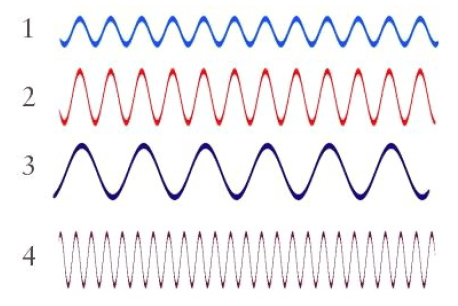
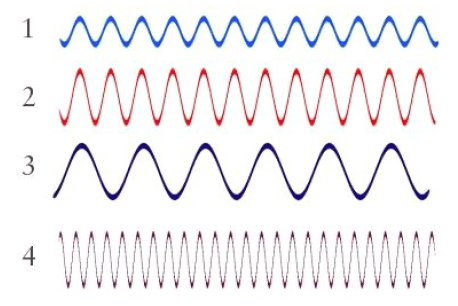
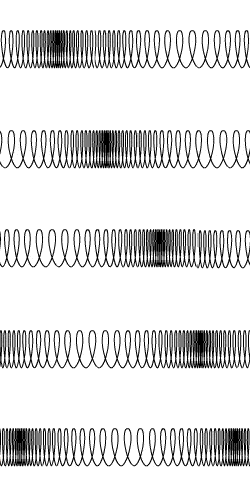
Which wave in the diagram has the greatest frequency?
a)
1
b)
2
c)
3
d)
4
22.
Which wave in the diagram has the greatest wavelength?
a)
1
b)
2
c)
3
d)
4
23.
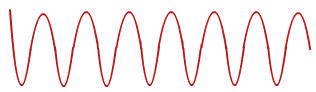
What type of wave is this?
a)
Longitudinal
b)
Transverse
24.
Which of the following can sound travel through?
a)
solid
b)
liquid
c)
gas
d)
all of the above
25.

Waves DO NOT transfer ______?

a)

Matter

b)

Energy

26.

The highest point of a wave is called what?

a)

Trough

b)

energy

c)

Peak

d)

amplitude

27.

What factors affect how fast a sound wave travels?

a)

The medium or material in is moving through

b)

The amplitude

c)

The wavelength

d)

The perpendicular motion in which it travels to the direction of the wave.

28.

As Devon ran up the stairs to his school building, the bell rang out above him. He had lost track of time during lunch while listening to music tracks with his headphones, which had silenced all other noise around him, including the first warning bell signaling the end...What kind of sound waves are responsible for Devon being able to enjoy his music?

a)

Mechanical

b)

chemical

c)

nuclear

d)

radiant

29.

What part of a sound wave measures LOUDness?

a)

wavelength

b)

magnitude

c)

amplitude

d)

frequency

30.

Sound travels fastest in............

a)

solids because the particles are closer together than air particles.

b)

air because the particles are moving slowly

c)

Liquid

d)

Air because the particles are moving quickly and the particles are far apart.

31.

A __________ is a substance through which a wave travels.

a)

Medium

b)

Longitudinal wave

c)

Transverse Wave

d)

Wave speed

32.

The number of waves in a given time period is called the ________________.

a)

wavespeed

b)

frequency

c)

Medium

d)

transverse

33.

Which wave has the most energy?

a)

Wave 1

b)

Wave 2

c)

Wave 3

d)

Wave 4

34.

What wave has particles that move perpendicularly to the direction of the wave?

a)

Transverse waves

b)

Longitudinal waves

c)

Sound waves

d)

Light waves

35.

If the wavelength of a wave increased, what would happen to the frequency?

a)

decrease

b)

increase

c)

stay the same

36.
Which of the following is NOT a mechanical wave?
a)
sound
b)
light
c)
ocean
d)
seismic
37.
How would a person measure the wavelength on this sound wave?
a)
dense to less dense
b)
trough to crest
c)
compression to compression
d)
beginning of illustration to the end
38.

You can't hear sounds in outer space because there is no

a)

medium

b)

light

c)

energy

d)

heat

39.
Longitudinal waves are ______.
a)
Parallel
b)
Perpendicular
c)
Crazy
40.
Transverse waves are ___.
a)
Parallel
b)
Perpendicular
c)
Weird
41.
In longitudinal waves, the parts where the coils are spread apart are called what?
a)
rarefactions
b)
compressions
c)
mechanicals
d)
longitudes
42.
In a longitudinal wave, the parts where the coils are close together are called what?
a)
longitudes
b)
rarefactions
c)
compressions
d)
contractions
43.
Which travels faster, light or sound?
a)
light
b)
sound
44.

Which are properties of a mechanical wave?

a)

can be longitudinal or transverse

b)

can move through space

c)

must have matter to move

d)

carries energy

45.

If the wavelength of a wave increased, what would happen to the frequency?

a)

decrease

b)

increase

c)

stay the same

46.

At which temperature would sound move fastest?

a)

40 degrees

b)

-20 degrees

c)

60 degrees

d)

90 degrees

47.

The wavelength of a sound wave is 20m. The frequency is 5 Hz. What is the wave speed?

a)

4 m/s

b)

100 m/s

c)

25 m/s

d)

15 m/s

48.

What is the unit for frequency?

a)

Meters

b)

Hertz

c)

Decibels

d)

Meters/Second

49.

High pitched waves would have wavelengths that are...

a)

at a rarefaction

b)

far apart

c)

close together

d)

at the trough

50.
When the sound source moves, the frequency changes
ex. police car siren sounding lower pitch after the car passes
a)
pitch
b)
frequency
c)
Doppler Effect
d)
medium
51.

The pitch of a sound wave relates to the wave's _________________.

a)

Amplitude

b)

Frequency

c)

Wavelength

d)

Period

52.

What is the Doppler Effect?

a)

A change in frequency due to the relative motion of a wave source and an observer

b)

When a wave overlaps with another wave

c)

When a wave bounces off of another object

d)

When a wave bends due to traveling through a different medium

53.

An ambulance is driving towards you as you stand on the sidewalk. What happens to the pitch of the siren as it comes towards you?

a)

It increases

b)

It decreases

54.

You are driving in a car and honk the horn at a person standing in the street. As you approach the person, what happens to the pitch of the horn according to you in the car?

a)

It increases

b)

It decreases

c)

It stays the same because you are in the car moving with the sound.

55.

Light can change color due to the Doppler Effect.

a)

True

b)

False

56.

You are standing on the side of the road when a police car races past you with its siren on. After the police car passes you, what happens to the pitch of the siren?

a)

It increases

b)

It decreases

c)

It turns red

57.

A car is not moving but the horn is on. You run towards the car to investigate what's going on. As you approach the car, what happens to the frequency of the sound waves from the horn?

a)

They increase

b)

They decrease

58.

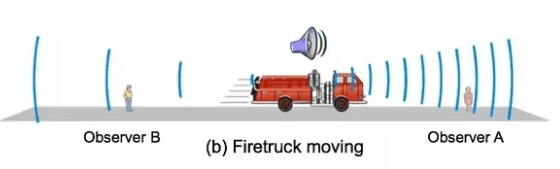
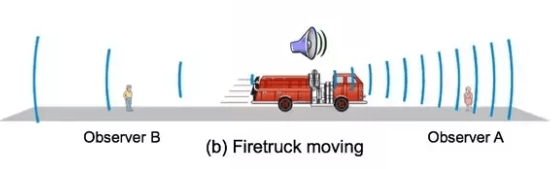
Look at the picture. Who is experiencing a higher pitched sound?

a)

Observer A

b)

Observer B

c)

There's no difference

59.

Look at the picture. Who is experiencing a lower pitched sound?

a)

Observer A

b)

Observer B

c)

There is no difference

60.
When the car moves AWAY from you, its horn seems...
a)
Low pitched
b)
High pitched
c)
Normal
61.
When an ambulance move TOWARD you it sounds ________ pitched. 
a)
high
b)
low
c)
medium
62.
What can you tell about this object's motion?
a)
Moving to the North (up).
b)
Moving to the South (down). 
c)
Moving to the West (left). 
d)
Moving to the East (right). 
63.
What can you tell about the motion of this object?
a)
Moving left.
b)
Moving right quickly.
c)
Standing still. 
d)
Moving up slowly. 
64.
What direction is this object moving?
a)
left
b)
right
c)
up
d)
down
65.

What is the doppler effect used for?

a)

police radars

b)

to track storms

c)

to be loud

d)

to communicate with other countries

66.
The speed of sound at 20 degrees celcius is:
a)
331 m/s
b)
365 m/s
c)
621 m/s
d)
343 m/s
67.
Sound does not travel in space because
a)
Space is too far away.
b)
There is no matter in space.
c)
Space is the final frontier
d)
Space has planets.
68.
Sound moves in a _________.
a)
Transverse wave
b)
Longitudinal wave
69.

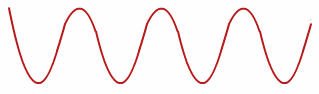
Which of these sound waves has the highest frequency?
a)
b)
c)
70.
The volume of a sound is measured in units called ________
a)
decibels
b)
liters
c)
sound waves
d)
inches per minute
71.

What type of interference is being shown in the picture?

a)

Constructive

b)

Destructive

72.

What type of interference is occurring in the picture?

a)

Constructive

b)

Destructive

73.

When 2 waves meet and create a bigger wave

a)

Constructive Interference

b)

Destructive Interference

74.

When two waves meet and create a smaller wave

a)

Constructive

b)

Destructive

75.
a)
Constructive Interference
b)
Destructive Interference
c)
Refraction
d)
Diffraction
76.

The crest of a 2m tall wave collides with a trough of a 1m tall wave. What will be the amplitude of the resulting wave?

a)

1 meter

b)

2 meters

c)

3 meters

d)

4 meters

77.

The crest of a wave with an amplitude of 5m crashes into the crest of another wave with an amplitude of 3m. What will the amplitude of the resulting wave be?

a)

2 meters

b)

6 meters

c)

8 meters

d)

12 meters

78.

When two waves experience constructive interference, the result is….

a)

A bigger wave

b)

A smaller wave

c)

A wave that is completely destroyed

d)

They simply pass through each other

79.

Constructive interference happens when two waves are:

a)

out of phase.

b)

zero amplitude.

c)

in phase.

80.

Two waves with phase difference 180° have resultant of amplitude

a)

one.

b)

zero.

c)

same as the single wave.

d)

doubles the single wave.

81.
Which wave behavior do noise cancelling headphones use?
a)
diffraction
b)
refraction
c)
constructive interference
d)
destructive interference
82.
In a standing wave, destructive interference creates points of zero amplitude called nodes. Which letters represent this.
a)
A,E,F
b)
B,D,F
c)
B,C,D
d)
A,C,F
83.
In a standing wave, constructive interference creates larger amplitudes.  The points of maximum amplitude are antinodes.  The letters for these are?
a)
B,C,D
b)
A,E,F
c)
A,C,F
d)
B,D,E
84.

Beats are the result of:

a)

Diffraction

b)

Destructive interference

c)

Constructive and destructive interference

d)

Superposition of two waves of nearly equal frequency

85.
One end of the rope is vibrated to produce a wave with a wavelength of .25 m.  The Frequency of the wave is 3.0 Hz.  What is the speed of the wave?
a)
3.00 m/s
b)
2.50 m/s
c)
.75 m/s
d)
1.25 m/s
86.

If this wave chain represents 1 second, What is the frequency of the waves?

a)

1 Hz

b)

9 Hz

c)

3 Hz

d)

6 Hz

87.
A tennis coach paces back and forth along the sideline 10 times in 2 minutes. The frequency of her pacing is 
a)
5 Hz
b)
5 s
c)
0.08 Hz
d)
0.08 s
88.
 A wave has frequency of 50 Hz and a wavelength of 10 m. What is the speed of the wave?
a)
500 m/s
b)
50 m/s
c)
5 m/s
d)
0.5 m/s
89.
 A wave has frequency of 5 Hz and a speed of 25 m/s. What is the wavelength of the wave?
a)
25 m
b)
125 m
c)
5 m
d)
25 m/s
90.
A wave has wavelength of 10 m and a speed of 340 m/s. What is the frequency of the wave?
a)
34 m/s
b)
3400 Hz
c)
3400 m/s
d)
34 Hz
91.

A guitar string vibrates with a frequency of 320 hz. If the wavelength of the vibration is 0.23 meters what is the speed of the wave?

a)

320.23 m/s

b)

1391.3 hz

c)

73.6 m/hz

d)

73.6 m/s

92.
The blue-throated hummingbird flaps its wings 300 times a minute.  What is its frequency?
a)
5 hz
b)
300 hz
c)
300/60 
d)
a lot?
93.
What is the speed of a 20 Hz with a 4m wavelength?
a)
0.2 m/s
b)
5 m/s
c)
80 m/s
d)
320 m/s
94.
What is the frequency of a wave traveling at 300 m/s with a 4 m wavelength?
a)
0.013 Hz
b)
75 Hz
c)
300 Hz
d)
1200 Hz
95.
A wave has wavelength of 10 m and a speed of 340 m/s. What is the frequency of the wave?
a)
34 m/s
b)
3400 Hz
c)
3400 m/s
d)
34 Hz