wayground logo

Free Printable Worksheets

Font size

S
M
L
XL
Worksheets

IIT-JEE & NEET LEVEL-3 (9-T)

Total questions: 100

Worksheet time: 2hrs 40mins

Name
Class
Date
1.
The side of a cube whose surface area is 600 cm2 is____
a)
10 cm
b)
10 cm2
c)
60 cm
d)
6 cm
2.
Two cubes with 9 cm edge are joined end to end. Find the length of the newly formed solid.
a)
18 cm
b)
9 cm
c)
27 cm
d)
None of the above
3.
1 km2 is equivalent to ______ m2
a)
104 m2
b)
106 m2
c)
105 m2
d)
103 m2
4.
Say 'TRUE' or 'FALSE'
The perimeter of square of area 36 cm² is 24 cm.
a)
TRUE
b)
FALSE
5.
The side of a square whose perimeter is 64 cm is __________
a)
32 cm
b)
8 cm
c)
16 cm
d)
12 cm
6.

Choose the correct answer to find the area of a circle

a)

πr2\pi r^2

b)

2πr22\pi r^2

c)

2πr2\pi r

7.

The formula to find the volume of a right circular cylinder =

a)

πr2\pi r^2

b)

πr2h\pi r^2h

c)

2πrh2\pi rh

d)

2πr(h+r)2\pi r\left(h+r\right)

8.

The volume of a cone is ____________ of that of a cylinder

a)

three times

b)

equal

c)

half

d)

one third

9.

6 km 435 m

a)

64,350 meters

b)

6,435 grams

c)

6,435 liters

d)

6,435 meters

10.
Used in places where diffusion needs to occur, such as blood vessels and air sacs in the lungs
a)
Cuboidal
b)
Columnar
c)
Simple Squamous
d)
Stratified Squamous
11.
Lines ducts and glands
a)
Columnar
b)
Cuboidal
c)
Simple Squamous
d)
Transitional
12.
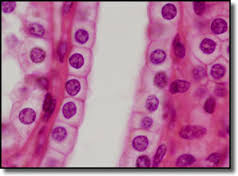
Identify:
a)
Pseudostratified
b)
Simple cuboidal
c)
Transitional
d)
Simple Squamous
13.
Absorbs nutrients in the digestive tract
a)
Columnar
b)
Cuboidal
c)
Simple Squamous
d)
Pseudostratified
14.

Stratified epithelium is typically used for

a)

excretion

b)

secretion

c)

protection

d)

absorption

15.

What type of muscle(s) is involuntary?

a)

skeletal and smooth

b)

cardiac and skeletal

c)

smooth and cardiac

d)

skeletal

16.

Which muscle type can contract rapidly with great force, BUT tires easily and must rest after short periods of activity.

a)

skeletal

b)

smooth

c)

cardiac

17.

What type of muscle is/are voluntary?

a)

smooth and cardiac

b)

smooth

c)

skeletal and smooth

d)

skeletal

18.

This type of muscle has no striations and is involuntary, which means that we cannot consciously control it.

a)

skeletal

b)

smooth

c)

cardiac

19.

_____ muscle is found in only one place in the body- the heart, where it forms the bulk of the heart walls.

a)

skeletal

b)

smooth

c)

cardiac

20.
Neurons have a nucleus.
a)
true
b)
false
21.
Nervous tissue
a)
Tissue that is responsible for lining, covering, and glandular tissue
b)
Tissue responsible for protecting, supporting, and binding together other body tissues
c)
Tissues that contracts and shortens to produce movement
d)
Tissue that receives and conducts electrochemical impulses from one part of the body to another
22.
Which cell transmits an impulse from the brain to the muscles in order to respond to a situation?
a)
sensory neuron
b)
motor neuron
c)
axon neuron
d)
dendrite neuron
23.

The connective tissue has an extracellular matrix.

a)

True

b)

False

24.

Cells that can build bone matrix.

a)

Osteoblasts

b)

Osteoclasts

c)

Canaliculi

d)

Lamellae

25.
Identify the part of the neuron
a)
axon
b)
axon terminal
c)
dendrite
d)
Node of Ranvier
26.
Identify the part of the neuron
a)
axon
b)
axon terminal
c)
dendrite
d)
Node of Ranvier
27.

The part of the neuron that insulates the axon and increases the speed of the neural message within the neuron.

a)

Cell Body

b)

Dendrite

c)

Myelin Sheath

d)

Axon Terminal

28.
Which connective tissue contains a gel-like matrix and is found in the nose, ear, and at the end of bones.
a)
Bone
b)
Cartilage
c)
Blood
d)
Adipose
29.
This tissue carries nutrients, waste, respiratory gases, and many other substances throughout the body.
a)
Bone
b)
Cartilage
c)
Blood
d)
Adipose
30.

The chemical symbol for carbon

a)

C

b)

H

c)

O

d)

Na

31.

The chemical symbol for oxygen.

a)

C

b)

H

c)

O

d)

Na

32.

The chemical symbol for hydrogen.

a)

C

b)

H

c)

O

d)

Na

33.

The chemical symbol for sodium.

a)

C

b)

H

c)

O

d)

Na

34.

The chemical symbol for chlorine.

a)

C

b)

Cl

c)

Fe

d)

Pb

35.

The chemical symbol for nitrogen.

a)

N

b)

Cl

c)

Fe

d)

Pb

36.

The chemical formula for water.

a)

H

b)

O

c)

H2

d)

H2O

37.

The chemical formula for carbon dioxide.

a)

C

b)

O2

c)

H2O

d)

CO2

38.

The chemical formula for ammonia.

a)

ClO

b)

NH3

c)

H2O

d)

CO2

39.

Chemical symbol for magnesium

a)

Mg

b)

M

c)

Ma

d)

M

40.

Chemical symbol for sodium

a)

So

b)

No

c)

S

d)

Na

41.

Chemical formula for carbon dioxide

a)

CO

b)

CO2

c)

CO3

d)

C2O

42.

Name this compound MgCl2

a)

magnesium chlorine

b)

chlorine magnesium

c)

magnesium chloride

d)

magneium chlorate

43.

Name the compound with the formula KOH

a)

potassium hydride

b)

potassium oxide

c)

potassium oxygen hydrogen

d)

potassium hydroxide

44.

Name the compound with the formula KOH

a)

potassium hydride

b)

potassium oxide

c)

potassium oxygen hydrogen

d)

potassium hydroxide

45.

Chemical formula for sodium chloride

a)

NaCl2

b)

NaCl

c)

Na2Cl

d)

NaClO2

46.
Which of the following is NOT an element?
a)
H2O
b)
H2
c)
O2
d)
Au
47.

CaCO3 represents a

a)

Symbol

b)

Formula

c)

Subscript

d)

Coefficient

48.
How many elements are in C6H12O6?
a)
1
b)
2
c)
3
d)
4
49.
He is the chemical symbol for...
a)
Hydrogen
b)
Helium
c)
Neon
d)
Iodine
50.

Velocity is...

a)

The rate of change of acceleration

b)

The rate of change of displacement

c)

The rate of change of distance

d)

The rate of change of speed

51.

What is the difference between a vector quantity and a scalar quantity?

a)

A scalar has a magnitude and direction and a vector has only a magnitude

b)

A vector has a magnitude and direction and a scalar has only a magnitude

c)

A scalar has a direction and a vector has a magnitude

d)

None of the above

52.

An unladen swallow flies 5 m/s. How far has the bird traveled after 1 min?

a)

5 m

b)

12 m

c)

120 m

d)

300 m

53.

Which of the following is a vector quantity?

a)

Velocity

b)

Acceleration

c)

Displacement

d)

All of the above

54.
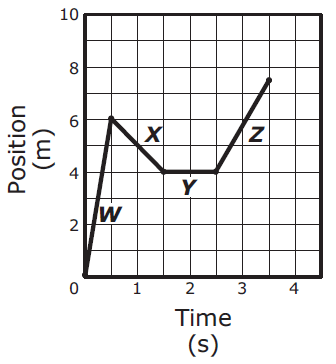
Motion sensors recorded the following data about a runner during a cross-country race. During which segment of the race did the runner have the greatest speed?
a)
W
b)
X
c)
Y
d)
Z
55.

What is the acceleration of an object moving at constant velocity?

a)

2 m/s2

b)

1 m/s2

c)

0 m/s2

d)

0.8 m/s2

56.

When velocity is negative and acceleration is negative, what happens to the object’s motion?

a)

The object slows down

b)

The object speeds up

c)

Nothing happens to the objects motion

d)

The object remains at rest

57.

A dolphin swims 1.85 km/hr. How far has the dolphin travelled after 0.6hr?

a)

1.1 km

b)

2.5 km

c)

0.63 km

d)

3.7 km

58.

A coin released from rest from the top of a tower hits the ground after 1.5 seconds. What is the speed of the coin as it hits the ground?

a)

15 m/s

b)

21 m/s

c)

31 m/s

d)

39 m/s

59.

The graph shows the position of a truck vs. time. According to the graph, the velocity of the truck is...

a)

increasing

b)

remaining constant

c)

decreasing

60.
The graph respresents
a)
no motion
b)
constant velocity
c)
increasing velocity
d)
decreasing velocity
61.

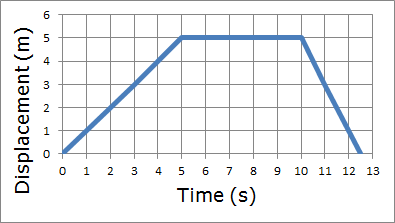
What is the person doing from 5 seconds to 10 seconds?

a)

Walking

b)

Running

c)

Standing Still

d)

Walking Fast

62.
According to the graph how far does the person travel in the first 5 seconds?
a)
2 m
b)
10 m
c)
0 m
d)
5 m
63.

What quantity is equal to the slope of this graph?

a)

Distance

b)

Displacement

c)

Acceleration

d)

Velocity

64.

An object is thrown into the air at 60 m/s, straight up. What is its velocity at the highest point?

a)

0 m/s

b)

-9.8 m/s

c)

60 m/s

d)

-60 m/s

65.
Scott travels north 5 miles and then goes west 3 miles before coming straight back south 2 miles. What is his distance?
a)
10
b)
7
c)
8
d)
6
66.

A dog running with an initial speed of 7.5 m/s comes to a stop in 15 seconds. What is the dog's acceleration?

a)

-7.5 m/s

b)

-7.5 m/s2

c)

-0.5 m/s2

d)

7.5 mi//hr

67.
A car is traveling at 21.0 m/s. It slows to a stop at a constant rate over 5.00 s. How far does the car travel during those 5.00 seconds before it stops? 
a)
4.20 m
b)
52.5 m
c)
105 m
d)
158 m
68.
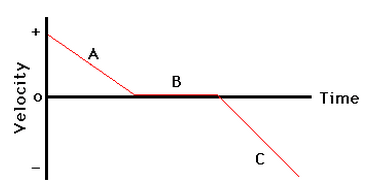
Describe the motion in segment C
a)
Slowing down;  Positive direction
b)
Slowing down;  Negative direction
c)
Speeding up;  Negative direction
d)
Constant velocity;  Negative direction
69.

What is the person doing from 5 seconds to 10 seconds?

a)

Walking

b)

Running

c)

Standing Still

d)

Walking Fast

70.

log 3 9 =

a)

1/2

b)

2

c)

1/3

d)

3

71.

log 16 8 =

a)

1/2

b)

4/3

c)

2

d)

3/4

72.

log 9 27 =

a)

3

b)

2/3

c)

3/2

d)

1/3

73.

log 1000 =

a)

1/10

b)

10

c)

1/3

d)

3

74.

log (1/10,000)

a)

1/4

b)

-4

c)

1000

d)

-1000

75.

log a a =

a)

10

b)

0

c)

1

d)

-1

76.

log(xy2)

a)

logx+2logy

b)

logx+logy2

c)

logx-2logy

d)

logx+logy+log2

77.

 log(xy)\log\left(\frac{x}{y}\right)  

a)

logx+logy

b)

xlogy

c)

log(x-y)

d)

logx-logy

78.

 log(m3n)\log\left(\frac{m^3}{n}\right)  

a)

logm-log3-logn

b)

3logm+logn

c)

3logm-logn

d)

3log(m-n)

79.

ln(4xy)

a)

ln4+lnx+lny

b)

4lnxy

c)

4lnx+lny

d)

4ln(x+y)

80.

log(3x)2

a)

2log(3+x)

b)

2log3+logx

c)

log3+2logx

d)

2(log3+logx)

81.

 ln(2x2yz4)\ln\left(\frac{2x^2y}{z^4}\right)  

a)

ln2+2lnx+lny+4lnz

b)

ln2+2lnx+lny-4lnz

c)

2ln(2xy)-4lnz

d)

2ln2x+lny-4lnz

82.

 log(8xyz) \log\left(\frac{8x}{yz}\right)\   

a)

log8+logx-logy-logz

b)

log8+logx-logy+logz

c)

log(8x)-log(yz)

d)

8logx-ylogz

83.

log(x7)

a)

log(7x)

b)

log7+logx

c)

xlog7

d)

7logx

84.

 log(94)\log\left(\frac{9}{4}\right)  

a)

log9+log4

b)

log(9-4)

c)

log9-log4

d)

4log9

85.
Find the value of y. log5 (25) = y
a)
y=1
b)
y=2
c)
y=3
d)
y=4
86.
Find the value of y. logy (16) = 2
a)
y=1
b)
y=2
c)
y=3
d)
y=4
87.
Convert to exponential form. log4 (4) = x
a)
logx (4) = 4
b)
x^4 = 4
c)
4^x = 4
d)
log4 (x) = 4
88.

The length of the edge of a cube is 60 cm. Find the volume of the cube.

a)

180 cm3180\ cm^3

b)

21600 cm221600\ cm^2

c)

216000 cm3216000\ cm^3

d)

720 cm3720\ cm^3

89.

Which of the following is the correct Pythagoras' Theorem?

a)

c2=a2+b2c^2=a^2+b^2

b)

c2=a2b2\ c^2=a^2-b^2

c)

a2=b2+c2a^2=b^2+c^2

90.

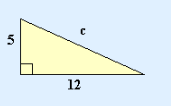
Solve for c

a)

7

b)

9

c)

13

91.

Volume of a cube is 125 cu cm. Find its total surface area.

a)

150 sq cm

b)

25 sq cm

c)

150 sq cm

d)

100 sq cm

92.
The capacity of a water tank of dimensions 10m X 5m X 1.5 m is
a)
75 lits
b)
750 lits
c)
7500 lits
d)
75000 lits
93.
The total surface area of a cuboid with dimension 10cm X 6cm X 5cm is
a)
280sq.cm
b)
300sq.cm
c)
360sq.cm
d)
600sq.cm
94.
The volume of a cuboid whose dimensions are 12cm X8cm X6cm is
a)
576cu.cm
b)
276cu.cm
c)
176cu.cm
d)
256cu.cm
95.
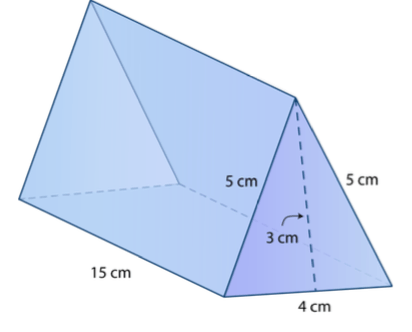
Calculate the volume. 
a)
 90 cm³
b)
150 cm³
c)
180 cm³
96.
Find the volume of the cone. Round your answers to the nearest tenth.
a)
127.3 yd3
b)
347.6 yd3
c)
287.7 yd3
d)
147.7 yd3
97.
Find the volume of this shape
a)
1520.53
b)
276.46
c)
552.93
d)
6082.12
98.
Find the volume.
a)
13680 m3
b)
684 m3
c)
1140 m3
d)
228 m3
99.
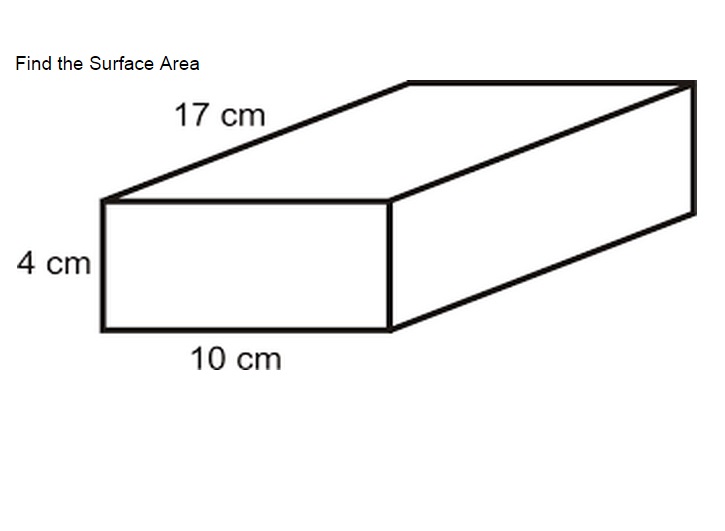
Find the Surface Area
a)
556 cm2
b)
278 cm2
c)
680 cm2
d)
340 cm2
100.

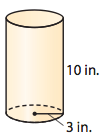
Calculate the surface area of the given shape. Round to the nearest tenth.

a)

282.7 in2

b)

56.5 in2

c)

188.5 in2

d)

245.0 in2