wayground logo

Free Printable Worksheets

Font size

S
M
L
XL
Worksheets

ELECTRICITY AND MAGNETISM

Total questions: 84

Worksheet time: 1hrs 7mins

Name
Class
Date
1.
The flow of electricity in a circuit-
a)
current
b)
flow
c)
circuit
2.
____________ allows electricity to flow.
a)
A conductor
b)
An insulator
c)
A magnet
3.
Two types of circuits are
a)
parallel and magnetic
b)
electromagnetic and series
c)
series and parallel
4.
What will happen when these magnets are brought close together?
a)
They will attract each other.
b)
They will repel each other.
c)
Both magnets will turn to the left
d)
Both magnets will turn to the right
5.
Where is the strongest attraction force of the magnet?
a)
at the poles
b)
in the middle
c)
above the magnet
d)
below the magnet
6.
What happens when two north poles of a magnet are placed together?
a)
they repel
b)
they attract
c)
they cancel each other out
d)
the strength of the magnet is doubled
7.
True or False: All metals are attracted to magnet.
a)
True
b)
False
8.
Which of the following is true about a bar magnet?
a)
Its magnetic field is strongest near its center.
b)
It is surrounded by a magnetic field.
c)
The north pole is stronger than the south pole.
d)
The south pole is stronger than the north pole.
9.
What can an electromagnet do that a permanent magnet cannot do?
a)
It is stronger than any permanent magnet.
b)
It can be turned on and off
c)
They can glow in the dark
10.
A circuit that has two or more paths that electricity can follow.
a)
Series Circuit
b)
Electromagnet
c)
Parallel Circuit
11.
A circuit that has only one path in which electricity can follow is a
a)
insulator
b)
conductor
c)
parallel circuit
d)
series circuit
12.
The space in which an electric force act is an
a)
insulator
b)
resistance
c)
electric field
d)
static electricity
13.
A temporary magnet made up of a wire wrapped around a core is an
a)
insulator
b)
electromagnet
c)
copper
d)
nail
14.
The measure of how much a material opposes the flow of current is called
a)
conductor
b)
insulator
c)
electric field
d)
resistance
15.
Which is a characteristic of most electrical conductors?
a)
They can be cut easily.
b)
Positive charges move easily through them.
c)
Negative charges move easily through them.
d)
They are soft and flexible.
16.
Which statement is TRUE about an electromagnet?
a)
It is a permanent magnet.
b)
Increasing the number of coils decreases the strength.
c)
It cannot be turned off.
d)
It is made by wrapping current-carrying wire around an iron core.
17.
If one burned-out bulb causes all of the lights to fail in a circuit, what might you conclude?
a)
It is a parallel circuit.
b)
More batteries are needed.
c)
It is a series circuit.
d)
A heavier wire is needed.
18.
A student added another light to an electric circuit and all the lights became dimmer.  What is most likely the cause of the dimmer lights?
a)
The batteries are weak.
b)
The light bulbs are hot.
c)
The circuit is a series circuit.
d)
The circuit is a parallel circuit.
19.
What energy transformation takes place in a battery powered fan that is spinning?
a)
kinetic to chemical to electrical
b)
chemical to kinetic
c)
chemical to electrical to kinetic
d)
electrical to kinetic to chemical
20.
What is a complete path through which electric charges can flow called?
a)
magnetic pole
b)
electric circuit 
c)
electric resistance
d)
magnetic field 
21.
What are huge wheels that rotate when pushed by water, wind, or steam?
a)
magnet wheels
b)
turbines
c)
batteries
d)
generators 
22.

What device changes mechanical kinetic energy into electrical energy?

a)

electric motor

b)

insulator

c)

electromagnet

d)

generator

23.
What device changes electrical energy to mechanical energy?
a)
electromagnet
b)
electric motor
c)
conductor
d)
generator 
24.
What do you make if you wrap a current-carrying wire around an iron bolt?
a)
electromagnet
b)
electric motor
c)
generator
25.
What is the region of force around a magnet known as?
a)
magnetic field
b)
magnetic pole
c)
magnetic domain 
d)
lodestone
26.
What is a stream of electrons moving through a copper wire called?
a)
current electricity
b)
light bulb
c)
series circuit
d)
motor
27.
Why are electrical cords covered in plastic or rubber?
a)
Because plastic and rubber are insulators which keeps us safe
b)
because it looks nicer
c)
because all wires must have plastic or rubber
d)
because they won't melt
28.
A balloon is rubbed all over with wool.  The balloon will now attract wool because the balloon and wool
a)
are magnets
b)
have opposite charges
c)
have like charges
d)
have neutral charges
29.
A piece of nickel will be attracted to
a)
only the north pole of an electromagnet
b)
only the south pole of an electromagnet
c)
either pole of an electromagnet
d)
the iron core of an electromagnet
30.
Which of these is NOT a function of a diode?
a)
to turn current on
b)
to turn current off
c)
to block the flow of current in the wrong direction
d)
to adjust the amount of current that flows
31.
Electric current flowing through a wire produces
a)
static electricity
b)
an open circuit
c)
a permanent magnet
d)
a magnetic field
32.
What is the purpose of an iron core in an electromagnet?
a)
to hold the loops of wire in place
b)
to make the magnetic force stronger
c)
to change the direction of the electric current
d)
to change the direction of the magnetic force
33.
A group of lights are connected in a parallel circuit.  One of the lights is removed.  The rest of the lights will
a)
get brighter
b)
get dimmer
c)
go out
d)
not change
34.
A scientist observed that the needle of a compass moved when it was placed near a wire carrying an electric current.  What did this observation show?
a)
Opposite charges attract.
b)
Electric current generates a magnetic field.
c)
Magnetized wires generate electricity.
d)
Like charges repel.
35.
A string of lights is lit.  They are part of a series circuit.  One of the bulbs is removed.  The rest of the lights will
a)
go out
b)
stay lit
c)
get brighter
d)
get dimmer
36.
A student is investigating how changing the size of the core of an electromagnet affects its strength.  Which of these is most likely the dependent variable in the student's investigation?
a)
the number of wire coils wrapped around the core
b)
the number of paper clips picked up by the electromagnet
c)
the voltage of the battery used in the circuit
d)
the size of the piece of iron used as the core
37.
Pick the correct sentence.
a)
This circuit will work because it is a closed circuit.
b)
Energy will freely flow in this circuit.
c)
This circuit will not work because there is no energy source.
d)
This circuit will not work because there is no switch.
38.
Iron, Nickel, Cobalt, and Steel are all __________________ materials
a)
Expensive
b)
Insulators
c)
Magnetic
d)
Cold
39.

In which of the following circuits will all of the remaining light bulbs go out if bulb 3 burns out?

a)
b)
c)
d)
40.

An electric current is traveling in a wire. A compass is placed under the wire with the current flowing from north to south. In response, the compass needle will-

a)

rotate because of a magnetic force that acts on the needle

b)

rotate because of an electric force that acts on the needle

c)

not move because moving electric charges do not exert magnetic forces on the needle

d)

not move because moving electric charges do not exert electric forces on the needle

41.

Diagrams of electric fields and magnetic fields often look similar. What is an important difference between electric field lines and magnetic field lines?

a)

Electric field lines always point away from the object generating the field, while magnetic lines always point toward it.

b)

Electric field lines are close together where the electric field is strong, but magnetic lines are close where the magnetic field is weak.

c)

Electric field lines start and end on charges, while magnetic field lines form closed-loop paths to and from the poles.

d)

Magnetic field lines cannot cross, while electric field lines can

42.
How do you make an electromagnet stronger?
a)
Add a motor and/or lightbulbs
b)
Add more light bulbs and/or wire coils
c)
add more wire coils and/or a switch
d)
add more wire coils and/or batteries
43.

What type of core is best for electromagnets?

a)

Steel

b)

Iron

c)

Plastic

d)

Copper

44.

Why is Earth's magnetosphere important?

a)

It deflects dangerous solar wind from the sun

b)

It keeps us in orbit around the sun

c)

it keeps the moon in orbit around the earth

d)

it prevents extraterrestrial objects from crashing into earth

45.

Where is the Earth's magnetic South pole located in relation Earth's geographic South pole

a)

Earth's magnetic south pole is located directly at earth's geographic south pole

b)

Earth's magnetic south pole is located 10 degrees from Earth's geographic south pole

c)

Earth's magnetic south pole is located 10 degrees from Earth's geographic north pole

d)

Earth's magnetic south pole is located directly at Earth's geographic north pole

46.

How can you make a magnetic material a temporary magnet?

a)

heat it

b)

drop it

c)

strike it on a magnet

d)

electrify it

47.

What happens if you cut a magnet in half?

a)

Nothing

b)

The magnets repel

c)

There will be two magnets

48.

When running a current through a wire, what do the blue lines represent?

a)

The wire spinning

b)

A magnetic field that was created

c)

Electrons leaving

d)

Electricity

49.
Voltage can be induced in a wire by
a)
a. moving the wire near a magnet.
b)
b. moving a magnet near the wire.
c)
c. changing the current in a nearby wire.
d)
d. all of these
50.
What would happen if I move a bar magnet in and out of a coil of copper wire?
a)
Electric current would disappear 
b)
The magnet would explode 
c)
Electric current will flow through the wire
d)
It would produce a gravitational field
51.
A magnet is moved in and out of a coil of wire connected to a high-resistance voltmeter. If the number of coils doubles, the induced voltage 
a)
quadruples
b)
doubles
c)
is the same
d)
halves
52.

Which action will increase the deflection of the galvanometer pointer?

a)

The magnetic pole is reversed

b)

The number of turns of coils is increased

c)

The coil is made from insulated wire

d)

The magnet is slowly pushed into the coil

53.
The voltmeter is at 0 in this image. How would you manipulate the experiment to create electricity (measured in volts)?
a)
Flip the magnet around so the North pole is facing out
b)
Move the magnet back and forth
c)
Take the magnet out
d)
Add more coils around the paper cylinder
54.
13.7 Based on this picture, which side will have a higher voltage?
a)
Secondary
b)
Primary
c)
Both sides have the same voltage
d)
Cannot be determined
55.
Who discovered electromagnetic induction?
a)
Hans Christian Orsted
b)
Michael Faraday
c)
James Maxwell
d)
Heinrich Hertz
56.

What type of transformer is used to increase the voltage from power stations.

a)

Step-down transformer

b)

Step-up transformer

57.

Why transformers work with A.C. current but not D.C.

a)

A.C current produces changing magnetic field.

b)

D.C current produces changing magnetic field.

c)

D.C current is weak

d)

A.C current is powerful

58.

Ratio of voltages is equal to ratio of _______________________.

a)

number of iron sheets in core

b)

number of coil

c)

number of turns in coil

d)

number of electromagnetic

59.

A transformer has 100 turns in the primary coil and 25 turns in the secondary coil. When a 120 V is applied to the primary coil, what is the voltage in the secondary coil?

a)

480V

b)

30V

c)

20V

d)

450V

60.

The function of a transformer is to ...

a)

raise and lower the apparent power levels

b)

transfer DC voltage from the primary winding to the secondary winding

c)

increase or decrease A.C voltage or A.C current levels

d)

transform mechanical energy into electrical energy

61.

A step up transformer has its primary winding to secondary winding ratio

a)

Greater than 1

b)

Equal to 1

c)

Less than 1

d)

Unknown

62.

Transformer can able to transform both AC and DC Voltages in a Circuit

a)

True

b)

False

63.

What does the thumb indicate in flemings left hand rule?

a)

Force

b)

Motion

c)

Current

d)

Magnetic field direction

64.

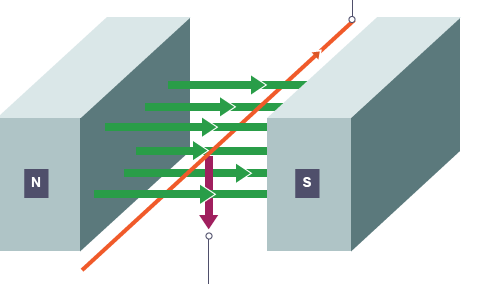
What direction is the force/motion in the following diagram?

a)

Perpendicular to the magnets

b)

Downwards

c)

Parallel and through the magnets

65.

Name the effect that causes a coil of current-carrying wire in an electric motor to move.

a)

The electromagnetism effect

b)

The magnetic effect

c)

The motor effect

66.

Which rule can be used to work out which way a coil of wire rotates in a motor?

a)

Fleming's left-hand rule

b)

Fleming's right-hand rule

67.

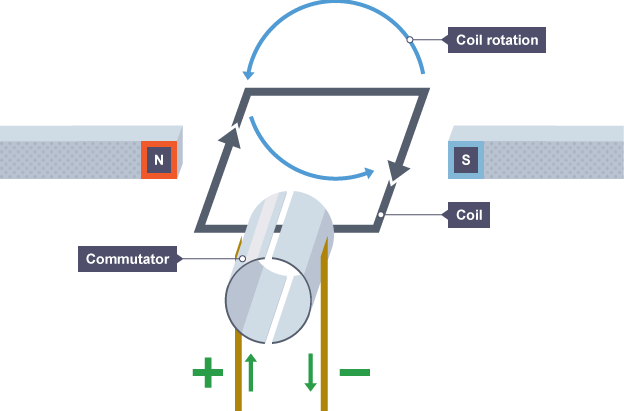
How does a split ring commutator work?

a)

Swaps the contact evert full turn, so that the left-hand and right-hand arms of the coil always experience a force in the same direction.

b)

Swaps the contact evert half turn, so that the left-hand and right-hand arms of the coil do not experience a force in the same direction.

c)

Swaps the contact evert half turn, so that the left-hand and right-hand arms of the coil always experience a force in the same direction.

68.
a)
Bulbs are in parallel - Circuit X is brighter than Circuit Y
b)
Bulbs are in parallel - Circuit Y is brighter than Circuit X
c)
Bulbs are in series - Circuit X is brighter than Circuit Y
d)
Bulbs are in series - Circuit Y is brighter than Circuit X
69.
a)
A2 = A3
b)
A2 + A3 = A1
c)
A1 + A2 = A3
d)
A4 = A2 - A3
70.

A 3-ohm resistor and a 6-ohm resistor are connected in parallel across a 9-volt battery. Which statement best compares the potential difference across each resistor?

a)

The potential difference across the 6-ohm resistor is four times as great as the potential difference across the 3-ohm resistor.

b)

The potential difference across the 6-ohm resistor is half as great as the potential difference across the 3-ohm resistor.

c)

The potential difference across the 6-ohm resistor is the same as the potential difference across the 3-ohm resistor.

d)

The potential difference across the 6-ohm resistor is twice as great as the potential difference across the 3-ohm resistor.

71.

A 3.0-ohm resistor and a 6.0-ohm resistor are connected in series in an operating electric circuit. If the current through the 3.0-ohm resistor is 4.0 amperes, what is the potential difference across the 6.0-ohm resistor?

a)

12 V

b)

24 V

c)

2.0 V

d)

8.0 V

72.

The circuit diagram above represents four resistors connected to a 12-volt source. What is the total current in the circuit?

a)

2.0 A

b)

0.50 A

c)

24 A

d)

8.6 A

73.

This is the symbol for a...

a)

Light Dependent Resistor

b)

Light Emitting Diode

c)

Thermistor

d)

Cell

74.

This is the symbol for a...

a)

Light Emitting Diode

b)

Light Dependent Resistor

c)

Fuse

d)

Cell

75.

This is the symbol for a...

a)

Fuse

b)

Wire

c)

Light Emitting Diode

d)

Heater

76.

This is the symbol for a...

a)

Thermistor

b)

Fixed Resistor

c)

Variable Resistor

d)

Fuse

77.
a)
Buzzer
b)
Switch (Open)
c)
Diode
d)
Horn
78.

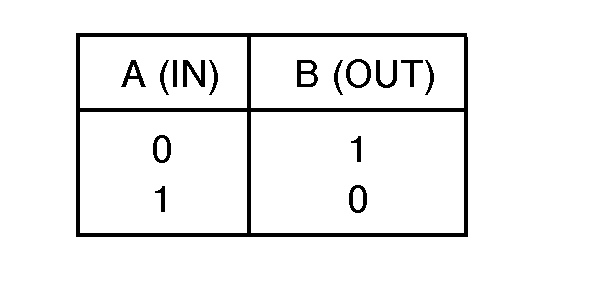
What type of logic gate is this table showing?

a)

AND

b)

OR

c)

NOT

79.

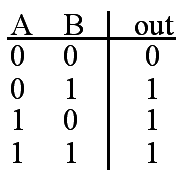
What type of logic gate is this table showing?

a)

AND

b)

OR

c)

NOT

80.

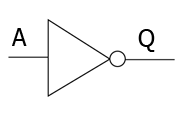
Which logic gate is this?

a)

AND

b)

OR

c)

NOT

81.

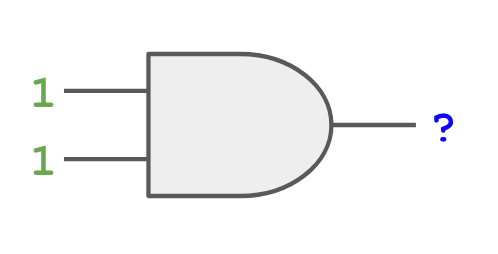
What will this gate's output be?

a)

0

b)

1

82.

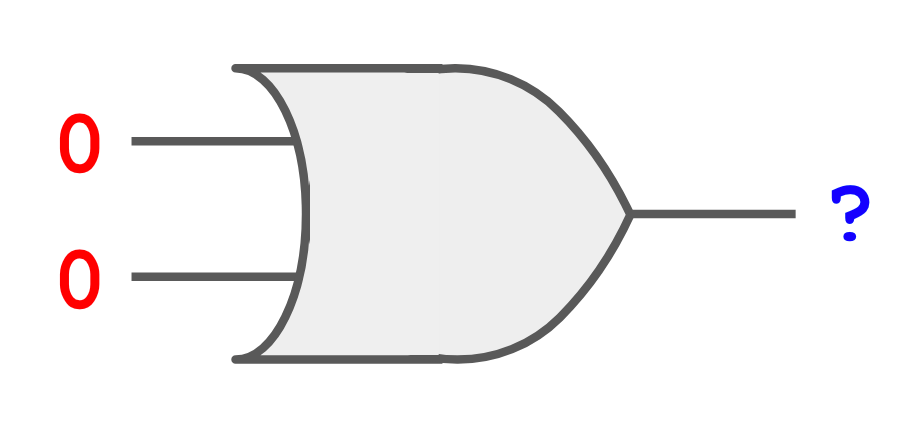
What will this gate's output be?

a)

0

b)

1

83.

According to Ohm's law

a)

The current flowing through a resistor is directly proportional to the voltage

b)

The current flowing through a resistor is inversely proportional to the voltage

c)

The current flowing through a resistor is directly proportional to the resistence

d)

The current flowing through a resistor is inversely proportional to the potential difference

84.

The resistance of a wire is

a)

directly proportional to the cross section area of the wire

b)

inversely proportional to the length of the wire

c)

directly proportional to the length of the wire

d)

independent of the length and area of the wire