
 Worksheets
Physics Revision (Theme 1: Motion, Forces & Energy)
Total questions: 85
Worksheet time: 3hrs 50mins

The diagram shows arrows representing two vector quantities.
Which diagram shows the resultant R of these two vectors?


Which quantity is a vector?
energy
force
speed
time
The diameter of a copper wire is thought to be approximately 0.3 mm.
Which instrument should be used to obtain a more accurate measurement of the diameter of the
wire?
measuring tape
metre rule
micrometer screw gauge
vernier caliper
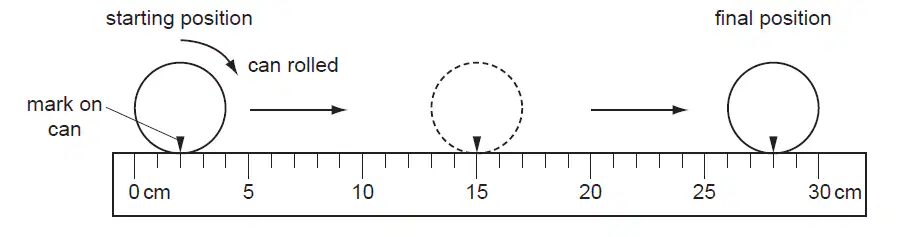
A cylindrical can is rolled along the ruler shown in the diagram.
The can rolls over twice.
What is the circumference (distance all round) of the can?
13cm
14cm
26cm
28cm
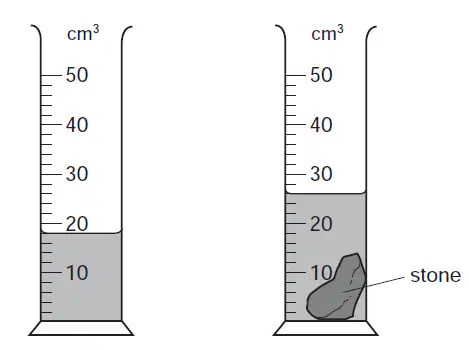
The diagram shows a measuring cylinder used to measure the volume of a small stone.
What is the volume of the stone?
8cm3
9cm3
14cm3
26cm3
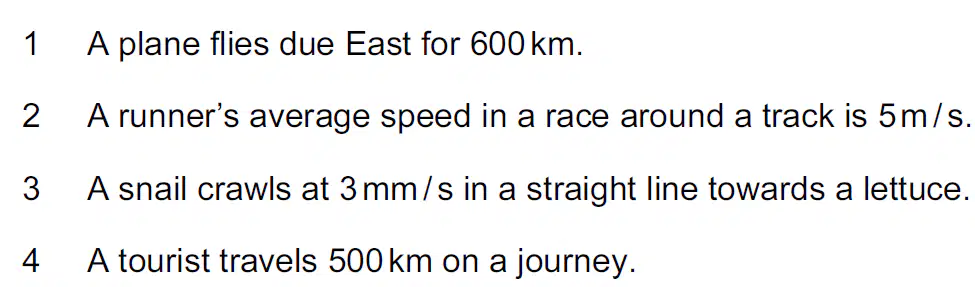
The following statements are about motion.
Which statements describe vector quantities?
1 and 2
1 and 3
2 and 3
2 and 4

What is the reading on this micrometer?
5.43 mm
6.63 mm
7.30 mm
8.13 mm
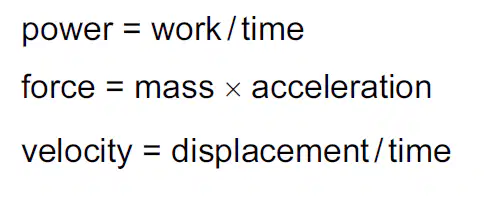
A student studies some equations.
How many vector quantities are contained in the equations?
1
2
3
4
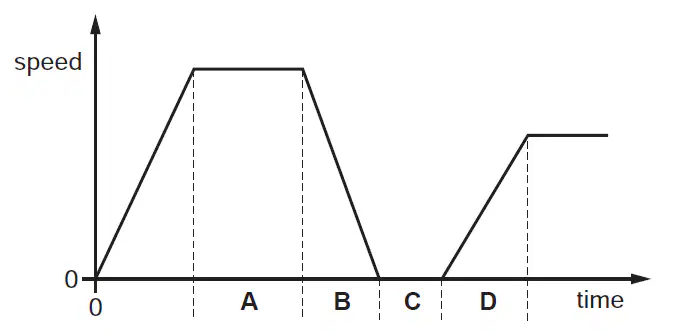
The graph shows how the speed of a van changes with time for part of its journey. In which labelled section is the van decelerating?
A
B
C
D
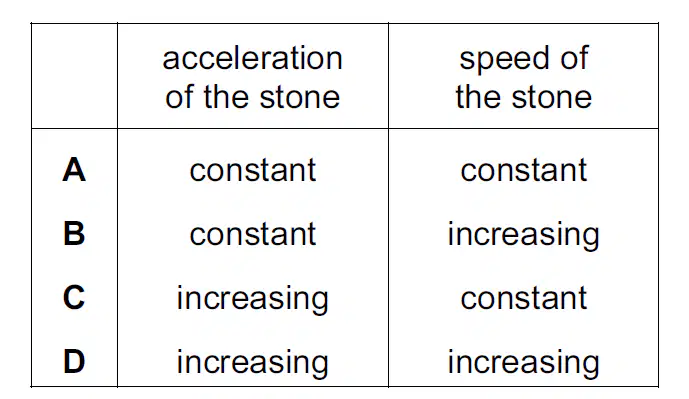
A large stone is dropped from a bridge into a river. Air resistance can be ignored.
Which row describes the acceleration and the speed of the stone as it falls?
A
B
C
D
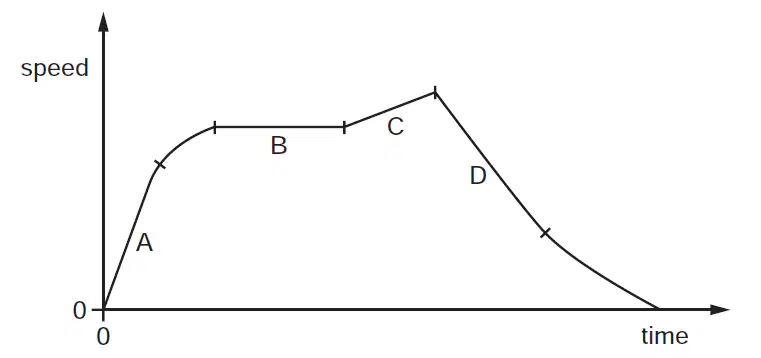
A car travels along a straight road.
The speed-time graph for this journey is shown.
During which labelled part of the journey is the resultant force on the car zero?
A
B
C
D
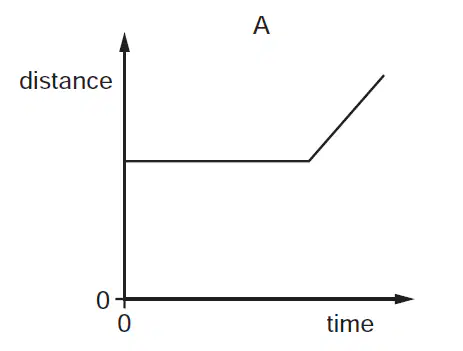
An object moves at a constant speed for some time, then begins to accelerate.
Which distance-time graph shows this motion?
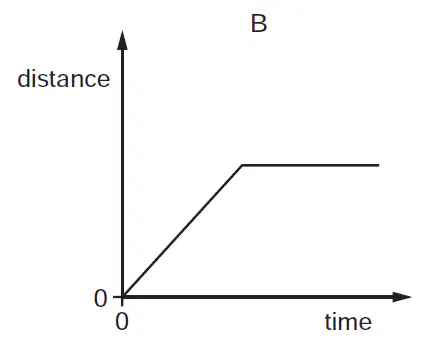
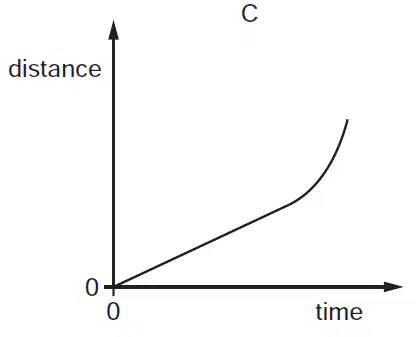
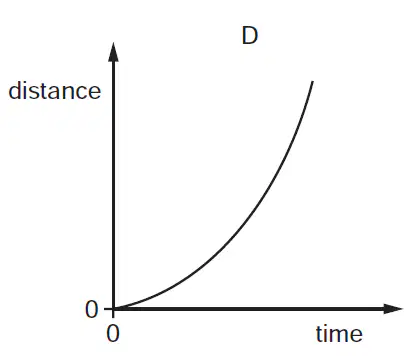
A train begins a journey from a station and travels 60 km in a time of 20 minutes.
What is the average speed of the train?
3.0 m / s
5.0 m / s
50 m / s
60 m / s

Two runners take part in a race.
The graph shows how the speed of each runner changes with time.
What does the graph show about the runners at time t ?
Both runners are moving at the same speed.
Runner 1 has zero acceleration.
Runner 1 is overtaking runner 2.
Runner 2 is slowing down.
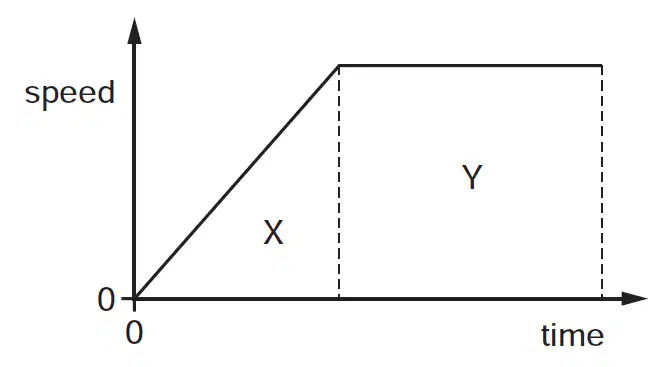
The diagram shows the speed-time graph for a car.
Which area represents the distance travelled while the car is accelerating?
X
X+Y
Y
X²
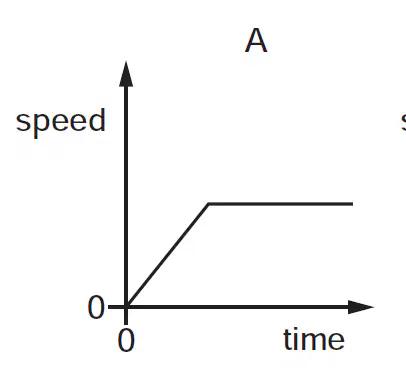
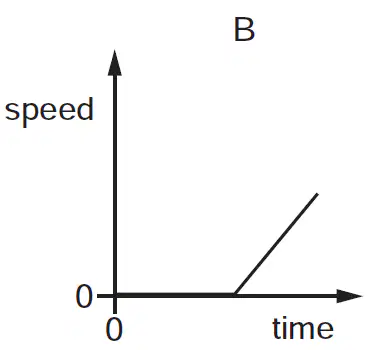
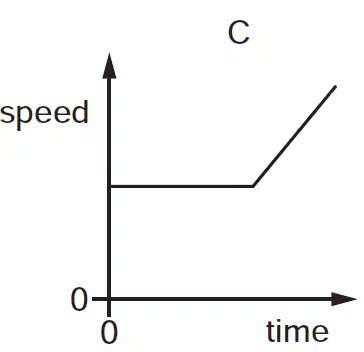
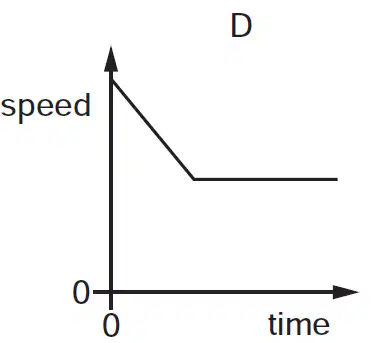
A car moves with constant speed and then constant acceleration.
Which graph is the speed-time graph for the car?
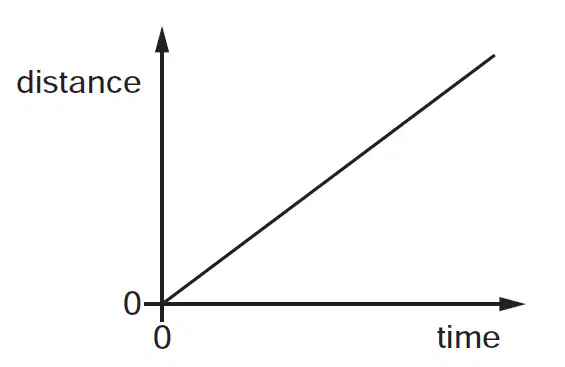
The diagram shows the distance-time graph of an object.
Which statement describes the object?
It is accelerating.
It is moving at a constant speed.
It is slowing down.
It is at rest.
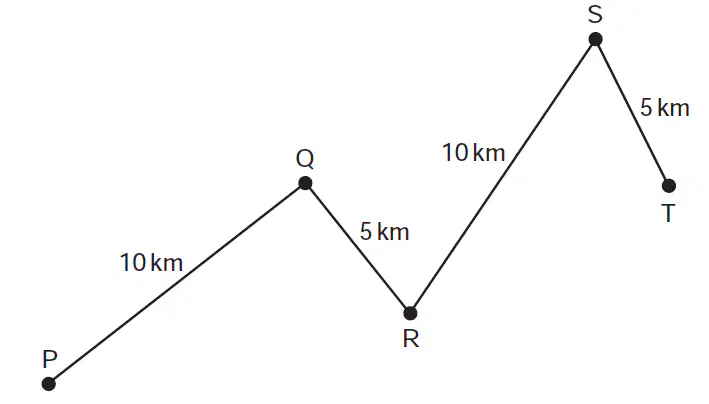
A car travels along the route PQRST in 30 minutes.
What is the average speed of the car?
10 km/h
20 km/h
30 km/h
60 km/h
Which person is experiencing an acceleration?
a driver of a car that is braking to stop at traffic lights
a passenger in a train that is stationary in a railway station
a shopper in a large store ascending an escalator (moving stairs) at a uniform rate
a skydiver falling at constant speed towards the Earth

The diagram shows the speed / time graph for a train as it travels along a track. For which part of the graph is the train’s speed changing at the greatest rate?
PQ
QR
RS
ST
A small steel ball is dropped from a low balcony.
Ignoring air resistance, which statement describes its motion?
It falls with constant acceleration.
It falls with constant speed.
It falls with decreasing speed.
It falls with increasing acceleration.
An object is released from rest and falls to Earth. During its fall, the object is affected by air
resistance. The air resistance eventually reaches a constant value.
Which description about successive stages of the motion of the object is correct?
constant acceleration, then constant deceleration
constant deceleration, then zero acceleration
decreasing acceleration, then constant deceleration
decreasing acceleration, then zero acceleration
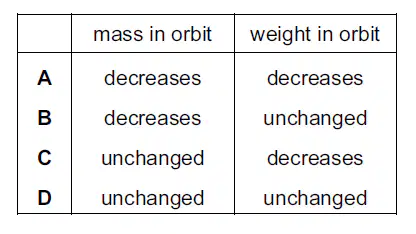
An astronaut in an orbiting spacecraft experiences a force due to gravity. This force is less than when she is on the Earth’s surface.
Compared with being on the Earth’s surface, how do her mass and her weight change when she goes into orbit?
A
B
C
D
What is the weight of an object?
the force of gravity on the object
the gravitational potential energy of the object
the internal energy of the object
the mass of the object
Which instrument is used to compare the masses of objects?
a balance
a barometer
a manometer
a measuring cylinder
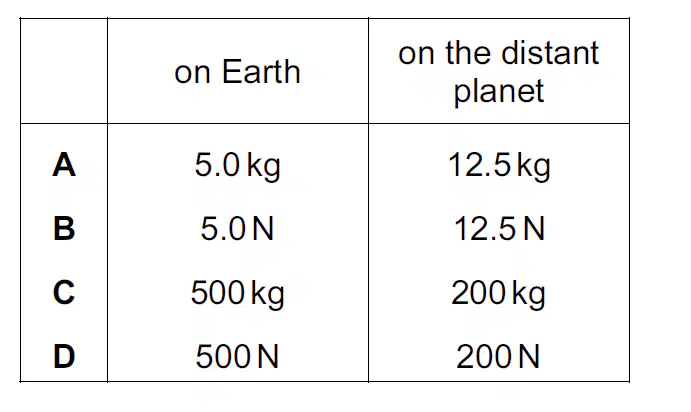
An object has a mass of 50 kg.
The gravitational field strength on Earth is 10.0 N / kg.
The gravitational field strength on a distant planet is 4.0 N / kg.
What is the weight of the object on Earth, and what is its weight on the distant planet?
A
B
C
D
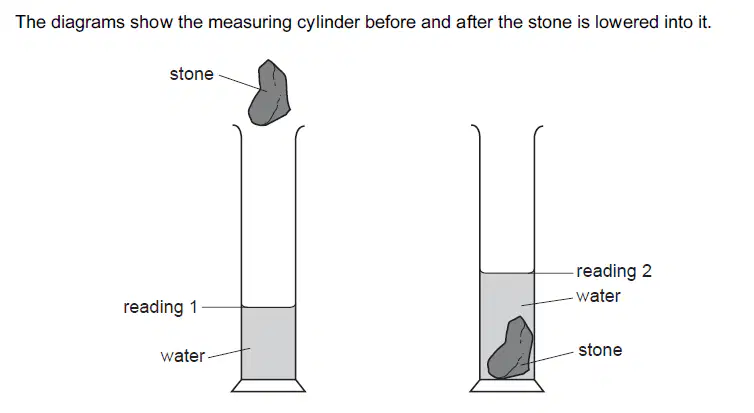
A student wishes to determine the density of an irregularly-shaped stone. First he finds the mass of the stone. Next he lowers the stone into a measuring cylinder containing water.
How should the student calculate the density of the stone?
mass of stone × reading 2
mass of stone × (reading 2 – reading 1)
mass of stone ÷ reading 2
mass of stone ÷ (reading 2 – reading 1)
The diagrams show four blocks with the same mass.
Which block is made from the least dense material?



Two cylinders are made of the same metal. Both cylinders have the same cross-sectional area but one is longer than the other.
Which quantity is the same for both cylinders?
density
mass
weight
volume
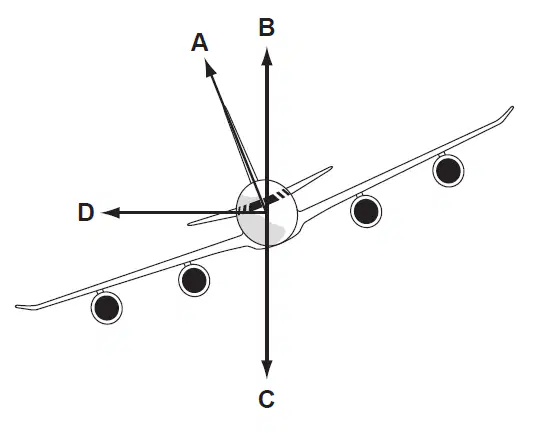
The diagram shows an aeroplane turning in a horizontal circle at constant speed. In which direction is there a resultant force?
A
B
C
D
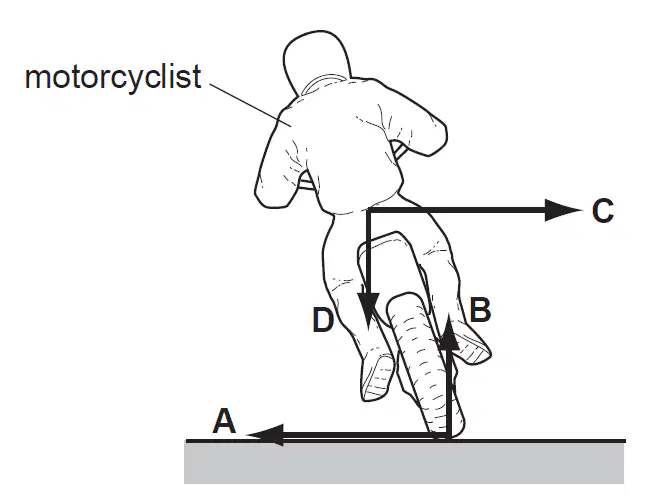
The diagram shows a motorcyclist leaning over in order to move around a corner.
Which force causes him to move around the corner?
A
B
C
D
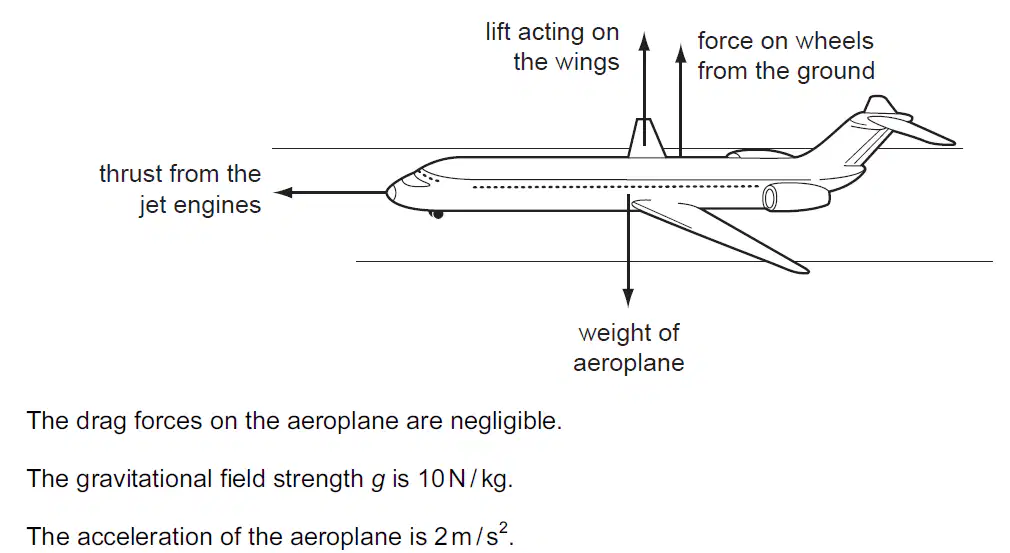
An aeroplane is half way along a runway before it takes off.
The arrows show the directions of four forces acting on the aeroplane.
What is the largest force?
the force on the wheels from the ground
the lift acting on the wings
the thrust from the jet engines
the weight of the aeroplane
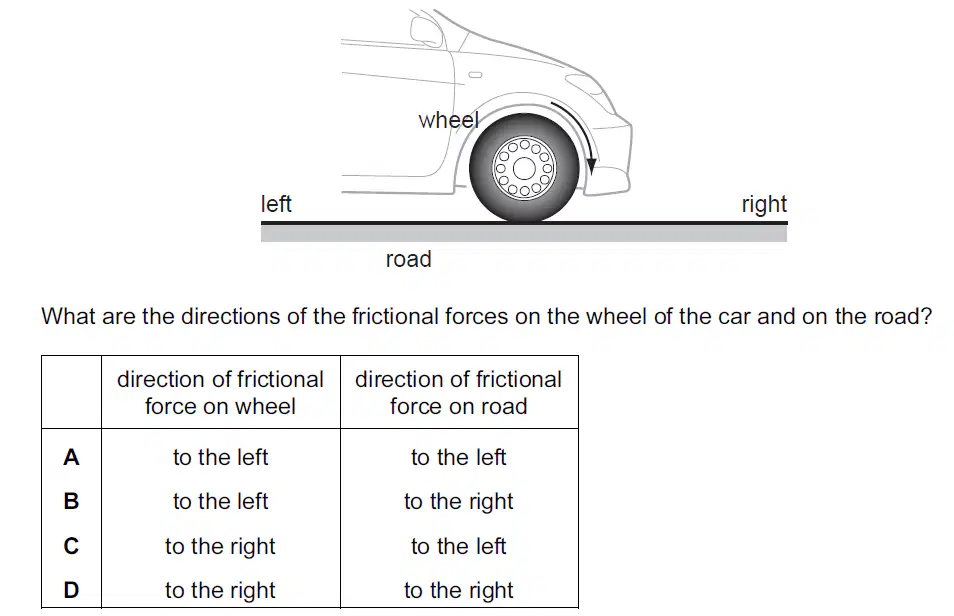
The front wheel of a car is turned in a clockwise direction by the engine as the car accelerates towards the right, as shown in the diagram. There is a force of friction between the wheel and the
road.
What are the directions of the frictional forces on the wheel of the car and on the road?
A
B
C
D
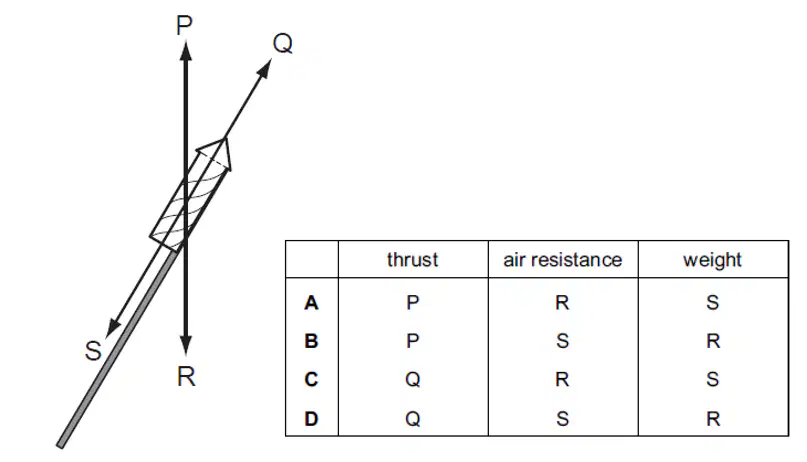
The diagram shows a firework rocket. As the rocket flies through the air, three forces act on it. These forces are weight, thrust and air
resistance.
What are the three forces?
A
B
C
D

According to Newton’s third law, what is the forward force on the propeller due to the water?
200 N
1800 N
2000 N
3800 N

A person just supports a mass of 20 kg suspended from a rope.
What is the resultant force acting on the mass?
0 N
10 N
20 N
200 N
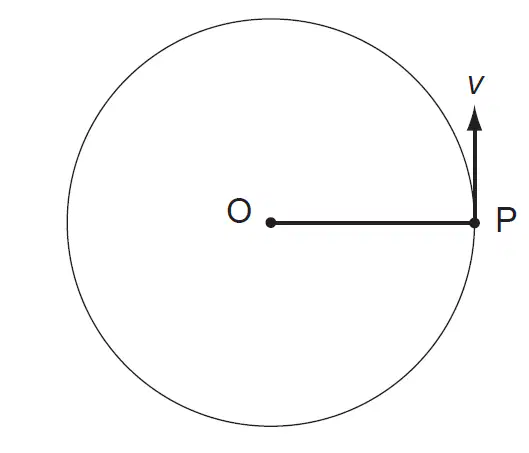
A particle P is moving in a horizontal circle about O. P moves at constant speed v.
Which statement is true?
A force of constant magnitude is acting in the same direction as v.
A force of constant magnitude is acting towards O.
The force on P varies in size as it moves around the circle.
The force on P varies in size as it moves around the circle.
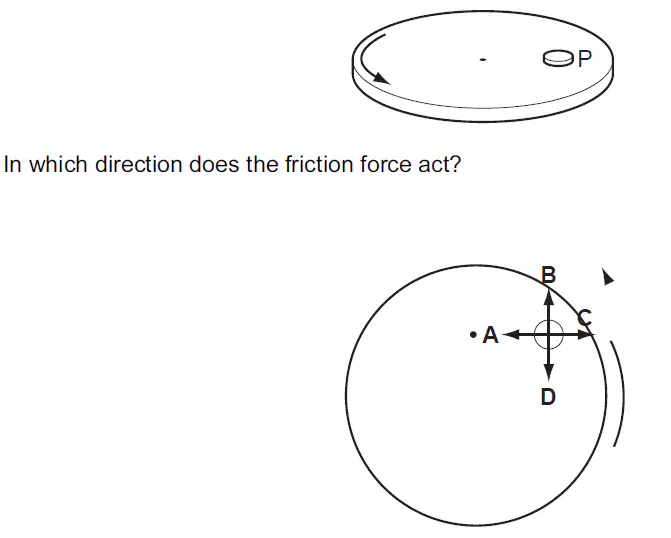
A turntable rotates at constant speed. A coin is placed on the turntable at P. The friction force between the coin and the turntable keeps the coin in the same position on the turntable.
In which direction does friction act?
A
B
C
D
A force of 20 N pushes an object of mass 5.0 kg along a rough horizontal surface where the
frictional force is 5.0 N.
What is the acceleration of the object?
1.0 m/s2
2.0 m/s2
3.0 m/s2
4.0 m/s2

Which two forces are a Newton’s third law pair (action and reaction)?
P and Q
P and R
Q and S
R and S
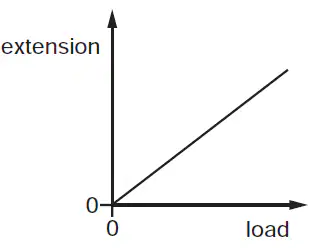
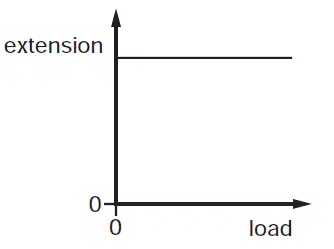
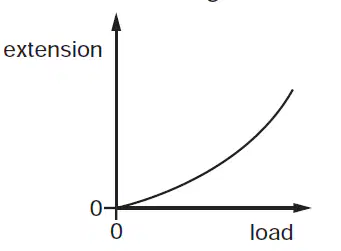
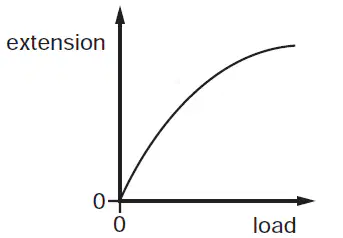
A spring obeys Hooke’s law.
Which graph is obtained by plotting the extension of the spring against the load applied?

A student adds weights to an elastic cord. He measures the length of the cord for each weight.
He then plots a graph from the results, as shown. Which length has he plotted on the vertical axis?
measured length
original length
(measured length – original length)
(measured length + original length)

The diagrams show a steel spring and a graph of its length against the load applied to it.
What is the extension of the spring when a load of 20 N is applied to it?
3.0 cm
4.5 cm
5.0 cm
8.0 cm

The unstretched length of the spring is 17.0 cm. When an object is hung from the spring, the length of the spring is 19.2 cm.
What is the weight of the object?
1.4 N
1.6 N
2.6 N
3.0 N
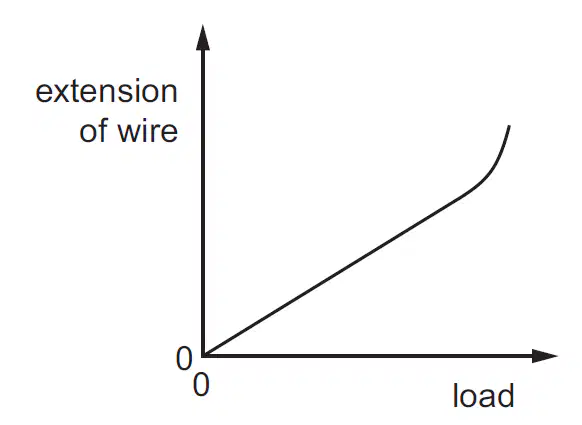
The graph shows the extension of a piece of copper wire as the load on it is increased. What does the graph show?
At a certain load the wire becomes easier to extend.
At a certain load the wire becomes harder to extend.
The load and extension are directly proportional for all loads.
The load and extension are inversely proportional for all loads.

A spring extends by 4 cm when 10 N is suspended from it. Two of these springs are used as shown to carry a 30 N load.
What is the extension of each spring?
4cm
6cm
8cm
12cm

An extension-load graph is plotted to show the result of increasing the load on a spring.
Which point marks the limit of proportionality for this spring?
A
B
C
D

The graph shows extension-load curves for four fibres.
Which fibre is the hardest to stretch over the range of loads shown?
A
B
C
D
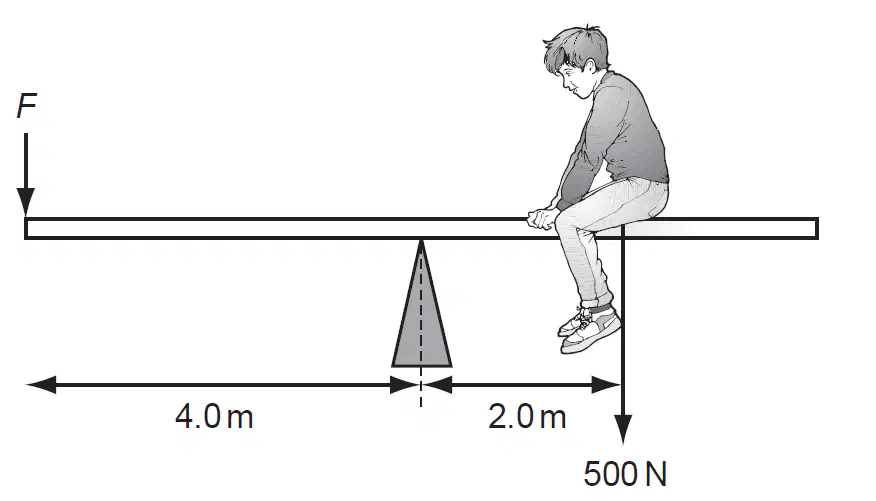
The diagram shows a boy of weight 500 N sitting on a see-saw. He sits 2.0 m from the pivot. What is the force F needed to balance the see-saw?
250N
750N
1000N
3000N
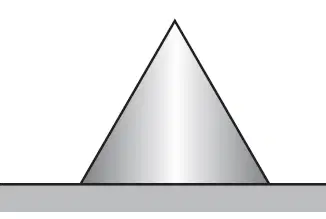
A metal cone with a circular base is placed on a flat surface.
The stability of the cone depends on
its weight only.
the diameter of its base and the position of its centre of mass.
the diameter of its base only.
the position of its centre of mass only.
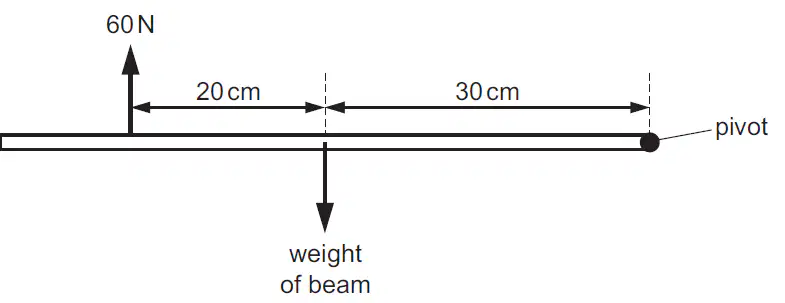
A uniform horizontal beam, pivoted at its right-hand end, is in equilibrium. A force of 60 N acts vertically upwards on the beam as shown. What is the weight of the beam?
36 N
40 N
90 N
100 N

A beam pivoted at one end has a force of 5.0 N acting vertically upwards on it as shown. The beam is in equilibrium.
What is the weight of the beam?
2.0 N
3.0 N
3.3 N
5.0 N
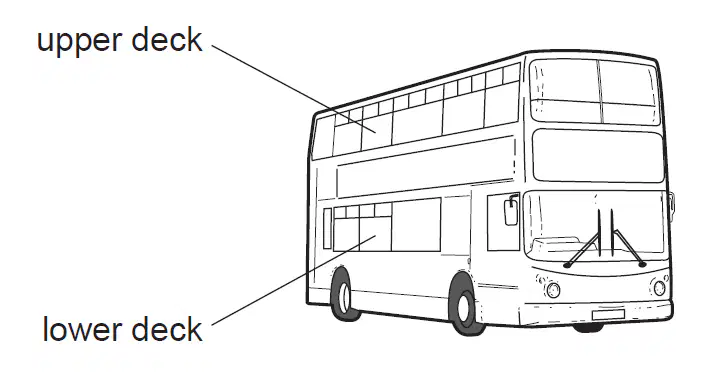
Passengers are not allowed to stand on the upper deck of double-decker buses. Why is this?
They would cause the bus to become less stable.
They would cause the bus to slow down.
They would increase the kinetic energy of the bus.
They would lower the centre of mass of the bus.
A uniform rod rests on a pivot at its centre. The rod is not attached to the pivot. Forces are then
applied to the rod in four different ways, as shown. The weight of the rod can be ignored.
Which diagram shows the rod in equilibrium?


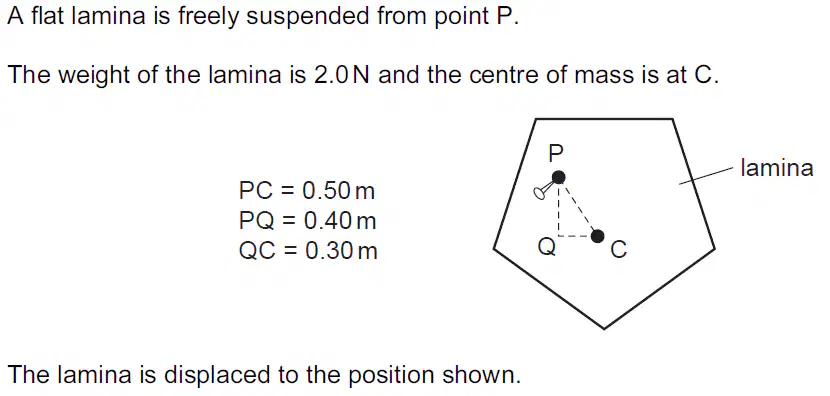
What is the moment that will cause the lamina to swing?
0.60 N m clockwise
0.80 N m anticlockwise
1.0 N m clockwise
1.0 N m anticlockwise
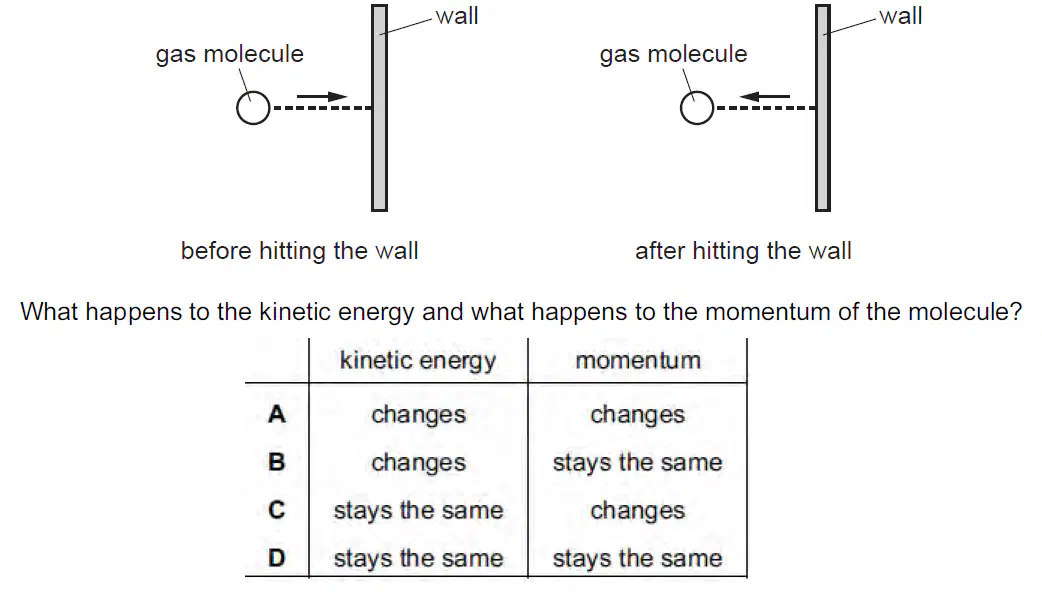
A gas molecule strikes the wall of a container. The molecule rebounds with the same speed.
What happens to the KE and the momentum of the molecule?
A
B
C
D
Which quantity is measured in newton seconds (N s)?
impulse
moment
power
work done
An object of mass 50 kg accelerates from a velocity of 2.0 m / s to a velocity of 10 m / s in the same
direction.
What is the impulse provided to cause this acceleration?
250 N s
400 N s
850 N s
2500 N s
A truck of mass 10 000 kg is moving at
5.0 m/s . Calculate the momentum of the truck.
5.0 × 10⁻⁴ kg m/s
2.0 × 10³ kg m/s
5.0 × 10⁴ kg m/s
2.5 × 10⁵ kg m/s
A basketball player is bouncing a ball on the ground. The ball hits the ground 10 times in 20 seconds.
The average change in momentum for each collision is 15 kg m/s.
What is the force that the ground exerts on the ball?
0.75N
2N
7.5N
20N
A cyclist travels along a horizontal track at constant speed.
The work done by the cyclist is equal to...
the change in kinetic energy.
the force of air resistance.
the force of friction in the bicycle.
the thermal energy (heat) produced.
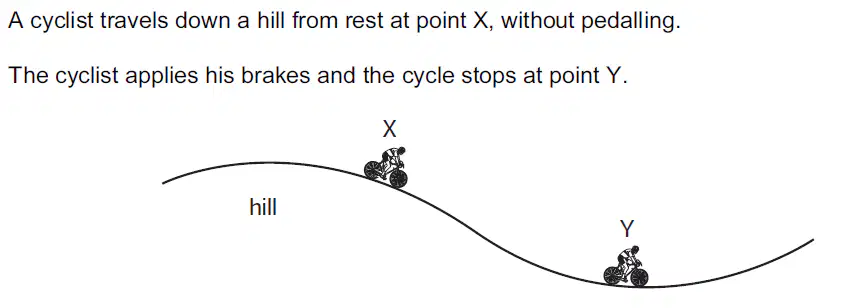
Which energy changes have taken place between X and Y?
gravitational potential → kinetic → thermal (heat)
gravitational potential → thermal (heat) → kinetic
kinetic → gravitational potential → thermal (heat)
kinetic → thermal (heat) → gravitational potential

A car is stationary at the top of a hill with the engine switched off. The brakes are released and the car rolls down the hill.
At which labelled point does the car have the greatest kinetic energy? Ignore friction.
A
B
C
D
A helicopter takes off from the ground and rises vertically. It then hovers at a constant height above the ground.
Which sequence of energy changes takes place during the gain in height?
chemical → gravitational potential → kinetic
chemical → kinetic → gravitational potential
gravitational potential → chemical → kinetic
kinetic → chemical → gravitational potential
Which energy transfer takes place when a matchstick burns?
chemical to thermal
chemical to nuclear
nuclear to chemical
thermal to chemical
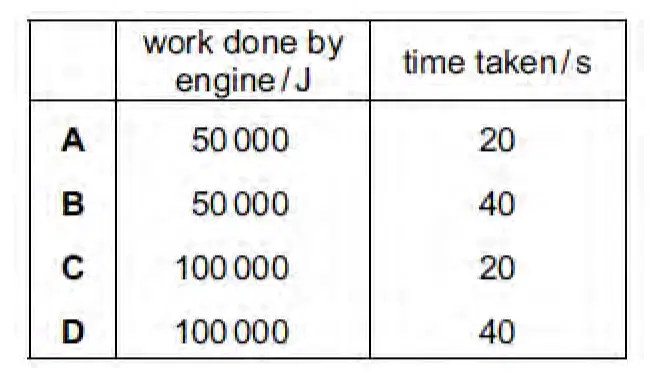
Four cars are driven along a road. The table shows the work done by the engine in each car and the time taken by each car.
Which engine produces the most power?
A
B
C
D
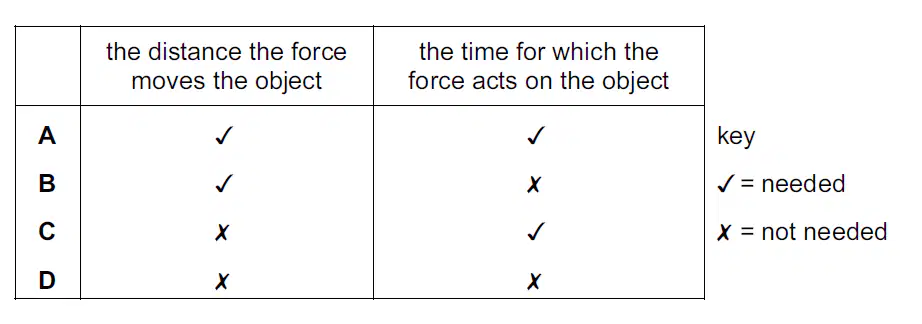
To calculate the power produced by a force, the size of the force must be known.
What else needs to be known to calculate the power?
A
B
C
D
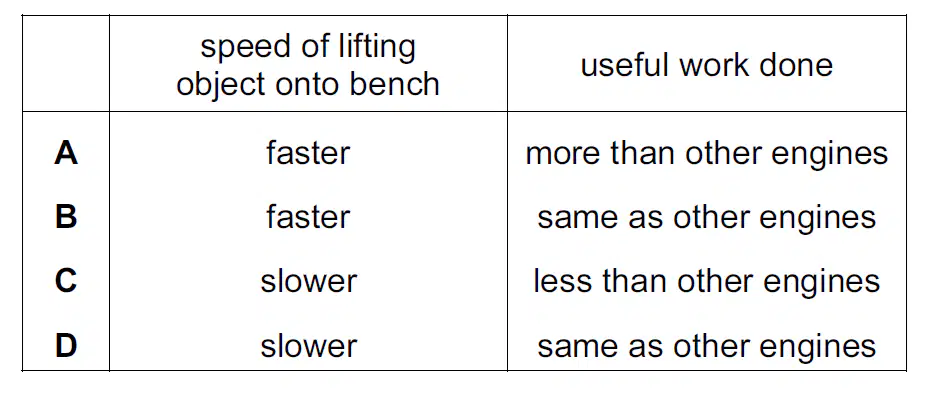
Four different model steam engines each lift a 1.0 kg object from the same laboratory floor to the same laboratory bench. Each engine takes a different time to lift the object.
How does the most powerful engine compare with the other engines?
A
B
C
D
Energy from uranium is transferred to electrical energy in a nuclear power station.
What is the correct order of the stages of this process?
boiler → generator → reactor → turbine
generator → boiler → turbine → reactor
reactor → boiler → turbine → generator
reactor → turbine → boiler → generator

Which form of energy is needed to complete the word equation?
chemical
gravitational potential
elastic
thermal
Electricity can be obtained from different energy resources.
Which energy resource is used to obtain electricity without producing heat to boil water?
coal
gas
hydroelectric
nuclear
Which energy source is renewable and reliably available at all times?
coal
geothermal
nuclear
wind
Which is a non-renewable energy resource?
coal
solar
tides
wind

Four beakers contain the same liquid.
At which point is the pressure the greatest?
A
B
C
D
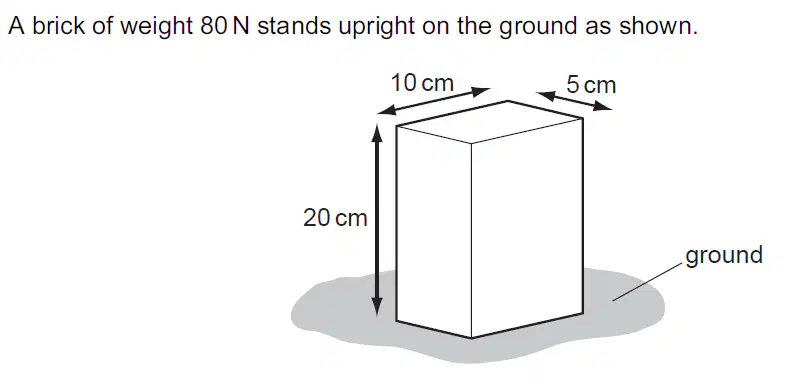
What is the pressure it exerts on the ground?
0.080 N/cm2
0.40 N/cm2
0.80 N/cm2
1.6 N/cm2
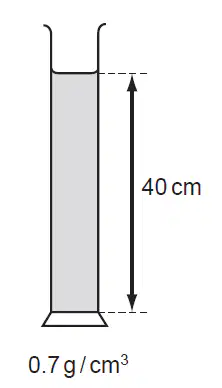
Four different liquids are poured into identical measuring cylinders. The diagrams show the
depths of the liquids and their densities.
Which liquid causes the largest pressure on the base of its measuring cylinder?


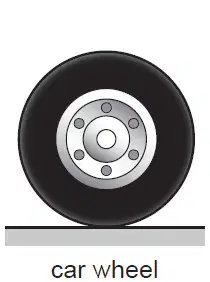
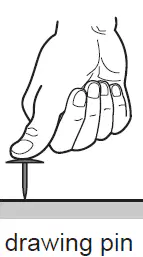
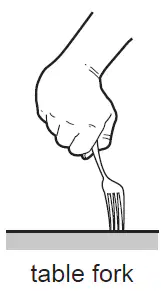
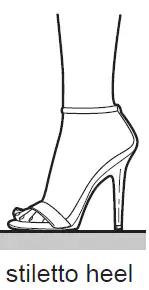
The same downward force is applied to four objects resting on a horizontal surface.
Which exerts the greatest pressure on the surface?
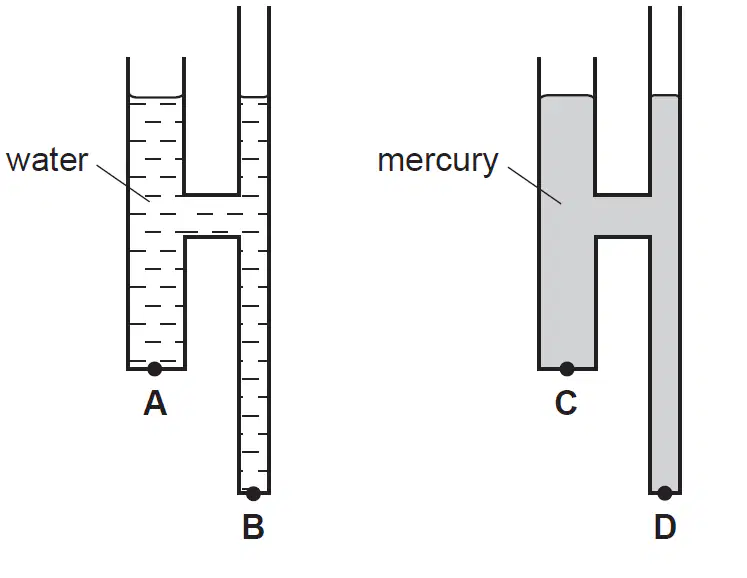
The diagram shows two identical pieces of apparatus. One is filled with water and the other is filled with mercury. Water is less dense than mercury.
At which point is the liquid pressure greatest?
A
B
C
D
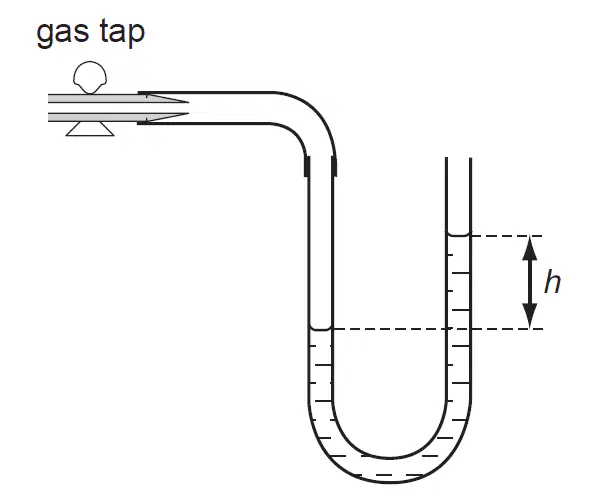
A water manometer is connected to a gas supply. One end of the manometer is open to the atmosphere. Which statement about the pressure of the gas supply is true?
The pressure is h cm of water.
The pressure is h cm of water below atmospheric pressure.
The pressure is the same as atmospheric pressure.
The pressure is h cm of water above atmospheric pressure.
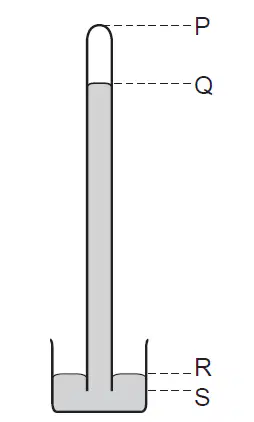
A long tube full of mercury is inverted in a small dish of mercury.
The mercury level in the tube falls, leaving a vacuum at the top.
When the atmospheric pressure falls, which length decreases?
PQ
PS
QR
RS
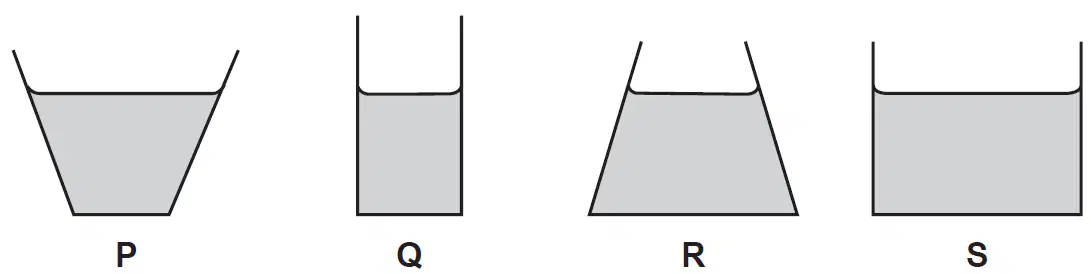
The diagrams show, to the same scale, the vertical sections of a set of circular vessels. Each vessel contains the same depth of water.
Which of the following statements is correct?
The water exerts the greatest pressure on the base of vessel P.
The water exerts the greatest pressure on the base of vessel S.
The water exerts the same force on the base of each vessel.
The water exerts the same pressure on the base of each vessel.
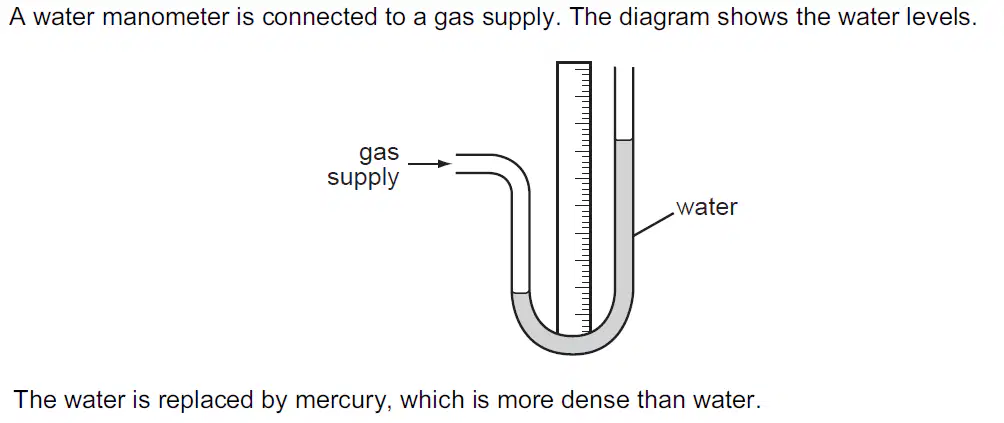
Which diagram shows the mercury levels when the manometer is connected to the same gas supply?


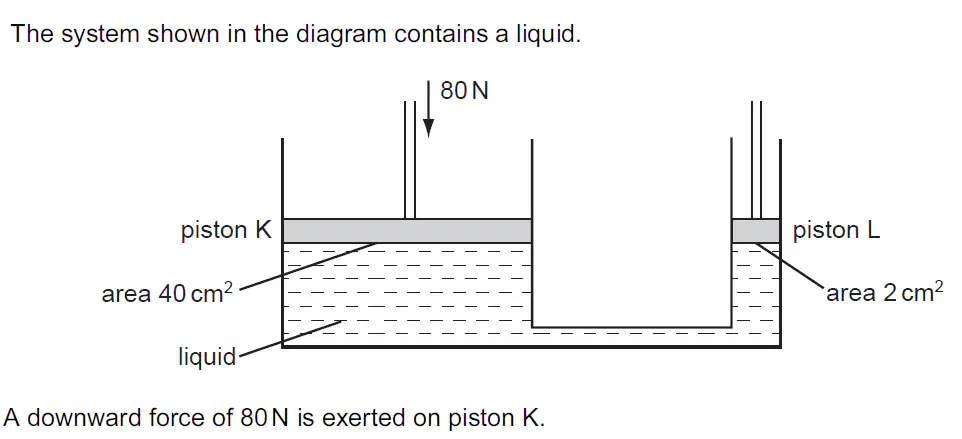
What will be the upward force exerted by the liquid on piston L?
1 N
4 N
80 N
1600 N
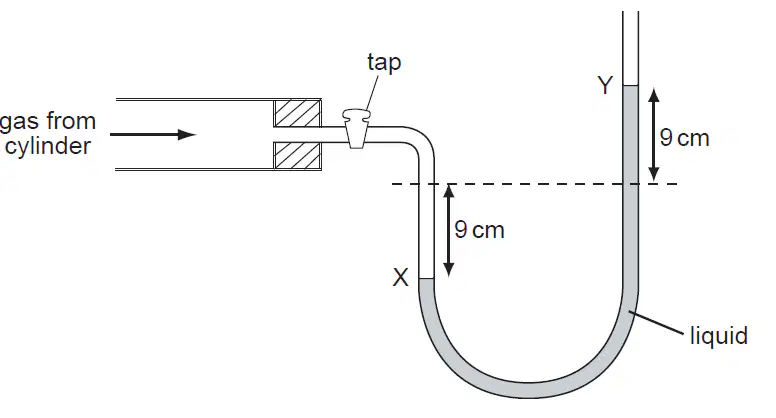
The diagram shows the levels X and Y in a liquid manometer when the gas tap is opened.
What is the pressure of the gas in the cylinder?
18 cm of liquid below atmospheric pressure
9 cm of liquid below atmospheric pressure
9 cm of liquid above atmospheric pressure
18 cm of liquid above atmospheric pressure
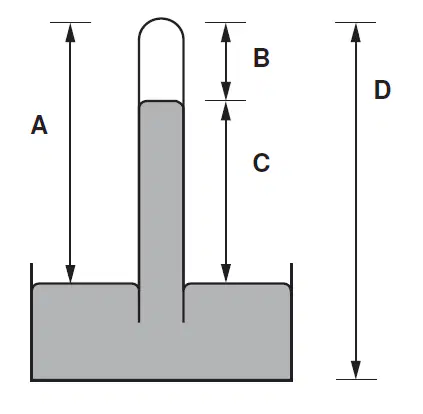
The diagram shows a simple mercury barometer.
Which height is a measure of the atmospheric pressure?
A
B
C
D

