wayground logo

Free Printable Worksheets

Font size

S
M
L
XL
Worksheets

Energy Unit Review

Total questions: 83

Worksheet time: 1hrs 4mins

Name
Class
Date
1.

The ability to do work (move) is called...

a)

Matter

b)

Energy

c)

Weight

d)

Force

2.

True or false: Energy cannot change from one type to another.

a)

True

b)

False

3.

Which of the following is an example of thermal energy?

a)

A light bulb

b)

The movement of a car

c)

The digestion of food

d)

Heat from a fire

4.

True or False: Energy can be created.

a)

True

b)

False

5.

Which has more gravitational energy?

a)

A snowboarder at the top of a mountain

b)

A person laying on the beach

6.

Energy that is stored is called...

a)

Kinetic Energy

b)

Potential Energy

c)

Mechanical Energy

d)

Thermal Energy

7.

Which has the most kinetic energy?

a)

A caught baseball

b)

A turtle swimming

c)

A parked car

8.
Energy of motion is which type of energy?
a)
Potential
b)
Kinetic
c)
Sound
d)
Gravitational
9.
What type of energy is in this picture?
a)
Kinetic
b)
Potential
c)
Chemical
d)
Sound
10.
When plants convert the sun's energy into food, which type of energy is it?
a)
kinetic
b)
chemical
c)
thermal
d)
radiant
11.
What kind of energy is represented in this picture?
a)
Thermal
b)
Potential
c)
Nuclear
d)
Mechanical
12.
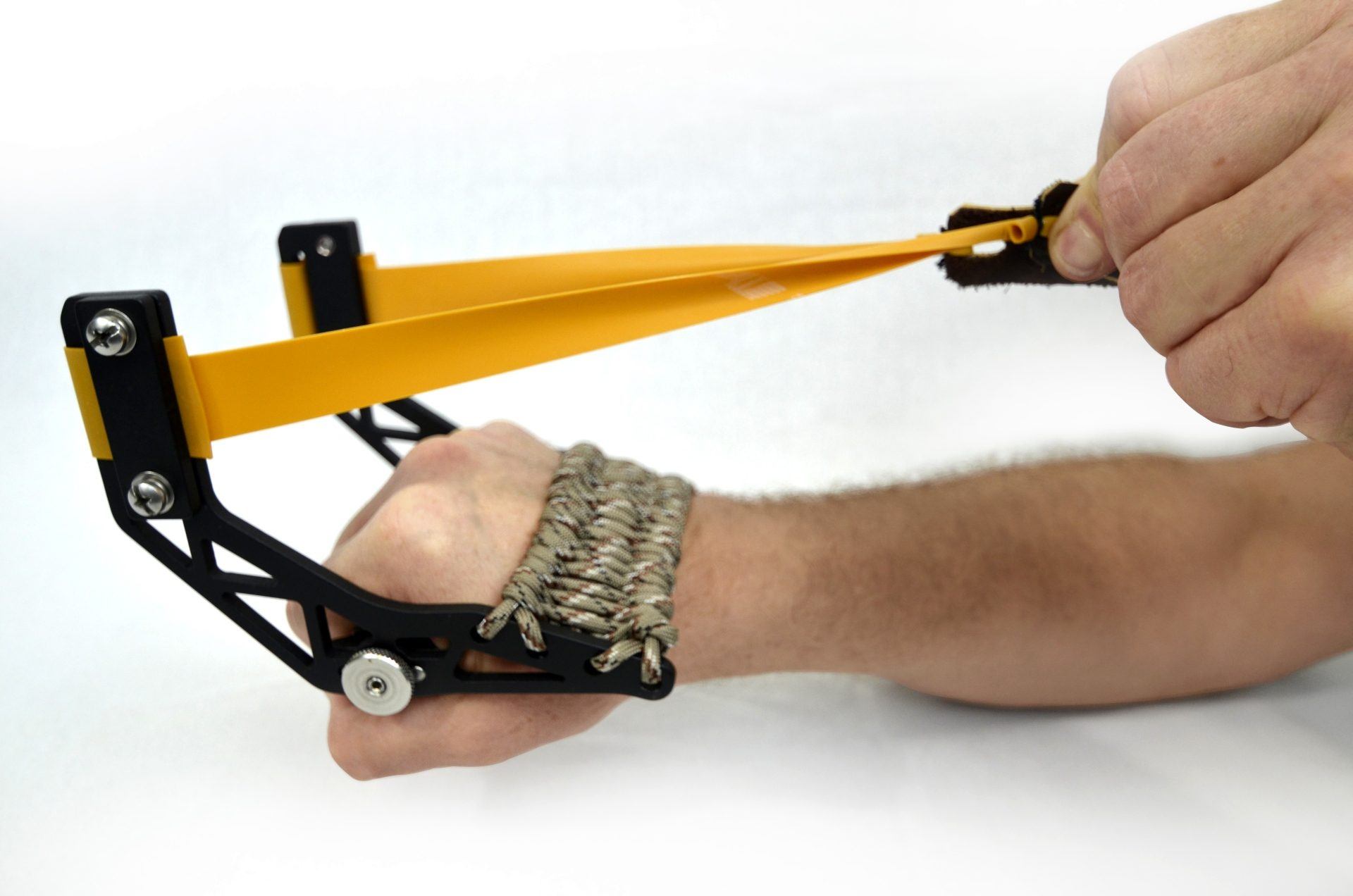
What kind of energy does this device use?
a)
Chemical
b)
Electrical
c)
Thermal
d)
Chemical
13.
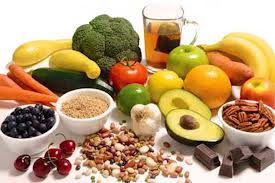
What kind of energy is represented in the picture?
a)
Thermal
b)
Chemical
c)
Sound
d)
Nuclear
14.
A battery converts what type of energy to another?
a)
sound to kinetic
b)
light to heat
c)
mechanical to electrical
d)
chemical to electrical
15.
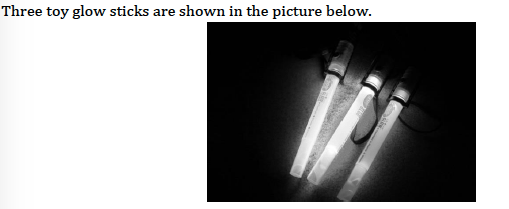
The glow sticks produce light for a short amount of time. The light from the glow stick is a conversion from what to what?
a)
thermal to light
b)
gravitational to potential
c)
radiant to electrical
d)
chemical to light
16.
Wind turbines and windmills convert what energy to another?
a)
Kinetic to electric
b)
Gravitational potential to electric
c)
Mechanical to potential
d)
Thermal to sound
17.
Work is:
a)
A transfer of energy by a force to move and object
b)
Something you get paid for
c)
Something you take home
d)
Makes you sweat
18.
On a roller coaster, where is maximum potential energy?
a)
At the bottom of a big hill
b)
When going around a corner
c)
When going upside down
d)
At the top of a big hill
19.
On a roller coaster, where is maximum kinetic energy?
a)
At the bottom of a big hill
b)
When going around a corner
c)
When going upside down
d)
At the top of a big hill
20.
The formula for work is:
a)
d = r x t
b)
p = m x v
c)
f = m x a
d)
w = d x f
21.
Energy that is stored in bonds between atoms is:
a)
Mechanical energy
b)
Chemical energy
c)
Kinetic energy
d)
Nuclear energy
22.
Energy caused by the movement in the particles of matter. It is a form of kinetic energy.
a)
Nuclear energy
b)
Sound energy
c)
Light energy
d)
Thermal energy
23.
Energy that comes from the nucleus of an atom. A form of potential energy.
a)
chemical energy
b)
Nuclear energy
c)
Sound energy
d)
Electrical energy
24.
The purpose of the panels is to change solar energy into ____________.
a)
light energy
b)
electrical energy
c)
chemical energy
d)
mechanical energy
25.

If the Total Energy is 50J, Potential Energy is 40 J, what is the Kinetic Energy?

a)

50 J

b)

10 J

c)

40 J

26.
What kind of energy does an object possess when it's resting on top of the hill?
a)
Potential Energy
b)
None
c)
Kinetic Energy
d)
All
27.
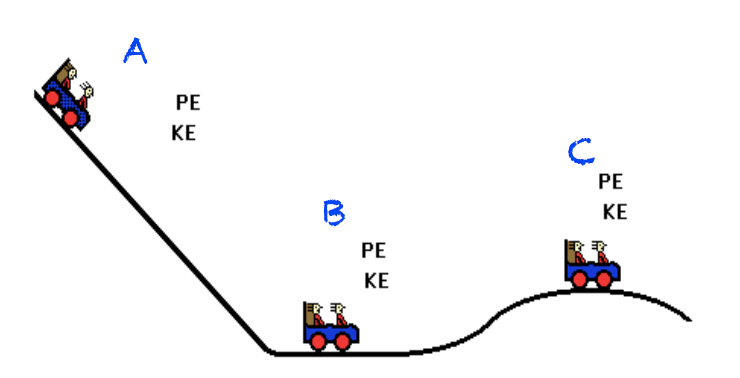
Which specific type of energy is at point A?
a)

Gravitational Potential Energy

b)

Kinetic Energy

c)

Potential Energy

d)

Total Energy

28.
When the velocity of the car is given, what kind of energy can we calculate right away?
a)
Potential Energy
b)
Kinetic Energy
c)
Mechanical Energy
d)
None
29.
Which equation would you use to solve for point A?
a)

1/2mv2

b)

mgh

30.

What is the total energy at point A if the car is 10 meters above the ground?

a)

0 J

b)

15 J

c)

50 J

d)

500 J

31.
What is the potential energy at point B?
a)
0 J
b)
15 J
c)
50 J
d)
500 J
32.
If the roller coaster is 2 meters above the ground at point C, what is its potential energy?
a)
10 m/s
b)
100 m/s
c)
10 J
d)
100 J
33.

At point C, the Total Energy= 500 J, and PE= 100 J, what is its KE?

a)

600 J

b)

400 J

c)

500 J

d)

100 J

34.

Which specific type of energy is at point B?

a)

Gravitational Potential Energy

b)

Kinetic Energy

c)

Potential Energy

d)

Total Energy

35.

When the height of the car is given, what kind of energy can we calculate right away?

a)

Potential Energy

b)

Kinetic Energy

c)

Mechanical Energy

d)

None

36.

Potential Energy + Kinetic Energy =

a)

Total Energy

b)

Mechanical Energy

c)

Thermal Energy

d)

All Energy

37.

According to the conservation of energy, the total energy in a system will always

a)

increase

b)

decrease

c)

stay the same

38.

If the catapult has 27J of Potential Energy before it is launched, how much Kinetic Energy does the ball have when its launched by the catapult?

a)

27 J

b)

10 J

c)

52 J

39.
What is work?
a)
A push or pull.
b)
The distance an object can be moved.
c)
Applying a force & moving an object.
d)
The rate at which energy is transferred.
40.
The door to the classroom weighs 3 kg. How much work is done when Michael pushes on the door to the classroom with 15 Newtons of force, pushing the door 1.3 meters?
a)
45 Joules
b)
19.5 Joules
c)
3.9 Joules
d)
58.5 Joules
41.
Ms. McDonald holds a desk perfectly still above her head. If she holds the desk at a height of 0.5 meters above her head, and applis 68 Newtons of force to do so, how much work has she done?
a)
34 Joules
b)
0 Joules
42.
I do 12 Joules of work on a bookcase. If I apply a force of 6 Newtons, how far have I moved the bookcase?
a)
2 meters
b)
792 meters
c)
17 meters
d)
320 meters
43.
If you move an object a greater distance... 
a)
you have more power
b)
you do more work
c)
you do the work faster
d)
you do less work
44.
If you push an 5 N object 2 m and then push a 10 N object 2 m. which is TRUE?
a)
you do the same amount of work
b)
you are more powerful when you move the 5 N object
c)
you do more work when you move the 10 N object
d)
you use the same amount of force
45.
What is the definition of power?
a)
the amount of work an object does
b)
the rate at which force is applied
c)
the amount of matter in an object
d)
the rate at which work is done
46.
Johann Sebastian Bach carries his piano up the stairs doing 2500 Joules of work. If he did this in 25 seconds, how much power did he do?
a)
62,500 Watts
b)
6200 Wats
c)
100 Watts
d)
125 Watts
47.
Gravity is pulling down on Mr. Mitchell with 850 Newtons of force. If he climbs 30 meters up the cliff in 30 seconds, how much power did he show?
a)
850 Watts
b)
28.3 Watts
c)
765,000 Watts
d)
1.06 Watts
48.
Kyrell pushes a basketball with a force of 32 Newtons. In 4 seconds, he moves the ball 12 meters. How much power did Kyrell demonstrate?
a)
32 Watts
b)
96 Watts
c)
10.67 Watts
d)
1536 Watts
49.
Which of the following would result in an increase in power?
a)
Decrease the amount of time to do work.
b)
Increase the amount of time to do work.
c)
Decrease the distance moved.
d)
Decrease the amount of work done.
50.
A Mustang has more horsepower than your mom's minivan. What does this mean?
a)
The Mustang has a higher topspeed.
b)
The minivan has a worse gas mileage.
c)
The Mustang can do work faster.
d)
The Mustang will die.
51.
What are energy and work measured in?
a)
Joule
b)
Watt
c)
Birds
d)
Newton
52.
You push against the back of your friends car that is stuck. You push and be become very tired. Did you do work?
a)
Yes, work was done
b)
No, work wasn't done
53.
Person A is twice the weight of Person B and climb the same hill. If person A gets the top in half the time then...
a)
Person A is twice as powerful
b)
Person B is twice as powerful
c)
Person A is four times as powerful
d)
Person B is four times as powerful 
54.
If a new fork lift can do the four times the amount of work in the same amount of time of an old forklift, then the new forklift is...
a)
Twice as powerful
b)
Four time as powerful
c)
Sixteen times the power
d)
of equal power of the old forklift
55.
What is the transfer of energy that occurs when a force makes an object move?
a)
power
b)
work
c)
force
d)
efficiency
56.
The amount of power produced or used depends on which of the following?
a)
work and time
b)
force and distance
c)
work and force
d)
time and distance
57.
What is the unit of measurement for power?
a)
newtons
b)
joules
c)
watts
d)
meters
58.
Tommy carries his piano up the stairs doing 100 Joules of work. If he did this in 10 seconds, how much power did he do?
a)
62,50 Watts
b)
1000 Watts
c)
10 Watts
59.
Work requires force and _______.
a)
distance
b)
time
c)
position
60.

A job is done slowly, and an identical job is done quickly. Both jobs require the same amount of ___, but different amounts of _____

a)

work, work

b)

power, work

c)

work, power

d)

force, work

61.
If a powerlifter raises a 1000 N weight a distance of 2.0 meters in 0.5 seconds, what is his power output? 
a)
1000 W
b)
2000 W
c)
4000 W
d)
5000 W
62.

Which of the following is the minimum amount of work done by a hydraulic lift to raise an aluminum block 2.0 m with a MASS of 150 kg?

a)

75 J

b)

300 J

c)

1470 J

d)

2940 J

63.

In which of these cases is work being done?

a)

A student stands with her backpack on her back

b)

A student pushes a locked door that does not move

c)

a student pushes his chair into another room

d)

A student sits on the carpet

64.
Work/Time = ________?
a)
Force
b)
Speed
c)
Velocity
d)
Power
65.
Calculate the amount of work done if you use a 100N force to push a 50 kg box 5 m across the kitchen floor. 
a)
250 J 
b)
500 J
c)
5000 J
d)
50,000 J
66.
Work is done when a weightlifter holds a barbell still above his head.
a)
True
b)
False
67.
Person A is twice the weight of Person B and climb the same hill. If person A gets the top in half the time then...
a)
Person A is twice as powerful
b)
Person B is twice as powerful
c)
Person A is four times as powerful
d)
Person B is four times as powerful 
68.

Which of the following is the best example of work being done.

a)

doing homework

b)

lifting a box

c)

pushing a stationary box

d)

holding a box

69.
You move a 12-newton box up a 6-meter ramp. In order to find out how much power you created, what would you need to know?
a)
The mass of the box
b)
The slope of the ramp 
c)
The direction the box moved
d)
How long the task took
70.

Potential energy depends on the ________ and ________ of the object.

a)

Height (position)

b)

Mass

c)

Speed

d)

Friction

71.

Which point has the most potential energy?

a)

G

b)

F

c)

B

d)

A

72.

At which point of the roller coaster is potential energy the greatest?

a)

W

b)

X

c)

Y

d)

Z

73.

The faster an object moves, the ________ kinetic energy it has.

a)

more

b)

less

74.
What is energy?
a)
rate of work
b)
Motion of an object
c)
ability to do work
d)
force over time
75.

Kinetic energy depends on the ________ and ________ of the object.

a)

Height (position)

b)

Mass

c)

Speed

d)

Friction

76.

How much gravitational potential energy does a 100kg (220lb.) skydiver have if they jump from 4000 meters?

a)

3920000 J

b)

294 J

c)

180000 J

d)

1225 J

77.

A 6kg cat misjudges a jump and falls 5 meters. How much gravitational potential energy does the cat have? (The cat is fine by the way.)

a)

294 J

b)

180000 J

c)

1225 J

d)

3920000 J

78.

Calculate the potential energy of a car with a mass of 2,500 kg that is on a hill 100 meters above sea level.

a)

250,000 J

b)

2,450,000 J

c)

2,451,663 J

d)

248 J

79.

A 50kg (100lb) person is running at 7m/s (about 16 mph). How much kinetic energy do they have?

a)

1225 J

b)

180000 J

c)

294 J

d)

3920000 J

80.

A cheetah can run briefly with a speed of 31 m/s. Suppose a cheetah with a mass of 47 kg runs at this speed. What is the cheetah’s kinetic energy?

a)

1457 J

b)

728.5 J

c)

45,167 J

d)

22,583.5 J

81.
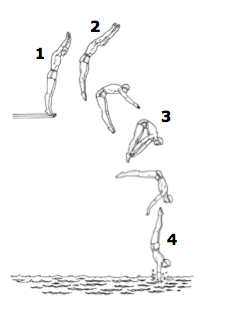
2. The diagram to the right represents a diver’s motion from the top of a high diving board into a pool of water. At what point does the diver have the greatest kinetic energy and the least potential energy?
a)
1
b)
2
c)
3
d)
4
82.
How much kinetic energy does a moving 6 kg object have if it moves with a velocity of 3 m/s?
a)
27 J
b)
18 J
c)
9 J
d)
2 J
83.

The coaster at B is at -

a)

Maximum PE, Minimum KE

b)

Minimum PE, Minimum KE

c)

Minimum PE, Maximum KE

d)

Maximum PE, Maximum KE