wayground logo

Free Printable Worksheets

Font size

S
M
L
XL
Worksheets

IIT-JEE & NEET LEVEL - 4 (9-T)

Total questions: 80

Worksheet time: 1hrs 20mins

Name
Class
Date
1.

Velocity is...

a)

The rate of change of acceleration

b)

The rate of change of displacement

c)

The rate of change of distance

d)

The rate of change of speed

2.

What is the difference between a vector quantity and a scalar quantity?

a)

A scalar has a magnitude and direction and a vector has only a magnitude

b)

A vector has a magnitude and direction and a scalar has only a magnitude

c)

A scalar has a direction and a vector has a magnitude

d)

None of the above

3.

An unladen swallow flies 5 m/s. How far has the bird traveled after 1 min?

a)

5 m

b)

12 m

c)

120 m

d)

300 m

4.

Which of the following is a vector quantity?

a)

Velocity

b)

Acceleration

c)

Displacement

d)

All of the above

5.

A dog running with an initial speed of 7.5 m/s comes to a stop in 15 seconds. What is the dog's acceleration?

a)

-7.5 m/s

b)

-7.5 m/s2

c)

-0.5 m/s2

d)

7.5 mi//hr

6.

A car traveling at 22.4 m/s skids to a stop in 2.55 s. Determine the skidding distance of the car (assume uniform acceleration).

What number represents final velocity?

a)

v = 2.55s

b)

v= 22.4m/s

c)

v= 0m/s

d)

v =?

7.

A car traveling at 22.4 m/s skids to a stop in 2.55 s. Determine the skidding distance of the car (assume uniform acceleration).

What number represents initial velocity?

a)

v0 = 2.55s

b)

v0= 22.4m/s

c)

v0= 0m/s

d)

v0 =?

8.

A car traveling at 22.4 m/s skids to a stop in 2.55 s. Determine the skidding distance of the car (assume uniform acceleration).

What number represents displacement?

a)

x = 2.55s

b)

x= 22.4m/s

c)

x= 0m/s

d)

x =?

9.

1. In addition to time, which of the following must be used for a more complete description of the average acceleration of an object?

a)

Mass

b)

Displacement

c)

Velocity

d)

None of these

10.

What is the acceleration of an object moving at constant velocity?

a)

2 m/s2

b)

1 m/s2

c)

0 m/s2

d)

0.8 m/s2

11.

A bird flies 5 m/s. How far has the bird traveled after 1 min?

a)

5 m

b)

12 m

c)

120 m

d)

300 m

12.

What is the speed of an object at rest

a)

0 m/s

b)

1 m/s

c)

9.8 m/s

d)

10 m/s

13.

A toy car is given an initial velocity of 5m/s and experiences a constant acceleration of 2 m/s2 for 6 seconds. What is the final velocity of the car?

a)

10 m/s

b)

12 m/s

c)

16 m/s

d)

17 m/s

14.

Acceleration due to gravity is also called...

a)

negative velocity

b)

displacement

c)

free fall acceleration

d)

instantaneous velocity

15.

What is the difference between the displacement of a traveler who takes a train from San Francisco to Los Angeles and the displacement of a traveler who flies from Los Angeles to San Francisco

a)

They are the same

b)

Displacement of the second traveler is greater

c)

They are of equal magnitude but opposite sign

d)

None of the above

16.
An object  accelerates at 2  m/s^2. Assuming the object starts from rest, how much time does it need to accelerate to a speed of 16  m/s?
a)
4 s
b)
8 s
c)
16 s
d)
1/16 s
17.

In each of the following cases, determine which car has the greatest acceleration.

a)

starts from 0 m/s to 20 m/s in 4 seconds.

b)

speed up from 20m/s to 40m/s in 3 seconds

c)

slow down from 50m/s to stop in 2 seconds

d)

starts from 0 m/s to 20m/s in 5 seconds

18.

A car is traveling at 21.0 m/s. It slows to a stop at a constant rate over 5.00 s. How far does the car travel during those 5.00 seconds before it stops? (HINT: This is a 2 step problem and you must find the acceleration FIRST)

a)

4.20 m

b)

52.5 m

c)

105 m

d)

158 m

19.

Which of the following are considered to be scalar quantities? Pick all that apply.

a)

the temperature of a room

b)

the acceleration of a runner

c)

the speed of a snail

20.

A feather is dropped on the moon from a height of 1.40 meters. The acceleration of gravity on the moon is 1.67 m/s2. If we wanted to determine the time for the feather to fall to the surface of the moon, which equation should you use to solve the above problem the most efficiently?

a)
b)
c)
d)
21.

The total surface area of a cube whose edge is "a" is

a)

4a2

b)

6a2

c)

5a2

d)

3a2

22.

Total Surface Area of a Cuboid

a)

T.S.A = 2 (lb +bh +hl)T.S.A\ =\ 2\ \left(lb\ +bh\ +hl\right)

b)

T.S.A = 2(l +b)hT.S.A\ =\ 2\left(l\ +b\right)h

c)

T.S.A = 6a2T.S.A\ =\ 6a^2

d)

T.S.A =lbhT.S.A\ =lbh

23.

Curved Surface Area of a Cuboid

a)

 C.S.A = 2 (lb +bh +hl)C.S.A\ =\ 2\ \left(lb\ +bh\ +hl\right) 

b)

 C.S.A = 2(l +b)hC.S.A\ =\ 2\left(l\ +b\right)h 

c)

 C.S.A = 6a2C.S.A\ =\ 6a^2 

d)

 C.S.A =lbhC.S.A\ =lbh 

24.

Volume of a Cuboid

a)

 V= 2 (lb +bh +hl)V=\ 2\ \left(lb\ +bh\ +hl\right) 

b)

 V= 2(l +b)hV=\ 2\left(l\ +b\right)h 

c)

 V = 6a3V\ =\ 6a^3 

d)

 V =lbhV\ =lbh 

25.

Total Surface Area of a Cube is

a)

6a26a^2

b)

4a24a^2

c)

a3a^3

d)

6a36a^3

26.

Total Surface Area of a Cylinder is

a)

2πr(r +h)2\pi r\left(r\ +h\right)

b)

2πrh2\pi rh

c)

πr2h\pi r^2h

d)

2πr2h2\pi r^2h

27.

Curved Surface Area of a Cube is

a)

6a26a^2

b)

4a24a^2

c)

a3a^3

d)

6a36a^3

28.

Volume of a Cylinder is

a)

2πr(r +h)2\pi r\left(r\ +h\right)

b)

2πrh2\pi rh

c)

πr2h\pi r^2h

d)

2πr2h2\pi r^2h

29.

Total Surface Area of a Cone is

a)

 πr(l +r)\pi r\left(l\ +r\right) 

b)

 πrl\pi rl 

c)

 13πr2h\frac{1}{3}\pi r^2h 

d)

 13πr2l\frac{1}{3}\pi r^2l 

30.

Volume of a Cone is

a)

πr(l +r)\pi r\left(l\ +r\right)

b)

πrl\pi rl

c)

13πr2h\frac{1}{3}\pi r^2h

d)

13πr2l\frac{1}{3}\pi r^2l

31.

In a Cone value of 'l' is

a)

r2 + h2\sqrt{r^2\ +\ h^2}

b)

r2 h2\sqrt{r^2\ -\ h^2}

c)

h2 r2\sqrt{h^2\ -\ r^2}

d)

r3 +h3\sqrt{r^3\ +h^3}

32.

 Total Surface Area of a Hemisphere is

a)

πr2\pi r^2

b)

2πr22\pi r^2

c)

3πr23\pi r^2

d)

4πr24\pi r^2

33.

Curved Surface Area of a Hemisphere is

a)

πr2\pi r^2

b)

2πr22\pi r^2

c)

3πr23\pi r^2

d)

4πr24\pi r^2

34.

Volume of a Hemisphere is

a)

 23πr2\frac{2}{3}\pi r^2 

b)

 23πr3\frac{2}{3}\pi r^3 

c)

 43πr2\frac{4}{3}\pi r^2 

d)

 43πr3\frac{4}{3}\pi r^3 

35.

Surface Area of a sphere is

a)

πr2\pi r^2

b)

2πr22\pi r^2

c)

3πr23\pi r^2

d)

4πr24\pi r^2

36.

Volume of a sphere is

a)

 23πr2\frac{2}{3}\pi r^2 

b)

 23πr3\frac{2}{3}\pi r^3 

c)

 43πr2\frac{4}{3}\pi r^2 

d)

 43πr3\frac{4}{3}\pi r^3 

37.

Curved Surface Area of a Solid Shape is

a)

Perimeter of the Base X Height

b)

Area of the Base X Height

38.

Volume of a Solid Shape is

a)

Perimeter of the Base X Height

b)

Area of the Base X Height

39.

Luas permukaan balok tersebut adalah ... cm2

a)

90

b)

144

c)

180

d)

288

40.

Q1 A match box is an example of ______ shape.

a)

Cube

b)

Cuboid

41.

Q2 All the faces of cuboid are of _______ shape.

a)

Square

b)

Rectangle

42.

Simplify the following surd...

a)

6√2

b)

2√6

c)

8√2

d)

4√6

43.

Simplify the following surd...

a)

4√2

b)

8√2

c)

2√4

d)

2√8

44.
Simplify fully: 
√32
a)
4√8
b)
16√2
c)
4√2
d)
4√4
45.
Simplify fully: 
2√45 - 5√45 + 9√16
a)
-9√5 + 36
b)
-3√45 + 144
c)
6√16
d)
6√106
46.

What should you multiply 615\frac{6}{1-\sqrt{5}}  by to rationalize the denominator?

a)

-4

b)

 151-\sqrt{5}  

c)

 1+51+\sqrt{5}  

d)

 (335)2-\frac{\left(3-3\sqrt{5}\right)}{2}  

47.
What is a rational number ?
a)
A rational number  is a number that cannot be written as a fraction.
b)
A rational number is a number that can be written as a ratio.
c)
A rational number cannot be a repeating  decimal.
48.
What type of number is π ?
a)
Rational
b)
Irrational
49.
Simplify fully: 
√32 + 5√32
a)
6√32
b)
24√8
c)
24√2
d)
6√8
50.
Simplify the surds then complete the subtration:  8√84 - 5√84
a)
3√84
b)
2√21
c)
6√21
d)
5√10
51.
Which one would you multiply by to rationalise this denominator:
√5 /(√2 - 1)
a)
(√2 - 1)
b)
√2
c)
√2 + 1
d)
√5
52.
Simplify fully: 
√32 + 5√32
a)
6√32
b)
24√8
c)
24√2
d)
6√8
53.

Fully simplify....

a)
b)
c)
d)
54.

 7×7=\sqrt{7}\times\sqrt{7}=  

a)

 77  

b)

 4949  

c)

 7\sqrt{7}  

d)

 1414  

55.

 3÷3=\sqrt{3}\div\sqrt{3}=  

a)

 11  

b)

 33  

c)

 00  

d)

 3\sqrt{3}  

56.

 5+5=\sqrt{5}+\sqrt{5}=  

a)

 252\sqrt{5}  

b)

 00  

c)

 55  

d)

 10\sqrt{10}  

57.

 33=\sqrt{3}-\sqrt{3}=  

a)

 00  

b)

 33  

c)

 3\sqrt{3}  

d)

 11  

58.

 12=\sqrt{12}=  

a)

 232\sqrt{3}  

b)

 323\sqrt{2}  

c)

 434\sqrt{3}  

d)

 343\sqrt{4}  

59.

 45=4\sqrt{5}=  

a)

 80\sqrt{80}  

b)

 100\sqrt{100}  

c)

 20\sqrt{20}  

d)

 9\sqrt{9}  

60.

 2×3=\sqrt{2}\times\sqrt{3}=  

a)

 6\sqrt{6}  

b)

 5\sqrt{5}  

c)

 66  

d)

 55  

61.
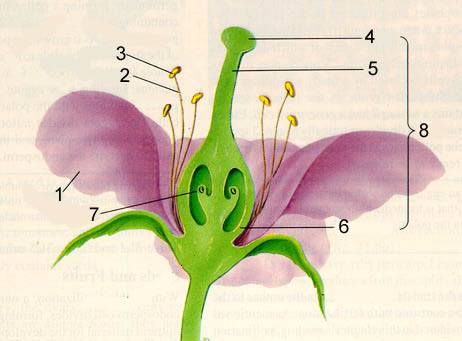
What is #1 pointing to?
a)
ovary
b)
petal
c)
stigma
d)
stamen
62.
What is #8 pointing to?
a)
petal
b)
stamen
c)
pistil
d)
ovary
63.
The male part of the flower is known as the _____.
a)
stamen
b)
pistil
c)
ovary
d)
petal
64.
The female part of the flower is known as the ____.
a)
stamen
b)
anther
c)
filament
d)
pistil
65.
What is #2 pointing to?
a)
anther
b)
filament
c)
ovary
d)
style
66.
What is #3 pointing to?
a)
stigma
b)
filament
c)
ovary
d)
anther
67.
What is #5 pointing to?
a)
anther
b)
filament
c)
stigma
d)
style
68.
In what part of the flower does fertilization take place?
a)
anther
b)
stigma
c)
ovary
d)
filament
69.
Where is pollen made?
a)
ovary
b)
petal
c)
pistil
d)
anther
70.
What is the sticky part of the flower that catches pollen?
a)
style
b)
stigma
c)
ovary
d)
petal
71.
What part of the flower will turn into a fruit?
a)
petal
b)
ovary
c)
ovule
d)
stamen
72.
What part of the flower will turn into a seed?
a)
ovary
b)
anther
c)
ovule
d)
filament
73.
Why are flowers very colorful (and why do they produce odor?)
a)
So people buy them
b)
To make gardens look good
c)
To attract pollinators
d)
To attract sunlight
74.
What is a pollinator?
a)
Animal that moves pollen from plant to plant
b)
Animal that eats pollen
c)
A plant that makes pollen
d)
A plant that does not make pollen
75.
Male reproductive parts of a plant....
a)
Petals and ovary
b)
Ovary and ovule
c)
Anther and filament
d)
Stigma and style
76.
In which part of the flower is pollen found?
a)
Filament
b)
Anther
c)
Ovary
d)
Xylem
77.
How does pollen reach the ovule?
a)
Stigma --> Style
b)
Style --> stigma
c)
Ovary --> stigma
d)
Ovary --> style
78.
How else can pollen be moved besides pollinators?
a)
Sunlight
b)
Wind
c)
Snow
d)
Hail
79.
Fertilization is....
a)
Egg and Sperm cells join
b)
Sperm Cells
c)
Egg Cells
d)
Pollination
80.
After fertilization the ovule will....
a)
Be carried away by a pollinator
b)
Be blown away by the wind
c)
Will grow into a new plant
d)
Develop into a fruit that contains seeds