wayground logo

Free Printable Worksheets

NEW

Font size

S
M
L
XL
Worksheets

Topics 14 - 17 review

Total questions: 78

Worksheet time: 2hrs 44mins
Name
Class
Date
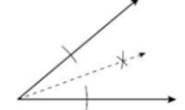
1.

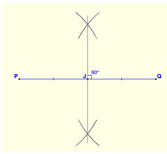
What type of construction do you see?

a)

midpoint

b)

angle bisector

c)

perpendicular bisector

d)

altitude

2.

The drawing shows a compass and straight edge construction of...what?

a)

the bisector of a given angle

b)

a perpendicular to a given line at a point on the line

c)

a perpendicular to a given line from a point NOT on the line

d)

an angle congruent to a given angle

3.

Finding the next number in the sequence requires what kind of reasoning?

1, -1, 2, -2, 3, ___

a)

Conjecture

b)

Deductive

c)

Counter Example

d)

Inductive

4.
Obtuse angles are greater than 90 degrees.  This angle is 110 degrees, so it is obtuse. 
a)
Deductive
b)
Inductive
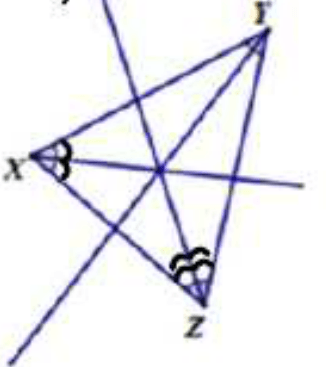
5.

What is the point of concurrency?

a)

Orthocenter

b)

Circumcenter

c)

Incenter

d)

Centroid

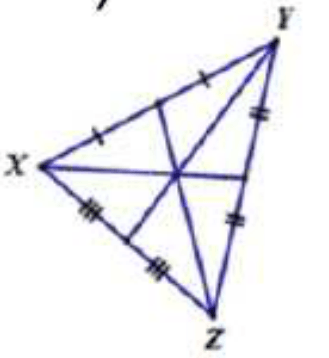
6.

What is the point of concurrency?

a)

Orthocenter

b)

Circumcenter

c)

Incenter

d)

Centroid

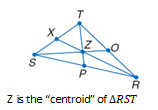
7.
If Z is the centroid, what type of segments are drawn?
a)
angle bisectors
b)
perpendicular bisectors
c)
altitudes
d)
medians
8.
If XZ = 9, what is the length of ZR? 
**Remember the 2/3 rule
a)
18
b)
9
c)
27
d)
12
9.
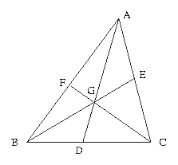
If G is the centroid of triangle ABC and GE= 7. Find the length of BE.
a)
7
b)
14
c)
21
d)
Not Enough Informaion
10.
When you draw the perpendicular bisectors of a triangle it creates the point of concurrency called the _____________.
a)
Centroid
b)
Incenter
c)
Circumcenter
d)
Orthocenter
11.

Solve for x.

a)

A

b)

B

c)

C

d)

D

12.

Solve for x.

a)

A

b)

B

c)

C

d)

D

13.
Determine how to translate triangle ABC to triangle A'B'C'. 
a)
right 2, down 5
b)
right 2, down 9
c)
left 2, up 9
d)
left 2, down 9
14.
How is trapezoid ABCD translated to trapezoid A'B'C'D'?
a)
5 units down and 5 units to the right
b)
5 units down and 1 to the right
c)
8 units down and 5 units to the right
d)
5 units down and 4 units to the right
15.
Which algebraic rule shows how triangle ABC being translated to triangle A'B'C'?
a)
(x, y) --> (x - 3, y + 8)
b)
(x, y) --> (x + 3, y - 8)
c)
(x, y) --> (x - 4, y + 9)
d)
(x, y) --> (x + 4, y - 9)
16.

Which answer shows a reflection across the line y=x?

a)

a

b)

b

c)

c

d)

d

17.
Identify the transformation from ABCD to A'B'C'D'.
a)
Translation
b)
Reflection across the x-axis
c)
Reflection across the y-axis
d)
90o counter clockwise rotation
18.
Identify the transformation from ABC to A'B'C'.
a)
90o clockwise rotation
b)
90o counter clockwise rotation
c)
Reflection across the y-axis
d)
Reflection across the x-axis
19.
How many degrees was the figure rotated?
a)
90 degrees counterclockwise 
b)
180 degrees
c)
270 counterclockwise 
20.
Identify the transformation from A to D.
a)
90o Clockwise Rotation
270o Counter Clockwise Rotation
b)
180o Rotation
c)
270o Clockwise Rotation
90o Counter Clockwise Rotation
d)
360o Rotation
21.

The figure that is to be transformed is called the:

a)

Pre-Image

b)

Image

c)

Post-Image

d)

Transformation

22.

A figure after transformation is called a(n):

a)

Pre-Image

b)

Post Image

c)

Transformed

d)

Image

23.
Write the rule for this translation:
Slide 3 up and 2 right
a)
(x, y)---->(x + 3, y + 2)
b)
(x, y)-----> (x+2, y + 3)
c)
(x, y)----> (x - 2, y + 3)
24.
Where will A' be at, if triangle ABC is reflected by
(x,y) --> (-x,y)?
a)
(2,1)
b)
(1,-2)
c)
(-1,2)
25.

What is the Coordinate Notation for this Reflection?

a)

(x, y) → (y, x)

b)

(x, y) → (-x, y)

c)

(x, y) → (-y, -x)

d)

(x, y) → (x, -y)

26.

What is the Coordinate Notation for this Reflection?

a)

(x, y) → (y, x)

b)

(x, y) → (-x, y)

c)

(x, y) → (-y, -x)

d)

(x, y) → (x, -y)

27.
Which answer shows a reflection across the x-axis?
a)
d
b)
c
c)
b
d)
a
28.

Symmetrical?

a)

Is symmetrical

b)

not symmetrical

29.

Symmetrical?

a)

Is symmetrical

b)

not symmetrical

30.
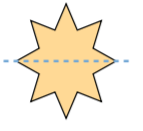
How many lines of symmetry does this shape have?
a)
1
b)
2
c)
4
d)
6
31.
How many lines of symmetry does this shape have?
a)
1
b)
2
c)
3
d)
4
32.
Identify the smallest angle of rotation that maps the image to itself.
a)
72°
b)
180°
c)
144°
d)
45°
33.
What is the angle of rotational symmetry?
a)
360°
b)
180°
c)
120°
d)
90°
34.
Shapes that are identical in size, shape and measure are...
a)
Congruent 
b)
Image 
c)
Angles 
d)
Vertices 
35.

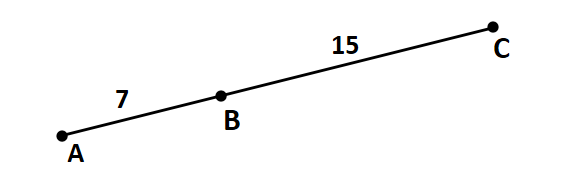
Find AC

a)

7

b)

8

c)

22

d)

23

36.
RM=
a)
RM=6
b)
RM=3
c)
RM=12
d)
RM=9
37.
Find the value of ∠A.
a)
25 degrees
b)
30  degrees
c)
35 degrees
d)
90 degrees
38.
Find the value of ∠A.
a)
39 degrees
b)
49 degrees
c)
51 degrees
d)
59 degrees
39.
RS is the segment bisector.  If OQ = 32 and PO = 4x, what does x equal?
a)
8
b)
28
c)
128
d)
36
40.
What is a ray?
a)
A part of a line that is straight, has 1 endpoint, and continues in 1 direction
b)
Another name for line segment
c)
A straight path that continues in both directions and does not end
d)
Points that are used to show segments of lines
41.
What is a line?
a)
An exact position or location
b)
A straight path that continues in both directions and does not end
c)
A straight path that has 2 endpoints
d)
A straight path that has only 1 endpoint
42.
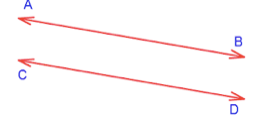
What is the best term to describe this image?
a)
intersecting lines
b)
perpendicular lines
c)
parallel lines
d)
arrows
43.
A part of a line with two endpoints
a)
Line
b)
Ray
c)
Angle
d)
Line Segment
44.
.
.
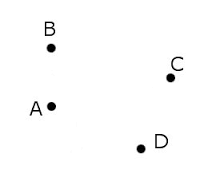
What kind of intersecting lines are these?
a)
Parallel Lines
b)
Perpendicular Lines
c)
Right Lines
d)
Scalene Lines
45.
Lines that cross and form a right angle
a)
parallel
b)
perpendicular
c)
ray
d)
intersecting
46.
What is a point?
a)
a straight path
b)
an exact location
c)
endless flat surface
d)
lines that cross
47.
A plane is named by...
a)
Any 1 point on the plane.
b)
Any 3 collinear points on the plane or a lowercase script letter.
c)
Any 3 non-collinear points on the plane or an uppercase script letter.
d)
All points on the plane that aren't part of a line.
48.
Name this angle.
a)
acute
b)
right
c)
obtuse
d)
none of the above
49.

Classify this angle.

a)

acute

b)

right

c)

obtuse

d)

none of the above

50.

What is the angle relationship of the two numbered angles?

a)

Alternate Interior

b)

Alternate Exterior

c)

Corresponding

d)

Vertical Angles

51.
Name the angle relationship.
a)
Alternate Interior
b)
Alternate Exterior
c)
 Correpsonding
d)
Vertical Angles
52.
Find m ∠C.
a)
∠C=116°
b)
∠C=64°
c)
∠C=180°
d)
∠C=26°
53.

Find the length of the missing side.

a)

17 cm

b)

22 cm

c)

15 cm

d)

13 cm

54.
The Pythagorean Theorem ONLY works on which triangle? 
a)
obtuse
b)
scalene
c)
isosceles
d)
right
55.
What is the opposite of squaring a number?
a)
divide
b)
multiply 
c)
fractions
d)
square root
56.
What is the side of a right triangle across from the right angle called?
a)
square
b)
arm
c)
leg
d)
hypotenuse
57.
Would a triangle with these side lengths be a right triangle?
4, 5, 6
a)
Yes
b)
No
58.
Which of the following sentences would belong in the proof that describes this image?
a)
The sum of the areas of the two smaller squares is equal to the area of the large square.
b)
The sum of the side lengths of the two smaller squares is equal to the side length of the large square.
c)
The difference of the areas of the two smaller squares is equal to the area of the large square.
d)
The differences of the side lengths of the two smaller squares is equal to the side length of the large square.
59.
?
a)
2
b)
3
c)
4.5
d)
81
60.
Find the missing side
a)
9
b)
41
c)
6.4
d)
3
61.

Find the missing side

a)

29.2

b)

400

c)

20

d)

10

62.
What is the slope of the line that passes through (-7, 8) and (9, -4)?
a)
¾
b)
c)
d)
4/3
63.
D is the midpoint of EF.
ED = 4x + 6
DF = 7x -9
 Find EF.
a)
5
b)
26
c)
52
d)
22
64.
What is the midpoint between (3, -1) and (7, -5)
a)
(5, -2)
b)
(10, -6)
c)
(5, -3)
d)
(2, -2)
65.
Point M with coordinates (3,4) is the midpoint of the line AB and A has the point (-1,6). What is the point of B?
a)
(1,5)
b)
(2,10)
c)
(7,2)
d)
(1,2)
66.
Find the midpoint of the segment with the endpoints:(4, 12) and (-6, 14)
a)
(-1, 13)
b)
(13, 1)
c)
(13, -1)
d)
(5, 13)
67.
Find the distance between the points (4, 3) and (0, 6).
a)
3
b)
4
c)
5
d)
7
68.
What is the distance of JK, where J(4,3) and K(2, -3)?
a)
√ ̅3̅2̅
b)
40
c)
32
d)
√ ̅4̅0̅
69.
Are these triangles congruent?
a)
Yes, by ASA
b)
Yes, by SAS
c)
Yes, by AAS
d)
No, this is the SSA one!!
70.
Are these triangles congruent?
a)
Yes, by SSS
b)
Yes, by SAS
c)
Yes, by ASA
d)
No, this is the SSA one!!
71.
Are these triangles congruent?
a)
Yes, by AAS
b)
Yes, by SAS
c)
Yes, by ASA
d)
No, this is the SSA one!!
72.
Are these triangles congruent?
a)
Yes, by AAS
b)
Yes, by SAS
c)
Yes, by ASA
d)
No, this is the SSA one!!
73.
Are these triangles congruent?
a)
Yes, by AAS
b)
Yes, by SAS
c)
Yes, by ASA
d)
No, this is the SSA one!!
74.
Are these triangles congruent?
a)
Yes, by SSS
b)
Yes, by SAS
c)
Yes, by AAS
d)
Yes, by HL
75.

ΔADC ≅ Δ_____ by _____

a)

ΔCBA , SAS

b)

ΔABC , ASA

c)

ΔCBA , ASA

d)

Cannot Be Determined

76.

ΔCZH ≅ Δ_____ by _____

a)

ΔZET , AAA

b)

ΔEZT , AAA

c)

ΔZET , SAS

d)

Cannot Be Determined

77.
What reason do we have to use to put the statement that AB = AB in our proof?
a)
Reflexive Property of Equality
b)
Transitive Property of Equality
c)
Symmetric Property of Equality
d)
Distributive Property of Equality
78.
Which is given in the diagram?
a)
BD ≅ BD
b)
AB ≅ BC
c)
D is the midpoint of AC
d)
ΔABD ≅ ΔCBD