
 Worksheets
Electricity & Circuits Review
Total questions: 81
Worksheet time: 4hrs 11mins
Name
Class
Date
1.

A path through which electric charges may travel is known as a(n) _____ circuit.
a)
circuit diagram
b)
switch
c)
electroscope
d)
closed circuit
2.

A shorthand method to represent the arrangement of the parts in a circuit is known as a(n):
a)
circuit diagram
b)
closed circuit
c)
electric charge
d)
switch
3.

A device that may be used to start and stop the flow of electricity in a circuit is known as a(n):
a)
electroscope
b)
switch
c)
coulomb
d)
circuit diagram
4.

A unit of electric charge is known as a(n):
a)
switch
b)
electroscope
c)
electric charge
d)
coulomb
5.

A measure of the potential energy of an electric charge is known as:
a)
current
b)
voltage
c)
conductivity
d)
power
6.

The flow of electric charges in a circuit is known as:
a)
insulator
b)
battery
c)
power
d)
current
7.

A material through which charges do not flow is known as a(n):
a)
conductor
b)
battery
c)
insulator
d)
current
8.

The property of a material that allows charge to flow is known as:
a)
current
b)
conductivity
c)
power
d)
battery
9.

The rate at which energy flows in a particular circuit is known as:
a)
current
b)
conductivity
c)
power
d)
voltage
10.

An equation that states current = voltage / resistance is known as:
a)
potentiometer
b)
Kirchoff's current law
c)
Ohm's law
d)
resistor
11.

The unit of current equals to one coulomb of charge per second is known as a(n):
a)
amp
b)
diode
c)
resistor
d)
potentiometer
12.

A circuit that has only one path for the flow of charge is known as a _____ circuit.
a)
parallel
b)
series
c)
branch
d)
short
13.

A circuit with zero or very low resistance is known as a ______ circuit.
a)
parallel
b)
series
c)
branch
d)
short
14.

One possible path for the flow of charge in a circuit with more than one path is known as a:
a)
parallel
b)
series
c)
short
d)
branch
15.

This is the symbol for a _____.
a)
switch
b)
light
c)
battery
d)
wires
16.

This is the symbol for a _____.
a)
light bulb
b)
switch
c)
battery
d)
resistor
17.

This is the symbol for a _____.
a)
bulb
b)
battery
c)
horn
d)
fuse
18.

This is the symbol for a _____.
a)
wire
b)
battery
c)
buzzer
d)
fuse
19.

Which of these choices best describes a parallel circuit?
a)
Electricity flows along one pathway.
b)
The flow of electricity comes from one source.
c)
Electricity flows along more than one pathway.
d)
The flow of electricity comes from more than one source.
20.

Which of these choices best describes a series circuit?
a)
It has two light bulbs.
b)
The same current flows through both light bulbs.
c)
It uses a single battery.
d)
The current is divided between the light bulbs.
21.

Which one of these circuits uses less wire?
a)
parallel circuit
b)
series Circuit
22.

In a parallel circuit if one light bulb goes out, then they will all go out.
a)
true
b)
false
23.

The picture shows an electrical circuit. This circuit is a series circuit because:
a)
It has three light bulbs.
b)
The same current flows through all three light bulbs.
c)
It uses a single battery.
d)
The electrical current is divided between the three light bulbs.
24.

In a series circuit the more light bulbs you add the brighter the bulbs become.
a)
false
b)
true
25.

What is a switch's function within a circuit?
a)
to make the current hotter or colder
b)
turn on and off the flow of current
c)
the pathway that current flows
d)
to add more power to the circuit
26.

Wood is a(n):
a)
conductor
b)
insulator
27.

Salt water is a(n):
a)
conductor
b)
insulator
28.

This circuit has more than one loop. When one light goes out, the others stay on.
a)
closed circuit
b)
series circuit
c)
parallel circuit
d)
open circuit
29.

Which of the following is true regarding a series circuit?
a)
All parts are connected in a single loop
b)
The charges travel in one path
c)
all loads must be functional for the circuit to be complete
d)
All of the above.
30.

Which of the following is not true of a series circuit?
a)
One light bulb can be broken and other lights will still work.
b)
All loads are a single loop
c)
Adding more loads will lessen the current in the loop
31.

The type of circuit used in your home is a _______ circuit.
a)
series
b)
parallel
32.

If you add more loads to a parallel circuit, they will not lose any voltage (they will appear the same)
a)
true
b)
false
33.

A device that contains a thin strip of metal for charges to flow is called a(n):
a)
fuse
b)
circuit
c)
overloaded circuit
34.

When charges bypass (don't go through) the load in a circuit, we say a _____ has occurred.
a)
overloaded circuit
b)
short circuit
c)
fuse box
35.

This image shows a:
a)
overloaded circuit
b)
parallel circuit
c)
short circuit
36.

This circuit has more than one loop. When one light goes out, the others will all stay on. This is a _____ circuit.
a)
closed circuit
b)
series circuit
c)
parallel circuit
d)
open circuit
37.

What type of circuit is shown?
a)
a series circuit
b)
a parallel circuit
38.

What type of circuit is shown in this image?
a)
a series circuit
b)
a parallel circuit
39.
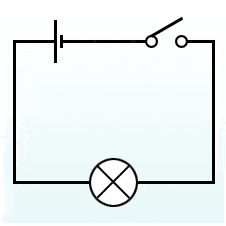
This is a(n) _____ circuit?
a)
open
b)
parallel
c)
closed
40.

When all parts of the circuit are connected it is a(n) ____ circuit.
a)
open
b)
closed
41.

When you flip a light switch on and off repeatedly you are opening and closing a circuit.
a)
true
b)
false
42.

A circuit is not a path through which electricity flows.
a)
true
b)
false
43.

A circuit must be closed for electrons to travel through it.
a)
true
b)
false
44.

Across all the paths in a parallel circuit the voltage is the same.
a)
True
b)
False
45.

When creating a circuit, what type of energy flows out of the battery?
a)
heat energy
b)
electrical energy
c)
light energy
d)
mechanical energy
46.

An electric circuit is a closed loop or pathway that allows electric charges to flow.
a)
true
b)
false
47.

An electric current is a flow of charged particles.
a)
true
b)
false
48.

Will the light bulb work?
a)
yes
b)
no
49.

Will the light bulb work?
a)
yes
b)
no
50.

This is a symbol for a:
a)
motor
b)
circuit board
c)
wires
d)
light bulb
51.

As the resistance of a circuit increases, the current will:
a)
increase
b)
decrease
c)
stay the same
52.

What happens to a parallel circuit's total resistance as more resistors are added it?
a)
increases
b)
decreases
c)
remains the same
53.

If the voltage across the battery was 10V in this diagram, what would be the voltage across each light bulb?
a)
10V
b)
5V
c)
20V
d)
0V
54.

In a series circuit the current is the same at all points of the circuit.
a)
true
b)
false
55.

The total resistance of a parallel circuit is always:
a)
greater than the sum of all the individual resistances.
b)
greater than any of the individual resistances.
c)
equalto the smallest of the individual resistances.
d)
less than any of the individual resistances.
56.

Does the following statement best describe a parallel or a series circuit.
The total resistance is equal to the sum of the individual resistances.
The total resistance is equal to the sum of the individual resistances.
a)
parallel circuit
b)
series circuit
57.

Does the following statement best describe a parallel or a series circuit.
If one part of the circuit fails, the other parts still work.
If one part of the circuit fails, the other parts still work.
a)
parallel circuit
b)
series circuit
58.

In the circuit shown, what is the value of the current through the 4 Ohm resistor?
a)
1 A
b)
1.33 A
c)
0.86 A
d)
0.46 A
59.
A circuit with 3 resistors, 10 Ohms, 30 Ohms and 20 Ohms are in series. What is the total resistance
a)
30 Ohms
b)
50 Ohms
c)
60 Ohms
d)
100 Ohms
60.

This type of circuit follows the rules governed by Ohm's Law.
a)
series circuit
b)
parallel circuit
c)
both
d)
neither
61.

Which of these best completes the circuit?
a)
rubber band
b)
metal nail
c)
leather shoelace
d)
wooden toothpick
62.

A class prepared some electrical circuits using a battery, connecting wires, and three light bulbs. Which of these circuits can make the three bulbs light?
a)
A
b)
B
c)
C
d)
D
63.

The electrician in this picture is wearing rubber gloves for protection. The purpose of the rubber gloves is to:
a)
keep the electrician dry
b)
create an electrical circuit
c)
produce electricity
d)
insulate the electrician from electrical shock
64.
Which of these substances is the best conductor of electricity?
a)
wood
b)
brick
c)
copper
d)
plastic
65.

What material would be safest to use as an insulator to cover electrical wires?
a)
rubber
b)
tin
c)
aluminum
d)
water
66.

Early scientists most likely saw a discharge of electricity for the first time when observing a:
a)
waterfall
b)
rainbow
c)
volcano erupting
d)
lightning storm
67.

Bits of paper are attracted to the surface of this balloon. What attracts the paper pieces to the balloon?
a)
friction
b)
static electricity
c)
magnetism
d)
potential energy
68.

Current is referred to as a:
a)
flow of electricity
b)
circuit
c)
flow of electrons
d)
battery
69.

What will happen if one light bulb is removed from this circuit?
a)
the other bulbs will go out
b)
the other bulbs will become dimmer
c)
the other bulbs will become brighter
70.

Ohm's law states that:
a)
V=IR
b)
V=I/R
c)
V=R/I
d)
V=I+R
71.

Voltage is measured in _____.
a)
Volts
b)
Watts
c)
Coulombs
d)
Ohms
72.

What is the formula for resistance?
a)
VI = R
b)
R = V/I
73.

Resistance is measured in _____.
a)
Watts
b)
Amp
c)
Ohm
d)
Volts
74.

What are the two factors that influence resistance?
a)
power and energy
b)
current and volts
75.

Resistance is a measure of:
a)
the energy per unit charge in a circuit
b)
how difficult it is for electrons to move through the circuit
c)
how hard it is for electrons to move through the battery
d)
the number of charge carriers in a circuit
76.

Current is measured in:
a)
Amps
b)
Volts
c)
Ohms
d)
Coulombs
77.

Why are electrical wires made from metal?
a)
Metal is relatively inexpensive.
b)
To better conduct electricity.
c)
To provide better insulation.
d)
Because it is typically shiny.
78.

How do you calculate voltage?
a)
Current x Resistance
b)
Resistance ÷ Current
c)
Current ÷ Resistance
d)
Power ÷ time
79.

How do you calculate current?
a)
Resistance X Voltage
b)
Voltage X Resistance
c)
Resistance ÷ Voltage
d)
Voltage ÷ Resistance
80.

How do you calculate resistance?
a)
Voltage X Current
b)
Current ÷ Voltage
c)
Voltage ÷ Current
d)
Current X Amps
81.

What voltage is needed to cause a 2A current flow through a 10Ω resistor?
a)
5V
b)
0.2V
c)
20V
d)
200V
100 %

