wayground logo

Free Printable Worksheets

Font size

S
M
L
XL
Worksheets

Physics Heat (Latent Heat & Gas Law)

Total questions: 81

Worksheet time: 4hrs 48mins

Name
Class
Date
1.

This formula is used to find the amount of heat (energy) neccesary when there's a phase change

a)

Q= (h)(ΔT)

b)

Q=(m)(L)

c)

Q=(m)(c)(ΔT)

d)

Q=(k)(A)(dT)

2.

How much heat is needed to change 12 grams of ice at 0 ºC to 12 grams of water at 0ºC? Heat of fusion = 334 kJ/kg; Specific heat of water = 4186 J/kgoC

a)

Q = 12 x 4186 x 0

b)

Q = 12 x 334

c)

Q = 12000 x 334

d)

Q = 0.012 x 334

3.

How much heat must be lost to change of 110 grams of water at 0 ºC to 110 grams of ice at 0ºC? Heat of fusion = 334 kJ/kg; Specific heat of water = 4186 J/kgoC

a)

Q = 110 x 4186

b)

Q = 110000 x 4186

c)

Q = 0.110 x 334

d)

Q = 110 x 334

4.

There are four main processes in changing of phase, and they are

a)

Melting

b)

Boiling

c)

Condensation

d)

All the above

5.

Latent heat is

a)

the heat absorbed or released at a boiling process during a change of phase

b)

the heat absorbed or released at a constant temperature during a change of phase

c)

the heat absorbed or released at a constant temperature during a change of phase of 1 kg object

d)

the heat absorbed or released by an object to increase or decrease its temperature by 1 degree Celcius

6.

The heat absorbed by melting a solid is known as

a)

latent heat of fusion

b)

latent heat of solid

c)

latent heat of liquid

d)

latent heat of vaporisation

7.

The amount of heat required to change the phase of a substance depends on two factors which are

a)

surrounding temperature

b)

temperature change

c)

material

d)

the mass

8.

specific latent heat of vaporisation is

a)

the amount of heat required to change 1 kg of the substance from the solid to liquid phase without change in temperature

b)

the amount of heat required to change 1 kg of the substance from the liquid to gaseous phase without change in temperature

c)

the amount of heat required to change the temperature 1 kg of the substance by 1 degree Celcius

9.

Water molecules have the greatest kinetic energy in

a)

Ice at 0 ⁰C

b)

Water at 90 ⁰C

c)

Water at 373 K

d)

Steam at 150 ⁰C

10.

The graph shows the cooling curve of a substance. At which stages the specific latent heat released?

a)

AB and CD

b)

BC and DE

c)

AB and EF

d)

BC and CD

11.

It's the SI unit for Heat

a)

Watts

b)

Celsius

c)

Joules

d)

Nm

12.

It's the amount of heat required to change the state (gas,liquid, solid) of a unit of material

a)

Latent Heat

b)

Specific Heat

c)

Temperature

d)

Q

13.

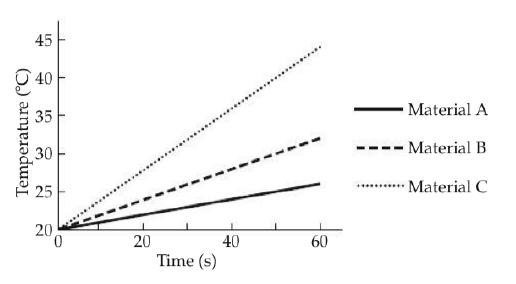
The graph shows the temperature of 1kg samples of three materials, A, B, and C, as they are heated. Heating occurs at a constant rate.

If material A starts to melt at 60 oC. At that point, the line on the graph will __________.

a)

continue on as before

b)

begin to curve upward

c)

become steeper

d)

become horizontal

14.

A 45.0-kg sample of ice is at 0.00 oC. How much heat is needed to melt it? For water Lf =334,000 J/kg and Lv =2.256×10⁶ J/kg.

a)

1.50×10⁴ kJ

b)

4.10×10⁶ kJ

c)

0.00 kJ

d)

1.02×10⁵ kJ

15.

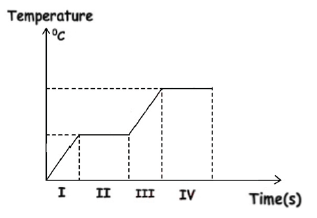
Consider the following temperature-time graph when a solid is heated. which part of the graph involves latent heat of vaporization?

a)

Part I

b)

Part II

c)

Part III

d)

Part IV

16.
The graph shows the cooling curve of a substance.
The specific latent heat released at stages?
a)
CD and FG
b)
DE and EF
c)
EF and FG
d)
DE and FG
17.
Water boils at 100°C and freezes at 0°C.
What happens to the boiling point and the freezing point when salt is added to the water?
a)
The boiling point and the freezing point remain unchanged
b)
Both the boiling point and the freezing point increases
c)
The boiling point increases and the freezing point decreases
d)
Both the boiling point and the freezing point decreases
18.
An 63 W immersion heater is switched on and put into the ice cubes in B.
After 4 minutes, the mass of the water in beaker A is 15 g. What is the mass of the water in beaker B?
[Specific latent heat of fusion of ice = 3.36 × 10⁵ J kg−1]
a)
60.0 g
b)
15.0 g
c)
45.0 g
d)
30.0 g
19.
An ice machine removes heat at the rate of 4.5 kW. How long does it takes to freeze 4 kg of water at the temperature 14°C?
[Specific latent heat of fusion of ice = 3.36 × 10⁵ J kg−1, specific heat capacity of water = 4.2 × 10³ J kg−1°C−1]
a)
52 s
b)
4 min 6 s
c)
4 min 59 s
d)
5 min 51 s
20.
Steam at temperature of 100°C is piped to 3 kg of water at the temperature of 5°C until the water reaches the boiling point. The mass of the steam required is
[Specific latent heat of vaporization of water = 2.26 × 10⁶ J kg−1, specific heat capacity of water = 4.2 × 10³ J kg−1°C−1]
a)
0.26 kg
b)
0.53 kg
c)
0.94 kg
d)
1.89 kg
21.
How many Joules of energy are required to change 10 gram of ice at -2 οC to water at 20 οC?
a)
440 J
b)
880 J
c)
3,840 J
d)
66,000 J
22.
How many Joules of energy are required to change 10 gram of water from 20 οC to 90 οC?
a)
1400 J
b)
2800 J
c)
210,000 J
d)
1,400,000 J
23.
How many Joules of energy are required to make 100 grams of ice at 0 οC completely melt?
a)
200 J
b)
400 J
c)
30,000 J
d)
2,000,000 J
24.
Does everything have Specific Heat?
a)
I give up!
b)
no 
c)
yes 
25.
For a skillet, used for cooking, do you want a high or low specific heat
a)
High, so that it will need more energy to heat up
b)
Low, so that it will change temperature quickly
26.
Boyle's Law shows the relationship between between which two factors of a gas?
a)
volume and pressure 
b)
temperature and pressure 
c)
pressure and temperature 
d)
Volume and mass
27.
Charles's law shows the relationship between which two factors of a gas ?
a)
volume and temperature 
b)
volume and pressure 
c)
pressure and volume
d)
volume and mass
28.
Directly proportional means that as one value increases ....................
a)
the other stays the same 
b)
the other increases as well
c)
the other decereases
d)
the other goes to zero
29.
Inversely proportional means as one value increases the other............. 
a)
increases 
b)
decreases 
c)
stays the same 
d)
goes to zero
30.
Boyle's law shows the volume and pressure of a gas are always ........
a)
inversely proportional 
b)
directly proportional 
31.
Charles's law shows that the temperature and volume of a gas are always........
a)
inversely proportional 
b)
directly proportional 
32.
Temperature describes  the ______________ of particles.
a)
volume
b)
mass
c)
motion
d)
conductivity
33.
When a basketball is left outside in the cold it goes flat because the volume of air inside the ball has been reduced. What  gas law does this represent?
a)
Boyle's Law
b)
Charles's Law
34.
If you push down the plunger of a bicycle pump the chamber's volume is decreased. When that happens pressure in the chamber increases and the air then rushes out of the pump and into your flat tire. What gas law does this represent?
a)
Charles's law
b)
Boyle's law
c)
Newtons laws
d)
Coulombs laws
35.
a)
this is a graph representing Boyle's law
b)
this is a graph representing Charles's law
36.
a)
This is an example of Charles's law
b)
This is an example of Boyle's law
37.
Gas Laws involve what three terms?
a)
Solid Liquid Gas 
b)
Speed Velocity Acceleration 
c)
Elements Compounds Mixtures 
d)
Pressure Temperature Volume 
38.
Charles' Law States...
a)
As Pressure goes up volume goes down
b)
As Pressure goes up temperature goes up
c)
As Volume goes up temperature goes up 
d)
As Pressure goes down volume goes down 
39.
Which law?
a)
Charles 
b)
Boyle
c)
Hooke
d)
Peter Pan 
40.

Whose law explains why our ears pop in an airplane?

a)

Boyle

b)

Charles

c)

Aglow

d)

Zampelli

41.

Which law?

a)

Govea

b)

Doyle

c)

Boyle

d)

Charles

42.
In order to convert to Kelvin, you add ______ to the Celsius measurement.
a)
372
b)
273
c)
237
d)
732
43.
What is 50 C in Kelvin?
a)
223
b)
323
c)
100
d)
50
44.
100 degrees Celsius is equal to _______ Kelvin. 
a)
0 K
b)
273 K
c)
173 K
d)
373 K
45.
If a balloon is cooled what will happen to the volume?
a)
Volume will increase
b)
Volume will decrease
c)
Volume will not change
46.
Which of the following would increase the (gas) pressure of a system?
a)
Increase the Temperature
b)
Pump in more gas
c)
Decrease the volume
d)
All of these
47.
The following graph shows ____ relationship. 
a)
Direct
b)
Inverse
48.
You have a gas that has a pressure of 2 ATM and a volume of 10L.  What would be the new volume if the pressure was changed to 1 ATM?
a)
5 L
b)
20 L
c)
It would stay at 10L
d)
1 L
49.
A sample of gas with a volume of 30.0 mL at 25.0oC is heated to 50.0oC.  What is the new volume of the gas?
a)
60.0 mL
b)
15.0 mL
c)
27.5 mL
d)
32.5 mL
50.
A sample of oxygen gas has a volume of 150.0 mL when its pressure is .947 atm. What will the volume of the gas be if it is lowered to a pressure of 0.658 atm and the temperature remains constant?
a)
72 mL
b)
144 mL
c)
216 mL
d)
288 mL
51.
Determine the initial temperature of a random gas when the initial volume is 2.2 L and it is cooled to 88K with a volume of 0.85 L. 
a)
0.029 K
b)
0.021 K
c)
227.76 K
d)
34 K
52.

A student measures the pressure and volume of an empty water bottle to be 1.4 atm and 2.3 L. She then decreases the pressure to 0.65 atm. What is the new volume?

a)

2.1 L

b)

5.0 L

c)

8.2 L

d)

3.9 L

53.

A student inflates a balloon with helium then places it in the freezer. The student should expect

a)

the balloon's volume to increase

b)

the balloon's volume to decrease

c)

the balloon's moles to increase

d)

the balloon's moles to decrease

54.

What is the pressure of a car tire that had an initial pressure of 1.8 atm but was heated from 38°C to 123°C?

a)

0.9 atm

b)

2.1 atm

c)

1.6 atm

d)

3.4 atm

55.

Three gases are mixed together in a container with a total pressure of 4.8 atm. If two of the gases have pressures of 1.2 atm and 1.5 atm, what is the pressure of the third gas?

a)

2.5 atm

b)

1.8 atm

c)

2.1 atm

d)

1.3 atm

56.

If a hairspray can is heated, what can be expected of the pressure of the gas inside the can?

a)

The pressure will increase

b)

The pressure will decrease

c)

The pressure will remain constant

d)

The pressure will equalize

57.
What is 50 °C in Kelvin?
a)
223
b)
323
c)
100
d)
50
58.

Pressure is

a)

defined as the mass that an object exerts when at rest.

b)

not a measurable in gases.

c)

defined as the number of moles of substance divided by the mass of the substance.

d)

created by the force of the gas particles impacting the walls of the container.

59.

Absolute zero is

a)

0 K

b)

where there is no molecular movement

c)

the coldest temperature possible

d)

all of these

60.

A sample of gas with a volume of 30.0 mL at 25.0oC is heated to 50.0oC. What is the new volume of the gas?

a)

60.0 mL

b)

15.0 mL

c)

27.5 mL

d)

32.5 mL

61.
Gases have...
a)
A definite shape and volume
b)
A definite shape but no definite volume
c)
No definite shape but a definite volume
d)
No definite shape or volume
62.
If 6L of gas at 293K is compressed to 4L, what is the new temperature? 
a)
195K
b)
439.5K
c)
0.082K
d)
12.2K
63.
Using Combined Gas Law, if the pressure of a gas starts out at 200kPa and increases to 600kPa, what would the initial temperature be if it ended up at 300K?
a)
50K
b)
200K
c)
400K
d)
100K
64.
The temperature at which all molecular motion stops is
a)
-460 .C
b)
-273K
c)
0K
d)
0.C
65.
When a cold tire is inflated to a certain pressure and then is warmed up due to friction with the road, the pressure increases. This happens because the
a)
air molecules hit the walls of the tire less frequently
b)
rubber in the tires reacts with oxygen in the atmosphere
c)
air molecules speed up and collide with the tire walls more often
d)
air molecules diffuse rapidly through the walls of the tire.
66.
The random molecular motion of a substance is greatest when the substance is
a)
condensed
b)
frozen
c)
gas
d)
a liquid
67.
A gas has a volume of 3L at 200 kPa. What will its volume be if the pressure is changed to 500 kPa?
a)
1.0L
b)
1.2L
c)
2.0L
d)
7.5L
68.
A gas has a volume of 5 liters at 3 atm. To expand the volume to 6L, what the new pressure ( in atm ) have to be?
a)
0.5atm
b)
1.5atm
c)
2.5atm
d)
3.0atm
69.
A gas has a volume of 4 liters at 500K. What will its volume be (in liters) at 300K?
a)
1.4L
b)
1.8L
c)
2.0L
d)
2.4L
70.
A gas has a volume of 3.50L at 200K. If the volume changes to 7L, what is the new temperature?
a)
100K
b)
300K
c)
350K
d)
400K
71.
A gas has a volume of 5.0L at 350K. If the volume changes to 4.0L, what is the new temperature?
a)
220K
b)
280K
c)
310K
d)
360K
72.
A gas has a pressure of 2 atm at 400K. If the temperature changes to 200K, what is the new pressure be?
a)
0.5atm
b)
1.0atm
c)
2.5atm
d)
3.0atm
73.
A gas has a pressure of 1.5 atm at 100K. If the pressure changes to 6 atm, what is the new temperature be?
a)
200K
b)
250K
c)
400K
d)
600K
74.
4L of a gas is contained at 300 kPa and 200K. What will its volume be in L at 140 kPa and 100K?
a)
4.3L
b)
4.8L
c)
6.2L
d)
8.5L
75.
Which of the following would increase the (gas) pressure of a system?
a)
Decreasing the kinetic energy
b)
Increasing the Volume
c)
Increasing the energy of the particles
d)
Removing gas particles
76.
TRUE or FALSE the properties of Gases (pressure, volume, temperature) are all directly proportional to each other?
a)
TRUE
b)
FALSE
77.
A gas that has a pressure of 2 atm and a volume of 10 L.  What would be the new volume if the pressure was changed to 1 atm?
a)
P1/T1 = P2/T2
b)
P1V1 = P2V2
c)
V1/n1 = V2/n2
d)
PV = nRT
78.
A sample of a gas has a volume of 852 mL at 298 K. What temperature is necessary for the gas to have a volume of 945 mL?
a)
Pt = P1 + P2 + P3 + ...
b)
P1V1 = P2V2
c)
V1/T1 = V2/T2
d)
P1V1/T1 = P2V2/T2
79.
If a nitrogen gas occupies a volume of 500 ml at a pressure of 0.971atm. What volume will the gas occupy at a pressure of 1.50 atm?  
a)
P1V1 = P2V2
b)
PV = nRT
c)
P1/T1 = P2/T2
d)
V1/n1 = V2/n2
80.
A sample of gas with a volume of 30.0 mL at 25.0oC is heated to 50.0oC.  What is the new volume of the gas?
a)
P1V1 = P2V2
b)
P1/T1 + P2/T2
c)
PV = nRT
d)
V1/T1 = V2/T2
81.
The gas in the container is at a pressure of 3.00 atm at 298 K.  What would be the pressure in the container at 325 K?
a)
P1/T1 = P2/T2
b)
P1V1 = P2V2
c)
V1/T1 = V2/T2
d)
PV = nRT