wayground logo

Free Printable Worksheets

Font size

S
M
L
XL
Worksheets

WJEC Recall Quiz Physics JHa

Total questions: 84

Worksheet time: 2hrs 23mins

Name
Class
Date
1.
Define Voltage
a)
The push around the circuit provdied by the battery
b)
The flow of electrons around the circuit
c)
The ability to reduce the flow of charge
2.
Define Current
a)
The push around the circuit provdied by the battery
b)
The flow of electrons around the circuit
c)
The ability to reduce the flow of charge
3.
Define Resistance
a)
The push around the circuit provdied by the battery
b)
The flow of electrons around the circuit
c)
The ability to reduce the flow of charge
4.
Define Resistance
a)
The push around the circuit provdied by the battery
b)
The flow of electrons around the circuit
c)
The ability to reduce the flow of charge
5.
What is the rule for Resistance in a series circuit
a)
Resistance increases as components are added
b)
Resistance decreases as components are added
c)
Resistance stays the same as components are added
6.
What is the rule for Resistance in a parallel circuit
a)
Resistance increases as components are added
b)
Resistance decreases as components are added
c)
Resistance stays the same as components are added
7.
What is the rule for Current in a parallel circuit
a)
Current is shared
b)
Current is the same
8.
What is the rule for Voltage in a parallel circuit
a)
Voltage is shared
b)
Voltage is the same
9.
What is the rule for Current in a series circuit
a)
Current is shared
b)
Current is the same
10.
What is the rule for Voltage in a series circuit
a)
Voltage is shared
b)
Voltage is the same
11.
What is the unit for current
a)
Volt, v
b)
Ohm
c)
Amps, A
d)
Watt, W
12.
What is the unit for resistance
a)
Volt, v
b)
Ohm
c)
Amps, A
d)
Watt, W
13.
What is the unit for voltage
a)
Volt, v
b)
Ohm
c)
Amps, A
d)
Watt, W
14.
What is the unit for power?
a)
Volt, v
b)
Ohm
c)
Amps, A
d)
Watt, W
15.
The renewable energy resources are…
a)
Geothermal, wave, wind, solar, tidal, HEP, Biofuels
b)
Coal, OIl, Gas, Nuclear
c)
Powerstations
d)
Step-up and step-down transformers
16.
The non-renewable energy resources are…
a)
Geothermal, wave, wind, solar, tidal, HEP, Biofuels
b)
Coal, OIl, Gas, Nuclear
c)
Powerstations
d)
Step-up and step-down transformers
17.
The nergy resources that are reliable are….
a)
Coal, OIl, Gas, Nuclear, Geothermal, HEP
b)
Wind and solar
c)
Coal, OIl, Gas, Nuclear
d)
Nuclear
18.
The energy resources are weather dependent are…
a)
Solar and wind
b)
Coal, OIl, Gas, Nuclear, Geothermal and HEP
c)
Coal, OIl, Gas and Nuclear
d)
Nuclear and Wind
19.
The energy resources that impact on the environment are…
a)
Geothermal, wave, wind, solar, tidal, HEP, Biofuels, Coal, oil, Nuclear
b)
Solar and wind
c)
Coal, OIl, Gas, Nuclear, Geothermal, HEP
d)
Coal, OIl, Gas, Nuclear
20.
The energy resource are most expensive to build are
a)
Nuclear
b)
Wind
c)
Biofuels
21.
Which energy resourcs produce carbon dioxide
a)
Coal, OIl, Gas, Biofuels
b)
Nuclear
c)
Solar and wind
22.
Which energy resourcs produce sulphur dioxide
a)
Coal
b)
Biofuels
c)
Wind
23.
Which energy resources are carbon neutral
a)
Coal
b)
Biofuels
c)
Wind
24.
The order of a fossil fuel power station are…
a)
furnace-boiler - turbine-generator-
b)
Power station - step up transformer- Grid - Step down transformer - consumers
c)
furnace-boiler - generator-turbine-
25.
The parts of the national grid are
a)
furnace-boiler - turbine-generator-
b)
Power station - step up transformer- Grid - Step down transformer - consumers
c)
furnace-boiler - generator-turbine-
26.
The function of a step-up transformer is..
a)
to increase the voltage to reduce current to make the heating effect smaller
b)
To decrease voltage for safety
c)
To store excess energy and release it when necessary
27.
The function of a step-down transformer is..
a)
to increase the voltage to reduce current to make the heating effect smaller
b)
To decrease voltage for safety
c)
To store excess energy and release it when necessary
28.
How does the national grid ensure a reliable supply of electricity
a)
Excess energy is stored in HEP and released when necessary
b)
to increase the voltage to reduce current to make the heating effect smaller
c)
To decrease voltage for safety
29.
A metal spoon heating up in a bowl of hot soup
a)
Conduction
b)
Convection
c)
Radiation
30.
Getting a sunburn on while spending the day on the beach
a)
Conduction
b)
Convection
c)
Radiation
31.
Feeling the hot air when opening the oven
a)
Conduction
b)
Convection
c)
Radiation
32.
Burning your tongue on a hot soup
a)
Conduction
b)
Convection
c)
Radiation
33.
The movement of liquid in a lava lamp
a)
Conduction
b)
Convection
c)
Radiation
34.
The sand burning your feet while walking on the beach on a hot day
a)
Conduction
b)
Convection
c)
Radiation
35.
Sitting by a campfire 
a)
Conduction
b)
Convection
c)
Radiation
36.
Pancakes cooking on a pan
a)
Conduction
b)
Convection
c)
Radiation
37.
Popcorn cooking in a microwave
a)
Conduction
b)
Convection
c)
Radiation
38.
Water boiling in a pot
a)
Conduction
b)
Convection
c)
Radiation
39.
Magma creating a current in the mantle to move tectonic plates
a)
Conduction
b)
Convection
c)
Radiation
40.
What is the definition of CONDUCTION?
a)
When heat is transferred from objects like rays of light or electromagnetically.
b)
a  hot liquid or air that  expands, becomes less dense, and rises or becomes more dense, and sinks.
c)
When heat transfers from objects that are touching.
d)
When heat transfers through the heater or AC in your house.
41.
What is the definition of CONVECTION
a)
When heat transfers through waves.
b)
When heat transfers from objects that are touching.
c)
a  hot liquid or air that  expands, becomes less dense, and rises or becomes more dense, and sinks.
d)
Heat traveling from the sun
42.

In heat transfer, heat always flows from the _______________ substance to the _______________ substance.

a)

Hotter to colder

b)

Colder to hotter

c)

Hotter to hotter

d)

Colder to colder

43.
 Why do we wear sweaters in cold weather?
a)
To keep cold out.
b)
To generate heat.
c)
To reduce heat loss.
d)
All of the above.
44.
As water in a freezer turns into ice,
a)
the water absorbs energy from the air in the freezer.
b)
the water absorbs the coldness from the air in the freezer.
c)
the freezer air absorbs heat from the water.
d)
the water neither absorbs nor releases energy
45.
On a warm sunny day, you will feel cooler wearing light colored clothes because they...
a)
reflect more radiated heat energy.
b)
prevent sweating.
c)
are not as heavy as dark clothes.
d)
let more air in.
46.
On a hot day, the upstairs rooms in a house are usually hotter than the downstairs rooms. Why?
a)
Cool air is less dense than hot air.
b)
Warm air rises and cool air sinks.
c)
The roof insulation warms the air.
d)
Heat rises.
47.
When you hold a metal coat hanger in a camp fire to roast a marshmallow, the coat hanger might become too hot to hold. Why might the coat hanger get too hot?
a)
The heat radiates along the coat hanger.
b)
The heat builds up near the flame until it can’t hold it anymore and then moves     along the coat hanger.
c)
Metal atoms vibrate with more energy when they get hot, and they collide with   atoms near them, which causes the neighboring atoms to vibrate.
d)
Since metals melt in fire, they react strongly to fire and get hot easily.
48.
When placed in direct sunlight, which object will absorb the most radiated heat energy?
a)
A white sweater
b)
A snowball
c)
Aluminum foil
d)
A black sweater
49.
What is the only method of heat transfer that DOESN’T require matter?
a)
Conduction
b)
Convection
c)
Radiation
50.
What method of heat transfer uses direct contact? 
a)
Conduction
b)
Convection
c)
Radiation
51.
What method of heat transfer uses fluids?
a)
Radiation
b)
Conduction
c)
Convection
52.
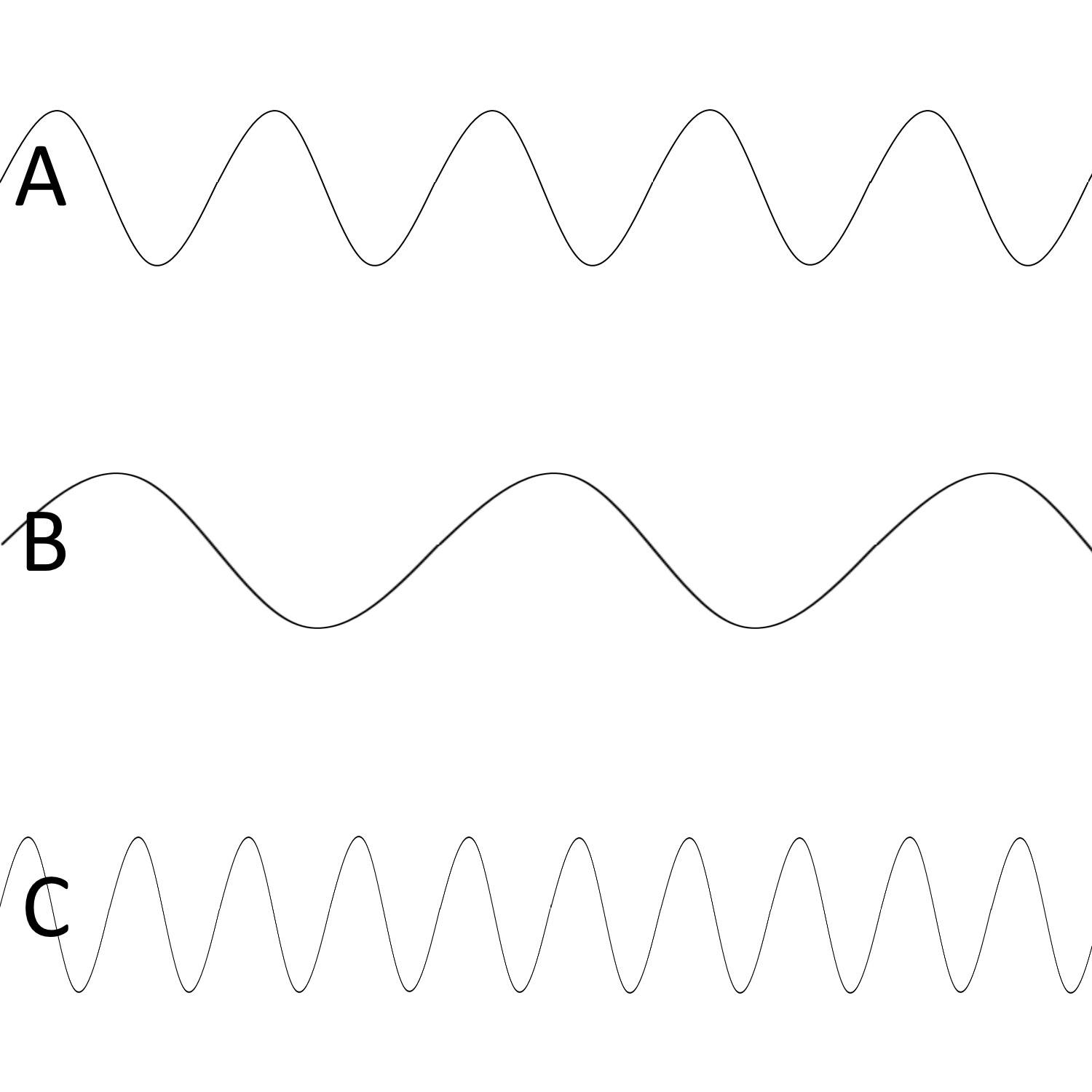
Which wave has the largest wavelength?
a)
A
b)
B
c)
C
d)
None (same wavelength)
53.
Which wave has the largest frequency?
a)
A
b)
B
c)
C
d)
None (same frequency)
54.
If all three are waves of light, which wave has the largest speed?
a)
A
b)
B
c)
C
d)
None (same speed)
55.
Which type of wave arrives first during an earthquake?
a)
Primary (p-wave) waves
b)
Secondary (s-wave) waves
c)
Rayleigh Waves
d)
Love Waves
56.
An s-wave is an example of what type of wave?
a)
Longitudinal
b)
Converse
c)
Transverse
d)
Ocean
57.
A p-wave is an example of
a)
Longitudinal
b)
Transverse
c)
Converse
d)
Ocean
58.
What part of the earth is broken in to 12 major tectonic plates?
a)
Crust
b)
Mantle
c)
Inner Core
d)
Outer Core
59.
Which body waves cause particles of rock material to move at right angles to the direction in which the waves are traveling?
a)
Body Waves
b)
P- Waves
c)
S- Waves
d)
Surface Waves
60.
What is the shaking of the Earth’s crust caused by a sudden release of energy?
a)
Earthquake
b)
Epicenter
c)
Fault
d)
Plate
61.

What happens to light during total internal reflection?

a)

The angle of incidence is greater than the critical angle.

b)

The angle of reflection is the same as the critical angle.

c)

The angle of refraction is less than the critical angle.

d)

The angle of incidence is zero.

62.

Fiber optic cables work because of the principle of _____.

a)

total internal refraction

b)

incomplete internal refraction

c)

total internal reflection

d)

partial internal reflection

63.

_____ cables transmit beams of light without allowing any of the light to escape until it gets to the end of the cable.

a)

Ethernet

b)

Fiber optic

c)

Armored

d)

Coaxial

64.

When angle of incident (i) equals to critical angle (c) if light is traveled from a denser medium to a less dense medium,

a)

total internal reflection occurs.

b)

angle of refraction is equal to 90 degree.

c)

light is refracted out

d)

light travel in straight line

65.

Which of the following statement about optical fibre is incorrect?

a)

Light is totally internally reflected down the fibre.

b)

It is used in medical (endoscope).

c)

It is used in fibre optic communication.

d)

Angle of incidence of light in optical fibre must less than critical angle.

66.

Why does the pencil appear bent?

a)

Light rays travelling from parts of the pencil above the water bend away from the normal and appear closer to the horizontal surface, thus making the pencil appear broken.

b)

Light rays travelling from parts of the pencil above the water bend towards from the normal and appear closer to the horizontal surface, thus making the pencil appear broken.

c)

Light rays travelling from parts of the pencil under the water bend away from the normal and appear closer to the horizontal surface, thus making the pencil appear broken.

d)

Light rays travelling from parts of the pencil under the water bend towards from the normal and appear closer to the horizontal surface, thus making the pencil appear broken.

67.

State the name given to the change in direction of the signal at A

a)

total internal reflection

b)

reflection

c)

dispirsion

d)

refraction

68.

State the name given to the change in direction of the signal at B

a)

Total internal reflection

b)

reflection

c)

dispirsion

d)

refraction

69.

Give a reason why the signal changes direction at A

a)

its a flat surface

b)

the density of the glass is greater than the density of the air

c)

the angle of incidence is more than 90 degrees

d)

The density of the glass is less than the density of the air

70.

A ray of light travels from air to glass with an angle of incidence of 45o. If the critical angle is 42o what will happen at the boundary?

a)

refract

b)

totally internally reflect

c)

travel along the boundary

d)

reflect

71.

The SI units J/g°C measures

a)

Specific heat

b)

mass

c)

temperature

d)

heat energy

72.
Copper, Stainless Steel, Carbon Steel, and Zinc were all heated using the same thermal energy.  What material would be the coolest after being heated?
a)
Copper
b)
Carbon Steel
c)
Zinc
d)
Stainless Steel
73.
_______________ describes how much energy is required to raise an object's temperature.
a)
Conduction
b)
Convection
c)
Specific Heat
d)
Radiation
74.
___________ is measured by the unit Joules.
a)
Heat energy
b)
Temperature
c)
Specific heat
75.
A high specific heat means...
a)
It heats up quickly with energy added
b)
It requires more energy to change temperature
76.
The symbol for specific heat is .......
a)
c
b)
Q
c)
m
d)
t
77.
What unit do you use to measure Thermal Energy?
a)
J/Kg ºC
b)
Kg
c)
ºC
d)
J
78.
What is Specific Heat?
a)
The  amount of thermal energy required to increase the temperature of 1kg of a material by 1°C.
b)
The  amount of radiant energy required to increase the temperature of 1kgof a material by 1°C
c)
The  amount of energy required to increase the temperature of 1kgof a material by 1°C.
d)
The  amount of friction  required to increase the temperature of 1kgof a material by 1°C.
79.

There are four main processes in changing of phase, and they are

a)

Melting

b)

Boiling

c)

Condensation

d)

All the above

80.

Latent heat is

a)

the heat absorbed or released at a boiling process during a change of phase

b)

the heat absorbed or released at a constant temperature during a change of phase

c)

the heat absorbed or released at a constant temperature during a change of phase of 1 kg object

d)

the heat absorbed or released by an object to increase or decrease its temperature by 1 degree Celcius

81.

The heat absorbed by melting a solid is known as

a)

latent heat of fusion

b)

latent heat of solid

c)

latent heat of liquid

d)

latent heat of vaporisation

82.

The amount of heat required to change the phase of a substance depends on two factors which are

a)

surrounding temperature

b)

temperature change

c)

material

d)

the mass

83.

specific latent heat of vaporisation is

a)

the amount of heat required to change 1 kg of the substance from the solid to liquid phase without change in temperature

b)

the amount of heat required to change 1 kg of the substance from the liquid to gaseous phase without change in temperature

c)

the amount of heat required to change the temperature 1 kg of the substance by 1 degree Celcius

84.

The graph shows the cooling curve of a substance. At which stages the specific latent heat released?

a)

AB and CD

b)

BC and DE

c)

AB and EF

d)

BC and CD