
 Worksheets
8th Grade Physics Review
Total questions: 81
Worksheet time: 2hrs 38mins
Name
Class
Date
1.

What is the net force?
a)
40 N left
b)
0 N Balalnced
c)
400 N right
d)
40 N right
2.

A wheeled cart is moving to the right at a constant speed. Two forces of equal magnitude are acting upon the cart. Which of the following best describes the forces and motion of the cart?
a)
Balanced Forces, Constant Speed
b)
Balanced Forces, Acceleration
c)
Unbalanced Forces, Constant Speed
d)
Unbalanced Forces, Acceleration
3.
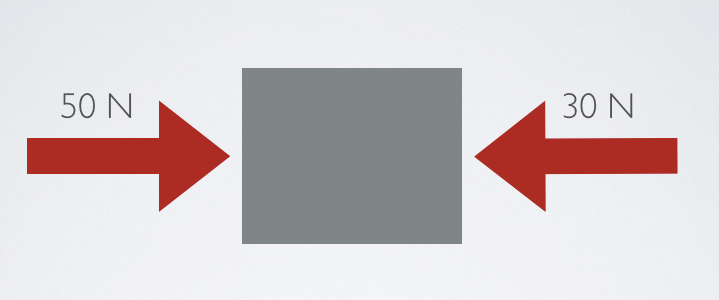
How will this object move?
a)
It won't move.
b)
It will move to the right.
c)
It will move to the left.
d)
It will move up.
4.

How will this object move?
a)
It won't move.
b)
It will move to the right.
c)
It will move to the left.
d)
It will move in both directions.
5.

What is the net force?
a)
30 N left
b)
25 N right
c)
5 N left
d)
55 N right
6.
Which could be an example of a balanced force?
a)
An asteroid moving at a constant speed through space
b)
A car accelerating from a stop sign
c)
A box of dishes falling from a counter
d)
A rocket taking off
7.
Which could be an example of an unbalanced force?
a)
A plate sitting on a dining table
b)
A ball at the top of a hill that is not moving
c)
Earth orbiting the Sun
d)
A baseball that has been thrown to home plate.
8.
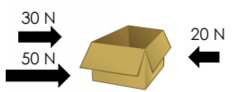
Calculate the Net Force.
a)
60N, Left
b)
40N, Right
c)
0N
d)
60N, Right
9.

Calculate the Net Force.
a)
40N, Left
b)
40N, Right
c)
0N, Balanced
d)
75N, Right
10.
You and your dad are moving the couch from one side to another. Your dad pushes with a force of 35 N to the right and you push with a force of 25 N right. What is the net force on the couch?
a)
60 N right
b)
10 N left
c)
60 n right
d)
50 N left
11.

Forces that have a net force of zero ( the object is still).
a)
Balanced force
b)
Unbalanced force
12.
The sum of all forces acting on an object and direction
a)
Contact Force
b)
Balanced Force
c)
Unbalanced Force
d)
Net Force
13.
What is the net force of an object that is not moving?
a)
0N
b)
100N
c)
Upward force
14.
Why does a book on a table not move?
a)
No forces are acting on the book
b)
Gravity is the only force acting on the book
c)
Forces of the table pushing up and gravity pulling down are balanced
15.
What is the unit of force?
a)
Kilogram
b)
Meter
c)
Pascal
d)
Newton
16.

A ____________ is a push or a pull on an object.
a)
chemical
b)
force
c)
magnet
d)
gravity
17.

Which force is so low that it causes the man to slip and fall?
a)
Gravity
b)
Friction
c)
Air Resistance
d)
Motion
18.

If these boys are pulling with the same amount of force. What will happen?
a)
The boy in blue will win.
b)
They will not move at all.
c)
The boy in red will win.
d)
Both will fall down.
19.
The tendency of an object at rest to stay at rest unless it is acted upon by a force is called ___________________
a)
inertia
b)
motion
c)
gravity
d)
lubricant
20.
___________ is the amount of matter in an object.
a)
mass
b)
weight
c)
volume
d)
force
21.
The force that opposes the motion of two surfaces sliding past each other is called ___________.
a)
acceleration
b)
inertia
c)
friction
d)
unbalanced
22.

What force causes the negative acceleration at Section 4?
a)
Force of Gravity Increases the Speed
b)
Force of Gravity Decreases the Speed
c)
Force of Friction Increase the speed
d)
Force of Wind resistance Increases the Speed
23.

On the Picture the balloon pushes the air right. What is the second force in this interaction pair?
a)
The air pulls the ball left
b)
Gravity pulls the balloon down
c)
The air pushes the balloon left.
d)
The air pulls the balloon right.
24.

Describe the forces and motion at Section 2 of the track.
a)
Balanced forces, Constant Speed
b)
Balanced Forces, Acceleration
c)
Unbalanced Forces, Constant Speed
d)
Unbalanced Forces, Acceleration
25.
Which of the following best describes unbalanced forces?
a)
The horizontal and vertical forces all have the same value.
b)
The object is moving at a constant speed.
c)
The object is speeding up.
d)
The net force (sum of all forces) = 0
26.

This is a rocket. The rocket pushes the fuel down. What is the other force in this interaction pair?
a)
The fuel pulls the rocket up.
b)
The fuel pushes the rocket up.
c)
The rocket pulls the earth up.
d)
The earth pulls the rocket down.
27.
Acceleration only takes place when things speed up.
a)
True
b)
False
28.
When are you undergoing an acceleration in a car?
a)
speed up
b)
slow down
c)
make turns
d)
All of the above
29.
Changes in our speed, direction or both are called _________.
a)
gravity
b)
changes
c)
acceleration
d)
displacement
30.
the energy possessed by an object because of its motion
a)
force
b)
inertia
c)
kinetic energy
d)
potential energy
31.
the energy possessed by an object because of its height above the ground
a)
kinetic energy
b)
potential energy
c)
inertia
d)
speed
32.
An object at rest will remain at rest or in the same uniform motion unless acted upon by an unbalanced force: law of inertia.
a)
Newton's First Law of Motion
b)
Newton's Second Law of Motion
c)
Newton's Third Law of Motion
33.
If one object exerts a force on a second object, the second object exerts a force equal in magnitude and opposite in direction on the object body; law of interaction
a)
Newton's First Law of Motion
b)
Newton's Second Law of Motion
c)
Newton's Third Law of Motion
34.
the speed and direction in which it moves
a)
weight
b)
velocity
c)
speed
d)
energy
35.
a measurement of the gravitational force acting on an object
a)
weight
b)
speed
c)
velocity
d)
inertia
36.
States that an object acted upon by a net force will accelerate in the direction of the force, and that acceleration equals the net force divided by the mass.
a)
Newtons 1st Law
b)
Newtons 2nd Law
c)
Newtons 3rd Law
d)
Inertia
37.
What is the formula for force?
a)
F=M/A
b)
F=A/M
c)
F=M*A
d)
F=M*F
38.
What happens when two forces act in the same direction?
a)
They cancel each other out.
b)
The stronger one prevails.
c)
Their strengths are added.
d)
Their sum divided by the two is the total force.
39.
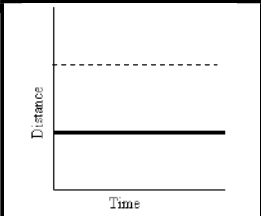
What does this graph represent?
a)
Constant speed
b)
Acceleration
c)
Not moving
40.
Speed is equal to
a)
Distance/Time
b)
Time/Distance
c)
Time x Distance
d)
Acceleration
41.

During which interval is the object speeding up?
a)
A to B
b)
B to C
c)
D to E
d)
E to F
42.

What is this graph showing?
a)
Constant Speed
b)
Acceleration (speeding up)
c)
Deceleration (slowing down)
d)
No motion
43.
A reference point is assumed to be
a)
moving
b)
invisible
c)
stationary
d)
speeding
44.
A change in an object's position relative to a reference point is called
a)
velocity
b)
constant
c)
speed
d)
motion
45.
On a graph showing distance versus time, a horizontal line represents an object that is
a)
moving at a constant speed.
b)
increasing its speed.
c)
decreasing its speed.
d)
not moving at all.
46.
You can show the motion of an object on a line graph in which you plot distance against
a)
velocity
b)
time
c)
speed
d)
direction
47.
The scientist who is most famous for developing the Laws of Motion is _____.
a)
Albert Einstein
b)
Stephen Hawking
c)
Sir Isaac Newton
d)
Galileo Galilei
48.
According to Newton’s first law of motion, a moving object that is not acted on by an unbalanced force will
a)
remain in motion.
b)
eventually come to a stop.
c)
change its momentum.
d)
accelerate.
49.
What can a force do?
a)
all of the above
b)
start a motion
c)
stop a motion
d)
change the direction of the motion
50.
A type of friction that occurs when air pushes against a moving object causing it to decelerate.
a)
surface area
b)
air resistance
c)
velocity
d)
gravity
51.
The amount of friction depends on the weight of the objects pressing together.
a)
True
b)
False
52.

What type of friction is not moving?
a)
static
b)
sliding
c)
fluid
d)
rolling
53.

Which runner had a head start?
a)
A
b)
B
c)
C
54.

Which runner won the race?
a)
A
b)
B
c)
C
55.

At what time did runner A pass runner B?
a)
0 seconds
b)
1 second
c)
2 seconds
d)
3 seconds
56.

Which graph shows the object standing still?
a)
A
b)
B
c)
C
d)
D
57.
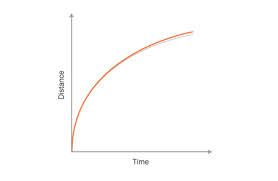
What is this graph showing?
a)
Constant Speed
b)
Acceleration (speeding up)
c)
Deceleration (slowing down)
d)
No motion
58.
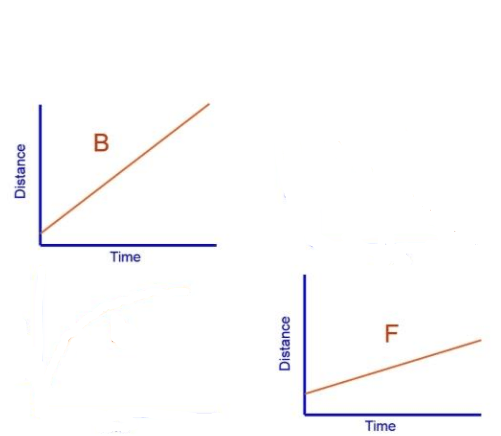
Which graph is showing a faster constant speed?
a)
B
b)
F
c)
They show the same speed
59.

Which graph is showing acceleration (getting faster)
a)
D
b)
E
c)
both D and E
d)
neither D or E
60.
Which graph is showing deceleration (getting slower)
a)
D
b)
E
c)
both D and E
d)
neither D or E
61.
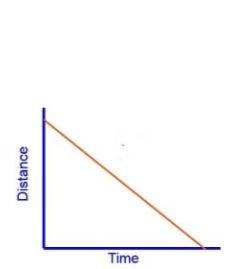
What is this line of this graph showing?
a)
moving away from starting point at a constant speed
b)
moving back towards the starting point at a constant speed
c)
acceleration (getting faster)
d)
deceleration (getting slower)
62.
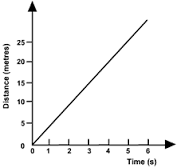
What is the line on this graph showing?
a)
moving away from starting point at a constant speed
b)
moving back towards the starting point at a constant speed
c)
acceleration (getting faster)
d)
deceleration (getting slower)
63.

A runner races in the 100 meter dash. It takes her 10 seconds to finish. What is her average speed?
a)
10 m/s
b)
1000 m/s
c)
100 seconds
d)
10 seconds
64.

What is happening at D?
a)
Stationary
b)
Accelerating
c)
Fast steady speed; moving away from the starting position
d)
Slower steady speed; moving away from the starting position
65.

What is happening at E?
a)
Stationary
b)
Accelerating
c)
Fast steady speed; moving away from the starting position
d)
Steady speed; returning to start position
66.

What is happening at A?
a)
Stationary
b)
Accelerating
c)
Slower steady speed; moving away from the starting position
d)
Steady speed; returning to start position
67.
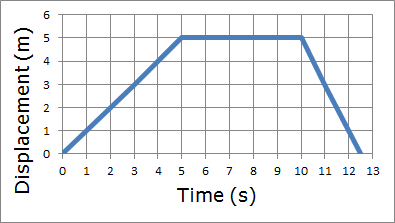
According to the graph how far does the person travel in the first 5 seconds?
a)
2 m
b)
10 m
c)
0 m
d)
5 m
68.

What is the person doing from 5 seconds to 10 seconds?
a)
Walking
b)
Running
c)
Standing Still
d)
Walking Fast
69.

How far is the person from the starting point after 3 seconds?
a)
0 m
b)
2 m
c)
3 m
d)
6 m
70.

What is the average speed of the person during the first 5 seconds?
a)
0 m/s
b)
1 m/s
c)
3 m/s
d)
6 m/s
71.

Which of the lines represent a constant velocity?
a)
A
b)
B
c)
C
d)
D
72.

Which of the lines represents a negative acceleration?
a)
A
b)
B
c)
C
d)
D
73.

At which point in time, does this person turn around?
a)
3 seconds
b)
5 seconds
c)
10 seconds
d)
25 seconds
74.

During which interval is the object slowing down?
a)
A to B
b)
D to E
c)
E to F
d)
G to H
75.

During which interval is the object not moving?
a)
B to C
b)
C to D
c)
D to E
d)
only at point A
76.
On which celestial object (outer space) would your mass be the greatest?
a)
Earth
b)
Jupiter
c)
Sun
d)
Your mass doesn't change on different celestial objects
77.
Why is a bowling ball harder to accelerate than a kickball?
a)
The kickball has more mass
b)
The bowling ball has more mass
c)
The kickball is easier to grip
d)
You can mold the kickball
78.
Which of the following does not describe non-uniform motion?
a)
Travels a constant speed
b)
Travels a constant direction
c)
Is at rest
d)
Changes its speed
79.
Which factor affects gravitational, elastic, magnetic, and electrical potential energy?
a)
mass
b)
charge
c)
pole
d)
distance
80.
Gravitational potential energy depends on the ________ and ________ of the object.
a)
Height and mass
b)
Friction and movement
c)
Mass and Movement
d)
Height and Friction
81.

What happens to the magnetic potential energy when the same poles are far apart?
a)
increases
b)
decreases
c)
stays the same
100 %

