wayground logo

Free Printable Worksheets

Font size

S
M
L
XL
Worksheets

Mechanical and Electromagnetic Waves

Total questions: 86

Worksheet time: 2hrs 9mins

Name
Class
Date
1.

Which of the following is true for sound waves?

a)

They require a medium.

b)

They are unrelated to vibrations.

c)

They cannot travel through liquids

d)

They can travel in a vacuum

2.

How do electromagnetic and mechanical waves compare?

a)

Mechanical waves can only travel through a vacuum, but electromagnetic waves can travel through a solid, liquid, or gas.

b)

Mechanical waves can travel through a solid, liquid, or gas, but electromagnetic waves can only travel through a gas.

c)

Mechanical waves can only travel through a solid, liquid, or gas, but electromagnetic waves can travel through a vacuum.

d)

Mechanical waves can travel through a solid, liquid, or gas, but electromagnetic waves can only travel through a solid.

3.

A student asks a series of questions about a wave. The answer to which question will allow the student to determine whether the wave is electromagnetic or mechanical?

a)

Does it require a medium in order to travel?

b)

Can it pass through air and water?

c)

Does it have a measurable speed?

d)

Does it have a measurable frequency?

4.

A student asks a series of questions about a wave. The answer to which question will allow the student to determine whether the wave is electromagnetic or mechanical?

a)

Does it require a medium in order to travel?

b)

Can it pass through air and water?

c)

Does it have a measurable speed?

d)

Does it have a measurable frequency?

5.

What is the term used to describe the maximum distance that a sound wave displaces air molecules from their original undisturbed position?

a)

Amplitude

b)

Speed

c)

Frequency

d)

Wavelength

6.

A student is measuring the distance between the crest and the rest position of both a mechanical wave and an electromagnetic wave. Which question is the student trying to answer?

a)

What is the speed of the waves?

b)

What is the amplitude of the waves?

c)

What is the wavelength of the waves?

d)

What is the frequency of the waves?

7.

Which distance represents the wavelength?

a)

W

b)

X

c)

Y

d)

Z

8.

Which distance represents the amplitude?

a)

W

b)

X

c)

Y

d)

Z

9.

What do radio waves, microwaves, X-rays, and gamma rays all have in common?

a)

They all have the same wavelength.

b)

They are electromagnetic waves.

c)

They are detected in the same way.

d)

They store the same amount of energy.

10.

How many wavelengths separate point A and point B?

a)

1.5

b)

2.0

c)

2.5

d)

3.0

11.

Point A represents what?

a)

Trough

b)

Midpoint

c)

Crest

d)

node

12.
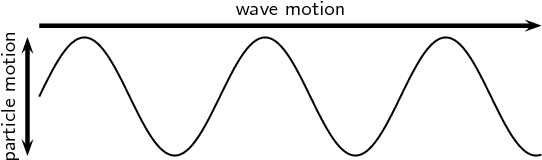
What kind of wave is pictured below?
a)
compressional wave
b)
transverse wave
c)
sound wave
d)
mechanical wave
13.
Waves are a transfer of what?
a)
Heat
b)
Light
c)
Energy
d)
Food
14.
Amplitude reflects the amount of ____________________ in a wave.
a)
energy
b)
compression
c)
rarefaction
d)
speed
15.
The units for frequency are measured in _____________.
a)
hertz
b)
seconds
c)
m/s
d)
m
16.
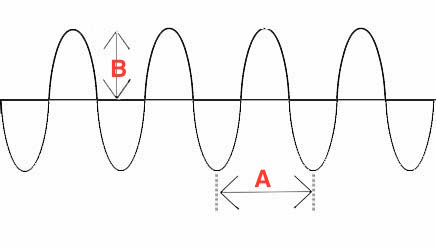
What property of this wave is represented by the letter "A"
a)
amplitude
b)
crest
c)
trough
d)
wavelength
17.
The highest point on a wave is:
a)
the crest
b)
the trough
c)
the top
d)
the coast 
18.
The lowest point on a wave is the:
a)
Amplitude
b)
Crest
c)
Trough
d)
Wavelength
19.
The number of wavelengths that pass a point each per second is:
a)
frequency
b)
period
c)
longitudinal 
d)
transverse wave 
20.
The type of waves that require medium to pass:
a)
Mechanical Waves
b)
Electromagnetic Waves
21.

Select the correct order of waves on the EMS from low to high energy

a)

Radio, Micro, Infra, Visible, Ultra, X-ray, Gamma

b)

Gamma, X-ray, Ultra, Vis, Infra, Micro, Radio

c)

Vis, Micro, Infra, Ultra, X-ray, Gamma, Radio

d)

Micro, Radio, Vis, Infra, Ultra, X-ray, Gamma
22.
Which has the LONGEST wavelength and, therefore, the lowest frequency/energy
a)
Gamma Rays
b)
Radio Waves
c)
Visible Light
d)
Infrared rays
23.

How are electromagnetic waves different from other waves?

a)

They have very short wavelengths

b)

They transmit energy instead of matter

c)

They can travel through the vacuum of space (without particles)

d)

They can change direction by reflection

24.

Which of the following electromagnetic waves has the lowest frequency?

a)

gamma ray

b)

infrared wave

c)

visible light wave

d)

microwave

25.

Which is true about the speed of radio waves compared to light waves? They are...

a)

less energy & frequency, but still the SAME speed as the speed of light (300,000,000 m/s)

b)

less energy & frequency, so LESS than the speed of light (300,000,000 m/s)
c)

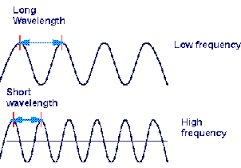
smaller wavelength, so LESS than the speed of light (300,000,000 m/s)

d)

more energy & frequency, so MORE than the speed of light (300,000,000 m/s)

26.

Wavelength and Frequency are related in that...

a)

they are always the same

b)

when one increases, the other decreases (inversely proportional)

c)

there is no correlation

d)

they both vary in an irregular pattern

27.

High frequency in EM waves equals

a)

high energy and short wavelength

b)

high energy and long wavelength

c)

low energy and short wavelength

d)

low energy and long wavelength

28.

The _______________ determines the color of visible light.

a)

wavelength (and frequency)

b)

speed

c)

amplitude

d)

particles of the medium

29.

Put the visible light colors in order from SHORTEST wavelength (highest frequency) to longest wavelength (lowest frequency)

a)

Violet, Indigo, Blue, Green, Orange, Yellow, Red

b)

Red, Yellow, Green, Orange, Violet, Blue, Indigo

c)

Red, Orange, Yellow, Green, Blue, Indigo, Violet

30.

All electromagnetic waves are...

a)

transverse waves and have the same frequency

b)

transverse waves and have the same speed

c)

mechanical waves and have the same wavelength

d)

longitudinal waves and have the same energy

31.
Light travels
a)
around corners
b)
in a straight line
32.
Light bounces when it is 
a)
reflected
b)
absorbed
c)
refracted
33.
Light bends when it is 
a)
refracted
b)
reflected
c)
absorbed
34.
mirror
a)
absorbs
b)
reflects 
c)
refracts
35.
smooth, shiny surfaces
a)
reflect
b)
refract
c)
absorb
36.
sunglasses and tinted windows
a)
refraction
b)
absorption
c)
reflection
37.
rainbow
a)
light is reflected
b)
light is refracted
c)
light is absorbed
38.
Which images are opaque?
a)
A & C
b)
A,C,E, & F
c)
D, E, & F
d)
A & E
39.
When a rainbow is formed outside naturally, what causes the light to refract?
a)
A. Small raindrops
b)
B. Sunlight rays
c)
C. Tiny mirrors
d)
D. Glass prisms
40.
Which explains why the fork looks different under water?
a)
light can't pass through the glass
b)
the wavelength of light lengthens
c)
the amount of light increases when going through water
d)
light is refracted at an angle
41.
Smooth surfaces _______ a lot of light.
a)
reflect
b)
bend
c)
absorb
d)
twist
42.
Opaque means...
a)
No light passes through it
b)
All light passes through it
c)
Some light passes through it
43.
Blurs light as it passes through
a)
Transparent
b)
Translucent
c)
Opaque
d)
Refraction
44.
Allows most light through
a)
eflection
b)
Refraction
c)
Translucent
d)
Transparent
45.
What do we call this tool that separates white light into the colors of the Visible Spectrum?
a)
tuning fork
b)
prism
c)
microscope
d)
graduated cylinder
46.

which is a transparent object

a)

glass

b)

copper

c)

iron

d)

steel

47.

Which travels faster?

a)

sound

b)

light

c)

water

48.
What is being blocked when a shadow is formed?
a)
Light Source
b)
Light Path
c)
Object
d)
Eye
49.
The three primary colors of light are
a)
Red, Blue, Yellow
b)
Pink, Green, Blue
c)
Violet, Green, Red
d)
Blue, Green, Red
50.
Why does an apple appear red?
a)
All colors are absorbed & none are reflected
b)
All colors are absorbed except for blue, which is reflected
c)
All colors are reflected and none are absorbed
d)
All colors are absorbed except for red, which is reflected
51.
How does light travel
a)
It curves around corners
b)
Really slow
c)
In a straight line
d)
In circles
52.
Which color reflects the least light?
a)
Black
b)
White 
c)
Blue
d)
Red
53.
Sunlight is
a)
not light at all
b)
red light
c)
yellow light
d)
white light
54.
Which of the following is the best reflector of light?
a)
Lens
b)
Microscope
c)
Mirror
d)
Prism
55.
Light enters this part of the eye first.
a)
Retina
b)
Cornea
c)
Lens
d)
Cones
56.
Humans can see colors because of these photo receptor cells in the Retina called 
a)
rods
b)
optic cells
c)
cones
d)
sclera
57.
Objects that reflect ALL colors will appear _____?
a)
Black
b)
White
c)
Gray
d)
Multi-colored
58.
Objects that ABSORB all colors of light will appear _______.
a)
white
b)
black
c)
multi-colored
d)
gray
59.
If you are using a green color filter, what color will you only see?
a)
blue
b)
green
c)
white
d)
red
60.
If you are using a red color filter, blue objects will appear what color?
a)
purple
b)
blue
c)
red
d)
black
61.
Why can we sometimes see only parts of the moon?  
a)
The path of light can only reach half of the moon at a time.
b)
The path of light from Earth to the Sun is blocked.
c)
The moon is partially eaten by giant zombie rodents, but it can regrow.
d)
Our brain just wants to make things up to confuse us.
62.
Which of the following would not reflect light?
a)
Mirror
b)
Water
c)
Glasses
d)
Brick Wall
63.
What is the purpose of a model in science?
a)
To make science look cool.
b)
To explain a phenomena or process.
c)
To make a topic interesting.
d)
To explain vocabulary.
64.
What percentage of colors makes white light?
a)
100% of red, green, and blue
b)
100% of red, blue, and yellow
c)
0% of red, green, and blue
d)
50% of all colors
65.
Which term describes when light bounces off of a smooth surface?  
a)
Refraction
b)
Transmission
c)
Absorption
d)
Reflection
66.
A girl in her bedroom saw her sister break her mother's lamp in the living room.  Explain how this could be possible.
a)
The girl can see through the wall.
b)
The girl can see her sister, because light can bend.
c)
The girl can see her sister because of a reflective surface in the kitchen.
d)
Since there is light in the living room and bedroom, she is able to see.
67.
What two colors make purple?
a)
Red and White
b)
Red and Blue
c)
Red and Green
d)
Red and Black
68.

Images in a plane mirror are

a)

real

b)

larger

c)

same size

d)

smaller

69.
According to the Law of reflection, a light ray striking a mirror
a)
continues moving through the mirror in the same direction
b)
moves into the mirror at a slightly different angle
c)
bounces off the mirror toward the direction it came from
d)
bounces off the mirror at the same angle it hits.
70.
Why do you not see an image when light reflects off a rough surface?
a)
because not enough light is not reflected
b)
because the reflection is regular
c)
because the reflection is diffuse
d)
because the law of reflection does not apply
71.
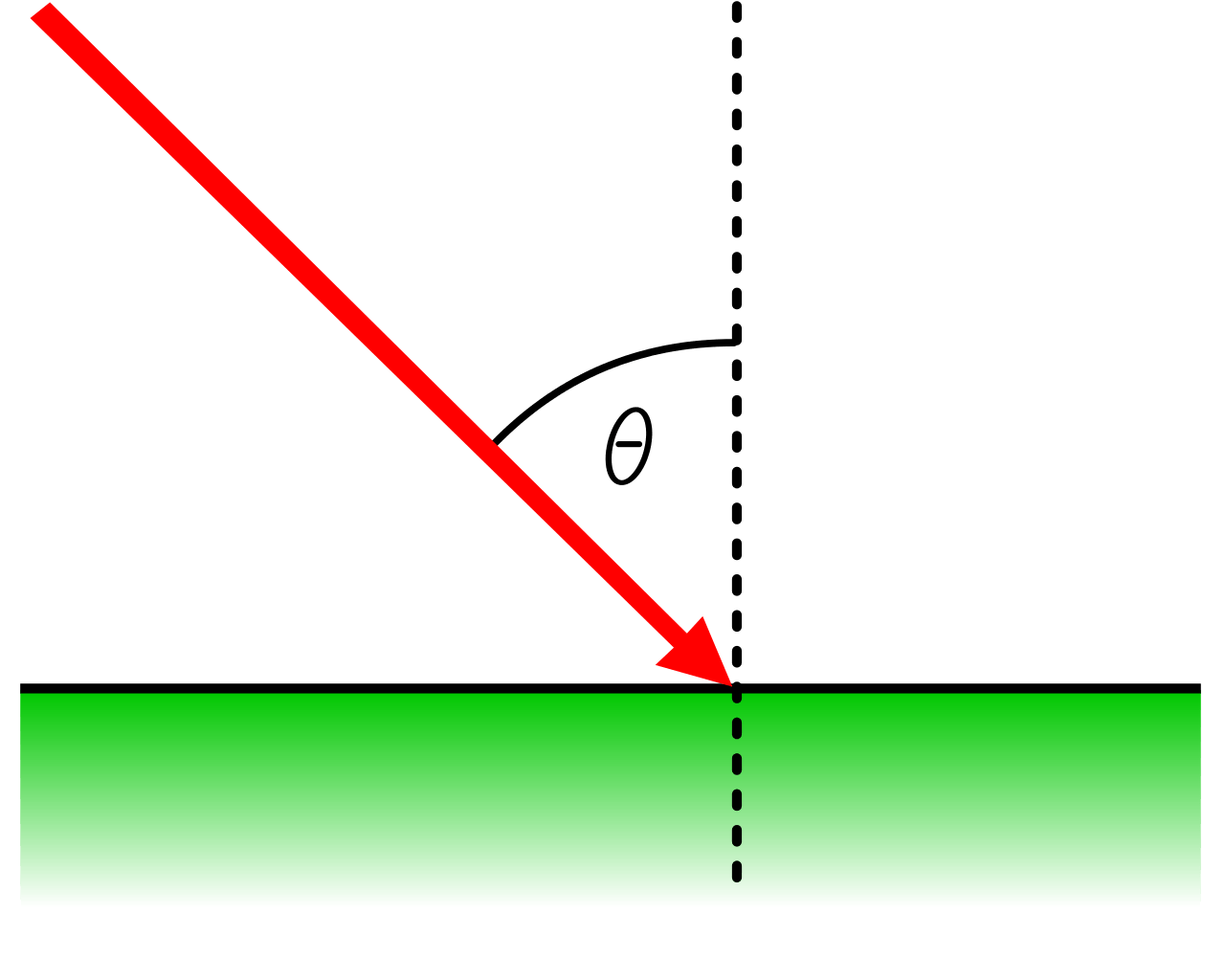
Which is the angle of incident?
a)
Angle 1
b)
Angle 2
72.
An image that you can see when you look into a mirror, but does not really exist is called which of the following?
a)
Real Image
b)
Fake Image
c)
Virtual Image
d)
Digital Image
73.
a real image...
a)
is produced by virtual rays and can be projected on a screen
b)
is produced by real rays and cannot be projected on a screen
c)
is produced by virtual images and cannot be projected on a screen
d)
is produced by real rays and can be projected on a screen
74.
What is an image called that forms when light rays actually meet
a)
virtual image
b)
real image
c)
diffuse reflection
d)
regular reflection
75.
What is an image called that forms where light seems to come from
a)
virtual image
b)
real image
c)
diffuse reflection
d)
regular reflection
76.
Plane mirrors always produce ______
a)
Real images
b)
Virtual Images
77.

The ray of light that strikes a mirror

a)

Reflected Ray

b)

Incidence Ray

c)

Angle of Incidence

d)

Angle of Reflection

78.

The ray that bounces off the mirror.

a)

Angle of Reflection

b)

Incidience Ray

c)

Reflected Ray

d)

Angle of Reflection

79.

The angle between the incident ray and the normal. (X on the diagram)

a)

Angle of X-Ray

b)

Angle of Reflection

c)

Angle of Incidence

d)

Angle of Normal

80.

The angle between the reflected ray and the normal (labelled Y on the diagram).

a)

Angle of Incidence

b)

Angle of Reflection

c)

Angle of Normal

d)

Angle of Light

81.

An imaginary line that is drawn at a right angle (90 degrees) to a mirror (Green line)

a)

Reflection Ray

b)

Normal

c)

Incidence Ray

d)

Light Ray

82.

Given that the angle of incidence = 30 degrees


Which is the correct diagam?

a)

A

b)

B

c)

C

d)

D

83.

A ray of light is incident towards a plane mirror at an angle of 30-degrees with the mirror surface. What will be the angle of reflection?

a)

30°

b)

60°

c)

90°

d)

120°

84.
Which of the following waves in the electromagnetic spectrum has the highest energy?
a)
Radio Waves
b)
Ultraviolet Rays
c)
Gamma Rays
d)
Infrared Waves
85.
Which of the following electromagnetic waves has the longest wavelength?
a)
Infrared Waves
b)
Ultraviolet Rays
c)
Visible Light
d)
Gamma Rays
86.

A image is formed when rays

a)

intersect

b)

are parallel

c)

are diffuse

d)

are absorbed