wayground logo

Free Printable Worksheets

Font size

S
M
L
XL
Worksheets

Ch. 4 Waves

Total questions: 90

Worksheet time: 4hrs 52mins

Name
Class
Date
1.
A wave will travel only as long as it has ____________ to carry.
a)
energy
b)
matter
2.
Bending of wave caused by moving from one medium to another
a)
Law of Reflection
b)
Refraction
3.
When two or more waves overlap and combine to form a new wave
a)
Interference
b)
Diffraction
4.
The highest point of a wave is called the ___________?
a)
Wavelength
b)
Crest
5.
The lowest point, or dip, in the wave is called its _______ ?
a)
Trough
b)
Crest
6.
A pencil in a glass of water looks broken due to _____?
a)
Refraction
b)
Bad eyesight
7.
The distance between two corresponding parts of a wave is the wave's ________.
a)
Wavelength
b)
Speed
8.
Waves combine to produce a smaller or zero-amplitude wave in a process called __________.
a)
reflection
b)
destructive interference
9.
How often a wave occurs is the wave's ____________.
a)
frequency
b)
wavelength
10.
The less energy a wave has, the smaller it's __________________.
a)
amplitude
b)
trough
11.
Frequency is measure in units called _________.
a)
hertz
b)
nanoseconds
12.

Which electromagnetic waves have the longest wavelengths and lowest frequencies?

a)

infrared waves

b)

radio waves

c)

gamma rays

d)

ultraviolet rays

13.

The electromagnetic waves with the highest frequencies are called

a)

radio waves.

b)

gamma rays.

c)

X-rays.

d)

visible light.

14.

In a vacuum, all electromagnetic waves have the same

a)

wavelength.

b)

speed.

c)

frequency.

d)

amplitude.

15.

Which of the waves is carrying the greatest amount of energy?

a)
b)
c)
d)
16.

Which of the following waves has the highest frequency?

a)
b)
c)
d)
17.

Which of the following provides an example of sound waves being reflected?

a)

Hearing music being played by a neighbor's stereo through a wall

b)

Water in a glass vibrating because of the sound of thunder

c)

A noise that produces an echo when it bounces off a distant wall

d)

The sound of a distant train getting louder as it approaches an observer

18.

A student places a pencil in a glass of water and observes that the pencil appears to be broken. Which of these provides the best explanation for why the pencil appears broken?

a)

The pencil absorbs all the light rays that hit it.

b)

Water reflects light rays away from the pencil.

c)

Light rays are bent by the water in the glass.

d)

The surface of the water reflects light rays.

19.

Which of the following is the best example of an object absorbing light?

a)

A black sweater in the sun

b)

A clean window in the sun

c)

A curved mirror in the sun

d)

A long shadow in the sun

20.

Humans see different colors because our eyes are responding to light that is different in which characteristic?

a)

Speed

b)

Amplitude

c)

Angle

d)

Wavelength

21.

Of all seven forms of electromagnetic waves, we can only see _____________________________. The colors we see are the colors ___________________________ back to our eyes.

a)

ultraviolet, reflected

b)

ultraviolet, refracted

c)

visible light, reflected

d)

visible light, refracted

22.
You produce speech by vibration of the ____.
a)
throat bones
b)
skin
c)
lips
d)
vocal cords
23.
Sound travels fastest in a ____.
a)
gas 
b)
liquid
c)
solid
d)
vacuum
24.
Resonance can be used to ____ sound.
a)
Amplify
b)
increase
c)
decrease
d)
modulate
25.
The unit for measuring pitch is the ____________________.
a)
base unit
base unit
b)
wave
c)
hertz
d)
newton
26.
Because sound is a wave, it can be described by its ____________________ and ____________________.
a)
refraction, defraction
b)
inflection, deflection
c)
wavelength and frequency
d)
sound, loudness
27.
The change in the frequency of a sound because of the motion of the source is ____________________.
a)
echo
b)
Doppler Effect
c)
wavelenght
wavelength
d)
ellipse
28.
A place where molecules are far apart is a ___________.
a)
refraction
b)
reflection
c)
rarefaction
d)
compression
29.
When light bounces off a surface it is called ____.
a)
reflection
b)
refraction
c)
diffraction
d)
interference
30.
Since sound is a mechanical wave it needs a ____________________ to travel through
a)
boost
b)
push
c)
medium
d)
large
31.
Waves that do not require matter to transfer energy are ____________________ waves.
a)
transverse
b)
mechanical 
c)
compressional
d)
electromagnetic
32.
Sound travels faster in ____________________ than in liquids
a)
gases
b)
liquids
c)
solids
33.
The change in direction of waves when the wave travels from air to glass is ____________________
a)
interference
b)
bending
c)
reflection
d)
refraction
34.

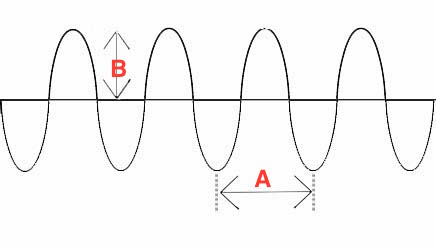
What property of the wave is represented by the letter "A"?

a)

amplitude

b)

crest

c)

trough

d)

wavelength

35.

The highest point on a wave is:

a)

the crest

b)

the trough

c)

the top

d)

the coast

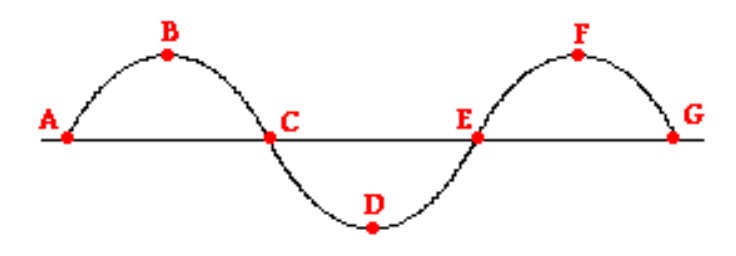
36.

Which letter(s) represent the trough of the wave?

a)

A

b)

B & D

c)

D

d)

C & G

37.

You can't hear sounds in outer space because there is no

a)

medium

b)

light

c)

energy

d)

heat

38.
The pitch of the sound depends on
a)
frequency
b)
amplitude
c)
wavelength
39.
Is refracting light bending or bouncing?
a)
bending
b)
bouncing
40.
Light hits the ____ in your eyes telling your brain which color you see.
a)
Cones
b)
Retina
c)
Pupil
d)
Cornea
41.
Which color has the lowest frequency?
a)
red
b)
green
c)
blue
d)
violet
42.
Which color has the highest frequency?
a)
blue
b)
yellow
c)
orange
d)
violet
43.

To calculate the frequency of an electromagnetic wave, you need to know the speed of the wave and its

a)

wavelength.

b)

intensity.

c)

refraction.

d)

amplitude.

44.

The full range of frequencies of electromagnetic radiation is called

a)

visible light.

b)

radio waves.

c)

the electromagnetic spectrum.

d)

invisible radiation.

45.

Which of the following occurs as a light wave bends when it passes from one medium into another?

a)

constructive interference

b)

refraction

c)

destructive interference

d)

reflection

46.

A communications satellite transmits a radio wave at a frequency of 5.0 x 10⁹ Hz. What is the signal’s wavelength? Assume the wave travels in a vacuum.

a)

(5.0 x 10^9 Hz) x (3.0 x 10^8 m/s)

b)

(5.0 x 10^9 Hz) / (3.0 x 10^8 m/s)

c)

(3.0 x 10^8 m/s) / (5.0 x 10^9 Hz)

d)

(5.0 x 10^9 Hz) + (3.0 x 10^8 m/s)

47.
When the frequency of a wave increases, what happens to the wavelength?
a)
The wavelength is not directly affected by the frequency of a wave.
b)
The wavelength increases.
c)
The wavelength decreases.
d)
More specific information is needed to form a conclusion about the wavelength.
48.
Which of the following can sound travel through?
a)
solid
b)
liquid
c)
gas
d)
all of the above
49.
A wave in which the particles of the medium move perpendicularly to the direction the wave is traveling
a)
A. surface wave
b)
B. transverse wave
c)
C. electromagnetic  wave
d)
D. longitudinal wave
50.
A wave in which the particles of the medium vibrate parallel to the direction of the wave motion
a)
A. mechanical wave
b)
B. surface wave
c)
C. longitudinal wave
d)
D. wave
51.
A wave has wavelength of 10 m and a speed of 340 m/s. What is the frequency of the wave?
a)
34 m/s
b)
3400 Hz
c)
3400 m/s
d)
34 Hz
52.
 A wave has frequency of 50 Hz and a wavelength of 10 m. What is the speed of the wave?
a)
500 m/s
b)
50 m/s
c)
5 m/s
d)
0.5 m/s
53.
The shortest wavelength in visible light is______.
a)
violet
b)
red
c)
blue
d)
yellow
54.
What occurs when vibrations traveling through an object match the object’s natural frequency?
a)
Refraction
b)
Reflection
c)
Diffraction
d)
Resonance
55.
Why do you see lightning from a distant storm before you hear thunder?
a)
Your eyes react faster than your ears
b)
Light travels faster than sound
c)
The thunder is produced after the lightening
56.
Waves combine to produce a smaller or zero-amplitude wave in a process called
a)
Destructive Interference
b)
Reflection
c)
Refraction
d)
Constructive Interference
57.
           In a longitudinal wave moving along a spring, areas where the coils are farthest apart are called ____________________.
a)
interference
b)
Compression
c)
Rarefraction
d)
Diffraction
58.
Through which type of medium does sound travel the most slowly?
a)
solids
b)
liquids
c)
gases
59.
The part of a longitudinal wave where the particles of the medium are close together.
a)
rarefaction
b)
compression
c)
crest
d)
trough
60.
Sound is able to travel faster in solids than in air because the molecules in a solid are
a)
closer together than air molecules
b)
more easily moved than air molecules
c)
moving faster than air moleculesmoving faster than air molecules
d)
larger than air molecules
61.
True or False: Sound travels better through solids than through liquids
a)
True 
b)
False
62.

The diagram shows two different sound waves.What can be concluded about the waves?

a)

Wave 1 is mechanical; Wave 2 is electromagnetic.

b)

Wave 1 has a shorter wavelength than Wave 2.

c)

Wave 2 transfers twice as much energy as Wave 1.

d)

Wave 2 has a higher frequency than Wave 1.

63.

Which best explains the behavior of light in this prism?

a)

The light waves refracted because they changed speed when it entered a different medium

b)

The light waves refracted because they changed shape when they entered a different medium

c)

The light waves reflected because they changed speed when it entered a different medium

d)

The light waves reflected because they changed shape when they entered a different medium

64.
The bouncing off of light rays from the surface of an object such as a mirror or other shiny surface is called:
a)
mirror
b)
laser
c)
reflection
d)
refraction
65.
Which window is opaque?
a)
Window 1
b)
Window 2
c)
Window 3
d)
None
66.
This diagram best represents 
a)
reflection
b)
refraction
c)
absorption
d)
diffusion
67.
How does light travel
a)
It curves around corners
b)
Really slow
c)
In a straight line
d)
In circles
68.
What is the ray of light that strikes the surface.
a)
Incident ray
b)
reflected ray
c)
normal ray
d)
normal
69.
....................... - the imaginary line perpendicular to the surface.
a)
Normal
b)
Angle of incidence 
c)
Angle of reflection
70.
........... – the angle between the normal and the reflected ray.
a)
Angle of incidence
b)
Angle of reflection
c)
Angle of coincidence
d)
Angle of direction
71.
Law of reflection state that - The angle of incidence is .................. to the angle of reflection.
a)
equal
b)
double
c)
half
72.
What is B?
a)
Angle of incidence
b)
Angle of reflection
c)
Incident ray
d)
Reflected ray
73.
What is C?
a)
Angle of incidence
b)
Angle of reflection
c)
Incident ray
d)
Reflected ray
74.
What is E?
a)
Angle of incidence
b)
Angle of reflection
c)
Normal
d)
Reflect ray
75.
_____ is a lens that is thicker in the middle and makes an object appear bigger.
a)
prism
b)
convex lens
c)
concave lens
d)
mirror
76.

if the object is beyond C (2F)

a)

image is real, smaller and upright

b)

image is real, smaller and upside down

c)

image is virtual, smaller and upside down

d)

image is real, bigger and upright

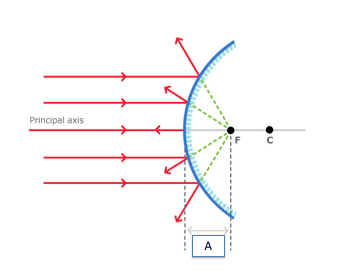
77.

In the image, all the rays meet at F, What is F

a)

focal length

b)

focal point

c)

center of curvature

d)

reflection

78.

this type of mirror is used in supermarkets to see around bends

a)

concave

b)

convex

c)

plane

d)

window

79.

The image formed by a plane mirror is ____.

a)

real and upright

b)

real and reversed

c)

upright and reversed

d)

virtual and inverted

80.

____ are thick in the middle and thin at the edges.

a)

Concave lenses

b)

Convex lenses

c)

Concave mirrors

d)

Plane mirrors

81.

Which of the following is true of a concave mirror?

a)

It will never form a real image.

b)

An inverted image will be formed if the object distance is greater than the focal length.

c)

An object can be magnified if placed at F.

82.

How does a concave lens differ from a convex lens?

a)

A convex lens is another way to describe a plane mirror; a concave lens is curved

b)

A concave lens is curved inward on both sides; a convex lens is on only one side

c)

A convex lens has a thick center and thin edges, a concave lens has a thin center and thicker edges

d)

A convex lens has a thin center and thick edges. a concave lens has a thick center and thinner edges

83.
Which part of the ear contains tiny bones called the hammer, anvil, and stirrup?
a)
middle ear
b)
outer ear
c)
inner ear
d)
eardrum
84.
What happens to the eardrum when sound hits, causing transmission of sound to the inner ear?
a)
it opens
b)
it grows hair
c)
it refracts the sound
d)
it vibrates
85.
What part of the eye controls how much light enters the black hole (pupil) in the center of the eye?
a)
optic nerve
b)
pupil
c)
cornea
d)
iris
86.
The part of the electromagnetic spectrum that humans can easily see is called _____________.
a)
visible light
b)
gamma rays
c)
microwaves
d)
eye waves
87.
The two parts of the eye that refract light are the ______________.
a)
eyelid and eyebrow
b)
eyelid and lens
c)
cornea and retina
d)
cornea and lens
88.
For clear vision, an image must be focused exactly on the ________________.
a)
retina
b)
pupil
c)
optic nerve
d)
lens
89.
What is the order of the path of light in the human eye?
a)
cornea, pupil, lens, retina, optic nerve, brain
b)
 lens,cornea, pupil, retina, optic nerve, brain
c)
pupil, lens, retina, optic nerve, cornea, brain
d)
brain, pupil, lens, retina, optic nerve, cornea,
90.
Which part of the ear is the first to vibrate as sound enters?
a)
cochlea
b)
auditory nerve
c)
eardrum
d)
hair cells