
 Worksheets
Worldviews: Contact and Change- Ch. 2 Expansion of Trade
Total questions: 85
Worksheet time: 49mins
What is the Silk Road?
A network of trade routes
The route the Crusaders took
An area where silk is grown
The area around a city state
What was the most valuable coin in Italy called?
Pound
Frank
Shilling
Florin
What were the Crusades?
A Christian military expedition
A trade route to China
The rural area around a city-state
An effort to increase trade
What is a city state?
A politically independant city
The main city in a kingdom
A type of city built along the Silk Road
A capital city of a country
Which of the following banking practices would repay merchants for damaged goods on risky journeys?
Loans
Interest
Insurance
Bills of Exchange
Which was the most valuable trade good brought in on the Silk Road?
Wool
Gold
Spices
Fruit
Which region controlled trade in the Mediterranean sea?
France
Italy
North Africa
The Byzantine Empire
What was the most efficient way to transport goods during the Renaissance?
Roads
Elephants
Railway
Water
True or false: Italian city states were monarchies
True
False
What is a merchant?
A type of crusader
A rank in the Catholic Church
The leader of a city state
Someone who buys and sells goods for a profit
Who was Marco Polo?
A banker
A priest
A merchant
An artist
The Silk Road connected Europe to what parts of the world?
Africa
Asia
The Middle East
All of the above
What is the name for the rural area around a city state?
County
Pasture
Orchard
Hinterland
Why was Italy able to transport goods easily and cheaply?
It had many ports on the Mediterranean Sea
It was located on a major river
It had lots of horses
They invented a new type of cart
How did the climate help Italian city-states grow powerful?
A longer growing season
Weather didn't provide barriers to trade
Icy winters froze bodies of water and connected trade routes
Intense heat forced city states to trade to survive
What was an unintended result of the Crusades?
Conquests of large areas of land
Decline in the variety of goods being traded in Europe
Increase in numbers of Muslim settlers in Europe
Contact with the Muslim’s knowledge and culture
Who were the leaders in most city-states?
King
The strongest warrior
The head of the largest guild
Wealthy business people
Who was the most famous and powerful family in 1400s Italy?
Florin
Polo
Medici
Da Vinci
1. One of the main reasons the expansion of trade in the late Middle Ages had its greatest impact on northern Italy was because:
a. other areas of Europe were more heavily affected by the Black Death
b. the feudal system was weaker in Italy than in the rest of Europe
c. agricultural production in Italy was greater than production in the rest of Europe
d. the government of Italy was controlled by a single, absolute King

4. The information on the map of trading routes in Renaissance Europe would be most useful in supporting the statement that:
a. most trade in Renaissance Europe was carried on sea routes
b. western Europe was the centre of Renaissance trading routes
c. Renaissance Europe traded mostly in exotic items from Asia
d. Renaissance Europe developed a wide-ranging trade system
Who was Marco Polo?
Your dad
Italian merchant, explorer, and writer born in Republic of Venice
Italian painter known for statues
Explorer who found North America
What was the silk road?
An important route in China
The bridge between England and France
A road made of silk
Ancient network of trade routes that connected the east and west
Check all the "things" that were traded along the Silk Road
Ideas
Pokemon cards
Spices
Knowledge
The Crusades were wars waged between which two religious groups?
Muslims and Jewish people
Christians and Jewish people
Christians and Muslims
Vaxxers and anti-vaxxers
How many MAJOR Crusades were waged in the Holy Land?
1
2
3
4
Two very important results of the Crusades for European nations were:
Increased trade and the Arts
Increased trade and contact with Muslim civilization
Contact with Muslim civilization and religious harmony
Salt and Pepper added to meals
What were the Crusades?
God vs. the Devil
Series of Holy Wars fought between Christians and Muslims
Series of Holy Wars fought between Christians and Buddhists
Series of wars that King Arthur won to become King of Avalon
What is a City State?
A city that is politically independent
A city that is geographically independent
A city that is emotionally independent
A city that is also a state
Check the main requirements for a successful city-state
Geography
Climate
Leadership
Money
Social organization
Rivalry was common between city-states
True
False
Usury was:
The practice of charging people to use boats
The practice of getting people to do your chores
The practice of charging interest on bank loans and loaning out money
The practice of using people to get your way
Who was John of Gaddesden? Check all that apply
An "expert" doctor
His cures relied on "sympathetic" magic
Tennis enthusiast
Discovered how blood flowed through the body
The medical renaissance was based on ideas from which civilizations?
Greek and Roman
Roman and American
Chinese and Japanese
Chinese and Greek
Who was Vesalius? Check all that apply
A doctor
Professor of anatomy
A scientist
Claimed the earth is flat
The name of the important book written by Vesalius is called:
Grey's Anatomy
How to cut people open 101
De animus
De humani corporis fabrica
De humani corporis fabrica was a textbook about:
Human geography
Human anatomy
Mathematics
History
William Harvey was an important doctor because he was the first to :
Discover a cure for the common cold
Describe in detail the correct way blood circulates in the body and the properties of blood
Try peanut butter with apples
Sail to America
Copernicus was important because he theorized:
Other planets exist
Earth is the centre of the universe, not the Sun
Earth is not the centre of the universe, the Sun is
Mars is scary
Brahae & Kepler were important because:
Supported Copernicus's theory
Used telescopes to observe the planets in the sky
Supported the Catholic Church
Gallelio was important because:
Argued in favour of Copernicus's theory
Improved telescopes
Invented poutine
The Renaissance period is one that may be understood as
an era of knowledge and change
an era of cultural rebirth
a French period of change
an era of knowledge and change AND cultural rebirth
all of the above
In the late Middle Ages, the Crusades were organized to do what?
Abolish Christians
Return land to the Muslim people
Control the Holy Land
Collect money for the Church
The Feudal (Manorial) System of government was
a hierarchical class structure
a system that sold land to peasants
controlled by the citizens
democratic in nature
The Bubonic Plague caused all of the following to happen except
many peasant deaths
people to move to the cities
nobles to lose their land
crops to become diseased
Life for the serfs in the medieval period would have been dominated most by the importance of
seeking educational opportunities
showing obedience to the lord of the manor
expanding knowledge of the world through travel
enjoying material possessions and wealth
An unintentional (not on purpose) result of the Crusades to the Holy Land was the
conquest of large areas of Palestine
decline in the variety of goods being traded in Europe
exposure of Europeans to Muslim learning and culture
increase in numbers of Muslim settlers in Europe
What is the MOST direct translation of the word Renaissance?
rebirth
resurgence
reawakening
reawareness
Which of the following descriptions BEST defines the Renaissance period?
a period of time after the feudal system of the Middle Ages
a time when the population of Europe was more urbanized
a rebirth of classical knowledge and learning in Europe
when a third of the population of Europe died of the Plague
Choose the statement that is untrue. Serfs...
were bound to their lord
could not advance to another social class
lived in huts outside the castle grounds
lived within the castle walls to serve their lord
The exchange of _____ was a key part of the Renaissance spreading throughout Europe.
money
ideas
art
inventions
The major factor that led to the growth and power of cities in Europe was
The Crusades
The sharing of ideas
Increased trading
War
Which worldview element was the most important in the development of strong trade centers?
Geography
Time
Values
Beliefs
Who was Marco Polo?
Traveller
Italian
Friend of Kubla Khan
all of the above
City States are
Countries
Republics
Democracies
Monarchies
The Medici family controlled which city for over 300 years?
Milan
Venice
Florence
Genoa
Usury is best defined as
Interest charged on a loan
A loan from the bank
A loan from the church
Profit made from a loan
Most medieval towns were centres for farm communities. They generally grew up close to...
Lakes
Guilds
Monasteries
Schools
During the Middle Ages, there was an organized system called Feudalism. Feudalism was a hierarchy. Below, pick the correct order of the way the hierarchy was ordered (highest class to lowest class).
Barons,
The Crown, Commoners, Knights
The Crown, Barons, Commoners, Knights
The Crown, Barons,
Knights, Commoners
Commoners, Knights,
Barons,
The Crown
Millions of Europeans died of _________________ Between 1346 and 1350. Outbreaks of this disease continued for the next several hundred years. As a result, there were severe labour shortages on the manors and many feudal estates were bankrupt.
Spanish Influenza
Bubonic Plague
Smallpox
Cholera
This famous explorer took the “Silk Road” and ventured all the way to China where the Mongol Empire was ruling. What was this explorer’s name?
Michelangelo
Vasco da Gama
Martin Luther
Marco Polo
What did the Crusaders hope to achieve by participating in the Holy War?
Wealth and power
Guaranteed place in heaven
Expansion of their territories
Revenge against the Turks
Which civilization was more advanced than Europe during the Crusades?
European civilization
Muslim civilization
Both were equally advanced
There was no significant difference
What were Europeans exposed to during the Crusades?
New ideas about medicine
New ideas about astronomy
New ideas about philosophy
All of the above
Which societies welcomed contributions from Christians and Jewish scholars?
European societies
Muslim societies
Both European and Muslim societies
Neither European nor Muslim societies
What goods did the Crusades bring to Europe?
Oil and spices
New varieties of fruit
Luxury goods
All of the above
What was the most sought after trade good during the Crusades?
Oil
Spices
New varieties of fruit
Luxury goods
Which seaports attracted merchants to buy luxury goods and spices?
Genoa and Venice
Rome and Athens
Paris and London
Berlin and Moscow
What was the value of pepper during the Crusades?
It was worthless
It was worth its weight in gold
It was worth less than its weight in gold
It was worth more than its weight in gold
True or False: The silk road was the name given to the routes that connected the Mediterranean Sea to the European colonies in North and South America.
True
False
True or False: In Italy, merchants, bankers, and other wealthy people wanted strong leadership because they realized they could conduct business more easily when the government was stable.
True
False
An unintentional consequence of Europeans fighting in the Crusades was
driving the Muslims from Palestine.
the Christians being defeated in the Holy Land by the Muslims.
they were exposed to Muslim culture and learning.
that many Muslims decided to settle in Europe
True or False: A city-state is politically independent and consists of a city and its hinterland.
True
False
Why was an Italian city-state's hinterland important?
It was where food was produced and natural resources were gathered.
It was where the wealthiest citizens lived.
All the residents of the hinterland were merchants.
It provided protection in case of an attack by enemies.
True or False: The routes between Europe and Asia were usually without any danger whatsoever.
True
False
What is meant by the term usury?
the practice of loaning money to someone
the practice of charging interest when loaning money to someone
the practice of selling land to peasants
the practice of churches taking donations
In which city-state did the Italian Renaissance begin?
Venice
Rome
Naples
Florence
What wealthy family ruled the city-state of Florence?
Ferrara
Nicholas
Alfonso
Medici
What is Feudalism?
A social and economic system of hierarchy, ruled by a King.
A political situation of violence, feuds, and small uproars.
A political system of a small elite ruling over the masses.
A socio-economic system of equity and individual ownership.
The rural area around a city state is called?
The countryside
The North Pole
The Hinterland
Wine country
Which of the following contributed to the success of the Italian City states?
Geography
Climate
Leadership
Social organization
Geography
Values
Kings
Family
What was the climate like in Italy?
Freezing
Hot
Mild
Cold
Cold
Mild
Hot
Freezing
What is a monarchy?
A President
a Prime Minister
Kings and Queens
A butterfly
Who lead the city states in Italy?
Knights
Lords of the Manor
Kings
Wealthy business people
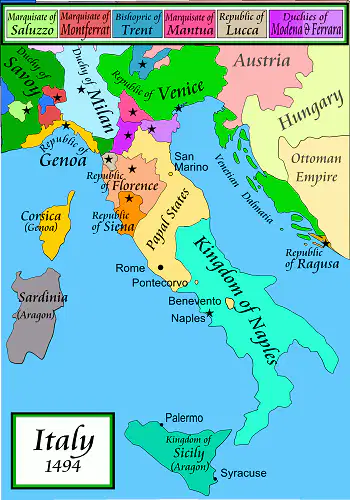
What does the map show?
Italian Kingdoms
Italian City-States
Italian Provinces
City-States of Ireland

The photo shows a series of trade routes called the

