
 Worksheets
WAVES INTRO
Total questions: 88
Worksheet time: 3hrs 49mins
Name
Class
Date
1.
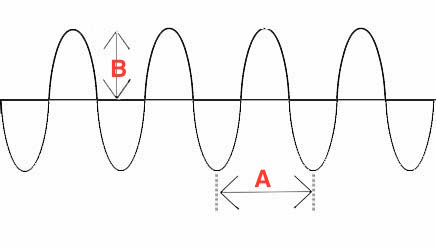
What property of this wave is represented by the letter "A"
a)
amplitude
b)
crest
c)
trough
d)
wavelength
2.
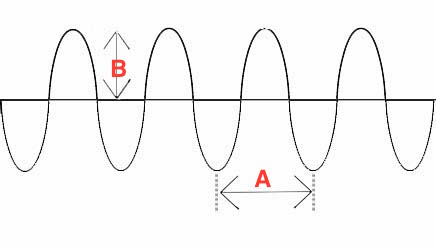
What property of the wave is represented by the letter "B"?
a)
amplitude
b)
crest
c)
trough
d)
wavelength
3.
The highest point on a wave is:
a)
the crest
b)
the trough
c)
the top
d)
the coast
4.
The lowest point on a wave is the:
a)
Amplitude
b)
Crest
c)
Trough
d)
Wavelength
5.
The number of wavelengths that pass a point each per second is:
a)
frequency
b)
period
c)
longitudinal
d)
transverse wave
6.
The type of waves that require medium to pass:
a)
Mechanical Waves
b)
Electromagnetic Waves
7.
When the frequency of a wave increases, what happens to the wavelength?
a)
The wavelength is not directly affected by the frequency of a wave.
b)
The wavelength increases.
c)
The wavelength decreases.
d)
More specific information is needed to form a conclusion about the wavelength.
8.
A mechanical wave cannot travel through...
a)
a vacuum(empty space).
b)
water.
c)
air.
d)
glass.
9.
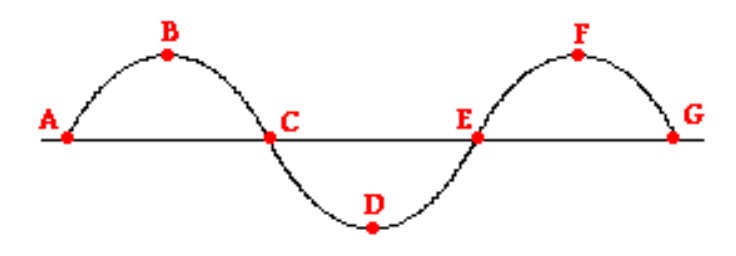
Which letter(s) represent the trough of the wave?
a)
A
b)
B & D
c)
D
d)
C & G
10.
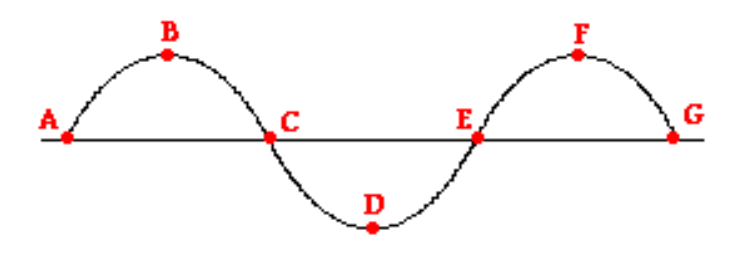
Which letter(s) represent the crest of the wave?
a)
A
b)
B & D
c)
B & F
d)
F
11.
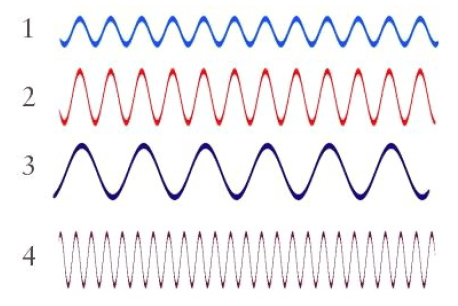
Which wave in the diagram has the greatest frequency?
a)
1
b)
2
c)
3
d)
4
12.
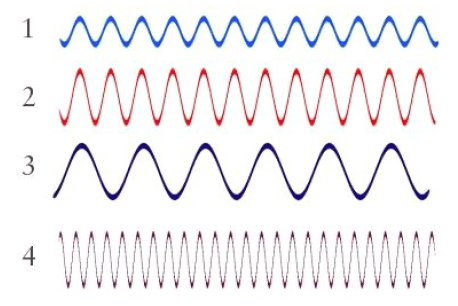
Which wave in the diagram has the greatest wavelength?
a)
1
b)
2
c)
3
d)
4
13.
Which of the following can sound travel through?
a)
solid
b)
liquid
c)
gas
d)
all of the above
14.
crest to crest or trough to trough
a)
crest
b)
trough
c)
amplitude
d)
wavelength
15.
Electromagnetic waves include the following except
a)
radio waves
b)
X-rays
c)
doing the wave at a football game
d)
microwaves
16.
regular disturbances that carry energy through matter or space
a)
crest
b)
energy
c)
wave
d)
trough
17.
which material does sound travel the fastest?
a)
solid
b)
liquid
c)
gases
18.

What kind of wave is pictured below?
a)
compressional wave
b)
transverse wave
c)
sound wave
d)
mechanical wave
19.

This type of Electromagnetic wave shows a break in bones.
a)
gamma ray
b)
x-ray
c)
brokenometer
d)
radio wave
20.

Which letter represents the wave crest?
a)
A
b)
B
c)
C
d)
D
21.

Which letter represents the wave trough?
a)
A
b)
B
c)
C
d)
D
22.

Which letter represents amplitude?
a)
A
b)
B
c)
C
d)
D
23.

Which wave has a greater frequency?
a)
A
b)
B
24.

How would a person measure the wavelength on this sound wave?
a)
dense to less dense
b)
trough to crest
c)
compression to compression
d)
beginning of illustration to the end
25.
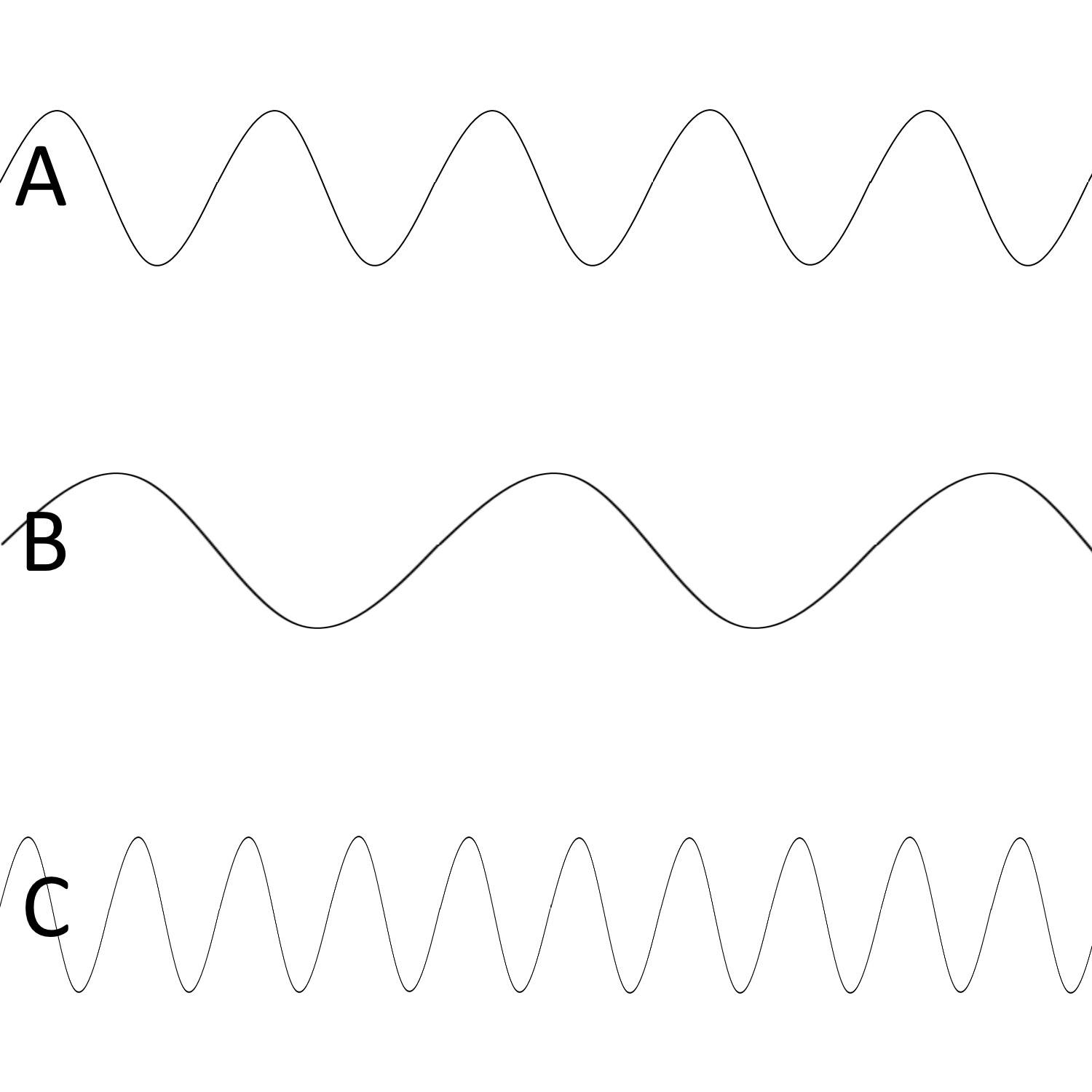
Which wave has the largest wavelength?
a)
A
b)
B
c)
C
d)
None (same wavelength)
26.

Which wave has the largest frequency?
a)
A
b)
B
c)
C
d)
None (same frequency)
27.

If all three are waves of light, which wave has the largest speed?
a)
A
b)
B
c)
C
d)
None (same speed)
28.

Which type of light has the lowest energy of this group?
a)
Radio
b)
Microwave
c)
Infrared
d)
Ultraviolet
29.
Which type of light has the largest wavelength of this group?
a)
X-rays
b)
Microwave
c)
Infrared
d)
Ultraviolet
30.

Which type of light has the highest energy of this group?
a)
red
b)
yellow
c)
green
d)
blue
31.

This color in the visible part of the spectrum has the smallest wavelength.
a)
Blue
b)
Red
c)
Violet
d)
Yellow
32.
This color in the visible part of the spectrum has the highest energy.
a)
Blue
b)
Red
c)
Violet
d)
Yellow
33.
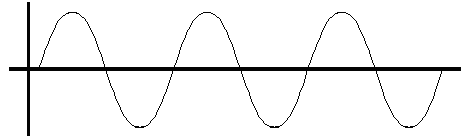
What type of wave is this?
a)
Longitudinal
b)
Transverse
34.
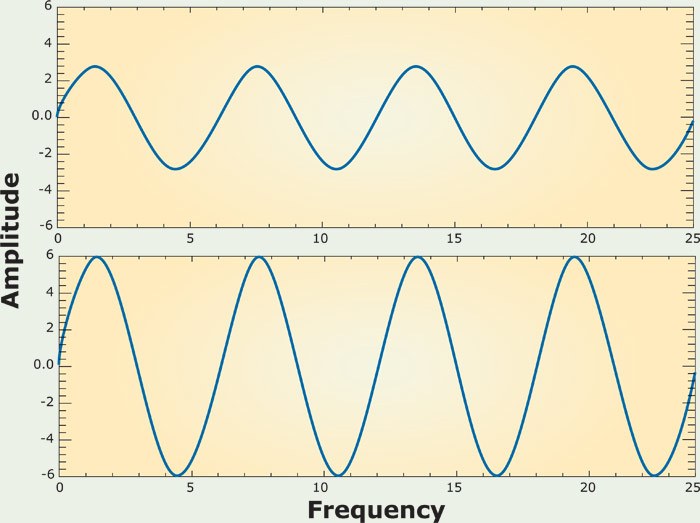
Which property of these waves differs?
a)
Frequency
b)
Wavelength
c)
Amplitude
d)
Pitch
35.

A high energy wave is considered to have a high
a)
amplitude
b)
frequency
c)
wavelength
d)
period
36.
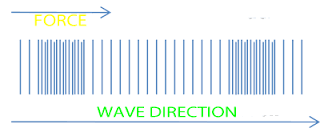
What type of waves have compressions and rarefactions?
a)
longitudinal
b)
transverse
37.
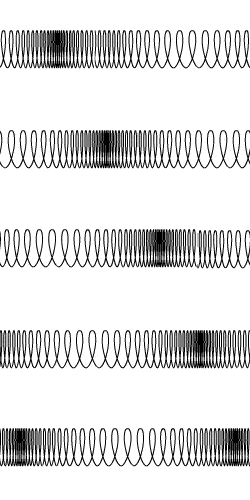
What type of wave is this?
a)
Longitudinal
b)
Transverse
38.
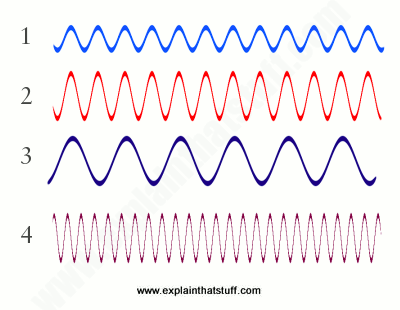
Which wave has the highest frequency?
a)
1
b)
2
c)
3
d)
4
39.

Which part of a longitudinal wave is where particles are packed closely together?
a)
compression
b)
rarefaction
c)
crest
d)
amplitude
40.
What is the material waves travel through?
a)
Period
b)
Frequency
c)
Medium
d)
Hertz
41.
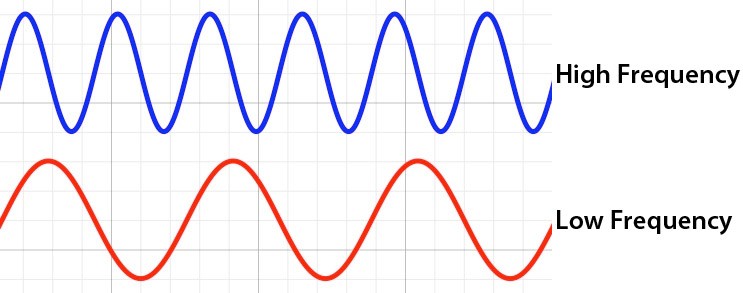
Frequency is measured in
a)
Newtons
b)
Joules
c)
Hertz
d)
Decibels
42.
Which is the correct equation for calculating the speed of a wave?
a)
T = 1/f
b)
Speed= Wavelength x Period
c)
Speed = Wavelength/Frequency
d)
Speed= Wavelength x Frequency
43.

A period is
a)
Amount of time it takes a wavelength to complete one cycle.
b)
How many wave lengths happen in a second.
c)
An indication of the amount of energy in a wave.
d)
The distance between two crests or two troughs.
44.
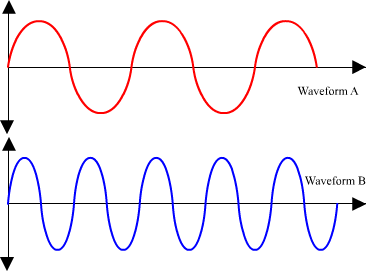
These waves have the same
a)
amplitude
b)
frequency
c)
period
d)
wavelength
45.

Which portion of the wave has the highest amplitude?
a)
A
b)
B
46.

Which portion of the wave has the lowest amplitude?
a)
A
b)
B
47.

Which portion of the wave is carrying the most energy?
a)
A
b)
B
48.
When a wave has a high amplitude, what is true about its energy?
a)
It is higher.
b)
It is lower.
49.
The type of waves that require medium to pass:
a)
Mechanical Waves
b)
Electromagnetic Waves
50.
What happens when a fixed end wave reflects?
a)
The wave bounces in the same side it came in on.
b)
The wave bounces in the opposite direction it came in on.
c)
Waves can't reflect.
d)
You surf it all the way to shore.
51.
Which wave in the diagram has the greatest frequency?
a)
1
b)
2
c)
3
d)
4
52.
Which wave in the diagram has the greatest wavelength?
a)
1
b)
2
c)
3
d)
4
53.

Which letter represents the wavelength of a wave?
a)
A
b)
B
c)
C
d)
D
54.

Which letter represents the amplitude of the wave?
a)
A
b)
B
c)
C
d)
D
55.

The image above shows a student using a Slinky to create a wave. The slinky is stretched at one end and the resulting wave travels back and forth. This is an example of a...
a)
Superposition Wave
b)
Refracted Wave
c)
Longitudinal Wave
d)
Transverse Wave
56.
Imagine one end of a rope is tied to a door handle. The other end is caused to vibrate vertically(up & down). The wave that travels along the rope is an example of a(n)...
a)
Electromagnetic Wave
b)
Microwave
c)
Transverse Wave
d)
Longitudinal Wave
57.

a)
Amplitude
b)
Crest
c)
Trough
d)
Wavelength
58.

a)
Frequency
b)
Amplitude
c)
Wavelength
d)
Trough
59.

a)
Trough
b)
Crest
c)
Amplitude
d)
Wavelength
60.

a)
Crest
b)
Trough
c)
Height
d)
Frequency
61.
A mechanical wave requires a ________.
a)
Motion
b)
Medium
c)
Vacuum
d)
Car
62.

What kind of wave is this?
a)
Transverse
b)
Longitudinal
c)
Compression
d)
Rarefraction
63.
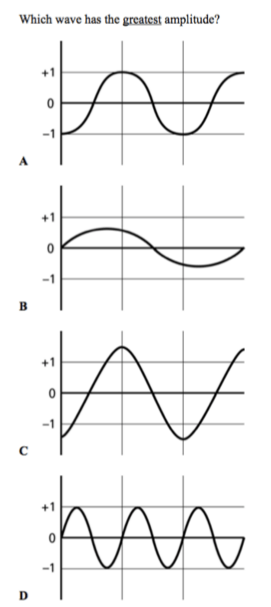
Which wave has the greatest amplitude?
a)
A
b)
B
c)
C
d)
D
64.

What part of the wave is a compression?
a)
A
b)
B
65.

What part of the wave is a rarefaction?
a)
A
b)
B
66.
What do waves carry through objects?
a)
light
b)
sound
c)
water
d)
energy
67.

How do these waves differ?
a)
they travel at different speeds
b)
they have different wavelengths
c)
they carry different amounts of energy
d)
they are a different distance from the source
68.

What type of wave is pictured here?
a)
longitudinal wave
b)
transverse wave
c)
light wave
d)
seismic wave
69.

Look at the waves amplitudes. Which has a higher intensity?
a)
top wave
b)
bottom wave
c)
neither
d)
they have the same intensity
70.
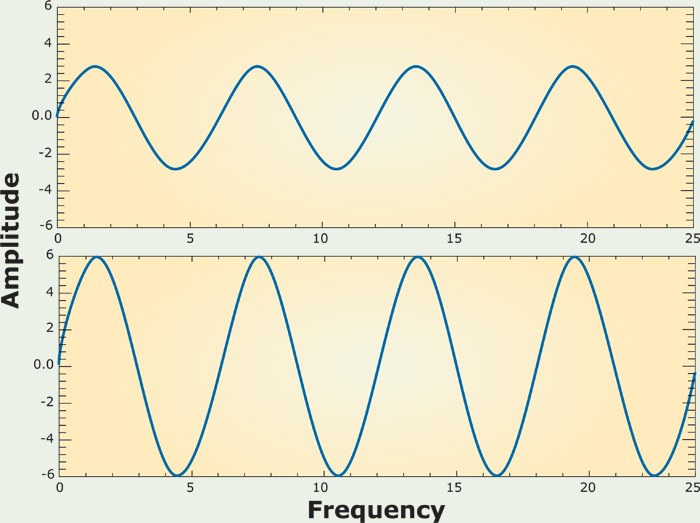
How much energy is the bottom wave carrying, compared to the top wave?
a)
bottom is carrying more energy than top
b)
bottom is carrying the same energy as top
c)
you cannot tell from the picture
d)
bottom is carrying less energy than top
71.

Waves carry the _____ but do not carry the _____.
a)
Energy; Matter
b)
Matter; Heat
c)
Heat; Energy
d)
Energy; Friction
72.

What is feature A on this wave diagram?
a)
Equilibrium position
b)
Amplitude
c)
Crest
d)
Trough
73.
What is feature B on this wave diagram?
a)
Equilibrium position
b)
Amplitude
c)
Crest
d)
Trough
74.

What is feature H on this wave diagram?
a)
Wavelength
b)
Rarefaction
c)
Diffraction
d)
Compression
75.
What is feature F on this wave diagram?
a)
Wavelength
b)
Rarefaction
c)
Diffraction
d)
Compression
76.
When graphing a wave, what does the horizontal axis usually represent?
a)
Amplitude
b)
Trough
c)
Time or distance
d)
Crest
77.
What does the horizontal line through the center of the wave on a graph represent?
a)
Amplitude
b)
Trough
c)
Crest
d)
Rest position
78.

What property of a wave is used to measure its intensity?
a)
Amplitude
b)
Frequency
c)
Wavelength
d)
Period
79.

The amount of time that it takes for a complete wave cycle to travel through a single point or particle is known as:
a)
Amplitude
b)
Frequency
c)
Wavelength
d)
Period
80.

How are wavelength and frequency related in waves?
a)
Directly Proportional
b)
Negatively Correlated
c)
Exponentially Increasing
d)
Inversely Proportional
81.
Sound travels fastest in which medium?
a)
Solid
b)
Liquid
c)
Gas
d)
Plasma
82.
Sound travels slowest in which medium?
a)
Solid
b)
Liquid
c)
Gas
d)
Plasma
83.
What affects the pitch of sound in a musical instrument?
a)
How hard you hit it.
b)
The frequency of the sound made.
c)
The amplitude of the sound made.
d)
The volume of the sound made.
84.
What affects the volume of a sound in an instrument?
a)
The pitch of the note played.
b)
The frequency of the sound.
c)
The amplitude of the sound.
d)
The type of material used.
85.

Choose the correct one
a)
x represents frequency
y represents wavelength
y represents wavelength
b)
x represents wavelength
y represents speed
y represents speed
c)
x represents amplitude
y represents frequency
y represents frequency
d)
x represents amplitude
y represents wavelength
y represents wavelength
86.
Light is______
a)
a surface wave
b)
an electromagnetic wave
c)
a sound wave
d)
a water wave
87.
The range of colors in the visible spectrum are
a)
ROYGB
b)
ROYGBIV
c)
RESPECT
88.

This is a picture of a __________
a)
Longitudinal
b)
Transverse
100 %

