Worksheets
Physics 4S BETA
Total questions: 90
Worksheet time: 3hrs 2mins
Which of the following physical quantities is not a base quantity?
Mass
Length
Area
Electric current

Which of the following physical quantities does not matched the correct S.I. unit?
A
B
C
D
Which of the following physical quantities is a derived quantity?
Work
Time
Mass
Length
The unit of pressure and volume are N m-2 and m3 respectively. The unit for the product of pressure and volume is equivalent to
Force
Work
Acceleration
Momentum

The variation of force, F with the mass, m of an object is represented by the graph above.
Which of the following statements about the graph is correct?
F is inversely proportional to m
F is directly proportional to m
F is a manipulated variable
m is a responding variable

What is the type of motion of the object from the ticker tape chart above?
constant acceleration
velocity decreases uniformly
constant velocity
at rest
A student is asked to solve the following problem:
An object is thrown upwards with a speed of 25 m s-1. How high will it be when the speed is 12 m s-1 ?
Which equation will allow the problem to be solved in a SINGLE calculation?
s=ut+21at2
s=2(u+v)t
v=u+at
v2=u2+2as

A bus is travelling at a speed of 9.0 m s-1. It then accelerates at a rate of 0.75 m s-2 for a time of 8.0 s. What therefore is its final speed?
6.0 m s-1
15 m s-1
17 m s-1
21 m s-1

The diagram shows a coin, marble and dried leaf being released at the same time in a vacuum cylinder. Which observation is correct?
Rajah menunjukkan sekeping syiling,sebiji guli dan sehelai daun kering dilepaskan pada masa yang sama dalam sebuah silinder vakum. Pemerhatian yang manakah adalah benar?
All three objects float in the cylinder
Ketiga-tiga objek terapung dalam silinder
All three objects reach the base at the same time
Ketiga-tiga objek sampai ke dasar dalam masa yang sama
The marble reaches the base earlier than the coin
Guli sampai ke dasar lebih awal daripada syiling
The marble and coin reach the base earlier than the dried leaf
Syiling dan guli sampai ke dasar lebih awal daripada daun kering

Diagram shows a coin and a feather experiencing free fall in a vacuum container. Which physical quantity is constant?
Rajah menunjukkan sekeping duit syiling dan sehelai bulu ayam yang sedang jatuh bebas di dalam bekas vakum. Kuantiti fizik yang manakah tetap?
Velocity
Halaju
Acceleration
Pecutan
Momentum
Momentum
Kinetic energy
Tenaga kinetik
A brick falls from a height of 10 m. Calculate the time taken for the brick to reach the ground.
Seketul bata jatuh dari ketinggian 10 m. Hitung masa yang diambil untuk bata itu sampai ke tanah.
0.5 s
0.7 s
1.0 s
1.4 s

Karim's weight on Earth is 800 N. What will happen to his weight on the moon?
Berat Karim di Bumi ialah 800 N. Apakah yang akan berlaku kepada beratnya di bulan?
Increased
Bertambah
Decreased
Berkurang
Unchanged
Tidak berubah
Become zero
Menjadi sifar
the tendency of an object to resist a change in its motion
acceleration
inertia
mass
frame of reference
Inertia is Newton's _______ Law of Motion.
First
Second
Third

Diagram 3 shows a cat chasing a rat. The inertia of the cat is bigger than the rat because.
The size of the cat is bigger than the rat
The length of the cat is more than the rat
The mass of the cat is bigger than the rat
Which of the objects listed below have the greatest inertia?
A 500 kg object that is not moving.
A 300 kg object that is not moving on the Moon.
A 250 kg object moving at 25 m/s.
A 700 kg object moving at 3 m/s.

The diagram shows a tennis player ready to hit a tennis ball.
Impulsive force is produced when ...
the racket is swung at high velocity
the racket is swung backward
the racket hits the tennis ball
the racket is gripped strongly
Which physical quantity is a vector quantity?
Mass
Momentum
Wavelength
Potential difference
Which of following action does NOT show the impulsive force used in a useful way?
Hitting a nail into a piece of board
Colliding between two vehicles
Hitting a ball with a racket
Kicking a ball in a game
Which of the following is NOT related to impulsive force?
High jumper's leg is injured when landing without used mattress
Hockey ball is hit by a player with a hockey stick
A bicycle descends a steep hill
Wood pieces broken by a karate expert
An object of mass 0.4kg is pulled with a force of 20 N for 10 s.
How much is the impulse upon the object?
8 Ns
80 Ns
200 Ns
250 Ns
Why are the front and rear sections of a car designed to crumple easily?
To reduce impact time
To increase momentum
To reduce impulsive force
To increase friction

The diagram shows the forces 550 N acts on a bicycle. The mass of the bicycle and the cyclist are 9.5 kg and 70 kg respectively.
What is the acceleration of the cyclist?
[Frictional force is negligible]
57.9 m s-2
9.1 m s-2
7.9 m s-2
6.9 m s-2
A force of 120 N acts on an object in a stationary. After 5 s the force is applied the velocity of the object is 40 m s-1.
What is the mass of the object?
0.6 kg
1.7 kg
15.0 kg
960.0 kg
Which of the following is true about weight?
It's a scalar quantity
It's measured in unit of kilogram
It's a based quantity and also is a vector quantity
It depends on the gravitational field strength
Karim’s weight on Earth is 800 N.
What will happen to his weight on the moon?
Increased
Decreased
Unchanged
Becomes zero
According to the Newton’s Universal Law of Gravitation, the force of gravity between two objects is directly proportional to
The distance between the objects.
The product of the masses of the objects.
The gravitational constant.
The square of the distance between the objects.
What is the reason for the motion of the Moon on its orbit?
The gravitational force exerted on the Earth by the Moon.
The gravitational force exerted by the Sun.
The gravitational force exerted by the Planets.
The gravitational force exerted on the Moon by the Earth
A satellite moves around the earth in its orbit and does not escape from the space because the satellite
becomes weightless
move in a vacuum.
always pulled by the earth gravitational force.
move with highest speed.
What keeps an Earth satellite moving in its orbit?
A Gravitational attraction of Sun.
Burning of fuel.
Ejection of gases from the exhaust of the satellite.
Gravitational attraction between satellite and Earth.
“A force that make an object to follow a circular path with direction always towards the center of curvature.” Statement above is the definition of
Gravitational force
Escape force
Centripetal force
Gravitational field strength
What happen to the weight of the object if the mass of the Earth decreases one-half from its original mass without changing its radius?
Does not change
Decreases to one half from original weight
Decreases to one quarter from original weight
Increases double from original weight
Kepler’s Third Law states
the orbit of a planet around the sun is an ellipse, with the sun at one focus.
the semi major axis is equal to the planet’s average distance from the Sun.
the square of the orbital period of a planet is directly proportional to the cube of orbital radius.
a line that connects a planet to the Sun sweeps out equal areas in equal times.
What shape is the path of a planet that surround the Sun?
Focus
Circle
Ellipse
Perihelion

Diagram shows two satellites, M and N, in different orbits around the Earth. The orbit of N is located further from the Earth than the orbit of M.
Which of the following comparison based on the Diagram is true?
Gravitational acceleration on N > Gravitational acceleration on M
Centripetal force on N > Centripetal force on M
Orbital period of N > Orbital period of M
Orbiting velocity of N > Orbiting velocity of M

Diagram 20 shows an illustration of Kepler’s Second Law. The planet took the same period to move from A to B as compared to moving from C to D through the orbit.
Which of the following is true?
Area of ABF is equal to Area of CDF
Area of ABF is more than Area of CDF
Average speed of planet from A to B is equal to average speed of planet from C to D.
Average speed of planet from A to B is less than average speed of planet from C to D.
Which of the following is true about geostationary satellite?
I It moves in the direction of the earth orbit.
II Its period of rotation is 24 hours.
III Its orbit is always above the same geographical
location.
IV It does not experience any gravitational pull.
I, II and III only
I and III only
II and IV only
I, II, III and IV
Which of the following statement is correct regarding geostationary satellites.
Satellite that moves around the Earth at changing orbit height
It is used to get the information for weather broadcasting, GPS and imaging the earth surface
Orbit period is 24 hours, same to the Earth orbit period
Its orbit must not always be above the earth quarter
Which of the following factors affects the escape velocity of an object from the surface of the earth?
Mass of earth
Gravity of satellite
Acceleration due to gravity
Mass of object
Which of the following statements about a geostationary satellite is true?
It always moves from east to west.
It remains stationary at any chosen fixed point over the Earth.
It has a linear speed equal to the speed of a point on the Earth’s equator.
It has the same orbital period as the Earth’s rotation on its axis.

Kepler's First Law states
objects attract other objects with a force that is directly proportional to the product of their masses
the square of the ratio of the periods of any two planets revolving around the Sun is equal to the cube of the ratio of their average distance from the Sun
An imaginary line joining a planet and the sun sweeps out an equal area of space in equal amounts of time.
Planets move about the Sun in an elliptical orbit with the Sun at one of the foci.
Which of the following best define heat?
Degree of hotness of an object
Measure of hotness contained by an object
A form of energy due to the hotness of an object
Heat is measured in unit
degree celcius
kelvin
Joule
Pascal
SI unit for temperature is
Kelvin
Joule
degree celcius
Newton
Which of the following is NOT the reason of using mercury as liquid inside a thermometer?
Mercury has low boiling point
Mercury is sensitive to heat
Mercury does not stick to the wall of capillary tube in thermometer
Mercury can expand and contradict uniformly with heat
Which of the following is the purpose of constriction in thermometer?
Help to react with temperature
To strengthen the hardness of bore on thermometer
A place to make the wide range of scale
To prevent the mercury from flowing back to the bulb before the reading is ready to be taken
What can you conclude when two objects in contact are in thermal equilibrium?
They have net flow of heat
They are equal in heat energy
They are in thermal contact with flow of heat between them
They have same temperature with zero net flow of heat
Which of the following best define the heat capacity?
Amount of heat to raise the temperature of an object by 1 ° C without change in physical state
Amount of heat to change the object physically without change in temperature
Amount of heat to raise 1kg object by 1 ° C without change in physical state
Amount of heat to change 1 kg object physically without change in temperature
Which of the following best define specific heat capacity?
Amount of heat to change an object physically without change in temperature
Amount of heat to change 1 kg object physically without change in temperature
Amount of heat to raise an object by 1 ° C without change in its physical state
Amount of heat to raise 1 kg object by 1undefined C without change in its physical state
What can you conclude if an object has very high specific heat capacity?
The object can change its physical state very easily by heat
The object can get hot very fast
The object is harder to melt or boil under heat
The object is slower getting hot under heat
A electric heat rated '12V 500W' is used to boil the water from 30C in 1.5 minutes. What is the mass of that water? [Specific heat capacity of water = 4200
J kg−1 °C−1 ]0.1 kg
0.15 kg
0.36 kg
1.5 kg
Which of the following is NOT correct?
Degree of hotness contained by an object is called the temperature
Water is widely as as coolant in car radiator because it has high specific heat capacity
Sea breeze happens in nighttime due to the movement of air from sea to the land
Handle of frying pan is made of high specific heat capacity so it it is slower getting hot
Which of the following best define the specific latent heat of vapourisation?
Amount of heat required to change 1 kg object from liquid to steam without change in its temperature
Amount of heat required to change an object physically without change in its temperature
Amount of heat required to change 1 kg object from solid to liquid without change in its temperature
Amount of heat required to change 1 kg object by 1 degree celcius without change in its physical state
During an experiment, the quantity of heat received by an object is always lower than its actual value? Why?
The object need to absorb the heat itself before getting hot
The ability of an object to resist to heat
Some of the heat energy is change to other form of energy during heating
Some of the heat is lost to the surrounding before absorbed by the object
Which of the following cannot conclude the kinetic theory of gas?
Gas molecules are in random movement
Average kinetic energy of gas molecules drop with temperature
Gas molecules move freely and fill the entire space in a container
Movement of gas molecules is in zig-zag directions
Define Boyle's law
Pressure of gas is inversely proportional to its volume for a fixed mass of gas at constant temperature
Pressure of gas is directly proportional to its volume for a fixed mass of gas at constant temperature
Pressure of gas is inversely proportional to its temperature for a fixed mass of gas at constant volume
Pressure of gas is directly proportional to its temperature for a fixed mass of gas at constant volume
What is Charles' law?
Volume of gas is directly proportional to its temperature for a fixed mass of gas at constant pressure
Volume of gas is directly proportional to its absolute temperature for a fixed mass of gas at constant pressure
Pressure of gas is directly proportional to its absolute temperature for a fixed mass of gas at constant pressure
Pressure of gas is inversely proportional to its volume for a fixed mass of gas at constant temperature
What is Gay-Lussac's law?
Pressure of gas is inversely proportional to its volume for a fixed mass of gas at constant temperature
Volume of gas is directly proportional to its temperature for a fixed mass of gas at constant pressure
Pressure of gas is directly proportional to its temperature for a fixed mass of gas at constant volume
Pressure of gas is directly proportional to its absolute temperature for a fixed mass of gas at constant volume
According to Gay-Lussac's law, a graph of pressure is plotted against the temperature will get an absolute temperature value. What is the absolute temperature?
-273 ° C
273 K
0 ° C
373 K
An enclosed container has a gas pressure of 200 KPa at a temperature of 50C. What is its gas pressure when the temperature is 80C?
125 kPa
219 kPa
320 kPa
400 kPa
The formula of
T1P1=T2P2is proposed by
Boyle's law
Charles' law
Gay-Lussac law
Hooke's law
A wave has frequency of 5 Hz and a speed of 25 m/s. What is the wavelength of the wave?
25 m
125 m
5 m
25 m/s


Which wave has the shortest wavelength?
1
2
3
4

Which of these waves has the smallest amplitude?
P
Q
S
T
The wavelength can be correctly measured as...
the distance from crest to consecutive crest
the distance between two consecutive points of equilibrium
the horizontal distance from crest to trough
The vertical distance from crest to trough

Which diagram correctly describes the critical angle c for air-water surface?
A
B
C
D

Light travels through a glass block as shown. Which angle is the critical angle for light in the glass?
A
B
C
D
The refractive index of a glass prism is 1.9. Determine its critical angle.
23o
30o
32º
35o
If an object is placed between F & 2F points in front of a converging lens, which of the following will describe the image correctly?
Real
Inverted
Diminished
Located beyond 2F
When an object is placed between the focal point and the optical centre of the convex lens, the image produced is ___.
real, diminished, and inverted
real, enlarged, and inverted
virtual, enlarged, and upright
virtual, diminished and upright

The diagram shows a ray of light AB striking the interface of medium X and medium Y. BC is the refracted ray. Which one of the following statements is correct?
Medium X is optically less dense than Y and ray BC travels faster than AB.
Medium X is optically denser than Y and ray BC travels slower than AB.
Medium X is optically denser than Y and ray BC travels faster than AB.
Medium X is optically less dense than Y and ray BC travels slower than AB.
When light passes from one medium into another, refraction occurs. This is because of
reflection of light.
a change in color of the light.
a change in velocity of the light.
the absorption of light.
Light travels through a liquid at 2.25 x 10 8 ms-1. What is the refractive index of the liquid? (speed of light in vacuum = 3.00 x 10 8 ms-1)
1.33
1.18
1.00
0.75

Which one shows the angle of refraction of the light?
A
B
C
D

If the refractive index of the water is 1.33, what is the value of x?
0.44 m
0.74 m
2.26 m
2.56 m
Which one is the condition where light does not bend when entering a medium of different optical density?
incident ray is normal to the refracting surface
incident ray is 45o to the refracting surface
the angle of incidence is 90o
the first medium has a higher refractive index than the second medium
A concave lens has focal length of 20 cm. At what distance from the lens a 5 cm tall object be placed so that it forms an image at 15 cm from the lens? Also calculate the size of the image formed.
u = -60 cm; h' =(1.25 cm)
u = -60 cm; h' =(0.80 cm)
u = +60 cm; h' =(1.25 cm)
u = +60 cm; h' =(0.80 cm)
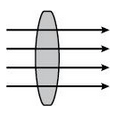
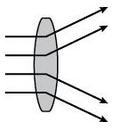
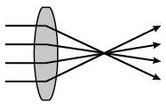
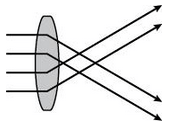
Which lens represents the path light takes through a diverging lens?


Which figure represents the path light takes through a converging lens?