wayground logo

Free Printable Worksheets

Font size

S
M
L
XL
Worksheets

Physical Science Spring Final Review #2

Total questions: 90

Worksheet time: 1hrs 11mins

Name
Class
Date
1.
Which information is needed to determine how fast a truck is traveling?
a)
direction and mass
b)
distance and time
c)
size and speed
d)
time and weight
2.

What is the speed of a runner who runs 400 meters in 40 seconds?

a)

10 meters/second

b)

40 meters/second

c)

100 meters/second

d)

1,600 meters/second

3.
What is the force that causes everything to be pulled down to the Earth?
a)
friction
b)
gravity
c)
balanced
d)
unbalanced
4.
Why does a rolling ball stop?
a)
Gravity
b)
Friction
c)
Waterfalls
d)
Sand
5.

What is the least distance between the starting and ending points?

a)

motion

b)

displacement

c)

reference point

d)

distance

6.

Speed has a direction.

a)

true

b)

false

7.

The formula to determine speed is

a)

change in velocity/change in time

b)

change in distance/change in time

c)

time/distance

d)

distance/time

8.

What is the measurement of change in an object’s velocity?

a)

displacement

b)

distance

c)

acceleration

d)

deceleration

9.

What is the total length of how far you traveled?

a)

speed

b)

velocity

c)

distance

d)

displacement

10.

The velocity of an object is its

a)

speed and direction

b)

displacement

c)

distance

d)

acceleration and distance

11.

Acceleration has a direction.

a)

true

b)

false

12.
Scott travels north 5 miles and then goes west 3 miles before coming straight back south 2 miles. What is his distance?
a)
10 miles
b)
7 miles
c)
8 miles
d)
6 miles
13.
What is magnitude?
a)
The direction that describes a quantity.
b)
A numerical value
c)
A unit of force
14.
A quantity that has both magnitude and direction is called a scalar quantity.
a)
True
b)
False
15.
What is a PUSH or PULL of an object?
a)
Motion
b)
Force
c)
Friction
d)
Gravity
16.
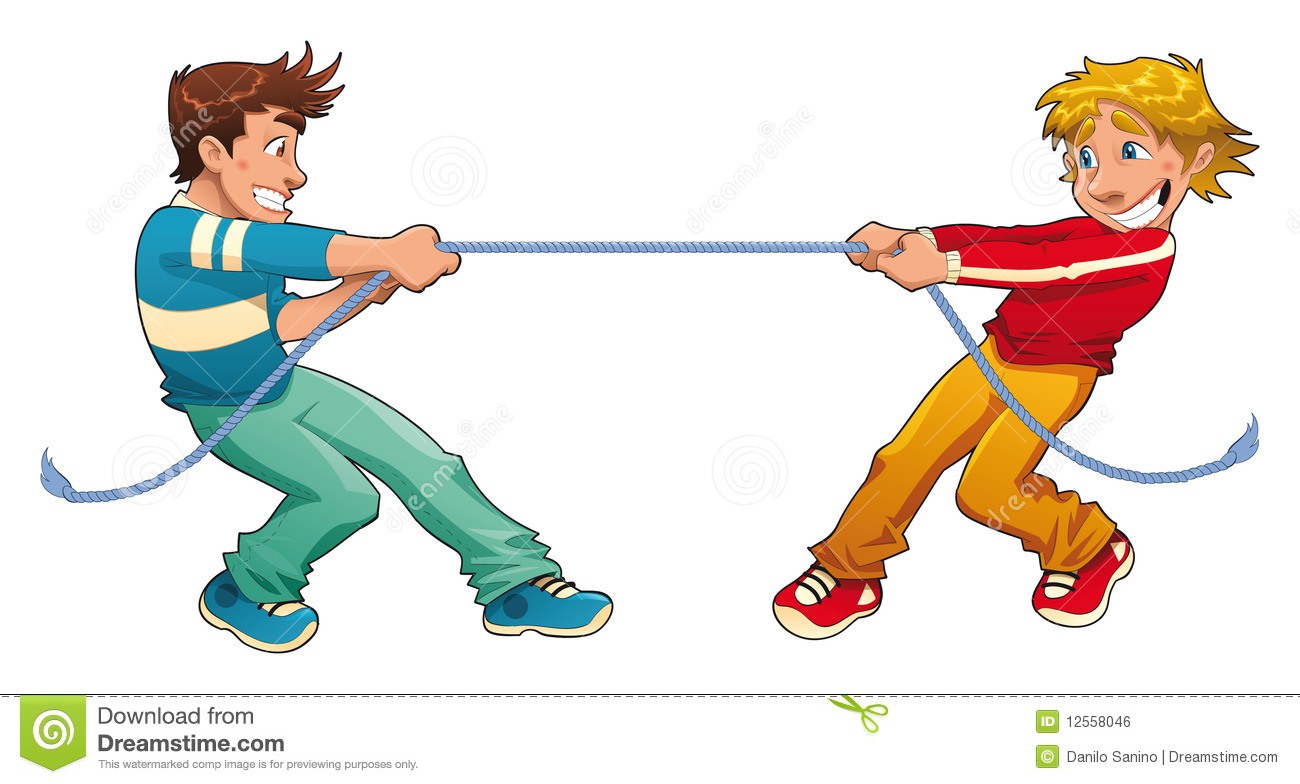
If these boys are pulling with the same amount of force.  What will happen?
a)
The boy in blue will win.
b)
They will not move at all.
c)
The boy in red will win.
d)
Both will fall down.
17.
For every action, there is an equal and opposite reaction.
a)
Newton's
1st
Law of Motion
b)
Newton's
2nd
Law of Motion
c)
Newton's
3rd
Law of Motion
18.
If an object is stationary (not moving) the forces acting upon it are _____________
a)
unbalanced
b)
weak
c)
balanced
d)
Hulk Smash!
19.
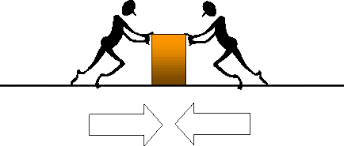
What is the net force
a)
10 N
b)
0 N
c)
25 N
d)
1 N
20.

What does this picture represent

a)

Force,magnetism,acceleration

b)

Force, money, Apples

c)

Force, Mass, Acceleration

d)

Funny, monkeys, Arrive

21.
Force = Mass x Acceleration
a)
Newton's 1st Law
b)
Newton's 2nd Law
c)
Newton's 3rd Law
d)
Newton's 4th Law
22.
The tendency of an object to resist changes in its motion is...
a)
inertia
b)
force
c)
acceleration
d)
velocity
23.
A force that opposes motion between a surface in contact with the atmosphere.
a)
air resistance
b)
gravity
c)
momentum
d)
terminal velocity
24.
The combination of all the forces acting on an object is the...
a)
net force
b)
action force
c)
reaction force
d)
balance force
25.

What is the acceleration of a 50 kg object pushed with a force of 500 newtons?

a)

100 m/s2

b)

25,000 m/s2

c)

10 m/s2

d)

25 m/s2

26.
Which force produces a change in motion?
a)
unbalanced force
b)
balanced force
c)
gravitational force
d)
frictional force
27.
The gravitational force of any object near Earth's surface is ____.
a)
unknown
b)
friction
c)
Newton's first law
d)
9.8 m/s2
28.

On this position vs time graph, describe the motion of A.

a)

constant positive velocity

b)

constant negative velocity

c)

positive acceleration

d)

negative acceleration

e)

velocity is zero

29.

On this position vs time graph, what is the velocity?

a)

40 m/s

b)

8 m/s

c)

5 m/s

d)

0 m/s

30.
Which graph shows the object standing still?
a)
A
b)
B
c)
C
d)
D
31.

The graph shows the distance a student walks down a hall over time. During which time interval was the student moving the fastest?

a)

A

b)

B

c)

C

d)

D

32.

The graph represents the motion of a car over 10 seconds. What is the average speed of the car during the first 4 seconds?

a)

.4 m/s

b)

2.5 m/s

c)

10 m/s

d)

40 m/s

33.

What is the total displacement of the car?

a)

60 m

b)

20 m

c)

0 m

d)

80 m

34.
The faster an object moves, the ________ kinetic energy it has. 
a)
more
b)
less
c)
none of the above
d)
all of the above 
35.
What is being transferred as you do work?
a)
Energy
b)
Heat
c)
Power
d)
Gravitational Potential Energy
36.
How do we calculate work?
a)
W = F * d
b)
w = f * D
c)
W = F * D
d)
w = f * d
37.
How much work is being done with 200 N of force over 426 meters?
a)
85,200 J
b)
45,620 J
c)
90,480 J
d)
62,329 J
38.
The SI unit for power is...?
a)
Watts
b)
Joules
c)
Newtons
d)
Meters
39.
Energy that is stored is called...
a)
Kinetic
b)
Potential 
40.
The energy of movement is...? 
a)
Kinetic
b)
Potential
41.
What is the formula for Gravitational Potential Energy?
a)
PE = m*g*h
b)
KE = 1/2m*v2
c)
W = F*d
d)
P = W/t
42.
What is the formula for Kinetic Energy?
a)
PE = m*g*h
b)
KE = 1/2m*v2
c)
W = F*d
d)
P = W/t
43.

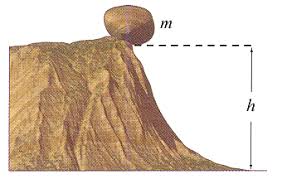
A roller coaster whose average speed is 32 m/s is at the top of a 72m hill and weighs 966N. At the top of the hill the coaster car has ___________________ energy.

a)

only kinetic energy

b)

only potential energy

c)

mostly kinetic energy

d)

both kinetic and potential energy

44.

A 100 N force is applied to move an object a horizontal distance of 5 meters at constant speed in 10 seconds. How much power is done?

a)

50J

b)

50W

c)

500J

d)

500W

45.

How will you describe the energy at Point A?

a)

mostly potential energy

b)

mostly kinetic energy

c)

losing PE, gaining KE

d)

losing KE, gaining PE

46.
Which of these is a measurement of power?
a)
100 joules
b)
100 watts
c)
100 meters per second
d)
100 hertz
47.
Which of the following is true about work?
a)
It measures how quickly an object accelerates
b)
It measures how much effort is applied over a distance.
c)
It measures the change of an object's rate of speed.
d)
It measures how much time it takes to move an object.
48.
True or false: when the distance an object moves is zero the work done on the object is also zero.  
a)
True
b)
False
49.

If you increase your work and decrease your time, you will have

a)

more power

b)

less power

c)

same amount of power

d)

power rating can not be determined

50.

Energy is

a)

how fast you do something.

b)

the ability to do work.

c)

confusing.

d)

how fast you lift something.

51.

What is the kinetic energy of a 10 kg ball moving at 3 m/s?

a)

15 J

b)

30 J

c)

45 J

d)

90 J

52.

What is the mass of an object with 1200 J of PE when it is 5 meters above the ground?

a)

10 kg

b)

24 kg

c)

100 kg

d)

240 kg

53.
In physics, we define work as this
a)
force x time
b)
force x distance
c)
force / time
d)
force / distance
54.
Jack pushes a lawnmower with a force of 25N and performs 250 J of work. How far did he push the mower?
a)
1 meter
b)
1 kilometer
c)
10 meters
d)
none of these
55.
Waves move ___ through vibrations
a)
Energy
b)
Matter
c)
Mass
d)
Weight
56.
Longitudinal waves are ______.
a)
Parallel
b)
Perpendicular
c)
Crazy
57.
Longitudinal waves are ______.
a)
Parallel
b)
Perpendicular
c)
Crazy
58.
Transverse waves are ___.
a)
Parallel
b)
Perpendicular
c)
Weird
59.
What is the wavelength?
a)
Length
b)
Height
c)
# of waves
60.
Which is the wavelength?
a)
1
b)
2
c)
3
d)
4
61.
If the wavelength gets longer, the frequency gets 
a)
higher
b)
lower
62.
The pitch of the sound depends on
a)
frequency
b)
amplitude
c)
wavelength
63.
Which electromagnetic wave is responsible for cell phones?
a)
gamma
b)
xray
c)
microwaves
d)
radio
64.
Is refracting light bending or bouncing?
a)
bending
b)
bouncing
65.
A blue tshirt looks blue because of ___.
a)
reflection
b)
refraction
c)
diffraction
66.
Which color has the highest frequency?
a)
blue
b)
yellow
c)
orange
d)
violet
67.

What is transferred from place to place by waves?

a)

matter

b)

energy

c)

particles

d)

light

68.

What can electromagnetic waves travel through (select all that apply)?

a)

solids

b)

empty space

c)

liquids

d)

gases

69.

Which of the following can a mechanical wave travel through (select all that apply)?

a)

solid

b)

liquid

c)

gas

d)

empty space

70.

Longitudinal waves move __________ to the energy of the wave (select all that apply).

a)

Parallel

b)

Perpendicular

c)

At a 90 degree angle

d)

In the same direction

71.

It is the high pressure part of the wave where the particles are close together. It is part A on this picture.

a)

Compression

b)

Amplituide

c)

Rarefaction

d)

Wavelength

72.

The formula for _________ is λ = v/f.

a)

wavelength

b)

frequency

c)

period

73.

What is the amplitude of a wave?

a)

Where there is no wave movement

b)

The distance the wave oscillates from it's resting position

c)

A disturbance that transfers energy from one place to another

d)

The distance between two corresponding parts of a wave

74.

What is a medium?

a)

The lowest point of a transverse wave

b)

The size of a wave

c)

The middle of a wave

d)

Matter through which a wave travels

75.
The number of wavelengths that pass a point each second
a)
frequency
b)
wavelength
c)
pitch
d)
amplitude
76.

What type of interference is represented in the diagram?

a)

Constructive

b)

Destructive

77.

What type of interference is represented in this diagram?

a)

Constructive

b)

Destructive

78.
What material is a good conductor?
a)
copper
b)
wood
c)
rubber
d)
plastic
79.
What material is an insulator?
a)
coper
b)
silver
c)
gold
d)
plastic
80.
What is the purpose of a generator?
a)
to convert electrical energy to mechanical energy
b)
to convert chemical energy to electrical energy
c)
to convert mechanical energy to electrical energy
d)
to convert mechanical energy to heat energy
81.

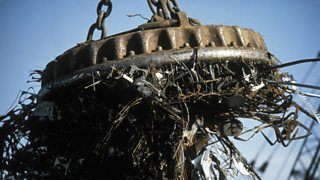
A temporary magnet that only works when electricity is passed through wires surrounding an iron core is called:

a)

electromagnet

b)

galvanometer

c)

induction

d)

super conductor magnet

82.

Voltage is

a)

the potential electrical energy or push that makes electrons flow

b)

causes a short circuit with electrical energy

c)

is the term used for rate of charge flow

d)

Wastes energy by allowing current to flow

83.

A laptop is plugged into a 120 V outlet and uses 60 ohm's of resistance. How much current is running though it?

a)

120 Amps

b)

60 Amps

c)

2 Amps

d)

20 Amps

84.

Electric charges always flow from _____ areas to _____ areas.

a)

positive; negative

b)

negative; positive

c)

neutral; negative

d)

neutral; positive

85.

Which of the following will increase the resistance of a wire?

a)

using a thicker/wider wire

b)

using a shorter wire

c)

increasing the temperature of the wire

d)

using silver instead of copper

86.

What is the current produced by a 9-volt battery flowing through a resistance of 0.2 ohms?

a)

1.8 amps

b)

45 amps

c)

0.022 amps

d)

8.8 amps

87.

Silver has a resistance of 0.0198 ohms. What voltage would produce a current of 100 amps?

a)

1.98 V

b)

0.000198 V

c)

5050 V

d)

100.0198 V

88.

What process is the method by which a neutral object obtains an electrical charge from a distance?

a)

convection

b)

conduction

c)

radiation

d)

induction

89.
If you wrap more coils around an electromagnet, it will become...
a)
brighter
b)
stronger
c)
weaker
d)
invisible
90.
Static electricity is an electric charge caused by friction that can build up on a material or surface. One example of static electricity is:
a)
solar power
b)
magnetism
c)
lightning