
 Worksheets
Physics mid term revision
Total questions: 90
Worksheet time: 1hrs 28mins
Which statement most accurately represents Hooke's Law?
The stretch of a spring is directly proportional to the force applied.
The stretch of a spring is proportional to the number of coils.
The stretch of a spring is inversely proportional to the force applied.
Thickness of a spring wire is proportional to the force applied.

As the hand pulls down on the mass, the spring constant _______, assuming that it doesn't pass the elastic limit of the spring.
increases
decreases
remains constant
needs more information
What force should be applied to compress a spring by 0.05 m if its spring constant is k = 1500 N/m?
75 N
30000 N
7500 N
Which of the following springs is the stiffest?
A spring that requires a force of 2000 N to compress it by 5 m.
A spring that requires a force of 4000 N to stretch it by 10.0 m.
A spring that requires a force of 2400 N to compress it by 4m.
A spring that requires a force of 4800 N to stretch it by 12 m.

What type of force is shown inside of the picture?
Tension
Friction
Elastic
Gravitational
For two or more springs in PARALLEL, the resulting spring constant is given as:
k1=k11+k21+...
k=k1+k2+...
k=k11+k21+...
k1=k1+k2+...
For two or more springs with spring laid in SERIES, the resulting spring constant k is given as:
k1=k11+k21+...
k=k1+k2+...
k=k11+k21+...
k1=k1+k2+...
Ropes, cords, and springs all stretch when you pull them.
True
False
The force in a rope that is being stretched is called ..............................
gravitational potential energy
tension
friction
If something is ................................, it will go back to its original length when you remove the force
nonelastic
elastic
plastic
The amount that something stretches is called the ...............................
extension
intension
friction
The amount that something stretches is called the ...............................
extension
intension
friction
If something is ..............................., and does not go back to its original length after stretching, we say it is plastic.
elastic
not elastic
A bigger force will produce a smaller extension.
False
True
Elastic materials will break if the force applied to them is too big.
True
False

At point P, _______.
the force applied to the spring is equal to its elongation
Hooke's Law ceases to be valid
the spring is can be stretched but still springs back into shape reversibly
the spring constant increases
SI units of angular displacement are
radian
Degree
360 degrees in radians is
π
2π
2π1
3.14
2 cars are moving at the speed of 22 m/s.
the radius of the 1st vehicle's tire is 22 cm
and of the 2nd vehicle's tires is 30 cm. which tire has a greater angular speed?
the 1st car
the 2nd car
2 cars are moving at the speed of 22 m/s.
the radius of the 1st vehicle's tire is 22 cm
and of the 2nd vehicle's tires is 30 cm. which tire has a greater angular speed?
the 1st car
the 2nd car
A bicycle wheel with diameter .43 m rotates at 3 revolutions per second. What is the the linear velocity?
7.1 m/s
64.5 m/s
129 m/s
129 cm/s
Calculate the angular velocity of a car tire with a radius of 0.31m traveling a speed of 22 m/s
71 rad/s
6.81 rad/s
6.81 m/s
68.1 rad/s

At which point(s) is the ball's velocity zero?
A
B
C
D

Calculate the angular frequency of a pendulum with a frequency of 1.2 Hz.
7.54 rad s⁻¹
5.23 rad s⁻¹
1.67 π rad s⁻¹
2.4 π rad s⁻¹

Calculate the angular frequency of a child on a swing that completes 20 cycles in one minute.
2.09 π rad s⁻¹
4.02 rad s⁻¹
2.09 rad s⁻¹
0.48 rad s⁻¹
Calculate the angular frequency of a child on a swing that completes 20 cycles in one minute.
2.09 π rad s⁻¹
4.02 rad s⁻¹
2.09 rad s⁻¹
0.48 rad s⁻¹

What is the frequency of a child on a swing that goes through 12 cycles in 30 seconds?
0.40 Hz
2.5 Hz
1.0 Hz
4.0 Hz

What does T stand for in the formula?
angular frequency
period
frequency
temperature
What does ω stand for in the formula?
angular frequency
period
frequency
temperature

What does f stand for in the formula?
angular frequency
period
frequency
temperature
How many radians make up one revolution of 360 degrees?
π/2
π
2π
3π/2
What is the formula for angular frequency( ω )?
ω=2πT
ω=t2π
ω=2πf
f=2πω
If the body is moving in a circle of radius r with a constant speed v, its angular velocity is
v2 / r
vr
v / r
r / v
Centripetal acceleration is directed
directed away from the center of the circle
directed towards the center of the circle
it is perpendicular to the radius at that point
It has no direction
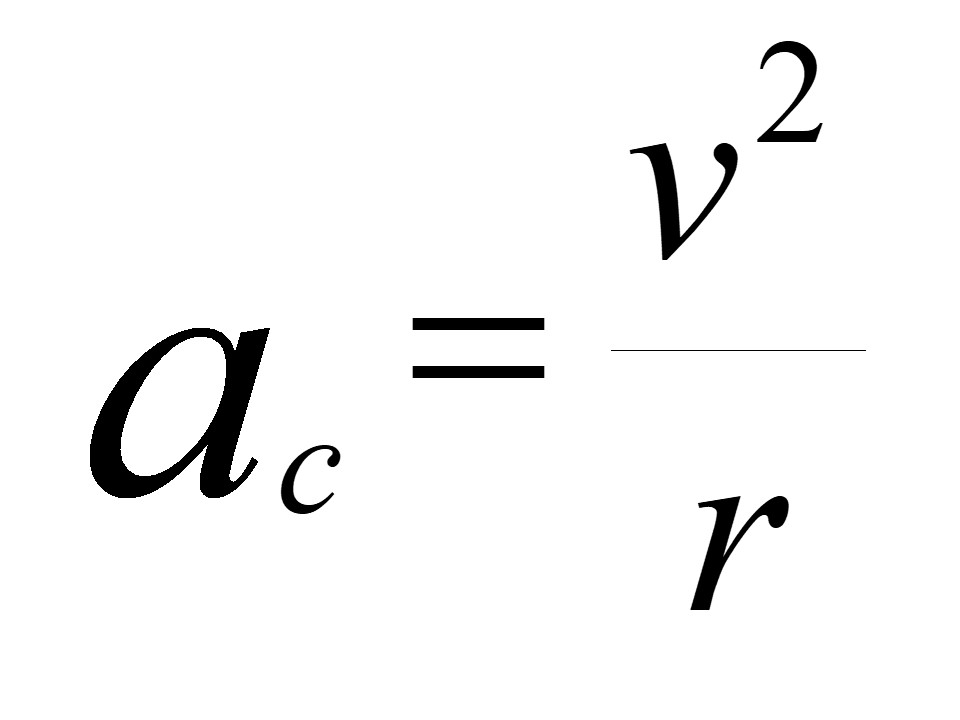
What's the centripetal acceleration of an object traveling 2.3 m/s around a circle of diameter 0.6 m?
5 m/s2
17.63 m/s2
10 m/s2
8.81 m/s2
Where will be the centre of mass of a uniform rod lies ?
At its end
At its middle point
At its centre of its cross sectional area
Depends upon its material
Where the center of mass of a circle lies?
At its centre
Anywhere on its radius
Anywhere on its circumference
Anywhere on its diameter

What is the amplitude of the wave?
3 cm
8 cm
16 cm
24 cm

What is the wavelength of the wave?
3 cm
8 cm
16 cm
24 cm
The number of cycles that are completed per second is called the ________ and is measured in _________.
frequency, Hertz
wavelength, meters
amplitude, meters
period, seconds
The period of a pendulum is 10 s. What is its frequency?
10 Hz
1 Hz
0.5 Hz
0.1 Hz
After closing a deal with a client, Kent leans back in his swivel chair and spins around with a frequency of 0.5 Hz. What is Kent’s period of spin?
120 s
0.0083 s
0.5 s
2 s
A 500g toy train completes 10 laps of its circular track in 1 min 40s. The diameter of the track is 1m. Calculate the period.
0.10 s
0.167 s
10 s
6 s

The diagrams show four solid cones. The centre of mass of each cone is marked by a point labelled M.
Which cone is the most stable
A
B
C
D
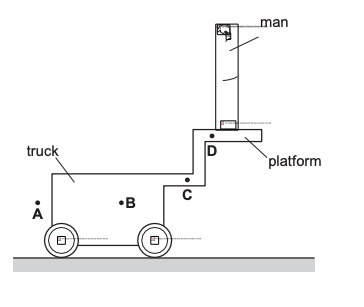
A heavy truck on wheels has a platform to attach to it. A man stands on the platform. The truck does not fall over.
Which position A, B, C, or D could be the centre of mass of the whole system (truck, platform and man) ?
A
B
C
D
A plane lamina with centre of mass X touches the ground at point P. Which diagram shows the lamina in equilibrium?
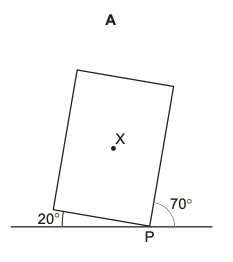
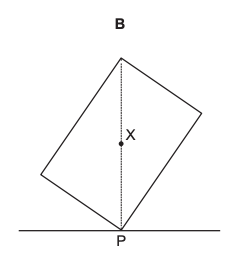
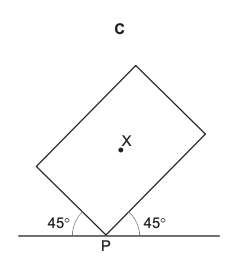
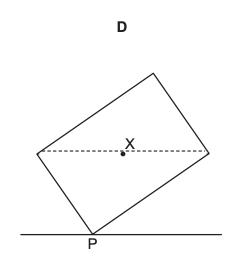

They would cause the bus become unstable
The would cause the bus to slow down
The would increase the kinetic energy of the bus
The would lower the centre of mass of the bus

A
B
C
D


A
B
C
D
How does a person become more stable in relation to my COG?
The higher the COG the more stable you are
If the COG is in the centre of the BOS you are stable
The lower the COG, the more stable you are

The diagram shows a uniform beam being used as a balance. The beam is pivoted at its centre.
A 1.0 N weight is attached to one end of the beam. An empty pan weighing 0.2 N is attached to the other end of the beam.
How many 0.1 N weights must be placed on the pan in order to balance the beam?
5
8
10
12

A heavy beam rests on two supports. The diagram shows the only three forces F1, F2 and F3 acting on the beam.
The beam is in equilibrium.
Which statement is correct?
All the forces are equal in size.
The resultant force on the beam is in the opposite direction to the resultant turning effect.
The resultant force on the beam is zero and the resultant turning effect on the beam is zero.
The total upward force is twice the total downward force.
The point through which the whole weight of the body acts is called
Inertial Point
Center of gravity
Centriod
Central point
Center of gravity of an object depends on it's
weight
mass
density
shape

The center of gravity of the bolt in the picture is in the center of the bolt at the level of the arrow. As it sits on the desk, it is in a(n) ___________________________ position with respect to its center of gravity.
neutral
stable
unstable
irreversible

The center of gravity of the bolt in the picture is in the center of the bolt at the level of the arrow. As it sits on the desk, it is in a(n) ___________________________ position with respect to its center of gravity.
neutral
stable
unstable
irreversible


If the velocity of a car traveling around a circular track doubles, its centripetal acceleration would be
1/2 as great
1/4 as great
2 times greater
4 times greater
An unbalanced force of 40 Newtons keeps a 5 kilogram object traveling in a circle of radius 2 meters. What is the speed of the object?
8 m/s
16 m/s
2 m/s
4 m/s
If a rubber stopper completes 20 revolutions in 10 seconds, what is the period?
0.5 s
2 s
10 s
20 s
Two factors effecting the strength of gravity between 2 objects are...
weight and mass
distance and weight
mass and matter
mass and distance


Formula for weight is
Fg=mg
Fg=r2GMm
Fg=mG
Fg= m
Calculate the gravitational force between two objects when they are 0.750m apart. Each object has a mass of 5.00kg.
2.96x10⁻⁷N
3.00x10⁻⁶N
2.22x10⁻⁹N
2.23x10⁻⁸N
What is the gravitational force between two identical 50,000 kg asteroids whose centers of mass are separated by 1000 m?
2500 N
3.3 x 10⁻¹² N
1.67 x 10⁻⁴ N
1.67 x 10⁻⁷ N
Two spherical objects have masses of 8000 kg and 1500 kg. Their centers are separated by a distance of 1.5 m. Find the gravitational attraction between them
5.4 X 10⁻⁴ N
1.2 X 10⁷ N
3.6 X 10⁻⁴ N
5.33 N
Find the distance between two objects whose masses are m1 = 4,500 kg, and m2 = 8,700 kg; if the gravitational force between them is F = 2.0 x 10⁻⁸ N.
130565.25 m
361.34 m
0.19575 m
0.783 m
What is the value of gravitation constant...
3×10⁸ ms−1
6.67 ×10⁻¹¹ Nm2kg−2
6.63×10⁻⁹ Nm2
A inversely proportional relationship between two parts of an equation means:
One part grabs the top part of a halfpipe and stands upside down on a skateboard or snowboard
One part is quiet, kinda keeps to themselves, isn't really outgoing to socialize with others, but is okay with it all and is more comfortable in smaller group settings.
If one increases in value, the other decreases in value
If one increases in value, the other increases in value
Which diagram best shows the gravitational interaction between Earth and a satellite?



