
 Worksheets
Final Exam Review
Total questions: 90
Worksheet time: 1hrs 13mins

If each of the transverse waves are travelling through the SAME medium, which wave has the highest frequency?
1
2
3
4
Which diagram shows the wavelength of a wave?


What does a wave carry from the wave's source to the wave's destination?
energy
matter
people
energy and matter
The lowest point on a transverse wave is the
compression
crest
rest position
trough
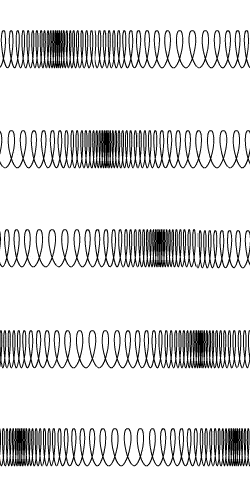
What type of wave is this?
Longitudinal
Transverse
Electromagnetic
x ray

Which of the following is NOT a mechanical wave?
sound
light
ocean
seismic

Sound waves can't travel in outer space because in outer space there is no
medium
light
energy
heat

The highest point on a wave is:
the crest
the trough
the top
the coast

All colors of light will be reflected
All colors of light will be transmitted
All colors of light will be absorbed
None of the above

Which electromagnetic radiation has the longest wavelength?
infrared
gamma
radio
ultraviolet
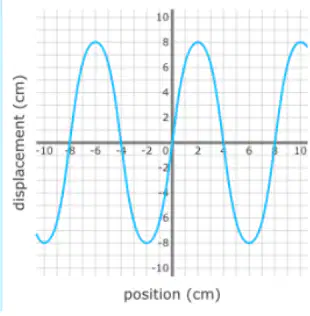
What is the amplitude of the wave?
8 m
4 m
16 cm
2 cm
Which material would an earthquake travel fastest in?
Air (density=0.001)
Water (density=1)
Iron (density=8)
Granite (desnity=3)
V=fλ
If the frequency is 5 Hz and the wavelength is 2 m, then what is the wave's velocity?
10 m/s
5/2 m/s
2/5 m/s
7 m/s

Which process bent the P-waves away from seismic station B? Note the Mantle and Core are different materials.
refraction
reflection
convection
conduction

When energy of a seismic wave increases, what happened to the amplitude of the wave?
Increases
decreases
stays the same

What is the relationship between frequency and wavelength?
high frequency --> short wavelength=same speed
high frequency --> long wavelength=faster speed
low frequency --> short wavelength=slower speed
there is no relationship
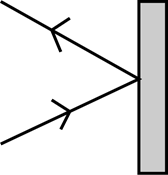
In the illustration, the light ray striking the object is-
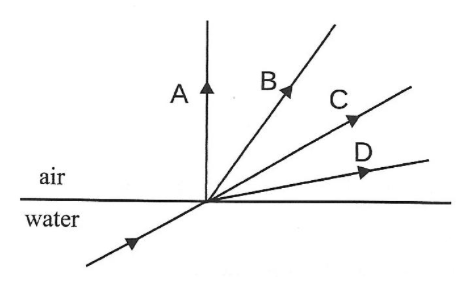
A light ray is incident from (slow) water to (fast) air. Which of the refracted rays is correct?
A
B
C
D

What type of interference is represented in the diagram?
Constructive
Destructive

What type of interference is being shown in the picture?
Constructive
Destructive

What color of light has the greatest energy per photon?
Red
Green
Blue

The energy of photoelectrons emitted from a metal surface can be increased by
using light of higher frequency.
using light of longer wavelength.
using light of higher intensity.
using monochromatic, polarized light.

Photoelectric effect provides the evidence for the ______ nature of radiation.
dual
wave
particle
electromagnetic

What is a nebula, the cloud that a star is formed in, mostly made of?
hydrogen
helium
oxygen
iron

What color of star is the coolest (has the lowest energy)?
Red
Yellow
Blue
White

Larger stars (stars with more mass) will.
Have a longer lifespan because they have more fuel to burn
Have a shorter lifespan because the pressure of gravity causes them to burn fuel faster

The Sun produces energy by FUSING hydrogen atoms into ____ atoms.
Carbon
Helium
Iron
Uranium
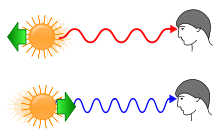

Is Galaxy A is
Red shifted and moving Away
Is Blue shifted and moving Towards us
Stationary
Is Red shifted and is moving Towards us
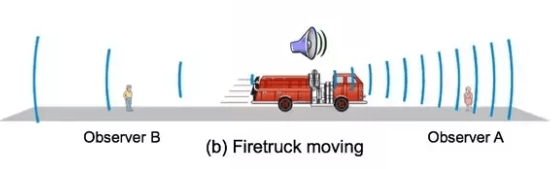
Look at the picture. Who is experiencing a lower frequency sound?
Observer A (who sees the firetruck moving closer)
Observer B (who sees the firetruck moving away)
There is no difference

What is the Doppler Effect?
A change in frequency due to the relative motion of a wave source and an observer
When a wave overlaps with another wave
When a wave bounces off of another object
When a wave bends due to traveling through a different medium

Why does light refract when it travels through a medium with a different optical density?
It changes its speed entering the new medium
It is reflected away from the material
Light gets absorbed
Light is absorbed and reflected leading to refraction
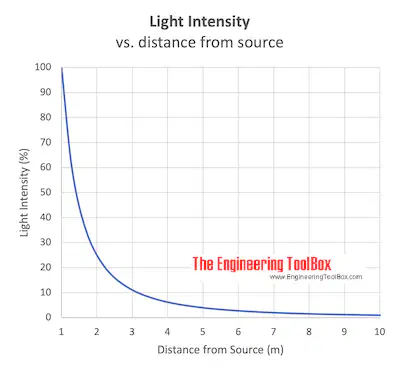
Which statement is correct?
The illuminance (brightness) is directly proportional to the square of the distance from the light source.
The illuminance (brightness) is inversely proportional to the square of the distance from the light source.
The illuminance (brightness) is not related to the distance from the light source.

Less prone to interference
Requires less power
Travels Farther
Carries more detailed information

Digital signals are better than analog signals because:
They are easy to transmit electronically
They take less storage space
They don't transmit signal noise
All of the above

I'm trying to convert an analog music recording to digital. If my sample rate is low (it takes me more time to take samples) the quality of the sound will be.....
Poor quality
High quality
Which electromagnetic radiation has the highest frequency (and photon energy)?
infrared
gamma
radio
ultraviolet

An object becomes positively charged by
losing protons
gaining electrons
losing electrons
gaining protons
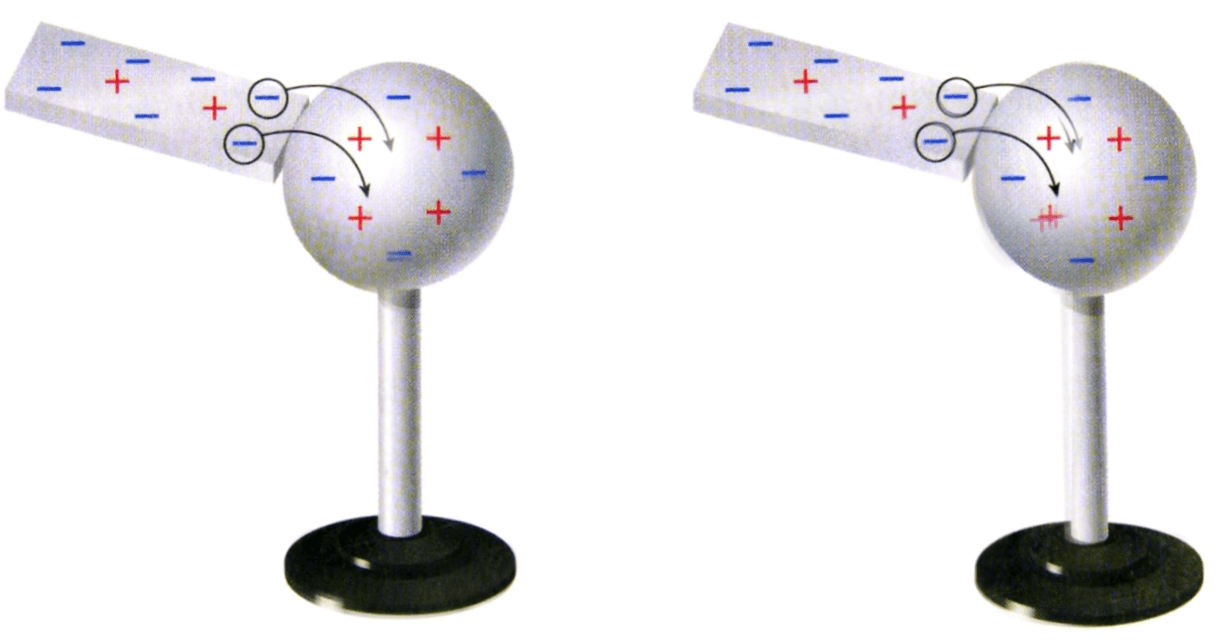

Charging by Friction results in two objects with the same charge.
True
False
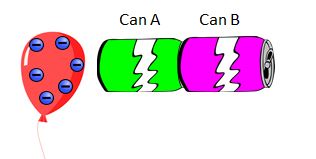
The negative charges in Can B move towards the negative balloon
The negative charges in Can A move away from the negative balloon
The positive charges in Can B move towards the negative balloon
The positive charges in Can A move away from the negative balloon

Materials through which electrons move easily:
insulators
conductors
polarizers
plastics

Which of the following exhibit inverse-square behavior?
Light spreading from a bulb.
The Sun's gravitational affect on the solar system.
Electric field around a Van der Graaff generator.
All of the above.

If the charge on one of the objects is doubled, what would happen to the force?
It would double in magnitude but remain in the same direction.
It would quadruple in magnitude but remain in the same direction.
It would double in magnitude and reverse direction.
It would quadruple in magnitude and reverse direction
If the two objects were twice as far apart, what would happen to the force between them?
It would increase by a factor of 4.
It would increase by a factor of 2.
It would decrease by a factor of 2 .
It would decrease by a factor of 4 .

If a grounding wire is touched to a positively charged object to discharge it,
electrons would flow from the Earth to the object.
electrons would flow from the object to the Earth.
protons would flow from the Earth to the object.
protons would flow from the object to the Earth.

The girl's hair and the comb are attracting one another. The hair and the comb have
opposite charges, because the force of attraction on the girl's hair is larger than the force of attraction on the comb
like charges, because the force of attraction on the girl's hair is larger than the force of attraction on the comb
like charges, because the force of attraction on the girl's hair is smaller than the force of attraction on the comb
opposite charges, Newton's third law says that the force of attraction on the comb and the girl's hair are equal


When the electroscope is charged by touching it with a charged object, this is called ____.
charging by conduction
charging by induction
energizing
grounding

Insulators are different than conductors in that insulators ____.
do not contain electrons or protons
do not contain any charge
have a weaker affinity for electrons
do not allow charge to freely move


What method of charging is depicted here? (note the positive rod does NOT touch the neutral metal sphere)
Induction
Conduction
Reduction
Friction


What does it mean when the electric field lines are close together?
the field is positive
the field is negative
The field is strong
the field is weak

What must occur for a magnetic field to create the voltage that pushes the electrons through the lightbulb?
The magnetic field must be really big in the loop of wire
The magnetic field must be stable in the loop of wire
The magnetic field must be changing through the loop of wire

What makes a charged balloon stick to the wall?
Protons transferred to the balloon when it was rubbed on metal.
Electrons on the surface of the balloon push away electrons in the wall, leaving a positively charged area.
The rubber in the balloon has a magnetic field that pulls on the wood in the wall.
Electricity in the balloon creates a magnetic field that attracts the metal in the wall.


series so the current through all of the devices is the same
parallel so the current through all of the devices is the same
series so the voltage across all of the devices is the same
parallel so the voltage across all of the devices is the same

A subatomic particle that has a negative charge
electron
proton
ion
neutron

parallel so the voltage across all of the devices is the same
series so the voltage across all of the devices is the same
parallel so the current through all of the devices is the same
series so the current through all of the devices is the same

This particle is
positively charged
negatively charged
neutral
polarized
Using the equation E=kQ/d2, If the distance (d) from the charge generating the field increases by 3x, how does that affect the field (E) at that point?
It will be 3x greater
It will be 9x greater
It will be 1/9 as strong
It will be 1/6 as strong

Candice learns that all magnets have two magnetic poles. Which of the following observations would best support this statement?
When a bar magnet is cut in half, each half has a north pole and a south pole.
the north pole of a compass needle is attracted to the south pole of a bar magnet
when an electric current flows through a wire, a magnetic field forms around the wire
the strength of a horseshoe magnet’s magnetic field decreases as the magnet is pulled away from another object


Which statement below best describes these pictures?
A is the strongest magnet
C is the strongest magnet
B is the strongest magnet

Add more coils of wire to the nail.
Use a smaller battery.
Increase the distance between the loops in the coil.
Remove the nail.

As the magnet moves through the wire loop,
an electric current is created through the wire
the wire loop becomes a South Pole
the magnet changes polarity
nothing happens

Which diagram below best represents the magnetic field near a bar magnet?
A
B
C
D

If the magnet is left at rest inside the coil, the resistor R (lamp)
will be on
will be off
will be unpredictable
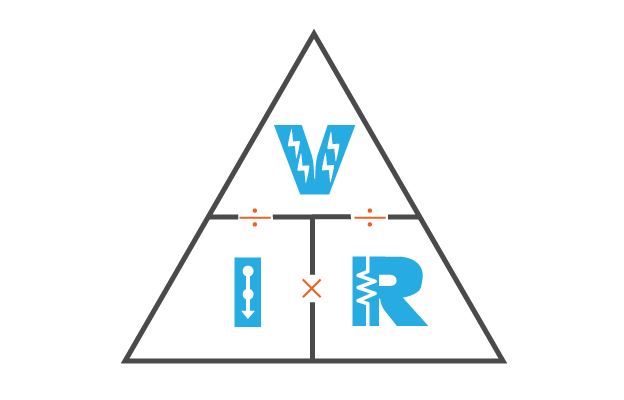
The current in a hair dryer measures 15.0 Amps. The resistance of the appliance is 8.0 ohms. What is the voltage?
120 V
0.5 V
7.0 V
1800 V

Which of the following statements describes the interaction between magnetic poles?
Like poles attract each other.
Like poles repel each other, and opposite poles attract each other.
Opposite poles repel each other.
Like poles attract each other, and opposite poles repel each other.
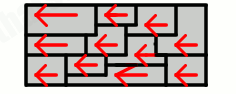

What would increase the strength of an electromagnet?
Changing the direction of the current
Increased the current that flows through the wire.
Inserting a wooden core inside the coil
Decreasing the number of coils of wire
If a substance has a higher number of protons than electrons, what type of charge does it have?
A positive charge.
A negative charge.
A neutral charge
No charge at all

Which graph best represents the relationship between the magnitude of the FORCE and the DISTANCE between two oppositely charged particles?


The graph shows the relationship between CHARGE and FORCE. What type of relationship is this?
Direct
Indirect
Inverse
Reverse

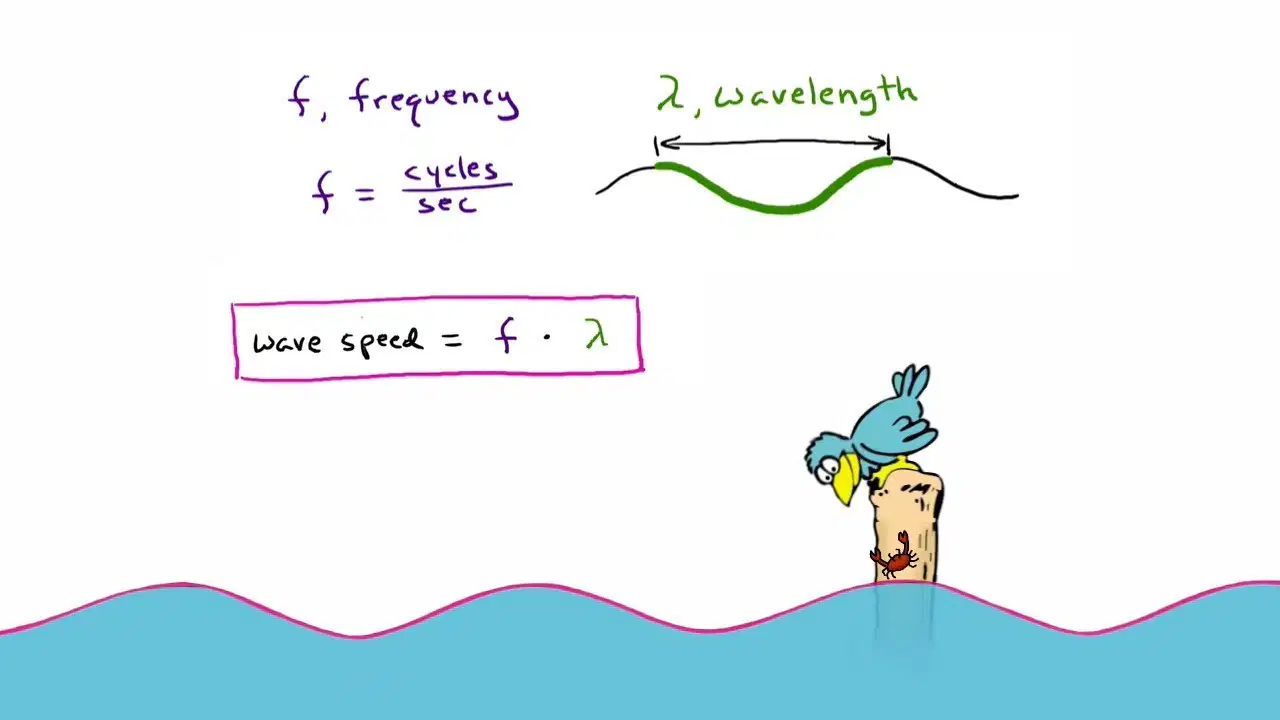
How can you increase the speed of seismic wave?
Increase the wavelength
Increase the frequency
Increase the amplitude
Increase the density
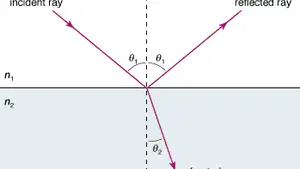
What happens when a wave hits a boundary with a material that slows it down?
The wave REFLECTS at an equal angle and REFRACTS at a smaller angle
The wave REFLECTS at an equal angle and REFRACTS at a larger angle
The wave only REFLECTS
The wave only REFRACTS
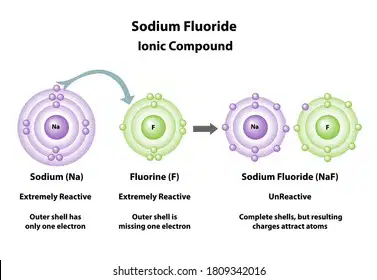
A fluorine ion has 9 protons and 10 electrons. What is its charge?
0
+
-

What happens if two objects have the same charge?
the objects attract
the objects repel
charges are transferred
electrical discharge will occur

Oppositely charged objects will
Repel
Attract
Have no effect on one another

What happens to the voltage as the you move closer to a negative charge?
It becomes more negative
It becomes less negative
There is no change

The red sphere has a charge of +2, the blue sphere has a charge of -1. How does the force on the red sphere compare to the force on the blue sphere?
The red sphere has a larger charge so it has a larger force.
The blue sphere has a smaller charge so it has a smaller force
Newton's 3rd Law tells us the forces are equal and opposite
There is no way to tell without knowing the distance
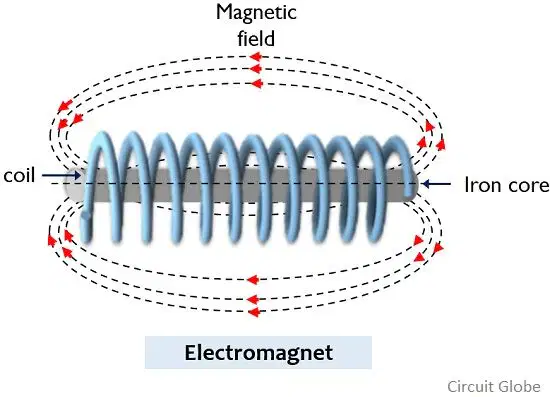
Where is the north pole
To the LEFT of the electromagnet
ABOVE the electromagnet
BELOW the electromagnet
To the RIGHT of the electromagnet
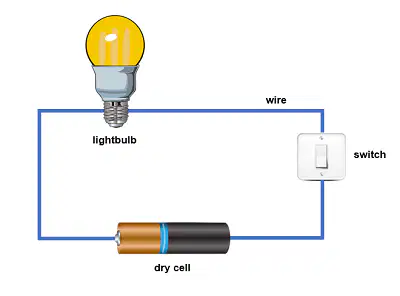
What device causes current to flow through the light bulb?
The switch
The voltage difference of the dry cell
The resistance in the lightbulb
The wire

