wayground logo

Free Printable Worksheets

Font size

S
M
L
XL
Worksheets

Force Test Review

Total questions: 88

Worksheet time: 3hrs 58mins

Name
Class
Date
1.
What is the net force?
a)
20 N 
b)
0 N 
c)
400 N 
d)
40 N 
2.

What is the unit to MEASURE force?

a)

Kilogram

b)

Meter

c)

Pounds

d)

Newton

3.

A ____________ is a push or a pull on an object.

a)

friction

b)

force

c)

magnet

d)

gravity

4.
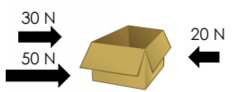
What is the net force?
a)
10 N
b)
0 N
c)
25 N
d)
1 N
5.
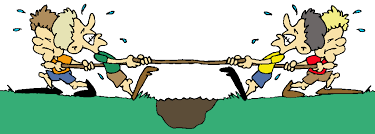
If these teams are pulling with the same amount of force what will happen?
a)
The boy in blue will win.
b)
They will not move at all.
c)
The boy in red will win.
d)
Both will fall down.
6.
Balanced or unbalanced?
a)
balanced
b)
unbalanced
7.

Forces that have a net force of zero Newtons

a)

Balanced force

b)

Unbalanced force

8.
What will cause an object to move?
a)
Applied forces
b)
Balanced forces
c)
Unbalanced forces
9.
Balanced or Unbalanced?
a)
Balanced 
b)
Unbalanced
10.
When forces are _________ the object DOES NOT move.
a)
unbalanced
b)
balanced
c)
heavy
d)
light
11.
What is the net force of an object that is not moving?
a)
0 N
b)
100 N
c)
Upward force
d)
10 N
12.
Calculate the Net Force. 
a)
60N, Left 
b)
40N, Right 
c)
0N
d)
60N, Right
13.
Calculate the Net Force. 
a)
40N, Left
b)
40N, Right
c)
0N, Balanced
d)
75N, Right
14.
You and your dad are moving the couch from one side to another. Your dad pushes with a force of 35 N to the right and you push with a force of 25 N right. What is the net force on the couch?
a)
60 N right
b)
10 N left
c)
60 n right
d)
50 N left
15.
What is the net force?
a)
400 N Up
b)
400 N Down
c)
- 400 N Down
d)
800 N Down
16.

Which example would be a balanced force?

a)

Train moving at a constant speed in the same direction.

b)

A skier going down a hill.

c)

A basketball being passed to a teammate.

d)

An apple falling to the floor.

17.

Two forces act on an object to the right at the same time. What force is required to bring the object into equilibrium?

a)

9 N to the right

b)

9 N to the left

c)

3 N to the left

d)

18 N to the left

18.
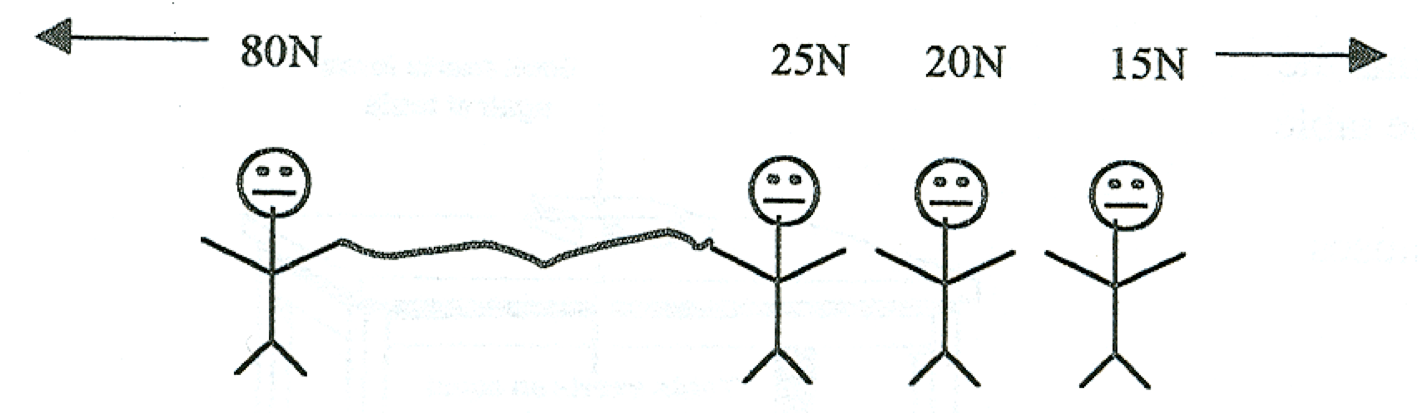
Who wins the tug of war with what net force?
a)
The person on the left with 20 N
b)
The person on the left with 80 N
c)
The people on the right with 20 N
d)
The people on the right with 100 N
19.
What is the net force in this picture?
a)
50 Newtons to the right
b)
950 Newtons to the right
c)
950 Newtons to the left
d)
50 Newtons to the left
20.
What is the net force?
a)
5000 N right
b)
4000 N right
c)
40 N left
d)
4000 N left
21.
Balanced forces do not change the objects speed or 
a)
direction
b)
distance 
c)
time
d)
mass
22.

How do you find the net force of this image.

a)

Add up all the arrows

b)

Add a green arrow and the orange arrow.

c)

Subtract all the arrows.

d)

Add the green arrows and subtract the orange arrow.

23.

Which one of Newton's laws is shown

a)

3rd law

b)

2nd law

c)

1st law

24.

Which one of Newton's laws are displayed

a)

2nd law

b)

1st law

c)

3rd law

25.

Which of Newton's laws is shown

a)

1st law

b)

3rd law

c)

2nd law

26.

This is Newton's 3rd law

a)

True

b)

False

27.

This is Newton's 2nd law

a)

True

b)

False

28.

An object in motion will stay in motion and an object at rest will stay at rest unless acted upon by an outside force. Which law does this describe

a)

2nd law

b)

1st law

c)

3rd law

29.

If there is a big mass, it would need a stronger force to accelerate it. Which law does this describe?

a)

3rd law

b)

1st law

c)

2nd law

30.

What force slows objects down and keeps them from moving?

a)

Acceleration

b)

Gravity

c)

Friction

d)

Net Force

31.

A squirrel sits on the ground and eats a donut. We know the forces on him must be balanced because...

a)

Forces are always balanced

b)

the squirrel is not accelerating

c)

squirrels are projectiles

d)

he's eating a donut

32.
What is the attractive force that exists between all objects that have mass?
a)
Weight
b)
Mass 
c)
Gravity
d)
Viscosity
33.
a)
1st
b)
2nd
c)
3rd
34.
The formula 
? = mass x acceleration
or 
? = m x a 
is used to find 
a)
Force
b)
Velocity
c)
Momentum
d)
Gravity
35.
What is Newton's First Law
a)
F=ma
b)
Every action has an equal and opposite reaction
c)
An object at rest stays at rest, an object in motion stays in motion. 
d)
Friction 
36.
Newton's third law states that any action will have a(n) _______ and ______ reaction
a)
Equal and similar
b)
Equal and opposite
c)
Equal and different
d)
Greater and opposite
37.

You push against a wall and the wall is pushing back on you.

a)

Newton's 1st Law

b)

Newton's 2nd Law

c)

Newton's 3rd Law

38.

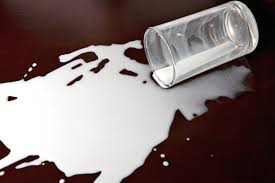
You are carrying a lunch tray when you bump into the edge of a table. Although the tray did not tip, your milk falls off of the front of the tray.

a)

Newton's

1st

Law of Motion

b)

Newton's

2nd

Law of Motion

c)

Newton's

3rd

Law of Motion

39.
Why is it harder to push a van filled with bowling balls than it is to push a van with basketballs?
a)
The mass of the car is greater than the mass of the basketballs
b)
The mass of the bowling balls is greater than the mass of the basketballs
c)
The van with the basketballs is bigger than the van with the bowling balls
d)
It should be equally as hard to push the two vans
40.
What is the acceleration of an object traveling at a constant velocity?
a)
10 m/s2
b)
0 m/s2
c)
250 m/s2
d)
20 m/s2
41.
What is Newton's First Law known as? The Law of
a)
Friction
b)
Mass
c)
Inertia
d)
Gravity
42.
What are the appropriate units to describe acceleration?
a)
m/s
b)
m/s2
c)
cm
d)
there are no units associated with acceleration
43.
You hit a wall with a stick.  The equal but opposite reaction is _____
a)
the wall pushes against you
b)
the stick pushes against you
c)
you push against the stick
d)
the wall pushes against the stick
44.
A 20 kg bike accelerates at 10 m/s2.  what was the force
a)
25 Newtons
b)
20 Newtons
c)
200 Newtons
d)
10 Newtons
45.
How much force is needed to accelerate a 3kg skateboard at 5m/s2?
a)
8N
b)
1.6N
c)
0.6N
d)
15N
46.
If a 10 kilogram object accelerates suddenly at 15 m/s^2, how much force was applied to the object?
a)
150 Newtons
b)
15 Newtons
c)
150 kilograms
d)
100 kilograms
47.

If the man pushes with an equal amount of force, which object will accelerate more?

a)

Car because it has more mass

b)

Lawnmower because it has less mass

c)

Car because it has less mass

d)

Lawnmower because it has more mass

48.
How much force is needed to accelerate a 2 kg physics book to an acceleration of 6 m/s/s?
a)

36 N

b)

12 N

c)

3 N

d)

0.33 N

49.
When force is 20 N, mass is 5 kg, what is acceleration?
F = ma
a)

25 m/s/s

b)

5 m/s/s

c)

100 m/s/s

d)

4 m/s/s

50.

Match the following:

a)

1.

Newton's 1st Law

b)

2.

Newton's 2nd Law

c)

3.

Newton's 3rd Law

d)

4.

Puppy

51.
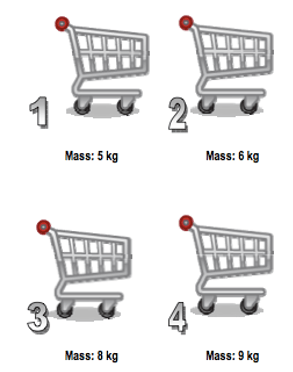
A force of 90N is applied to each cart below, which one will accelerate the fastest?
a)
Cart 1
b)
Cart 2
c)
Cart 3 
d)
Cart 4
52.

A ball has an acceleration of 8 m/s2. If the force is tripled, the ball's new acceleration will be:

a)

24 m/s2

b)

11 m/s2

c)

unchanged

d)

2.67 m/s2

53.

These two force arrows are acting on an object. The net force (in N) acting on this object is:

a)

16

b)

12

c)

28

d)

4.0

54.
If an object was accelerating at 10 m/s^2, and a force of 10 newtons was required to accelerate it, what was the object's mass?
a)
1 kilogram
b)
10 kilograms
c)
2 kilograms
d)
5 kilograms
55.
If a force of 26 N is exerted on two balls, one with a mass of 0.52 kg and the other with a mass of 0.78 kg, which ball will have the greater acceleration?  (F=ma)
a)
The one with a mass of .78 kg will have the greatest acceleration.
b)
The one with a mass of .52 kg will have the greatest acceleration.
c)
They will both accelerate at the same rate.
56.
The amount of matter in an object is 
a)
pressure
b)
weight
c)
mass
d)
force
57.
Which of the following never changes no matter where in the universe?
a)
weight
b)
force
c)
mass
d)
pounds
58.
A person would weigh less on on the Moon than on the Earth because . . .
a)
Moon has more mass, and therefore more gravity
b)
Moon has less mass, and therefore more gravity
c)
Moon has more mass, and therefore less gravity
d)
Moon has less mass and therefore less gravity
59.
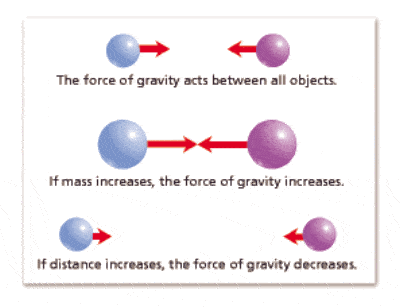
As mass increases, what happens to gravitational force?
a)
increases
b)
decreases
c)
stays the same
d)
i don't know
60.

Does mass change depending on the location?

a)

Yes

b)

No

61.

Does weight change depending on the location?

a)

Yes

b)

No

62.
Who said that falling objects fall at the same rate?
a)
Galileo
b)
Kepler
c)
Brahe
d)
Copernicus
63.

What is weight?

a)

The force of attraction between you and the Earth

b)

The amount of matter inside you

64.

In physics, weight is also known as:

a)

the force of gravity

b)

mass

c)

a push

d)

friction

65.

The standard unit of measurement for mass is the

a)

kilogram

b)

Newton

c)

killergram

d)

meter

66.

A baseball has a mass of 0.145kg, what is the gravitational attraction to the Earth?

a)

0.145N

b)

1.45N

c)

14.5 N

d)

9.8 N

67.

An object has a gravitational force of 100N. What is the mass of the object?

a)

100kg

b)

10kg

c)

1kg

d)

9.8 kg

68.

Mr. Malvik weighs about 700N on Earth. How would you calculate his mass?

a)

Divide by 700N by 9.8N/kg

b)

Multiply 700N by 9.8N/kg

c)

Add 700N + 9.8N/kg

d)

That's an impossible task

69.

If a bug hitting into the windshield of a car is the "action," what is the reaction?

a)

The car experiences an equal strength force from the bug

b)

The bug goes SPLAT

c)

The driver panics and needs to clean the windshield

70.

A bug hits into the windshield of a car. How do the forces on the bug and windshield compare?

a)

The force on the bug is greater

b)

The force on the windshield is greater

c)

The forces on the bug and windshield are equal in magnitude.

71.

A soccer ball breaks through a window. How does the force on the window compare with the force on the ball?

a)

The ball experiences a greater force

b)

The window experiences a greater force

c)

The window and ball experiences forces equal in magnitude

72.

Match the following Types of Friction to their descriptions

a)

1.

Static Friction

b)

2.

Sliding Friction

c)

3.

Fluid Friction

d)

4.

Rolling Friction

73.
What are 2 factors that determine the amount of friction between 2 objects?
a)
Force and roughness between surfaces
b)

The color and brightness of the objects

c)

How smelly or not smelly the objects are

d)

Whether Grogu is using his levitation powers or not... May the Force be with you, always!

74.

Rough surfaces have _________ compared to smoother surfaces.

a)

greater friction

b)

less friction

c)

the same level of friction

d)

no friction

75.

Which would NOT be a way of reducing friction?

a)
making the surfaces smoother
b)
using lubricants such as waxes, oils, or grease
c)
changing from sliding friction to rolling friction using ball bearings
d)
Using kitty litter on snow and ice to help your car gain traction
76.

Friction is a force that acts in a/an ___________ direction of movement.

a)
similar
b)
opposite
c)
parallel
d)

upward

77.

It is difficult to walk on an oily floor because

a)

Force of friction is very less

b)

Force of friction is very high

c)

we don't like to walk on oily floor

d)

None of these

78.
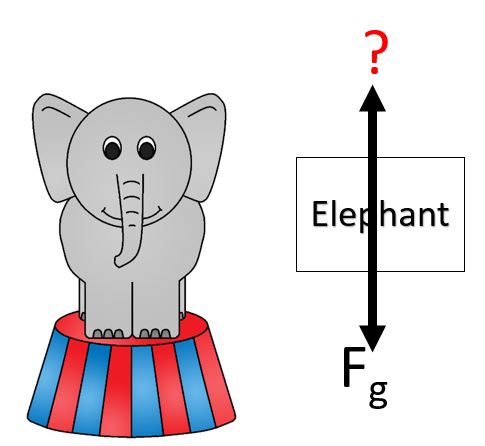
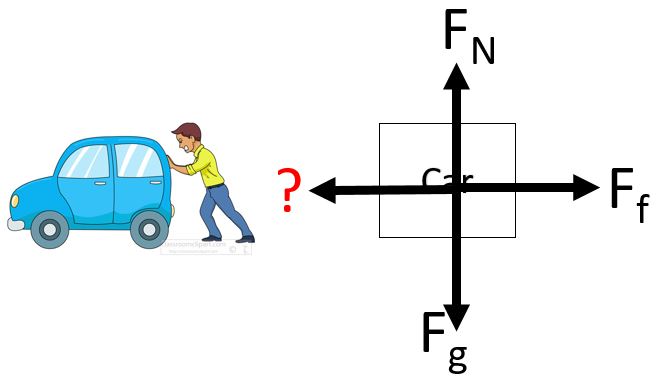
Name the missing force...
a)
weight force
b)
normal force
c)
applied force
d)
frictional force
79.
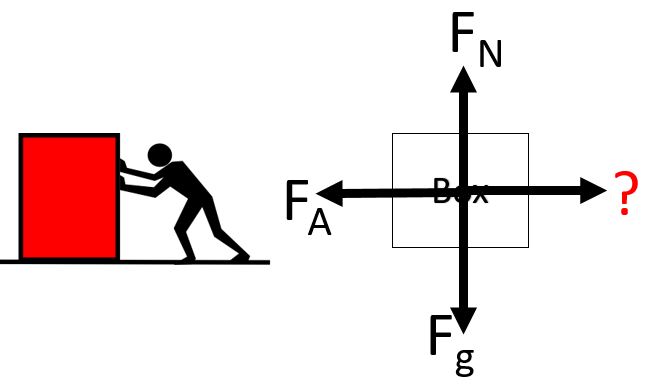
Name the missing force...
a)
applied force
b)
weight force
c)
tension force
d)
drag
80.
Name the missing force...
a)
frictional force
b)
weight force
c)
thrust
d)
buoyant force
81.
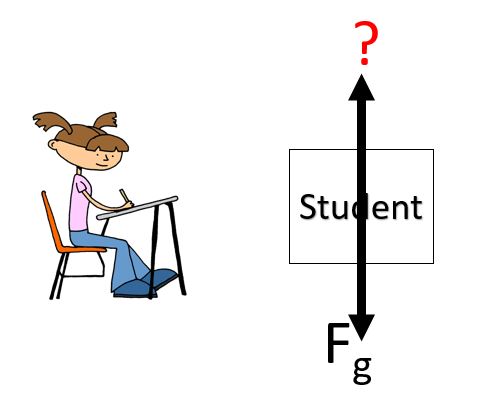
Name the missing force....
a)
weight force
b)
normal force
c)
frictional force
d)
tension force
82.

Whenever an object is moving, there is always this force opposing the motion:

a)

inertia

b)

momentum

c)

friction

d)

applied force

83.

If an object is moving to the right, this force is pushing or pulling to the left:

a)

friction

b)

applied

c)

normal

d)

tension

84.

The force that keeps objects on top of surfaces instead of letting them sink into the surface is known as:

a)

normal

b)

abnormal

c)

static

d)

inertia

85.

What is the NET FORCE of this diagram?

a)

17 N, right

b)

17 N, left

c)

23 N, right

d)

12 N, up

86.

The down-arrow in this diagram is most-likely:

a)

gravity

b)

normal

c)

a push or pull

d)

friction

87.
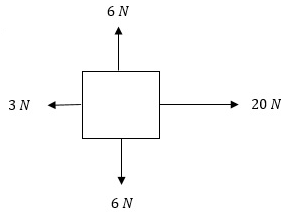
What is the net force?
a)
17 N Right
b)
3 N Right
c)
3 N Left
d)
17 N Left
88.
Match description with free-body diagram.
a)
A book is at rest on a tabletop.
b)
A gymnast holding onto a bar, is suspended motionless in mid-air. The bar is supported by two ropes that attach to the ceiling. Diagram the forces acting on the combination of gymnast and bar.
c)
An egg is free-falling from a nest in a tree. Neglect air resistance.
d)
A flying squirrel is gliding (no wing flaps) from a tree to the ground at constant velocity. Consider air resistance.