Worksheets
Year 10 Physics revision
Total questions: 86
Worksheet time: 14hrs 20mins

Energy is:
The ability to do work
The amount of power
Movement
Causing things to happen
Kinetic energy is
Stored energy
Force acting on objects
Associated with movement
Measured in speed
Potential energy is:
A type of kinetic energy
A fuel
Associated with movement
Stored energy

What type of energy is in this picture?
Kinetic energy
Rubber energy
Elastic energy
Stored energy

When glow sticks snap, they produce a glow. What energy transformation takes place?
Thermal to light
Light to radiant
Potential to heat
Chemical to light
Energy is neither created or destroyed, it is simply transferred between objects or transformed into
(a)
Work is:
The amount of energy used in creating a force
The amount of energy used in moving an object
The amount of energy used in creating power
Annoying

The following scenario relates to a rollercoaster:
When at the top of a hill, a cart has _________ energy, as it travels down the track, it has _______ energy.
Kinetic, potential
potential, generational
potential, kinetic
kinetic, exhilirating

What type of energy transformation would occur when a piece of wood is burnt?
Electrical energy is released as radiant energy
Mechanical energy is stored as chemical energy
Stored chemical energy is released as thermal energy
No transformation occurs
What energy transformation would occur in a toaster?
Electrical to thermal
Thermal to mechanical
Radiant to electrical
Solar to thermal
If the speed of an object increases, what also increases?
Potential energy
Kinetic energy
Select the following which demonstrate a change from kinetic energy to potential energy?
A sled sliding up a hill
A ball that is thrown into the air
A car driving down a hill
A rubber band being stretched
Which of the following is not a type of energy?
Mechanical
Gravitational
Electrical
A wave
Energy released when atoms split or join together is called
Gravitational
Nuclear
Elastic
Chemical
Energy made available through the flow of electric current is called...
Sound
Elastic
Radiant
Electrical
heat always transfers from
right to left
left to right
hot to cold
cold to hot
The energy conversion in a flashlight is _____________ ->_____________-> light + thermal energy
chemical energy > electrical energy
electrical energy > chemical energy
Neuclear energy > chemical energy
gravitational potential energy > kinetic energy
what is the law of conservation of energy
energy can be created but cannot be destroyed
energy cannot be created or destroyed, but it can be transformed
energy can be destroyed but not created
energy cannot be created destroyed or transformed
what is the energy conversion in a hydroelectric power station?
gravitational potential energy > kinetic energy > electrical energy
kinetic energy > thermal energy > electrical energy
gravitational potential energy > thermal energy > electrical energy
thermal energy > kinetic energy > electrical energy
a machine that is 20% efficient has 50 J of energy put into it. What is the output of energy?
15J
10J
10.0J
10
what is the conversion happening in a solar panel?
light energy > electrical energy
solar energy > electrical energy
kinetic energy > electrical energy
nuclear energy > electrical energy
what is the output energy for a motor that is 75.0% efficient and had 500J of energy put into it?
375 J
375 %
375
3.8 x 10^2 J
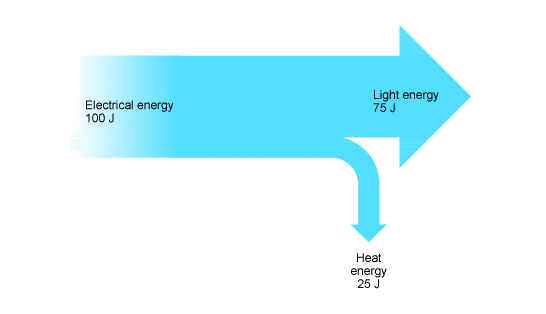
What is this diagram called?
Stankey Diagram
Sankey Diagram
Sankay Diagram
Samkay Diagram
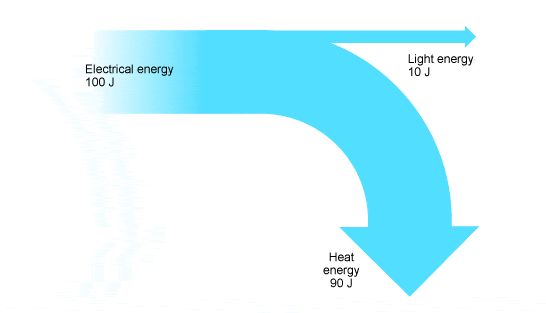
A washing machine uses 250J of electrical energy to produce 125J of useful energy. How efficient is it?
5%
50%
55%
100%

Total energy = 200J
Useful energy = 20J
Workout the efficiency of this lightbulb.
efficiency = total energy inuseful enegy ×100
100%
80%
40%
10%
A kettle uses 100J of electrical energy to produce 7J of sound energy and 93J of thermal energy. How efficient is the kettle?
100%
7%
93%
95%

Calculate the useful energy output for a toaster when total energy input is 51230J and it has an efficiency of 60%.
(a)

Calculate the useful energy output for a buzzer when total energy input is 8700 J and it has an efficiency of 3%.
(a)

Calculate the efficiency of a toy car which was supplied with 80000 J of input energy and generated two different forms of energy, including 12800 J of thermal energy.
(a)

What type of heat transfer takes place when you touch a warm mug of hot chocolate?
Radiation
Convection
Conduction
None of the above

Conduction requires
Electricity
the electromagnetic spectrum and particles
air or water flow
direct contact
If you walk barefoot on hot asphalt, energy is transferred by which process?
Convection
Radiation
Conduction
Reflection

When air is heated, its volume ____________.
increases
decreases
remains the same
When air is heated, its density ___________.
increases
decreases
remains the same
Which of the following is an application of convection?
The movement of heat through a metal pan to the food.
The use of ice box to keep drinks cool.
The sea breeze that blows from sea to land.
The use of wool blanket to keep the body warm.

What is the number of complete waves passing a fixed point in a given amount of time?
Amplitude
Intensity
Wavelength
Frequency

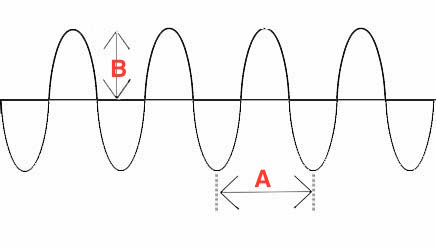
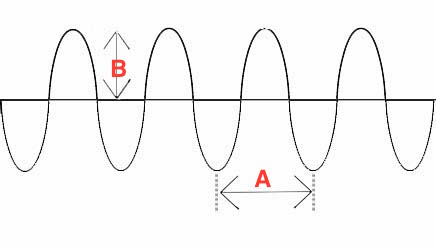
What kind of wave is pictured below?
compressional wave
transverse wave
sound wave
mechanical wave

What does sound waves travel the fastest through?
Liquids
Gases
Solids

Electromagnetic waves vary in
the speed they travel in a vacuum
wavelength and frequency
the way they reflect
the orientation of their electric and magnetic fields
Infrared rays have a shorter wavelength than
Ultraviolet ray
X-rays
gamma rays
radio waves
The full range of frequencies of electromagnetic radiation is called
visible light
the electromagnetic spectrum
radio waves
invisible radiation
The waves with the longest wavelengths in the electromagnetic spectrum
Infrared rays
gamma rays
radio waves
X-rays
The visible light spectrum ranges between
radio waves and X-rays
infrared rays and ultraviolet rays
television waves and infrared rays
ultraviolet rays and gamma rays
What does a wave carry?
boats
energy
matter
water
The human ear can detect frequencies between:
20 and 20000 Hz
100 and 200 Hz
1 and 100 Hz
20 and 30 Hz
The ________ ear collects sounds waves and transmits them to the ________ ear, which contains auditory ossicles.
superficial; deep
outer; middle
inner; middl
middle; inne
outer; inner
When an external force bends the stereocilia of the inner ear hair cells,
the hair cells are temporarily damaged.
dizziness results.
an electrical impulse is generated
the force is converted into mechanical energy
the cells become unresponsive.
When light travels through two different materials it bends and changes
direction because the speed of light changes. This is called __________
Reflection
Refraction
When light hits an opaque object it changes direction
and bounces off. This is called _________
Refraction
Reflection
Light appears white or transparent, but it is actually
made up of several different colours.
Is the given statement true or false?
True
False
The _________ is the hole in the centre of the iris. Light enters the eye through this hole.
pupil
optic nerve
lens
retina
3. Red from the color spectrum has the longest wavelength.
TRUE
FALSE
4. The color violet has the highest energy and frequency.
TRUE
FALSE
Meaning of Translucent
Absorbs all light and makes a shadow
Allows light to pass and scatters it
Light can pass straight through

What is this
opaque
Translucent
Transparent
True or False: Light has to travel through a medium.
True
False

The muscular diaphragm that controls the size of the pupil is ---------------
cornea
ciliary muscles
Iris
retina
The black opening between the aqueous humour and the lens is called --------------
retina
iris
cornea
pupil
What organ does the word "optic" refer to?
ear
heart
eye
nose
The covering over the front of the eye is the...
cornea
optic nerve
retina
blind spot
The clear, flexible lump shaped like a squashed marble is the...
(a)
A car travels 100km. The journey takes two hours. The highest speed of the car is 80km/ h, and the lowest speed is 40km/ h. What is the average speed for the journey?
40km/ h
50km/ h
60km/ h
120km/ h
An ice crystal falls vertically from a cloud. What happens to the acceleration of the ice crystal as it falls?
It decreases because of air resistance.
It decreases because of gravity.
It increases because of air resistance.
It increases because of gravity.
A car travels at an average speed of 60 km / h for 15 minutes. How far does the car travel in 15 minutes?
4.0 km
15 km
240 km
900 km
A train begins a journey from a station and travels 60 km in a time of 20 minutes. What is the average speed of the train?
3.0 m / s
5.0 m / s
50 m / s
60 m / s
The velocity of an object increases from 30 m / s to 50 m / s in 5.0 seconds.
What is the average acceleration of the object?
0.10 m / s2
0.25 m / s2
4.0 m / s2
10 m / s2