wayground logo

Free Printable Worksheets

Font size

S
M
L
XL
Worksheets

Unit 1 Review Game

Total questions: 94

Worksheet time: 2hrs 46mins

Name
Class
Date
1.
A possible explanation to a problem that has not yet been tested. 
a)
data
b)
theory
c)
hypothesis
d)
fact
2.
What step does every scientific experiment begin with?
a)
hypothesis
b)
question/problem
c)
procedures
d)
conclusion
3.
The summary at the end of an experiment that explains the results. 
a)
conclusion
b)
procedures
c)
materials
d)
responding variable
4.

What is an observation?

a)

A scientific statement based on ideas

b)

Using your senses to notice what is going on around you

c)

To be unaware of your surroundings

d)

The question that you want an answer to.

5.
A testable answer to a scientific question
a)
Question
b)
Observation
c)
Hypothesis
d)
Experiment
6.
This is the last step in the scientific method
a)
Draw a conclusion
b)
Record your data as results
c)
Share what you have learned with others
d)
Collaborate with others
7.
A series of steps used by scientists to solve a problem or answer a question. 
a)
scientific method
b)
recipe
c)
data collection
d)
metric system
8.
Which is NOT a step in the scientific method?
a)
Make observation
b)
Form a theory
c)
Collect data
d)
Form a hypothesis
9.
A hypothesis is simply a prediction that has not yet been _.
a)
proven or disproven
b)
made into a theory
c)
results calculated
d)
written about
10.
Testing a hypothesis often involves a(n):
a)
answer
b)
experiment
c)
problem
d)
safety check
11.
An experiment is being done to determine how light affects the growth of small zinnia plants. One plant is placed in full sunlight, the second in a shaded area, the third in an unlit closet. What is the independent variable in the experiment?
a)
the amount of light
b)
the type of plants
c)
the type of soil
d)
the length of the experiment
12.
What observations might you make about a nearby cat?
a)
The cat is black and white.
b)
The cat is hungry.
c)
The cat is lost.
13.
In a controlled experiment, how many variables can be worked with at a time? 
a)
one
b)
none
c)
two or more
d)
how ever many makes sense.
14.
The part of the experiment that remains the same for the control and experimental group.
a)
constants
b)
control
c)
independent
d)
dependent
15.
Sarah is participating in a walkathon to raise money for local literacy programs. The amount of money Sarah will raise depends on the distance she walks.
m = the amount of money Sarah will raise
d = the distance Sarah walks

Which of the variables is dependent?
a)
m
b)
d
16.

A statement that answers the question.

a)

Claim

b)

Evidence

c)

Reasoning

d)

science

17.

Scientific data to back up the claim. Tell me the numbers!

Prove it!

a)

Claim

b)

Evidence

c)

Reasoning

d)

science

18.

Use Scientific ideas to show how the evidence supports the claim.

Why? What it all means. Explain and discuss.

a)

Claim

b)

Evidence

c)

Reasoning

d)

science

19.

"I like KFC more than McDonalds!"

Is this a claim, evidence or reasoning?

a)

Claim

b)

Evidence

c)

Reasoning

20.
The Warriors won the NBA championship in 2017. 
a)
Claim statement
b)
Reasoning statement
c)
Evidence statement
21.
What sentence contains reasoning for this paragraph? 
 
In the United States, December is the greatest month of the year. For example, nine out of ten people get a gift in December. Everyone loves to receive gifts, therefore a month that encourages gift giving a d receiving as much as December must be an incredible month. In addition, December has a joyful and happy spirit.  No matter where a person travels during the month of December they will encounter singing, and smiling faces wishing those around them “Happy Holidays!”, impacting the mood of the entire month. It is clear that December is the greatest month for any American.
a)
It is clear that December is the greatest month for any American.
b)
For example, nine out of ten people get a gift in December.
c)
Everyone loves to receive gifts, therefore a month that encourages gift giving a d receiving as much as December must be an incredible month
22.

The Law of Inertia

a)

Newtons 1st Law of motion

b)

Newtons 2nd Law of motion

c)

Newtons 3rd Law of motion

23.

Whats Newtons First Law?

a)

The more force applied to an object the faster it will accelerate.

b)

An object in motion will stay in motion and an object at rest will stay at rest unless acted by an outside force.

c)

for every ection there is an equal and oposite reaction

24.

Newton's third law states that any action will have a(n) ___ and ___ reaction

a)

Equal and similar

b)

Equal and opposite

c)

Equal and different

d)

Greater and opposite

25.

Acceleration: is the rate of change in _____.

a)

distance

b)

Speed

c)

Velocity

d)

displacement

26.
What is the net force?
a)
30 N 
b)
25 N 
c)
5 N 
d)
55 N 
27.
What is the standard unit force is measured in?
a)
Newtons
b)
pounds
c)
grams
d)
meters
28.
Any push or pull on an object.
a)
force
b)
velocity 
c)
inertia
d)
momentum
29.
Who is the scientist who came up with the Laws of Motion?
a)
Sir Issac Newton
b)
The Greeks
c)
John Dalton
d)
Sir John Newt
30.
What is Newtons 2nd law of motion?
a)
Pancakes 
b)
Force= Mass multiplied by acceleration
c)
For every action there is a equal and opposite  re-action.
d)
Law of gravity 
31.
Which has more Inertia? (so need more force to move) 
a)
Truck
b)
Ant
c)
A cat
d)
A skateboard
32.
Balanced or Unbalanced?
a)
Balanced 
b)
Unbalanced
33.
In any collision (crash) the ______ is ALWAYS constant
a)
Total Momentum
b)
total speed
c)
total Velocity
d)
Energy
34.
Which has more momentum: a car stopped at a red light or a bike moving at 15 mph?
a)
car
b)
bike
c)
they are equal
d)
cannot determine using the info provided
35.
Which object listed below has the greatest momentum?
a)
A 0.05 kg object rolling at 0.2 m/s.
b)
A 0.15 kg object rolling at 2 m/s.
c)
A 0.15 kg object rolling at 1 m/s
d)
A 0.4 kg object rolling at 2 m/s.
36.

The Law of Conservation of Momentum states:

a)

The total momentum before a collision is equal to the total momentum after a collision.

b)

The total momentum before a collision is greater than the total momentum after a collision.

c)

The total momentum before a collision is less than the total momentum after a collision.
d)

The total momentum before a collision is not related to the total momentum after a collision.

37.
The definition of momentum is
a)
Mass in Motion
b)
The size of an object
c)
The velocity of an object
d)
A comparison between two objects
38.
When two objects collide, the Pbefore is ____________ the Pafter.
a)
more than 
b)
less than 
c)
equal to
d)
unrelated to
39.
When a cannon fires a cannonball we observe Newton's third law. Which force is the reaction force?
a)
The cannon moving forward
b)
The cannonball moving forward
c)
The cannon moving backward
d)
The cannonball moving backward
40.
a)
1st
b)
2nd
c)
3rd
41.
Two factors effecting the magnitude of the force of gravity between 2 objects are...
a)
mass and distance 
b)
mass and matter
c)
distance and weight 
d)
weight and mass
42.
Force of gravity is directly proportional to
a)
Mass
b)
Weight
c)
Distance
d)
Time
43.
Force of gravity is inversely proportional to
a)
Mass
b)
Weight
c)
Distance
d)
Time
44.
Two asteroids exert a gravitational force, F, on each other. Some time later, the asteroids are now three times as far from each other as before. Which of the following represents the gravitational force at this distance? 
a)
F/3
b)
F/2
c)
F/6
d)
F/9
45.
Which of the following is Newton's Law on Gravitation?
a)
F=Gm1m2/r
b)
F = Gm1m2/r2
c)
F = Gm1m2/2r
d)
F = m1m2/2r
46.
The units of velocity are
a)
kg
b)
m
c)
m/s
d)
N
47.

According to Coulomb's Law, when the distance increases, the electrostatic force ____________; we call this relationship ____________ proportional.

a)

decreases; directly

b)

decreases; inversely

c)

increases; inversely

d)

increases; directly

48.

The Coulomb is the unit for:

a)

Charge

b)

Force

c)

Distance

d)

Mass

49.

What happens to the force between two charged objects when you double the distance between them?

a)

it doubles

b)

it is cut in half

c)

it quadruples

d)

it is cut by 1/4

50.

If one of the charges doubles, what happens to the force?

a)

it doubles

b)

it gets cut in half

c)

it quadruples

d)

it is cut by 1/4

51.

Select all answer that apply:


What kinds of particles do Coulomb's Law apply to?

a)

electrons

b)

protons

c)

neutrons

d)

neutral atoms

52.

A repulsive force exists between which two particles?

a)

Two neutrons

b)

An electron and a neutron

c)

An electron and a proton

d)

Two protons

53.

Which is the value of the constant in Coulomb's equation?

a)

ke = 9·10-9

b)

ke = 9.8

c)

ke = 6.67·10-11

d)

ke = 9 ·109

54.

What does Fe stand for?

a)

the electrostatic force

b)

the symbol for iron

c)

the constant for the charges

d)

the charges of the particles

55.

Why are there two q's in the equation?

a)

because there are two charged objects

b)

because there are protons and electrons

c)

because the particles are moving away from each other

d)

because the particles are moving towards each other

56.

The equation to calculate momentum is

a)

p = m x v

b)

p = 1/2 m x v2

c)

p = m x g x h

d)

p = m x g

57.
The momentum of an object depends upon the object's ___________&_____________.  
a)
size and shape
b)
mass and speed
c)
mass and veloctiy
d)
mass and energy
58.
Determine the momentum of 1000-kg car moving southward at 20 m/s......... 
a)
20000 N
b)
20000 Joules
c)
20000 Kg * m/s south
d)
10000 kg * m/s south
59.

What is the unit for momentum?

a)

m/sec

b)

kg/sec

c)

kg/m

d)

kg x m/sec

60.
The total momentum before a collision is _________ the total momentum after a collision.
a)
equal to 
b)
less than 
c)
more than
d)
It depends on the type of collision
61.
Planets orbit the Sun in a shape called a(n)
a)
circle
b)
ellipse
c)
focus
d)
perihelion
62.
An ellipse is drawn around two points called
a)
aphelion
b)
perihelion
c)
foci
d)
axis
63.
The place where a planet is closest to the Sun as it orbits the Sun is called the
a)
perihelion
b)
aphelion
64.
The place where a planet is farthest away from the Sun in its orbit around the Sun is called the
a)
aphelion
b)
perihelion
65.
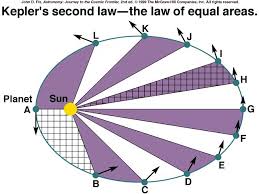
Where is the planet moving faster
a)
Position A to B
b)
Position B to C
c)
Position H to I
d)
Position I to J
66.
What is true about the area between points A, B and the Sun, and the area between points H, I and the Sun?
a)
The area between A, B and the Sun is the largest.
b)
The area between H, I and the Sun is the largest
c)
Both areas are equal in size
d)
There is not enough information to determine the areas
67.
What has an eccentricity of zero
a)
a straight line
b)
a large ellipse
c)
a circle
d)
a small ellipse
68.
Kepler's 2nd Law deals with 
a)
the shape of the planets' orbits
b)
the speed/area the planet travels 
c)
the length of time it takes the planet to orbit the sun
69.
The "Law of Harmonies" is which of Kepler's Laws?
a)
1st
b)
2nd
c)
3rd
d)
4th
70.
A planet moves __________ when it is farthest from the sun.
a)
faster
b)
slower
71.
Kepler's first law states that the orbits of the planets are oval in shape or 
a)
ellipses
b)
perfect circles
72.
The path a planet travels around the sun is called its 
a)
orbit
b)
ellipse
c)
barycenter
d)
precession
73.
A perfect circle has an eccentricity of ______.
a)
0
b)
.99
c)
1
d)
2
74.
The flattest ellipse before it becomes a line will have an eccentricity of _______.
a)
0
b)
.99
c)
1
d)
2
75.
The gravitational attraction between the star and the planet will be greatest at position 
a)
A
b)
B
c)
C
d)
D
76.
Which diagram shows a planet with the least eccentric orbit?
a)
1
b)
2
c)
3
d)
4
77.
What is the maximum eccentricity an ellipse can be?
a)
0
b)
.5
c)
1
d)
42
78.
Calculate the eccentricity for the following orbit. 
a)
1.6
b)
0.8
c)
0.6
d)
1.2
79.
If an orbit has an eccentricity value of "0", what shape is it? 
a)
perfectly circular
b)
perfectly flat
c)
very oval/elliptical
d)
slightly oval/elliptical
80.
Which orbit is most eccentric? 
a)
1
b)
3
c)
4
d)
5
81.
What is eccentricity? 
a)
a measurement of how elliptical an orbit is. 
b)
a measurement of the distance between the planet and the sun
c)
a measurement of how long the planet takes to rotate around the sun
d)
none of these
82.

Two like charges

a)

neutralize each other.

b)

repel each other.

c)

must be neutrons.

d)

attract each other.

83.

An atom loses an electron. What type of charge does it have now?

a)

positive

b)

negative

84.

A magnet will pick up an object that is made of...

a)

plastic

b)

iron or steel

c)

glass

d)

copper

85.

The strongest parts of the magnet are ...

a)

fronts

b)

backs

c)

poles

d)

middle

86.

The area around a magnet is called the .....

a)

attraction zone

b)

work area

c)

magnetic field

d)

hot zone

87.
The picture is an example of an:
a)
Electric circuit
b)
Electromagnet
c)
Electric nail
d)
Electric power cell
88.

To make this electromagnet stronger you could:

a)

use less wire

b)

have fewer wire coils around the nail

c)

have more wire coils around the nail

d)

use a plastic core

89.
Why does a compass needle point north?
a)
The compass is a bar magnet
b)
Because north is up
c)
Because it's magic
d)
It lines up with the Earth's magnetic field
90.

Which of the following is not a good conductor?

a)

Copper

b)

Silver

c)

Aluminium

d)

Plastic

91.

Protons have a ____________ charge.

a)

negative

b)

neutral

c)

positive

92.

Electrons have a ____________ charge.

a)

negative

b)

neutral

c)

positive

93.

You can make an electromagnet stronger by: having a __________________core inside the wire.

a)

smaller core

b)

larger core

c)

greener core

d)

water core

94.
Which statement best describes an insulator?
a)
A material that allows electricity to flow through it
b)
A material that does not allow liquids to flow through it
c)
A material that does not allow heat to flow through it
d)
A material that cools down quickly when heated