wayground logo

Free Printable Worksheets

Font size

S
M
L
XL
Worksheets

Mechanical Waves & Sound

Total questions: 92

Worksheet time: 2hrs 40mins

Name
Class
Date
1.

A wave that has the vibration parallel to the direction of the wave is called:

a)

Longitudinal

b)

Transverse

2.

A wave that has the vibration perpendicular to the direction of the wave is called:

a)

Longitudinal

b)

Transverse

3.

What does point C represent?

a)

Amplitude

b)

Trough

c)

Crest

d)

Wavelength

4.

What does point A represent?

a)

Amplitude

b)

Wavelength

c)

Crest

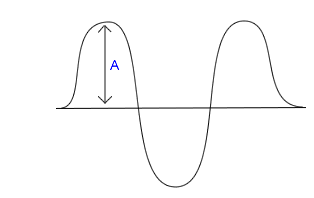
d)

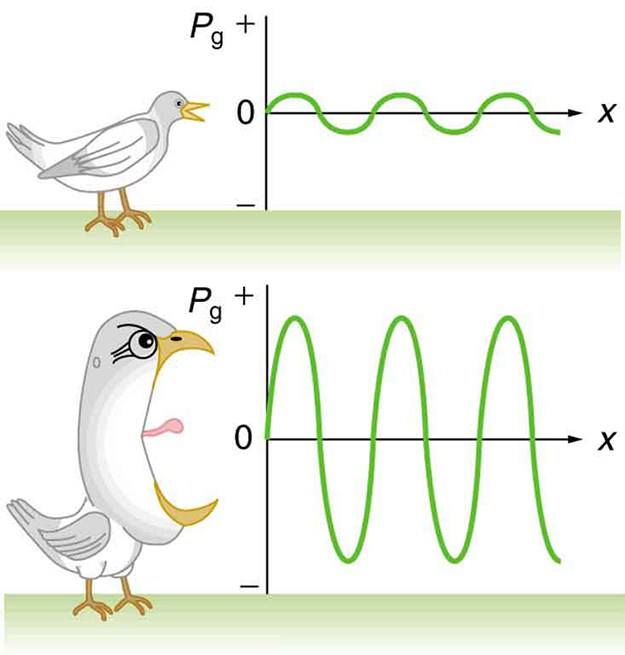
Trough

5.
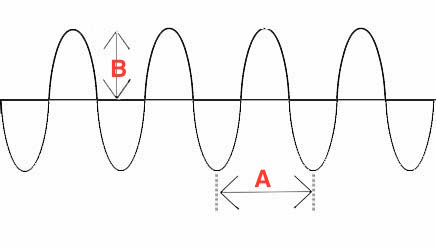
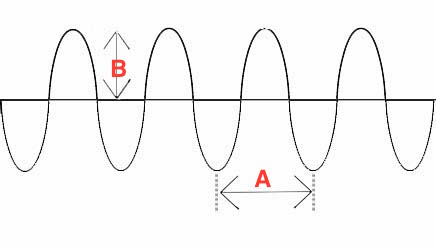
What property of this wave is represented by the letter "A"
a)
amplitude
b)
crest
c)
trough
d)
wavelength
6.
What property of the wave is represented by the letter "B"?
a)
amplitude
b)
crest
c)
trough
d)
wavelength
7.
The number of wavelengths that pass a point each per second is:
a)
frequency
b)
period
c)
longitudinal 
d)
transverse wave 
8.
The type of waves that require medium to pass:
a)
Mechanical Waves
b)
Electromagnetic Waves
9.
Which vocabulary term is used to identify the distance between points C & G?
a)
Amplitude
b)
Crest
c)
Frequency
d)
Wavelength
10.
When the frequency of a wave increases, what happens to the wavelength?
a)
The wavelength is not directly affected by the frequency of a wave.
b)
The wavelength increases.
c)
The wavelength decreases.
d)
More specific information is needed to form a conclusion about the wavelength.
11.
A mechanical wave cannot travel through...
a)
a vacuum(empty space).
b)
water.
c)
air. 
d)
glass.
12.
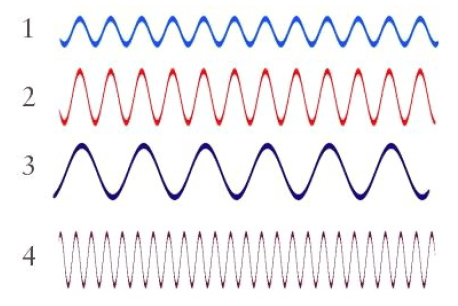
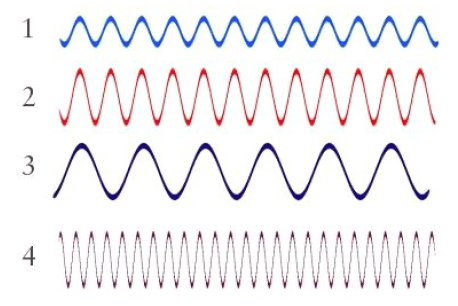
Which wave in the diagram has the greatest frequency?
a)
1
b)
2
c)
3
d)
4
13.
Which wave in the diagram has the greatest wavelength?
a)
1
b)
2
c)
3
d)
4
14.
Which of the following can sound travel through?
a)
solid
b)
liquid
c)
gas
d)
all of the above
15.

Waves transfer _______.

a)

particles

b)

matter

c)

energy

16.

Examples of this type of waves include water waves, waves on a string/jump rope, and light waves.

a)

transverse

b)

longitudinal

17.

Examples of _____ waves include sound waves and earthquake P-waves.

a)

transverse

b)

longitudinal

18.

Frequency is measured in _______.

a)

Hertz (Hz)

b)

Meters per second

c)

Meters

d)

Newtons

19.

Frequency is how many waves pass a point in 1 second. If 100 waves pass a given point in 4 seconds, what is the wave's frequency?

a)

25 Hz

b)

100 Hz

c)

4 Hz

d)

400 Hz

20.

In a longitudinal wave, a ____ is an area where the particles are spread apart and a ____ is an area where the particles are close together.

a)

crest, trough

b)

compression, rarefaction

c)

rarefaction, compression

d)

trough, crest

21.

Waves that can travel through empty space are called _____ waves. Waves that require a medium to travel, such as air or water, are called _____ waves.

a)

mechanical, electromagnetic

b)

electromagnetic, mechanical

c)

crest, trough

d)

compressional, rarefactional

22.

In this diagram of a transverse wave, A is showing the wave's _____ and B is showing the wave's _____.

a)

amplitude, trough

b)

amplitude, crest

c)

wavelength, trough

d)

wavelength, crest

23.

In this diagram of a transverse wave, C is showing the wave's _____ and D is showing the wave's _____.

a)

crest, amplitude

b)

trough, amplitude

c)

crest, wavelength

d)

trough, wavelength

24.
A period is
a)
Amount of time it takes a wavelength to complete one cycle.
b)
How many wave lengths happen in a second.
c)
An indication of the amount of energy in a wave.
d)
The distance between two crests or two troughs.
25.
One end of the rope is vibrated to produce a wave with a wavelength of .25 m.  The Frequency of the wave is 3.0 Hz.  What is the speed of the wave?
a)
3.00 m/s
b)
2.50 m/s
c)
.75 m/s
d)
1.25 m/s
26.
 A wave has frequency of 50 Hz and a wavelength of 10 m. What is the speed of the wave?
a)
500 m/s
b)
50 m/s
c)
5 m/s
d)
0.5 m/s
27.
 A wave has frequency of 5 Hz and a speed of 25 m/s. What is the wavelength of the wave?
a)
25 m
b)
125 m
c)
5 m
d)
25 m/s
28.
A wave has wavelength of 10 m and a speed of 340 m/s. What is the frequency of the wave?
a)
34 m/s
b)
3400 Hz
c)
3400 m/s
d)
34 Hz
29.

A guitar string vibrates with a frequency of 320 hz. If the wavelength of the vibration is 0.23 meters what is the speed of the wave?

a)

320.23 m/s

b)

1391.3 hz

c)

73.6 m/hz

d)

73.6 m/s

30.
1.  Frieda the fly flaps its wings back and forth 121 times each second. The period of the wing flapping is 
a)
0.008 Hz
b)
0.008 s
c)
121 Hz
d)
121 s
31.

As the frequency of a wave increases, then what happens to the wavelength?

a)

Gets bigger / increases

b)

Gets smaller / decreases

32.

Why does sound travel faster in water than in air?

a)

The particles in water are more tightly packed together

b)

The particles in water are more spaced apart

33.

V=fλV=f\lambda  
If the frequency is 5 Hz and the wavelength is 2 m, then what is the wave's velocity?

a)

10 m/s

b)

5/2 m/s

c)

2/5 m/s

d)

7 m/s

34.

V=fλV=f\lambda  
If the wave velocity is 20 m/s and the wavelength is 2 m, then what is the frequency?

a)

10 Hz

b)

40 Hz

c)

0.1 Hz

35.

V=fλV=f\lambda   f=1Tf=\frac{1}{T}  
If the period of a wave is 2 seconds and the wavelength is 4 m long, then what is the wave's velocity?

a)

2 m/s

b)

8 m/s

c)

1/2 m/s

36.
What kind of wave is pictured?
a)
Transverse Wave
b)
Longitudinal Wave
c)
compressional wave
d)
none of the above
37.
What kind of wave is pictured?
a)
Transverse
b)
Longitudinal
c)
surface
d)
none of the above
38.
A disturbance that travels through a medium as a longitudinal wave
a)
sound
b)
wavelength
c)
pitch
d)
frequency
39.
The part of a longitudinal wave where the particles of the medium are close together.
a)
rarefaction
b)
compression
c)
crest
d)
trough
40.
A part in a longitudinal wave where the particles are spread apart
a)
compression
b)
rarefaction
c)
crest
d)
trough
41.

In which of these types of media will sound travel fastest?

a)

Solid

b)

Liquid

c)

Gas

42.

Sound waves CANNOT travel through which of these:

a)

Paper

b)

Milk

c)

Outer space

43.
Which feature of sound is determined by amplitude?
a)
Pitch
b)
Smoothness
c)
Loudness
44.
If the distance represented by the letter A (the amplitude) were increased, how would it change the sound?
a)
The sound would be higher. 
b)
The sound would be lower. 
c)
The sound would be softer. 
d)
The sound would be louder. 
45.
What is changed in the second picture?
a)
Someone is talking louder in picture 2
b)
Someone is talking softer in picture 2
c)
Someone is talking lower pitch in picture 2
d)
Someone is talking higher pitch in picture 2
46.
When a sound is louder what measurement gets bigger?
a)
Frequency 
b)
Amplitude 
c)
Wavelength 
d)
Crest
47.
The term for how high or low a sound is:
a)
pitch
b)
volume
c)
sound
d)
medium
48.
What is changed in the second picture?
a)
Someone is talking louder in picture 2
b)
Someone is talking softer in picture 2
c)
Someone is talking lower pitch in picture 2
d)
Someone is talking higher pitch in picture 2
49.
What is changed in the second picture?
a)
Someone is talking louder in picture 2
b)
Someone is talking softer in picture 2
c)
Someone is talking lower pitch in picture 2
d)
Someone is talking higher pitch in picture 2
50.
Which pitch would likely be too high for humans to hear?
a)
10,000 Hz
b)
13,000 Hz
c)
18,000 Hz
d)
25,000 Hz
51.
A sound wave naturally occurs as a:
a)
longitudinal wave
b)
transverse wave
52.
Why is sound able to travel faster through a solid than a gas?
a)
Gas molecules are packed tightly.
b)
Solid molecules move quickly.
c)
Solid molecules are packed tightly.
d)
Gas molecules move slowly.
53.
Wavelength and frequency have what relationship?
a)
Direct - when one increases, so does the other
b)
Inverse - when one increases, the other decreases
c)
Unrelated - sometimes they both change in the same way, and sometimes they don't
d)
Exponentially squared relationship
54.

All sound begins with:

a)

light

b)

a vibration

c)

a person

d)

space

55.
A sound with a high pitch would have:
a)
a low frequency
b)
a high frequency
c)
a low amplitude
d)
a high amplitude
56.
Which of the following would have the highest amplitude?
a)
a dog barking
b)
clapping your hands
c)
knocking on a door
d)
thunder
57.
Which of the following would have the lowest pitch?
a)
striking a tuning fork against a glass jar
b)
playing a flute
c)
an angry dog's growl
d)
a child's squeal
58.
Which of the following would have the highest pitch?
a)
a lion's roar
b)
a bird chirping
c)
beating a drum
d)
a cow's moo
59.
Which sound wave has low frequency and high amplitude?
a)
sound wave 1
b)
sound wave 2
c)
sound wave 3
d)
sound wave 4
60.
What would be the pitch of the sound wave from the mouse squeak?
a)
high 
b)
low
61.

A reflected sound wave is called...

a)

Frequency

b)

Pitch

c)

Echo

d)

Compression

62.

One important characteristic of sound waves is that they are ___________________ waves.

a)

mechanical

b)

short

c)

ultraviolet

d)

primary

63.
Sound Waves Move faster in what temperature 
a)
Heat 
b)
Cold
c)
Doesn't Matter
d)
Both
64.

What is the definition reflection?

a)

The bending of waves as they enter a new medium

b)

Bouncing back of waves from a surface that it can’t pass through

c)

The bending of waves as they pass through openings or around corners

d)

When two interfering waves have a displacement in the same direction, two crests and two troughs overlap. Increased amplitude.

65.

What is the definition of Refraction?

a)

The bending of waves as they enter a new medium

b)

When two interfering waves have a displacement in the opposite direction, crest and trough overlap. Zero amplitude.

c)

When two interfering waves have a displacement in the same direction, two crests and two troughs overlap. Increased amplitude.

66.
If you want to change the pitch of a sound, you have to change the ___
a)
frequency
b)
amplitude
c)
speed
d)
volume
67.
The speed of a sound wave depends on
a)
the frequency
b)
the medium
c)
both air temperature and medium
d)
the air temperature
68.
The Doppler effect can cause an apparent change in...
a)
loudness
b)
intensity
c)
pitch
d)
reasonance
69.
As a sound source approaches and then moves past a stationary observer, the observer will hear
a)
a steady rise in pitch
b)
a sudden drop in pitch
c)
a drop in pitch, then a rise in pitch
d)
a rise in pitch, then a drop in pitch
70.
How does a sound wave interact with a human ear?
a)
vibrates the ear drum
b)
bounces off the ear canal
c)
rotates the ear drum
d)
vibrates the ear canal
71.
When two waves are aligned and come together to create a wave with a larger amplitude that is called:
a)
Resonance
b)
Constructive Interference
c)
Doppler Effect
d)
Destructive Interference
72.
Constructive interference will cause the wave to 
a)
Increase its displacement
b)
Decrease its displacement 
c)
Make its displacement stay the same
73.
Destructive interference is 
a)
When the two waves affect  each other in a negative way 
b)
The two waves add together and produce a single wave of greater amplitude
c)
Are in phase 
74.
Constructive interference is
a)
When two waves affect one another in  a positive way.
b)
Produce a single wave of greater amplitude (add together)
c)
Both
75.
What is interference?  
a)
occurs when two or more waves overlap and combine 
b)
occurs when two or more waves combine and neutralize each other 
c)
when one waves travels alone
76.
Which wave behavior do noise cancelling headphones use?
a)
diffraction
b)
refraction
c)
constructive interference
d)
destructive interference
77.
The changing pitch of a police siren as the car moves past you
a)
sound interfernce
b)
doppler effect
c)
constructive interference
d)
destructive interference
78.
Resonance occurs when
a)
an object is forced to vibrate at its natural frequency.
b)
sound changes speed in going from one medium to another.
c)
the amplitude of a wave is amplified.
d)
sound makes multiple reflections
79.
A guitarist strums two strings on a guitar. The first string vibrates more quickly than the second string. What is true about the pitch of the string?
a)
The first string has a higher pitch than the second string
b)
The second string has a higher pitch that the first string.
c)
The first string and the second string have the same pitch.
d)
The pitch of the second string depends on the pitch of the first string.
80.

Light waves bouncing off a surface is known as?

a)

Transmission

b)

Refraction

c)

Reflection

d)

Absorption

81.

Which type of interaction is shown in the image?

a)

Destructive Interference

b)

Absorption

c)

Constructive Interference

d)

Reflection

82.

The crest of a 2m tall wave collides with a trough of a 1m tall wave. What will be the amplitude of the resulting wave?

a)

1 meter

b)

2 meters

c)

3 meters

d)

4 meters

83.

The crest of a wave with an amplitude of 5m crashes into the crest of another wave with an amplitude of 3m. What will the amplitude of the resulting wave be?

a)

2 meters

b)

6 meters

c)

8 meters

d)

12 meters

84.

When you place things into water they sometimes look bent (see the image below). What is this an example of?

a)

Refraction

b)

Diffraction

c)

Transmission

d)

Absorption

85.

A wave hits an object as shown.

Which kind of wave interaction is shown?

a)

absorption

b)

diffraction

c)

refraction

d)

reflection

86.

A wave hits an object as shown.

Which kind of wave interaction is shown?

a)

absorption

b)

diffraction

c)

refraction

d)

reflection

87.

A wave hits a wall as shown.

As the wave interacts with a wall, which kind of wave interaction is shown?

a)

absorption

b)

diffraction

c)

refraction

d)

reflection

88.

Which best describes what is occurring when a door is almost closed and rays of light fan out from the small opening?

a)

absorption

b)

interference

c)

refraction

d)

diffraction

89.

The waves created by two speed boats in a lake interact to form larger waves. This is an example of

a)

constructive interference.

b)

destructive interference.

c)

absorption

d)

transmission

90.
This image is representing what wave interaction?
a)
Refraction
b)
Diffraction
c)
Reflection
d)
Interference
91.
True or False: Every object has at least one natural frequency.
a)
True
b)
False
92.
When a wave moves around a barrier or though an opening it is known as what?
a)
Diffraction
b)
Refraction
c)
Rarefaction
d)
Destruction