wayground logo

Free Printable Worksheets

Font size

S
M
L
XL
Worksheets

EOC Physics Review

Total questions: 90

Worksheet time: 3hrs 27mins

Name
Class
Date
1.

Velocity is...

a)

The rate of change of acceleration

b)

The rate of change of displacement

c)

The rate of change of distance

d)

The rate of change of speed

2.

What is the difference between a vector quantity and a scalar quantity?

a)

A scalar has a magnitude and direction and a vector has only a magnitude

b)

A vector has a magnitude and direction and a scalar has only a magnitude

c)

A scalar has a direction and a vector has a magnitude

d)

None of the above

3.

An unladen swallow flies 5 m/s. How far has the bird traveled after 1 min?

a)

5 m

b)

12 m

c)

120 m

d)

300 m

4.

Which of the following is a vector quantity?

a)

Velocity

b)

Acceleration

c)

Displacement

d)

All of the above

5.
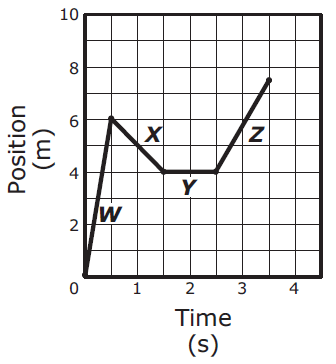
Motion sensors recorded the following data about a runner during a cross-country race. During which segment of the race did the runner have the greatest speed?
a)
W
b)
X
c)
Y
d)
Z
6.

What is the acceleration of an object moving at constant velocity?

a)

2 m/s2

b)

1 m/s2

c)

0 m/s2

d)

0.8 m/s2

7.

What is the acceleration of an object moving at constant velocity?

a)

2 m/s2

b)

1 m/s2

c)

0 m/s2

d)

0.8 m/s2

8.

When velocity is negative and acceleration is negative, what happens to the object’s motion?

a)

The object slows down

b)

The object speeds up

c)

Nothing happens to the objects motion

d)

The object remains at rest

9.

A dolphin swims 1.85 km/hr. How far has the dolphin travelled after 0.6hr?

a)

1.1 km

b)

2.5 km

c)

0.63 km

d)

3.7 km

10.

A coin released from rest from the top of a tower hits the ground after 1.5 seconds. What is the speed of the coin as it hits the ground?

a)

15 m/s

b)

21 m/s

c)

31 m/s

d)

39 m/s

11.

The graph shows the position of a truck vs. time. According to the graph, the velocity of the truck is...

a)

increasing

b)

remaining constant

c)

decreasing

12.
The graph respresents
a)
no motion
b)
constant velocity
c)
increasing velocity
d)
decreasing velocity
13.

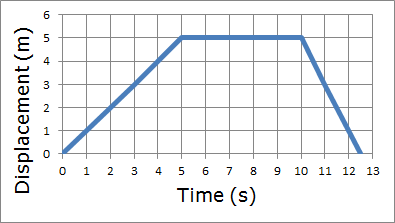
What is the person doing from 5 seconds to 10 seconds?

a)

Walking

b)

Running

c)

Standing Still

d)

Walking Fast

14.
According to the graph how far does the person travel in the first 5 seconds?
a)
2 m
b)
10 m
c)
0 m
d)
5 m
15.

What quantity is equal to the slope of this graph?

a)

Distance

b)

Displacement

c)

Acceleration

d)

Velocity

16.

An object is thrown into the air at 60 m/s, straight up. What is its velocity at the highest point?

a)

0 m/s

b)

-9.8 m/s

c)

60 m/s

d)

-60 m/s

17.
A  car starts from rest and after  7 seconds it is moving at 42  m/s. What is the car’s acceleration?
a)
0.17
b)
1.67
c)
6
d)
7
18.
How long will it take a running horse to travel 260 m and attain a speed of 12 m/s from rest?
a)
1200 seconds
b)
1.2 hours
c)
43 Hours
d)
43 minutes
19.
A car is traveling at 21.0 m/s. It slows to a stop at a constant rate over 5.00 s. How far does the car travel during those 5.00 seconds before it stops? 
a)
4.20 m
b)
52.5 m
c)
105 m
d)
158 m
20.

When a student runs and kicks a ball, they have applied an ___________ force to move the ball.

a)

Balanced

b)

Magnetic

c)

Spring

d)

Unbalanced

21.

When the teacher rearranges the desks in the classroom, she must apply ____________ to push and pull the desks around.

a)

acceleration

b)

force

c)

weight

d)

magnets

22.

Walking down the hall and speeding up when you turn and go down the stairs is an example of ____________.

a)

acceleration

b)

weight

c)

gravity

d)

friction

23.

What law is best described by inertia?

a)

1st

b)

2nd

c)

3rd

d)

law of conservation of mass

24.

What is Newton's First Law

a)

F=ma

b)

Every action has an equal and opposite reaction

c)

An object at rest stays at rest, an object in motion stays in motion.

d)

Friction

25.

What Unit do we Measure Force in?

a)

Newtons

b)

Joules

c)

Force

d)

Kilograms

26.

A 20 kg bike accelerates at 10 m/s2. what was the force

F = m x a

a)

25 Newtons

b)

20 Newtons

c)

200 Newtons

d)

10 Newtons

27.

Newton's third law states that any action will have a(n) _______ and ______ reaction

a)

Equal and similar

b)

Equal and opposite

c)

Equal and different

d)

Greater and opposite

28.

8 N to the left , and 4 N to the right. Find the net force. Is this balanced

a)

12 N Right No

b)

4 N Left No

c)

12 N Right Yes

d)

4 N Left Yes

29.

What is this graph representing?

a)

Constant Speed

b)

Acceleration (speeding up)

c)

Deceleration (slowing down)

d)

No motion

30.
What is the force that causes objects to fall to Earth?
a)
Air resistance
b)
Gravity
c)
Water resistance
d)
Pressure
31.

Which of these is NOT a force?

a)

Friction

b)

Normal

c)

Weight

d)

Electrical resistance

32.
When two objects rub together, what force do they produce
a)
Gravity
b)
Air resistance
c)
Friction
d)
Water resistance
33.
What type of force is shown in the picture?
a)
The Cat force
b)
Star Wars Force
c)
Unbalanced force
d)
Balanced  force
34.
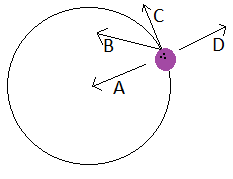
Which represents the acceleration of the ball?
a)
A
b)
B
c)
C
d)
D
35.
Which of the following depict the speed of the blowing ball?
a)
A
b)
B
c)
C
d)
D
36.
What is the SI unit for circumference?
a)
meter
b)
pi
c)
inches
d)
kilometer
37.

moving or tending to move toward a center...

a)

centripetal force

b)

centrifugal force

c)

Tangent

d)

Curvature

38.

the process or act of turning or circling around something

a)

Curvature

b)

Rotation

c)

Radius

d)

Orbit

39.
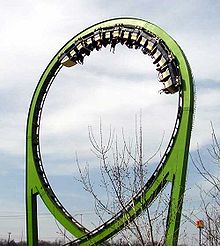
Where is the net force when the rollercoaster is at the top of the loop?
a)
Towards the sky
b)
Towards the Right
c)
Towards the left
d)
Towards the ground
40.
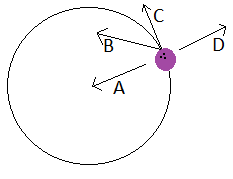
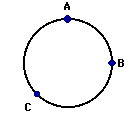
What is the direction of the velocity at point B, if the ball is revolving clockwise?
a)
up
b)
right
c)
down
d)
left
41.
Centripetal acceleration always points
a)
in the direction of the object's motion
b)
in the opposite direction of the object's motion
c)
towards the center of the circle
d)
towards the outside of the circle
42.

What is potential energy?

a)

moving energy

b)

stored energy

c)

renewable energy

d)

non renewable energy

43.

What is kinetic energy?

a)

moving energy

b)

potential energy

c)

stored energy

d)

renewable energy

44.

Two factors that determine work are

a)

force

b)

acceleration

c)

mass

d)

distance

e)

velocity

45.

units of force are

a)

newtons

b)

grams

c)

joules

d)

meters

46.

units for work are

a)

newtons

b)

joules

c)

meters

d)

seconds

47.

if you push a cart with a force of 60 N for 2 m... how much work have you done

a)

120 J

b)

30 J

c)

120 N

d)

30 N

48.
What is the formula for work?
a)
Force = work x distance
b)
Distance = force x work
c)
Work = force x distance
d)
Work = force x mass
49.
A kid applies a force of 70 N to a ball over 1.1 meters. How much work did he do on the ball? 
a)
77 J
b)
7.7 J 
c)
0.7 J 
d)
770 J 
50.
You do 90 joules of work in 30 seconds. How much power have you generated?
a)
30 watts
b)
3 watts
c)
120 watts
d)
270 watts
51.
The faster an object moves, the ________ kinetic energy it has. 
a)
more
b)
less
c)
none of the above
d)
all of the above 
52.

A cheetah can run briefly with a speed of 31.0 m/s. Suppose a cheetah with a mass of 47.0 kg runs at this speed. What is the cheetah’s kinetic energy?

a)

1457 Joules

b)

22,584 Joules

c)

15 Joules

d)

45,167Joules

53.
What would have the greatest kinetic energy?
a)
A car driving down a hill.
b)
A person running down a hill. 
c)
A ball rolling down a hill. 
54.
Which has a greater impact on KE?
a)
mass
b)
velocity
55.
As mass increases, KE ...
a)
increases
b)
decreases
c)
stays the same
56.
Rearrange the equation for kinetic energy to make mass the subject of the equation.
a)
m = KE/2v2
b)
m = 2KE/v2
c)
m = v2/2KE
d)
m = 2v2/KE
57.

What are Equations for Gravitational Potential Energy?

a)

Gravitational Potential Energy = Mass x Gravitational Field Strength x Height

b)

Gravitational Potential Energy = Weight x Height

c)

Gravitational Potential Energy = Mass x Gravitational Field Strength / Height

d)

Gravitational Potential Energy = Weight / Height

58.

An object's gravitational potential energy store can be increased by...

a)

by lifting the object higher

b)

increasing the velocity (speed) of the object

c)

decreasing the size of the object

d)

decreasing the mass of the object

59.
Momentum is a ____________________ quantity
a)
science
b)
scalar
c)
vector
d)
energy
60.

The momentum of an object depends upon the object's ___________&_____________.

a)

size and shape

b)

mass and speed

c)

mass and veloctiy

d)

mass and energy

61.
Determine the momentum of 1000-kg car moving northward at 20 m/s......... 
a)
20000 N
b)
20000 Joules
c)
20000 Kg * m/s
d)
20000 kg * m/s north
62.
The definition of momentum is
a)
Mass in Motion
b)
The size of an object
c)
The velocity of an object
d)
A comparison between two objects
63.
A 0.250 kg cart moving at 0.400 m/s has how much momentum?
a)
0.1 kg-m/s
b)
1 kg-m/s
c)
10 kg-m/s
d)
100 kg-m/s
64.
The equation to calculate momentum is
a)
p=mv
b)
p=1/2mv2
c)
p=mgh
d)
p=mg
65.
A 50 kg ball rolls down the street at 5 m/s. Calculate the momentum of the ball. 
a)
55 kg*m/s
b)
100 kg*m/s
c)
250 kg*m/s
d)
500 kg*m/s
66.
Can energy be destroyed?
a)
no
b)
yes
67.
Can energy be changed?
a)
yes
b)
no
68.
Energy can not be created or destroyed, only converted from one form to another.
a)
true
b)
false
69.

During an explosion, momentum is _____ conserved.

a)

always

b)

sometimes

c)

never

70.

During an elastic collision, momentum is _____ conserved.

a)

always

b)

sometimes

c)

never

71.

During an elastic collision, kinetic energy is _____ conserved.

a)

always

b)

sometimes

c)

never

72.

During an inelastic collision, momentum is _____ conserved.

a)

always

b)

sometimes

c)

never

73.

When objects collide elastically,

a)

they must stick together.

b)

they must bounce off of each other.

c)

they could either bounce or stick.
74.

When objects collide completely inelastically,

a)

they must stick together.

b)

they must bounce off of each other.

c)

they could either bounce or stick.

75.
In a longitudinal wave, the particles move...?
a)
back and forth
b)
up and down
c)
vertically
d)
in the direction of the hertz
76.
The type of waves that require medium to pass:
a)
Mechanical Waves
b)
Electromagnetic Waves
77.
A mechanical wave cannot travel through...
a)
a vacuum(empty space).
b)
water.
c)
air. 
d)
glass.
78.
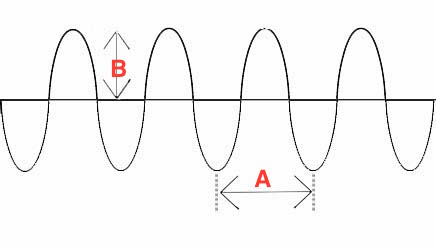
What property of the wave is represented by the letter "B"?
a)
amplitude
b)
crest
c)
trough
d)
wavelength
79.
The highest point on a wave is:
a)
the crest
b)
the trough
c)
the top
d)
the coast 
80.
The lowest point on a wave is the:
a)
Amplitude
b)
Crest
c)
Trough
d)
Wavelength
81.
The number of wavelengths that pass a point each per second is:
a)
frequency
b)
period
c)
longitudinal 
d)
transverse wave 
82.
The type of waves that require medium to pass:
a)
Mechanical Waves
b)
Electromagnetic Waves
83.
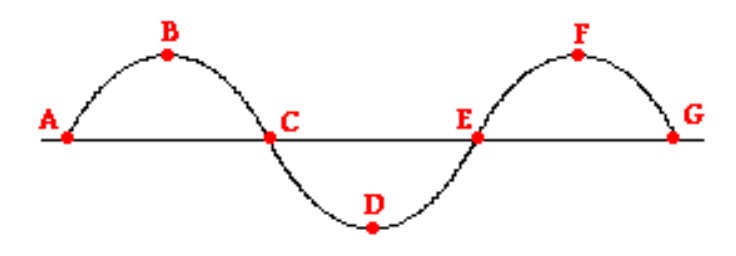
Which vocabulary term is used to identify the distance between points C & G?
a)
Amplitude
b)
Crest
c)
Frequency
d)
Wavelength
84.
When the frequency of a wave increases, what happens to the wavelength?
a)
The wavelength is not directly affected by the frequency of a wave.
b)
The wavelength increases.
c)
The wavelength decreases.
d)
More specific information is needed to form a conclusion about the wavelength.
85.
A mechanical wave cannot travel through...
a)
a vacuum(empty space).
b)
water.
c)
air. 
d)
glass.
86.
Which letter(s) represent the trough of the wave?
a)
A
b)
B & D
c)
D
d)
C & G
87.
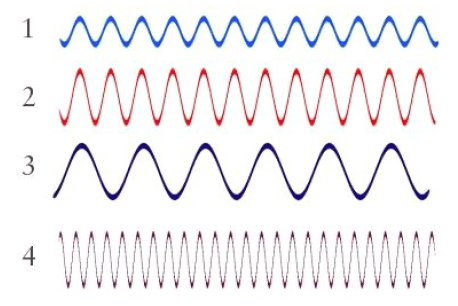
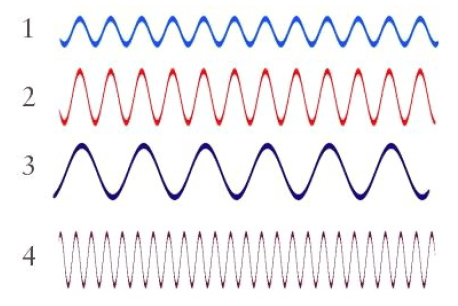
Which wave in the diagram has the greatest wavelength?
a)
1
b)
2
c)
3
d)
4
88.
Which wave in the diagram has the greatest frequency?
a)
1
b)
2
c)
3
d)
4
89.
What is transferred by the movement of waves?
a)
Matter
b)
Energy
c)
Nothing
d)
Water
90.
In which type of wave does the matter move at right a right angle (or opposite) to the direction of the wave?
a)
Mechanical
b)
Transverse
c)
Sound
d)
Compressional