
 Worksheets
Unit 2: 1-Dimensional Motion TEST
Total questions: 85
Worksheet time: 1hrs 20mins

An object starts from rest and accelerates at 2 m/s² for 5 seconds. What is its final velocity?
5 m/s
10 m/s
15 m/s
20 m/s
A car decelerates uniformly from 30 m/s to rest in 10 seconds. What is its deceleration?
-1 m/s²
-2 m/s²
-3 m/s²
-4 m/s²
Which of the following statements is true about free fall?
The object moves with constant velocity.
The object accelerates at 9.8 m/s² downward.
Air resistance increases the object's acceleration.
The acceleration depends on the mass of the object.
A physical quantity defined by its magnitude AND direction is called a...
Vector
Scalar
Which one of the following formulas would you need to use to calculate acceleration, if you are given the change in velocity and a time interval?
v = Δx / Δt
Δx = x f - x i
a = Δv / Δt
Δt = t f - t i
The slope on a velocity vs time graph represents
displacement
velocity
acceleration
cannot be determined
The area "under" the curve on a velocity vs time graph represents
displacement
velocity
acceleration
cannot be determined
A trucker drives with an average velocity of 27 m/s towards the east on a perfectly straight highway. What will the trucker's displacement be after 2 minutes?
97 m; east
190 m; east
1600 m; east
3200 m; east


Which runner won this 10 m race?
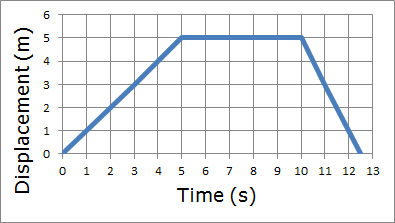
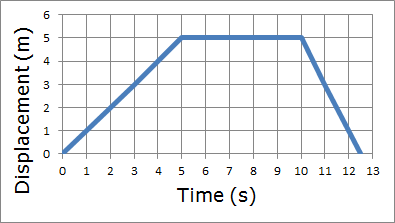
Can you accelerate while traveling at a constant speed?
Yes, by changing the direction in which you travel
No, as long as speed is the same, the acceleration is always zero.
A car traveling at 15 m/s slows down to a stop in a time of 3 seconds. What is its acceleration?
5 m/s2
-5 m/s2
15 m/s2
-10 m/s2
A driver in a car traveling at a speed of 5.8 m/s sees a stop sign 50 m away on the road. How long will it take for the car to accelerate uniformly to come to a complete stop at the stop sign?
55.8 s
8.6 s
17.2 s
290 s
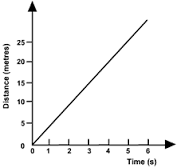
What is the line on this graph showing?
moving away from starting point at a constant speed
moving back towards the starting point at a constant speed
acceleration (getting faster)
deceleration (getting slower)
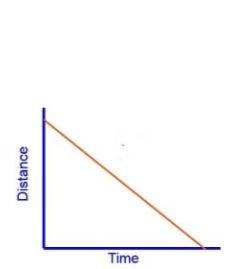
What is this line of this graph showing?
moving away from starting point at a constant speed
moving back towards the starting point at a constant speed
acceleration (getting faster)
deceleration (getting slower)

Part A of the graph is from 0s to 25s. Which of these statements is true about Part A?
The object is at rest.
The object is accelerating (its velocity is increasing)
The object is decelerating (its velocity is decreasing)
The object is moving at a constant velocity.

On this velocity vs time graph, describe the motion of C.
constant positive velocity
constant negative velocity
positive acceleration
negative acceleration
What two factors can create a change in velocity?
Change in speed and a change in time.
Change in direction and a change in time.
Change in speed and a change in direction.
Change in time and a change in direction.
What does the triangle, delta, Δ mean?
change in speed
change in velocity
change in acceleration
change in

Is this a scalar quantity or a vector quantity?
Wind blowing at 20 mph
Scalar
Vector
A trucker drives with an average velocity of 27 m/s towards the east on a perfectly straight highway. What will the trucker's displacement be after 2 mins?
97 m; east
190 m; east
1600 m; east
3240 m; east


A train with an initial speed of 5.30 m/s accelerates uniformly at the rate of 2.00 m/s2. Find the final speed after 7.00 s.
10.6 m/s
3.5 m/s
7.3 m/s
19.3 m/s
A driver in a car traveling at a speed of 5.8 m/s sees a stop sign 50 m away on the road. How long will it take for the car to accelerate uniformly to come to a complete stop at the stop sign?
55.8 s
8.6 s
17.2 s
290 s

Where would the chicken end up if the chicken has a +2 displacement?
+5 m
+2 m
0 m
+3 m

Which of the following is correct?
Initial Position = -2 m
Final Position = 0 m
Distance = 14 m
Displacement = +2 m
Initial Position = 0 m
Final Position = -2 m
Distance = 14 m
Displacement = -2 m
Initial Position = -2 m
Final Position = 0 m
Distance = -2 m
Displacement = -2 m
Initial Position = -2 m
Final Position = 0 m
Distance = 14 m
Displacement = +14 m
None are correct.

Two horses are running in a field. The gray horse runs 12 m/s north. The black horse runs 12 m/s east.
Which is true about their motions?
Equal speeds.
Equal velocities.
Equal displacements.
Which is a vector?
Displacement
Distance
Speed
Which of the following has INCORRECT units?
speed = m/s
time = s
displacement = m
velocity = s
A horse follows a dangling carrot for 20 m, if it took her 5 seconds to reach it, what was her average speed?
1,000 m/s
2.5 m/s
4 m/s
20 m/s
Which is the length of the path an object has traveled?
displacement
distance
motion
reference point
Scott travels north 5 miles and then goes west 3 miles before coming straight back south 2 miles. What is his distance?
10 miles
7 miles
8 miles
6 miles
You ride your bike in a straight line at a constant speed of 10 km/h.
Acceleration occurred because speed increased.
Acceleration did not occur because neither speed nor direction changed.
Acceleration occurred because you changed directions.
Acceleration occurred because speed decreased.

What is speed?
how far you go
how much distance is covered over a period of time
how fast you accelerate
the change in the location of a object
Changes in our speed, direction or both are called _________.
gravity
changes
acceleration
displacement

During which interval is the object speeding up? (More than one answer choice possible)
A to B
B to C
D to E
E to F
G to H
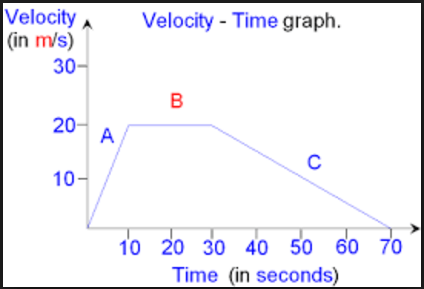
This is a velocity-time graph. What is the object doing in segment A?
Positive acceleration
Negative acceleration
Constant Velocity
Not moving

select all of the properties that are scalars
distance
time
temperature
speed
displacement
A dog ran at a speed of 20 m/s for 10 seconds. How far did it travel in this time?
2 m
1/2 m
20 m
200 m
Which of the following are vectors?
distance, speed, velocity
speed, acceleration, velocity
velocity, displacement, time
acceleration, velocity, displacement

During which interval is the object moving at a constant velocity? (More than one answer choice possible)
A to B
B to C
D to E
E to F
G to H

Define Origin
The reference point on which a frame of reference is based; the point of time 0 on a displacement-time graph
The measurement of the rate of change of position with respect to time
The constant acceleration on an object because of gravitational force; on Earth it is 9.81 m/s2 .
The vector quantity that gives the straight line distance from starting position to ending position

Define Acceleration Due to Gravity
The reference point on which a frame of reference is based; the point of time 0 on a displacement-time graph
The measurement of the rate of change of position with respect to time
The constant acceleration on an object because of gravitational force; on Earth it is 9.81 m/s 2 .
The vector quantity that gives the straight line distance from starting position to ending position

Define Displacement
The reference point on which a frame of reference is based; the point of time 0 on a displacement-time graph
The measurement of the rate of change of position with respect to time
The constant acceleration on an object because of gravitational force; on Earth it is 9.81 m/s2 .
The vector quantity that gives the straight line distance from starting position to ending position
Define Position
The measurement of the rate of change of position with respect to time
A vector quantity that shows how far an object is from the origin in a given direction. It can be positive, negative or zero.
The vector quantity that gives the straight line distance from starting position to ending position

Define X-Axis
The principal or horizontal axis of a system of coordinates, points along which have a value of zero for all other coordinates.
The secondary or vertical axis of a system of coordinates, points along which have a value of zero for all other coordinates.
Define Y-Axis
The principal or horizontal axis of a system of coordinates, points along which have a value of zero for all other coordinates.
The secondary or vertical axis of a system of coordinates, points along which have a value of zero for all other coordinates.
Which of the following describes one-dimensional motion?
Moving in a straight line
Moving in a circular path
Moving in a zigzag pattern
Moving in all three dimensions

Total Distance an object travels divided by the total time traveled.
Motion
Constant Speed
Acceleration
Average Speed

The distance an object moves over time
mass
distance
speed
acceleration

According to the graph below, what is the speed of the bird at 6 seconds?
1 meter per second
0 meters per second
- 4.5 meters per second
7 meters per second

What is the total distance traveled by the object in the graph below?
3 meters
9 meters
8 meters
6 miles

Imagine dropping a penny from the summit of Mount Everest, the highest peak in the world. Suppose the penny is dropped from rest and falls freely due to gravity. What is the speed of the penny after 3.25 seconds of free fall? Ignore air resistance.
9.8 m/s
1.63 m/s
31.85 m/s
9 m/s

A moon jellyfish drifts through the water for 350 meters in 70 seconds. What is its speed in meters per second?
2.45 m/s
24,500 m/s
0.2 m/s
5 m/s
Halley’s Comet travels an average of 156,000 miles per hour. How many hours would it take the comet to travel 3,744,000 miles?
0.04 hours
24 hours
185 hours
48 hours
Convert 55 km/hr to m/s
0.92 m/s
3,300 m/s
15.28 m/s
0.015 m/s
Convert 42 km to m
4,200 meters
0.042 meters
42,000 meters
420 meters
What are the units for the following:
Distance/Displacement
m
s
m/s
m/s2

