
 Worksheets
Spring Semester Physics Review
Total questions: 81
Worksheet time: 1hrs 9mins
Name
Class
Date
1.

If you throw a baseball straight up, what is its velocity at the highest point?
a)
9.8 m/s2
b)
9.8 m/s
c)
0 m/s2
d)
0 m/s
2.

If you throw a baseball straight up, what is its acceleration at the highest point?
a)
9.8 m/s2
b)
9.8 m/s
c)
0 m/s2
d)
0 m/s
3.

What is the horizontal acceleration of a projectile?
a)
0 m/s2
b)
9.8 m/s2
4.

What is the vertical acceleration of a projectile?
a)
0 m/s2
b)
9.8 m/s2
5.
An object is shot from the ground (at 25 m/s) at 25 degrees and 65 degrees. Which is in the air for longer? (assume no air resistance)
a)
25 degrees
b)
65 degrees
c)
same for both
6.
If a bullet is horizontally shot at the same moment another bullet is dropped from the same height, which will hit the ground first?
a)
Shot Bullet
b)
Dropped Bullet
c)
Hit at Same Time
7.
In the absence of air friction, the vertical component of a projectile's velocity doesn't change as the projectile moves.
a)
True
b)
False
c)
Sometimes true
d)
Sometimes false
8.
The velocity is always _____ to the line of a circle.
a)
outwards
b)
towards the center
c)
tangent
d)
faster
9.

When the puck is in the position shown in the diagram below, what is the direction of the net force that acts on the puck?
a)
Toward the top of the screen
b)
Toward the bottom of the screen
c)
Toward the left edge of the screen
d)
Toward the right edge of the screen
10.
Centripetal acceleration always points:
a)
in the direction of the object's motion
b)
in the opposite direction of the object's motion
c)
towards the center of the circle
d)
towards the outside of the circle
11.
What happens to the centripetal force exerted on an object if you triple the velocity?
a)
it increases to 3X
b)
it decreases to 6X
c)
it increases to 6X
d)
it increases to 9X
12.
Which of the following is the unit for centripetal force?
a)
J
b)
m/s2
c)
kg⋅m/s
d)
N
13.
A test car moves at a constant speed around a circular track. If the car is 48.2 m from the track's center and has a centripetal acceleration of 8.05 m/s2, what is the car's tangential speed?
a)
19.7 m/s
b)
5.99 m/s
c)
0.17 m/s
d)
388.01 m/s
14.

What kind of circuit is this?
a)
Series
b)
Consecutive
c)
Parallel
d)
Training
15.

What kind of circuit is this?
a)
Series
b)
Consecutive
c)
Parallel
d)
Training
16.
In a parallel circuit, if one connection is broken, all of the connections stop working.
a)
True
b)
False
17.
The movement of electrons from atom to atom in a line results in a flow of _____.
a)
amperage.
b)
electric current.
c)
electromagnetic connectors.
18.
Voltage is measured in __.
a)
volts.
b)
watts.
c)
coulombs.
19.
Power is defined as the product of voltage times amperage. The equations is ___.
a)
P=I x V
b)
V+ P = I
c)
I x P = V
20.
What is the formula for resistance?
a)
V x I = R
b)
R = V/I
21.
Resistance is measured in ___.
a)
watts.
b)
amps.
c)
ohms.
22.
The difference in electrical potential energy between two places is called
a)
resistance
b)
friction
c)
induction
d)
voltage
23.
If the current through a circuit is 2 A and the resistance of a light bulb in the circuit is 10 Ohms, what is the voltage difference across the light bulb?
a)
5 V
b)
12 V
c)
0.2 V
d)
20 V
24.

What would the voltmeter read
a)
1V
b)
2V
c)
3V
d)
6V
25.

If we have several light bulbs connected to a battery in parallel...
a)
The voltage will be the same across each bulb
b)
the current will be the same across each bulb
c)
The current will be the same through each bulb
d)
The resistance will be the same across each bulb
26.

The current passing through bulbs in series will be...
a)
...the same
b)
...different
27.
While electric current is flowing through a wire, what surrounds the wire?
a)
a magnetic field
b)
a glowing light
c)
neutrons
d)
protons
28.
What are three ways to make an electromagnet stronger?
a)
1. add more coils of wire around the iron core
2. add more electricity flowing through the wire
3. wrap a thinner wire around the core
2. add more electricity flowing through the wire
3. wrap a thinner wire around the core
b)
1. add less coils of wire around the iron core
2. add more electricity flowing through the wire
3. wrap a thinker wire around the core
2. add more electricity flowing through the wire
3. wrap a thinker wire around the core
c)
1. add more coils of wire around the iron core
2. add less electricity flowing through the wire
3. wrap a thicker wire around the core
2. add less electricity flowing through the wire
3. wrap a thicker wire around the core
d)
1. add more coils of wire around the iron core
2. add more electricity flowing through the wire
3. wrap a thicker wire around the core.
2. add more electricity flowing through the wire
3. wrap a thicker wire around the core.
29.
Generators are devices that convert _____ energy into _____ energy.
a)
chemical; mechanical
b)
mechanical; electrical
c)
electrical; mechanical
d)
potential; kinetic
30.
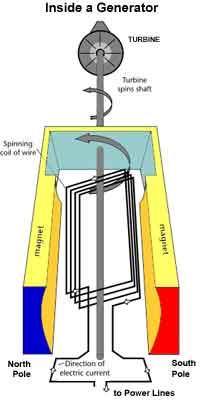
In large generators in power plants, ___________ rotate inside a coil of wire to produce an electric current.
a)
Wind
b)
Water
c)
Magnets
d)
Circuits
31.
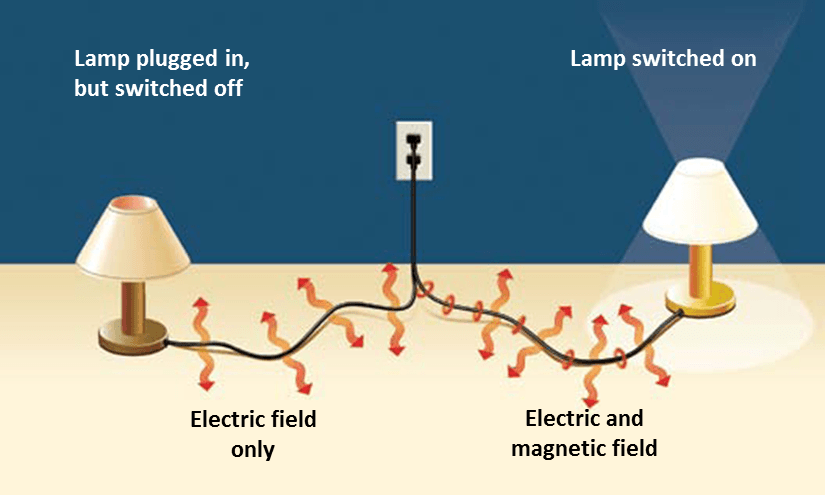
Electric fields are often associated with what other kind of field?
a)
Magnetic Fields
b)
Nuclear Fields
c)
Particle Fields
d)
Corn Fields
32.
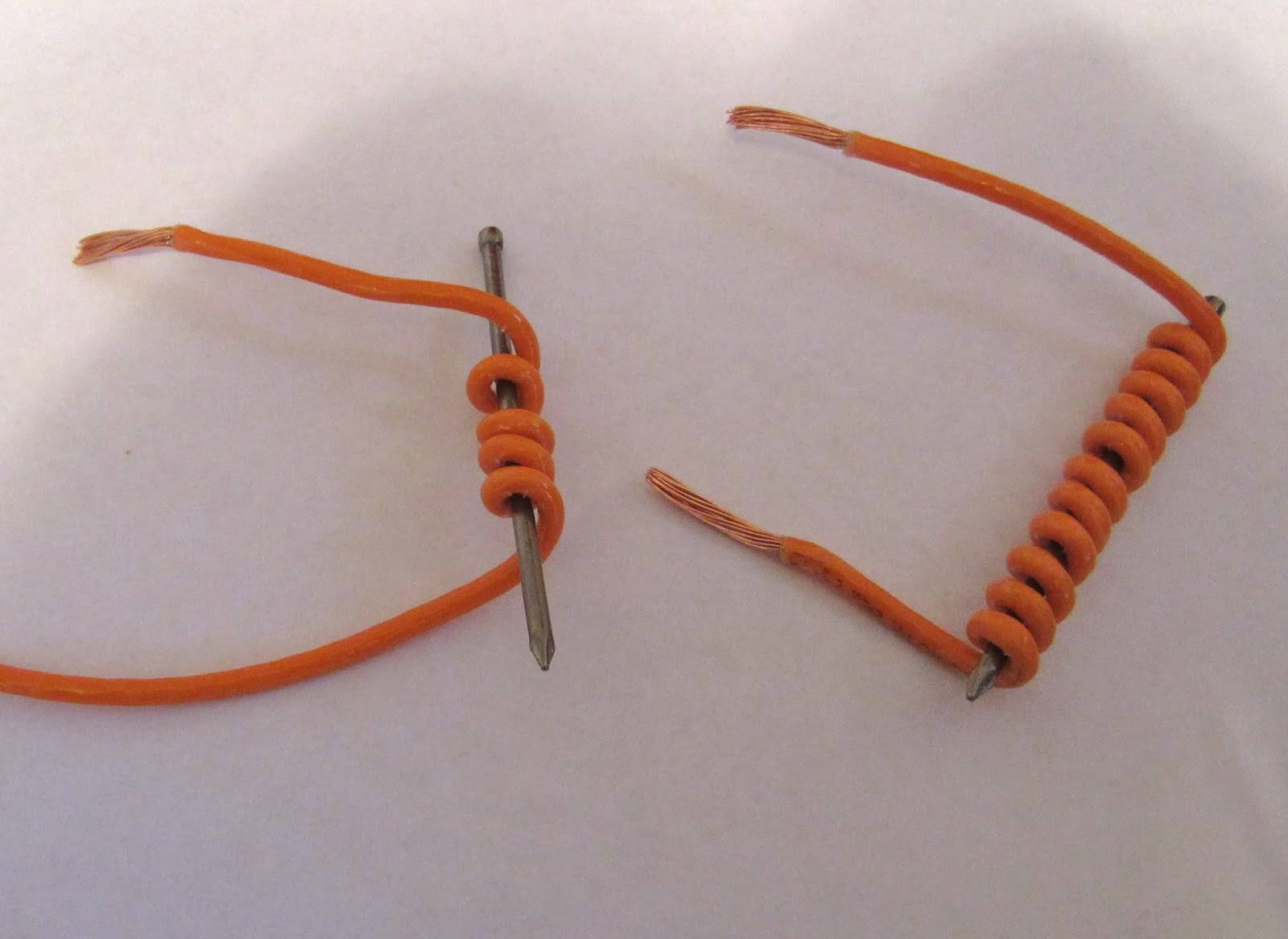
What happens to the strength of an electromagnet as you add more coils around it?
a)
Increases
b)
Decreases
c)
Stays the same
d)
Stops completely
33.
What is created when a wire moves between the poles of a magnet?
a)
A. a ferromagnet
b)
B. a solenoid
c)
C. an electromagnet
d)
D. an electric current
34.
A magnetic force is _______proportional to the velocity of the electric charge.
a)
Inversely
b)
Directly
c)
Indirectly
d)
Dialecticaly
35.
What is the direction of magnetic force relative to an electric current?
a)
Parallel
b)
Perpendicular
c)
The same
d)
Asymmetrical
36.
A changing electric field produces a...
a)
magnetic field
b)
electric field
37.
A changing magnetic field produces an..
a)
magnetic field
b)
electric field
38.
Electromagnetic forces are much stronger than gravity
a)
True
b)
False
39.
Magnetic forces are ONLY created by...
a)
Electric charges in motion
b)
Electricity
c)
Magnetic forces in motion
d)
Unpaired electrons
40.
Electricity and magnetism are both aspects of the same phenomenon
a)
True
b)
False
41.
Force of gravity is inversely proportional to
a)
Mass
b)
Weight
c)
Distance
d)
Time
42.
Force of gravity is directly proportional to
a)
Mass
b)
Weight
c)
Distance
d)
Time
43.
As distance between two objects increase the pull of gravity
a)
Increases
b)
Decreases
c)
Stays the same
44.
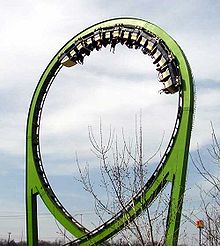
Where is the net force when the rollercoaster is at the top of the loop?
a)
Towards the sky
b)
Towards the Right
c)
Towards the left
d)
Towards the ground
45.
What will happen to the Electrostatic Force if the charge of one particle is increased 6 times?
a)
The force will decrease 6 times
b)
The force will increase 6 times
c)
The force will increase 36 times
d)
The force will decrease by 1/6
46.
Calculate the force exerted between two charged objects separated by a distance of 0.6 m. One object has a charge of -5 C and the other has a charge of +2.0 C.
a)
-1.5E-11 N
b)
2.5E-11 N
c)
-2.5E11 N
d)
-7.5E-10 N
47.
If each of the charges doubles, what happens to the force?
a)
Quadruples
b)
Doubles
c)
Stays the same
d)
Reduced by half
48.
If the distance doubles, what happens to the force?
a)
Reduced by half
b)
Reduced by 1/4
c)
Stays the same
d)
Quadruples
49.
Two oppositely charged particles are held in place near each other. When the particles are released, what will most likely happen?
a)
the will accelerate towards each other
b)
they will accelerate away from each other
c)
they will move towards each other at a constant speed
d)
they will move away from each other at a constant speed
50.
The Electric Force is strongest when charges are...
a)
close together
b)
far apart
c)
the electric force is constant everywhere
51.
The photoelectric effect only occurs if the light shining on the metal is:
a)
coherent.
b)
above a minimum intensity.
c)
above a minimum frequency.
d)
above a minimum wavelength.
52.
The following observations are made about the photoelectric effect:
1. No electrons are emitted below the threshold frequency.
2. Above the threshold frequency the energy of electrons depends on the frequency of the light.
3. Increasing intensity increases the number of emitted electrons.
Which (if any) of these observations can be explained by a wave theory of light?
1. No electrons are emitted below the threshold frequency.
2. Above the threshold frequency the energy of electrons depends on the frequency of the light.
3. Increasing intensity increases the number of emitted electrons.
Which (if any) of these observations can be explained by a wave theory of light?
a)
All of them.
b)
1 and 2 only.
c)
3 only.
d)
None of them.
53.
The photoelectric effect is when:
a)
Electrons collide inside a metal to release photons.
b)
One incident metal electron releases one photon.
c)
One incident photon releases one electron from a metal.
d)
Photons are absorbed in to metal ions releasing electrons.
54.
Which of the following is has the least amount of strength?
a)
electromagnetic
b)
gravitational
c)
weak nuclear
d)
strong nuclear
55.
The gravitational force acts over a __________ distance
a)
long
b)
short
c)
medium
d)
no
56.
The strong force acts over a __________ distance
a)
long
b)
short
c)
medium
d)
no
57.
Which of the following is NOT a weak nuclear force?
a)
generation of sunlight
b)
generation of magnetic fields
c)
dating of organic materials
d)
energy from plate tectonics
58.
The strong nuclear force _________.
a)
holds the universe together
b)
causes instability in the nucleus
c)
bonds protons and neutrons together to form the nucleus
d)
creates an magnetic field around the earth
59.
The photoelectric effect helps us to understand
a)
the particle nature of light.
b)
diffraction pattern produced as light passes through a single slit.
c)
the wave behavior of light.
d)
spectroscopes.
60.
The emission spectra is produced when
a)
electrons release energy as they move to their excited state.
b)
electrons absorb energy as they move to their excited state.
c)
electrons release energy as they return to the ground state.
d)
electrons absorb energy as they return to the ground state.
61.
When the frequency of light increases during the photoelectric effect the kinetic energy of the emitted electron __________.
a)
stays the same
b)
increases also
c)
decreases
d)
goes away completely
62.
Which of the following is has the greatest strength?
a)
electromagnetic
b)
gravitational
c)
weak nuclear
d)
strong nuclear
63.
The mass after a fission or fusion nuclear reaction is slightly less due to
a)
energy that is given off during the reaction.
b)
the gravitational strong force.
c)
the photoelectric effect.
d)
the law of weak forces.
64.
Rank the four fundamental forces of nature in order from weakest to strongest:
a)
Electromagnetism, Gravity, Strong Nuclear, Weak Nuclear
b)
Weak Nuclear, Gravity, Electromagnetism, Strong Nuclear
c)
Gravity, Weak Nuclear, Electromagnetism, Strong Nuclear
d)
Weak Nuclear, Electromagnetism, Gravity, Strong Nuclear
65.

When an atom undergoes radioactive decay, the energy that is released is due to:
a)
Gravity
b)
Electromagnetism
c)
Strong Nuclear
d)
Weak Nuclear
66.

An electron moving in wire is an example of ____________.
a)
Gravity
b)
Electromagnetism
c)
Strong Nuclear
d)
Weak Nuclear
67.
_____________ is the force that binds protons together in the nucleus of an atom.
a)
Gravity
b)
Electromagnetism
c)
Strong Nuclear
d)
Weak Nuclear
68.
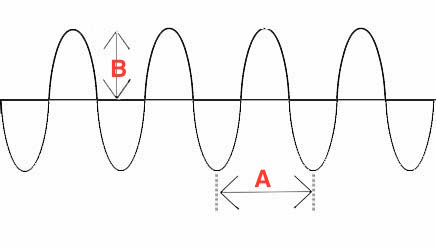
What property of this wave is represented by the letter "A"
a)
amplitude
b)
crest
c)
trough
d)
wavelength
69.
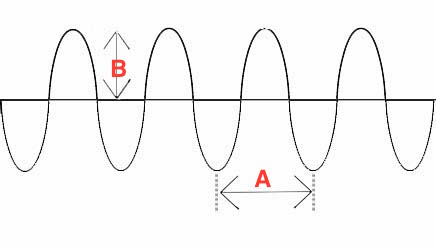
What property of the wave is represented by the letter "B"?
a)
amplitude
b)
crest
c)
trough
d)
wavelength
70.
When the frequency of a wave increases, what happens to the wavelength?
a)
The wavelength is not directly affected by the frequency of a wave.
b)
The wavelength increases.
c)
The wavelength decreases.
d)
More specific information is needed to form a conclusion about the wavelength.
71.
which material does sound travel the fastest?
a)
solid
b)
liquid
c)
gases
72.
When a wave strikes and object and bounces off. (example echo)
a)
medium
b)
refraction
c)
reflection
d)
interference
73.
When a wave bends as it passes through at an angle from one medium to another.(example: pencil in a glass of water-)
a)
medium
b)
refraction
c)
reflection
d)
interference
74.

What kind of wave is pictured below?
a)
compressional wave
b)
transverse wave
c)
sound wave
d)
mechanical wave
75.
The Frequency where standing waves are produced is known as _______________
a)
Standing Waves
b)
Standing Freuqency
c)
Resonance
d)
Resonant Frequency
76.
Which interaction of wave is known for when waves bend around a barrier?
a)
Refraction
b)
Reflection
c)
Diffraction
d)
Interference
77.

_____________ wave particles move left to right.
a)
Transverse
b)
Electromagnetic
c)
Longitudinal
d)
Ocean
78.
What happens when you increase the amplitude of a sound?
a)
it makes the sound louder
b)
it makes the sound travel faster
c)
it increases the wavelength of the sound
d)
it increases the frequency of the sound
79.
The Doppler effect can cause an apparent change in...
a)
loudness
b)
intensity
c)
pitch
d)
reasonance
80.
As a sound source approaches and then moves past a stationary observer, the observer will hear
a)
a steady rise in pitch
b)
a sudden drop in pitch
c)
a drop in pitch, then a rise in pitch
d)
a rise in pitch, then a drop in pitch
81.
What law says "the angle which a light wave strikes an object is the same angle which the light wave is reflected"?
a)
Refraction
b)
Resonance
c)
Reflection
d)
Retirement
100 %

