

wayground logo

Free Printable Worksheets

Font size

S
M
L
XL
Worksheets

Physics Final Review

Total questions: 83

Worksheet time: 3hrs 8mins
Name
Class
Date
1.
Distance and direction of an object's change in position from a starting point
a)
displacement
b)
distance
c)
motion
d)
reference point
2.
Liza is swimming laps from one end of a 50 meter pool to the other. Going from one end to the other is considered one lap. If she swims four complete laps, which statement is TRUE?
a)
Her distance and displacement are both zero.
b)
Her distance is zero, but her displacement is 200 meters.
c)
Her distance is 200 meters, but her displacement is zero.
d)
Her distance and displacement are both 200 meters.
3.
Ivan walks 10 meters west to the water fountain, then runs 2 meters east to his class to avoid a lockout. His displacement would be:
a)
8 meters
b)
8 meters, east
c)
8 meters, west
d)
12 meters
4.
During a game of dodgeball, Marina runs 2.45 meters forward to grab a dodgeball, then runs 1.25 meters backward to avoid a opponent's dodgeball. Her displacement would be:
a)
3.7 meters backwards
b)
1.2 meters backwards
c)
3.7 meters forwards
d)
1.2 meters forwards
5.
Ronaldo runs across a soccer field, moving 10 meters north, then 8 meters west. His displacement would be:
a)
10.2 m, NW
b)
12.8 m, NW
c)
15.4 m, NW
d)
18.0 m, NW
6.
Scott drives a Jeep 12 km east, then 4 km north, then finally 3 km west. He traveled a total distance of:
a)
5 km
b)
10 km
c)
13 km
d)
19 km
7.
A ping-pong ball rolls forward 6 meters, and bounces backward 3 meters. It traveled a total distance of:
a)
9 meters
b)
6 meters
c)
3 meters
d)
0 meters
8.

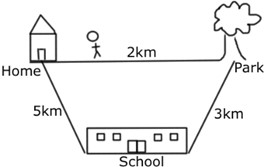
Jerry walked from home to school, then from the school to the park. What is his total displacement?

a)

2 km

b)

5 km

c)

8 km

d)

10 km

9.

Jerry walked from home to school, then from the school to the park. What is his total distance?

a)

2 km

b)

5 km

c)

8 km

d)

10 km

10.

A cat walks 3 meters toward a laser, then jumps 5 meters due south of the laser when it sees a thing. What is the displacement of the cat (to the nearest tenth)?

a)

3.0m

b)

5.0m

c)

8.0m

d)

5.8m

11.
Acceleration of an object happens when things ________
a)
slow down
b)
go faster
c)
change direction (turn)
d)
All of the above
12.
A ball rolling west at 5 cm per second is an example of ____. 
a)
Speed
b)
Velocity
c)
Acceleration
d)
Direction
13.
A truck slowing down to stop at a red light is an example of ____. 
a)
Speed
b)
Velocity
c)
Acceleration
d)
Direction
14.
Turning a corner on a motorcycle is an example of ____. 
a)
Speed
b)
Velocity
c)
Acceleration
d)
Direction
15.
Distance over Time is the definition of ___. 
a)
Speed
b)
Velocity
c)
Acceleration
d)
Direction
16.
What is the formula to calculate speed?
a)
Speed = time/distance
b)
Speed = distance/time
c)
Speed = distance x time
d)
Speed = time x distance
17.
Km (kilometers) is a unit for ___. 
a)
Speed
b)
Distance
c)
Time
d)
Direction
18.
Which of the following statements about speed and velocity is correct?
a)
Velocity only describes an object’s rate of motion.
b)
Speed describes how an object is changing its velocity.
c)
Speed and velocity both describe how an object is speeding up.
d)
Only velocity includes the direction an object is traveling.
19.
The gees fly 23 mph to the south when they migrate for the winter. 
a)
speed
b)
velocity
c)
acceleration
20.
The tornado is traveling northwest at 20 mph. 
a)
speed
b)
velocity
c)
acceleration
21.

What is a balanced force.

a)

Two forces are different strength but act in same direction.

b)

Two forces are the same strength but act in opposite direction.

c)

Two force with the same strength but act in the same direction.

d)

not equal

22.

Define Force

a)

sit and lay

b)

no strength and no energy

c)

stop and start

d)

push and pull

23.

Define net-force

a)

the resistance that on surface or object encounters

b)

causes a object to fall faster and faster

c)

Is the vector sum of all the forces that act upon an object.

d)

Two forces are the same strength but act in opposite direction.

24.

Newtons 3rd Law

a)

every action has a equal and opposite reaction

b)

an object at rest tends to stay at rest an object in motion

c)

acceleration depends on force and mass

f=m times a

d)

causes an object to fall faster and faster

25.

Newtons 2nd law

a)

an object

b)

a=f/m

c)

f=m times acceleration f=m times a

d)

f-m-a

26.

What does it mean for an object to be in free fall?

a)

Only air resistance acting on the object

b)

Any object that is in downward motion

c)

Gravity is the only force acting on the object

27.

Define acceleration due to gravity

a)

The velocity of an object under the influence of gravity

b)

The acceleration experienced by an object due to gravity

c)

The force of gravity

d)

The force of gravity acting on a object

28.

Difference between Mass and Weight

a)

mass is the amount of matter in a material, while weight is a measure of how the force of gravity acts upon that mass.

b)

mass is the measure of the force, while weight is a measure of how the force of gravity acts upon that mass.

c)

mass is the amount of matter in a material, while weight measure how much gravity acts upon a force.

29.

Newtons First Law

a)

Every action has a equal an opposite reaction.

b)

An object at rest tends to stay at rest an object in motion.

30.

Unbalanced Force

a)

Are not equal, and they always cause the motion of an object to change the speed and direction that is moving.

b)

Well cause no change in the speed of an object act in an opposite direction.

31.

You have just designed a machine that uses 900 J of work from a motor for 480 J of useful work the machine supplies. What is the efficiency of your machine?

a)

53%

b)

100%

c)

83%

d)

43%

32.

What are the 6 simple machines we discussed in class?

a)

wheel, hammer, spiral, stump, spike, cube

b)

pulley, lever, wheel and axle, screw, inclined plane, wedge

c)

ramp, bolt, circuit, wheel, block, spiral

d)

wheel and socket, ramp, cube, screw, lever, spiral

33.

You test a machine and find it exerts a force of 45 N for each 5 N of force you exert operating the machine. What is the Actual Mechanical Advantage of the machine?

a)

10

b)

11

c)

9

d)

5

34.

Scissors are an example of which simple machine?

a)

screw

b)

pulley

c)

inclined plane

d)

lever

35.

How much work is done when a crate is pushed with 50 N of force for a distance of 15m?

a)

750 J

b)

3 J

c)

65 J

d)

650 J

36.

You exert 640 J of work lifting a box in a time of 2 seconds. How much power is used to lift the box?

a)

642 W

b)

640 W

c)

1280 W

d)

320 W

37.

Which class of levers is shown in the image?

a)

First-Class Lever

b)

Second- Class Lever

c)

Third- Class Lever

d)

Fourth- Class Lever

38.

What is an inclined plane?

a)

Slanted surface along which a force moves an object to a different elevation

b)

V-shaped object which a force moves an object to a different location

c)

Uses a series of ropes to move an object in a different direction

d)

Consists of two disks which rotate an object clockwise

39.

If x = 7 cm and y = 21 cm, what is the ideal mechanical advantage of the pliers?

a)

33

b)

147

c)

3

d)

28

40.

An axe is an example of which simple machine?

a)

Pulley

b)

Wedge

c)

Screw

d)

Inclined plane

41.
The ability to cause change
a)
Transfer 
b)
Energy
c)
Transform
d)
Kinetic Energy 
42.
The energy of motion.
a)
Potential Energy 
b)
Kineitc Energy 
c)
Mechanical energy 
d)
Transfer
43.
Stored energy
a)
Potential Energy 
b)
Kinetic Energy 
c)
Mechanical energy 
d)
Transfer
44.
Energy an object has due to its position or height.
a)
Potential Energy 
b)
Kinetic  Energy 
c)
Mechanical energy 
d)
Transfer
45.
The sum of the potential and kinetic energy. 
a)
Potential Energy 
b)
Kinetic  Energy 
c)
Mechanical energy 
d)
Transfer
46.
A scientific law stating that energy can’t be created or destroyed. It can only be transformed.
a)
Law of Conservation of matter.
b)
Law of Conservation of mass. 
c)
Law of Conservation of energy.
d)
Law of Conservation of momentum 
47.
The change of energy from one form into another form.
a)
Kinetic energy  
b)
Transfer 
c)
Mechanical energy  
d)
Transform.
48.
If the potential energy is 45 J (joules)and the kinetic energy is 50 J, what is the mechanical energy? 
a)
5 J
b)
45 J
c)
50 J
d)
95 J
49.
Where  is the potential energy the greatest?
(enlarge the picture if needed)
a)
1
b)
2
c)
3
d)
4
50.

If a crate is moved 10 m with a force of 50 N, how much work is done?

a)

40 Joules

b)

60 Joules

c)

500 Joules

d)

5 Joules

51.

What is the correct unit for energy?

a)

meters (m)

b)

kilogram meters per second (kg m/s)

c)

Newtons (N)

d)

Joules (J)

52.

Lilly's cat ran through your yard. The cat has a mass of 5 kg. He is running at a speed of 3 m/s. What is the kinetic energy of the cat as he runs? (KE = 1/2mv2)

a)

8.5 J

b)

45 J

c)

7.5 J

d)

22.5 J

53.

Calculate the potential energy of a car with a mass of 2,500 kg that is on a hill 100 meters above sea level. (g = 10 Nkg-1)

a)

250,000 J

b)

2,500,000 J

c)

25,000,000 J

d)

250 J

54.
What is the top of a wave?
a)
trough
b)
crest
55.
What is the height of a wave?
a)
amplitude
b)
wavelength
56.

What is the red line showing?

a)

crest

b)

trough

c)

wavelength

d)

amplitude

57.

What is the letter a showing?

a)

crest

b)

trough

c)

wavelength

d)

amplitude

58.
When the particles of a medium are vibrating perpendicular to the direction of the wave,  this is a __________wave.
a)
sound
b)
water
c)
transverse
d)
longitudinal
59.
A wave that moves the medium parallel to the direction of the energy is a:
a)
electromagnetic
b)
standing
c)
transverse
d)
longitudinal
60.
What are waves that can transfer heat through the vacuum of empty space?
a)
Electromagnetic waves
b)
Convection
c)
Conduction
d)
Heat
61.
What is a transfer of heat energy by electromagnetic waves?
a)
Radiation
b)
Convection
c)
Conduction
d)
Heat
62.
What is the transfer of heat by direct contact?
a)
Convection
b)
Electromagnetic waves
c)
Radiation
d)
Conduction
63.
What is the measurement of the average kinetic energy of a substance?
a)
Kinetic energy
b)
Temperature
c)
Thermal energy
d)
Potential energy
64.
What is a substance that does NOT conduct heat well?
a)
Conductor
b)
Insulator
c)
Convector
d)
Radiator
65.
What is a substance that DOES conduct heat well?
a)
Conductor
b)
Insulator
c)
Convector
d)
Radiator
66.
What is the total amount of kinetic energy in a substance?
a)
Potential energy
b)
Kinetic energy
c)
Thermal energy
d)
Temperature
67.
What is the transfer of kinetic energy from one substance to another?
a)
Heat
b)
Energy
c)
Thermal energy
d)
Temperature
68.

What is the MEASURE of kinetic energy of the particles in a substance?

a)
Potential energy
b)
Kinetic energy
c)
Thermal energy
d)
Temperature
69.
What is energy?
a)
Kinetic
b)
Movement
c)
Ability to do work, son.
d)
Thermal energy
70.
What is the transfer of heat by movement of liquids or gases?
a)
Radiation
b)
Convection
c)
Conduction
d)
Heat
71.

A north pole and a south pole will attract each other.

a)

True

b)

False

72.

How is a permanent magnet different from a temporary magnet?

a)

A permanent magnet attracts materials made of iron.

b)

A permanent magnet has poles.

c)

A permanent magnet has a magnetic field.

d)

A permanent magnet keeps its magnetism for a long time.

73.

A device that uses a free-moving magnetic needle to show direction is a:

a)

Lodestone

b)

Magnet

c)

Compass

d)

Magnetic field

74.

What will happen when these magnets are brought close together?

a)

They will attract each other.

b)

They will repel each other.

c)

Both the magnets will turn to the left.

d)

Both the magnets will turn to the right.

75.

Iron, Nickel and Cobalt are all __________________ materials.

a)

Shiny

b)

Poles

c)

Magnetic

d)

Cold

76.

How is Earth's magnetic field similar to that of a magnet?

a)

It is hundreds of miles long.

b)

It has north and south poles.

c)

It is made in Earth's core.

d)

It is shaped like a horseshoe.

77.
For electrical energy to flow, there must be a(n) ______.
a)
good battery
b)
copper wire
c)
on/off switch
d)
closed circuit
78.
Which of the following is NOT a conductor?
a)
Water
b)
Aluminum
c)
Wood
d)
Penny
79.
In a _________ circuit, the components are arranged with one path for the current.
a)
series
b)
parallel
80.
The measure of potential energy stored in a battery is called _________.
a)
potentiometer
b)
capacity
c)
voltage
d)
resistance
81.
In a _________ circuit, each component has its own path for the current to flow.
a)
series
b)
parallel
82.
Which type of circuit would you use in order to turn each component on and off separately?
a)
Series
b)
Parallel
83.
Pennies can be used to make a battery because they are __________.
a)
conductors
b)
insulators
c)
capacitors
d)
voltage
