
 Worksheets
Waves - CP Physics
Total questions: 72
Worksheet time: 2hrs 3mins
The highest point on a wave is called the ___.
trough
amplitude
crest
equilibrium
wavelength
The lowest part of a wave is called the ______.
crest
trough
amplitude
wavelength
equilibrium
The amplitude is the _______
distance from trough to trough
length of wave
distance from midpoint to crest or from midpoint to trough
measured in seconds
Which of these is an example of a transverse wave?
Sound
A vibrating guitar string
pressure waves
Which of the following is an example of a longitudinal wave
Sound
X-Rays
A vibrating guitar string
Visible light
What is the relationship between frequency and wavelength?
Direct
Quadratic
Inverse
Not Related
A wave completes two cycles in 30.0 s. What is the period of the wave?
0.033 s
15 Hz
0.033 Hz
15 s
You shake a slinky up and down, creating 75 waves in 45.0 s. What is the frequency of the waves that you created?
1.67 Hz
1.67 s
0.6 Hz
0.6 s
What is the frequency of a wave?
Number of oscillations produced in a certain amount of time
The distance the wave oscillates from it's resting position
Resting point of a wave - no wave movement
What is a medium?
The lowest point of a transverse wave
The size of a wave
The middle of a wave
Matter through which a wave travels
How do you measure wavelength?
transverse and longitudinal
The distance between two identical parts of a wave
Crest to Trough
From resting position, up to crest
What are two parts of the wave can be used to help measure the wavelength? Hint: There are two correct answers
Crest to crest
Trough to trough
Resting position to wavelength
Amplitude + Frequency
What is an example of a LONGITUDINAL wave?
X-Ray
Light Waves
Sound
A WATER WAVE
If the wavelength of a wave increased, what would happen to the frequency?
decrease
increase
stay the same
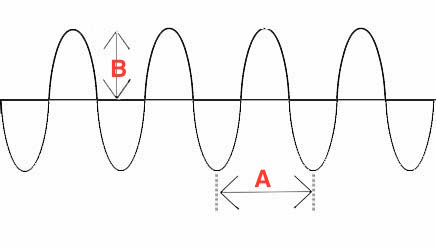
What property of this wave is represented by the letter "A"
amplitude
crest
trough
wavelength
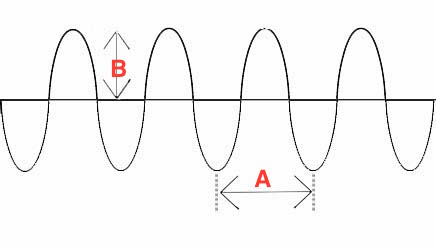
A wave has frequency of 5 Hz and a speed of 30 m/s. What is the wavelength of the wave?
30 m
150 m
5 m
6 m

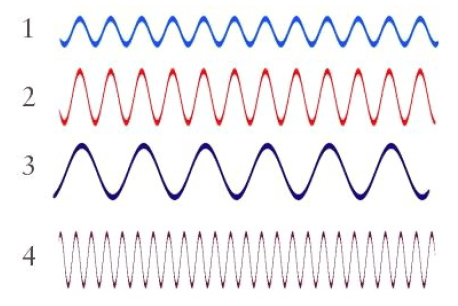
Which wave has the shortest/smallest wavelength?
1
2
3
4

Which wave has highest frequency?
A
B
C
D

Which of these waves has the smallest amplitude?
P
Q
S
T

Which statement is correct about the wave shown in the diagram?
It is a transverse wave because the particles are moving perpendicular to the motion of the wave.
It is a transverse wave because the particles are moving parallel to the motion of the wave.
It is a longitudinal wave because the particles are moving perpendicular to the motion of the wave.
It is a longitudinal wave because the particles are moving parallel to the motion of the wave.
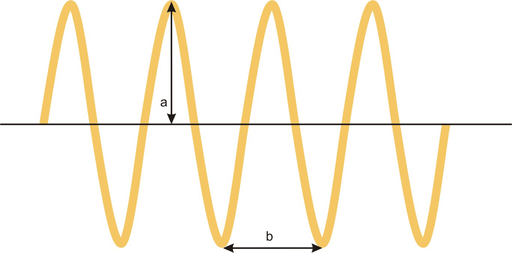
How many complete waves are presented above?
Which of the following is the speed of a wave traveling with a wavelength λ, frequency f, and period T?
v=fλ
v=λf
v=λ⋅f
v=f⋅T
v=Tf
The frequency of a wave is doubled when the wavelength remains the same. What happens to the speed of the wave?
It doubles
It quadruples
Remains unchanged
It is cut to one-half
It is cut to one-fourth
The frequency of a wave increases when the speed remains the same. What happens to the wavelength?
It increases
It decreases
Stays unchaged
It increases first and then decreases
It decreases first and then increases
Which of the following statements is true about longitudinal waves?
They always have the same frequencies
They always have the same velocities
They always have the same wavelengths
They always travel through a dense medium
The particles vibrate along the same direction as the wave motion

What is the amplitude of the wave?
0.5 cm
1 cm
2 cm
5 cm
20 cm
What is the wavelength of the wave?
0.5 cm
1 cm
2 cm
5 cm
20 cm

What is the amplitude of this wave?
1 cm
2 cm
4 cm
6 cm
8 cm
What is the wavelength of the wave?
1 cm
2 cm
4 cm
6 cm
8 cm

Which transverse wave has the highest frequency?
1
2
3
4
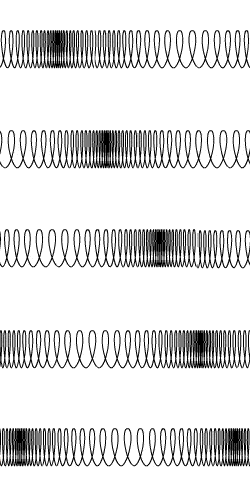
What type of wave is this?
Longitudinal
Transverse
Electromagnetic
x ray
What is the speed of a wave with a wavelength of 2 m and a frequency of 2.5 s?
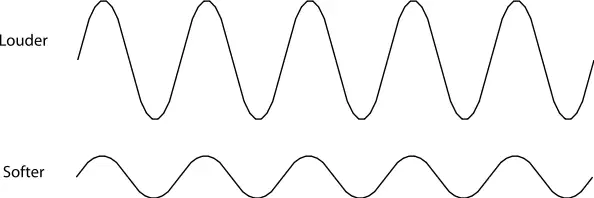
Which wave has the most energy?
They are the same

What type of interference is represented in this diagram?
Constructive
Destructive

What type of interference is represented in the diagram?
Constructive
Destructive
When a crest and a trough interfere, what occurs?
They combine to create a higher amplitude wave.
They interact to create a smaller amplitude wave.
The wave changes into a longitudinal wave.

The crest of a wave with a 2 meter amplitude collides with a the trough of a wave with a 1 meter amplitude. What will be the amplitude and direction of the resulting wave? Select two answers.
1 meter
2 meters
3 meters
Downwards
Upwards
The crest of a wave with an amplitude of 5m crashes into the crest of another wave with an amplitude of 3m. What will the amplitude of the resulting wave be?
2 meters
6 meters
8 meters
Upward
Downward
When two waves experience constructive interference, the result is….
A bigger wave
A smaller wave
A wave that is completely destroyed
They simply pass through each other
the unit for frequency is
lamda
hertz
meters
Avis

Two transverse waves overlap. Crests overlap with crests. Troughs overlap with troughs. _____ interference occurs.
Constructive
Destructive

Two transverse waves overlap. Crests overlap with troughs. Troughs overlap with crests. _________ interference occurs.
Constructive
Destructive

If two overlapping waves interact constructively, the resultant wave will have ______ compared to the two waves.

The correct unit for wavelength is:
Hz
S
m
m/s
A substance (like solid, liquid or gas) that the energy of a wave can travel through
amplitude
compression
medium
frequency
A single crest traveling through a medium is called a ___
wave
pulse
amplitude
tomato
The higher the tension in a string,
the greater the wavelength
the faster the wave moves
the slower the wave moves
the less energy is transfered.
If amplitude is increased then the wavelength
increases
decreases
stays the same
If frequency is increased then the period is ________-
increased
decreased
stays the same
Light can travel through
water
air
vacuum
solids
All of these
Light has a speed of ____ meters per second in air.
300
300,000
3,000,000
300,000,000
You can calculate the speed of a wave by dividing the wavelength ______
frequency
period
lambda
time
Whenever a wave changes materials, the wave’s ______ remains the same.
speed
frequency
color
favorite song
Whenever a wave changes materials, the wave's ______ changes.
FREQUENCY
FAVORITE SONG
SPEED
TYPE
If a string is attached to a fixed point, the pulse will be reflected back at the same amplitude ________-
AND DIRECTION
BUT INVERTED
BUT DIFFERENT FREQUENCY
BUT DIFFERENT ENERGY LEVEL
If a string is attached to a LOOSE END , the pulse will be reflected back at the same amplitude ________-
AND DIRECTION
BUT INVERTED
BUT DIFFERENT FREQUENCY
BUT DIFFERENT ENERGY LEVEL

Two wave pulses one with a positive amplitude the other with equal negative amplitude travel on a cord approaching each other. What is the result of the oscillations when the pulses reach the same point?
It is constructive interference with twice the amplitude
It is destructive interference with zero amplitude
It is constructive interference with slightly greater amplitude
It is constructive interference with the negative amplitude
The standing wave is produced

Two wave pulses with equal positive amplitudes travel on a cord approaching each other. What is the result of the oscillations when the pulses reach the same point?
It is constructive interference with twice the amplitude
It is destructive interference with zero amplitude
It is constructive interference with slightly greater amplitude
It is constructive interference with the negative amplitude
The standing wave is produced
The number of cycles that are completed per second is called the ________ and is measured in _________.
frequency, Hertz
wavelength, meters
amplitude, meters
period, seconds

If wave A has an amplitude of 5 meters, and wave B has an amplitude of 6 meters, what is the height of the wave when interference occurs?
0 m
-1 m
35 m
11 m

