
 Worksheets
SHM, Waves, and Sound Review
Total questions: 74
Worksheet time: 5hrs 44mins
The highest point of a wave
Crest
Trough
Amplitude
Wavelength
The lowest point of a wave
Crest
Trough
Amplitude
Wavelength
A wave in which the motion of the wave is parallel to the direction of the wave.
Crest
longitudinal
transverse
Wavelength
The height of a wave from the equilibrium point
Crest
longitudinal
wavelength
amplitude
The distance from the crest of one wave to the crest of the next wave
Crest
longitudinal
transverse
Wavelength
The number of waves in given time
Crest
frequency
period
Wavelength
The time it takes for one wavelength
Crest
frequency
period
Wavelength
A wave in which the motion of the wave is perpendicular to the direction of the wave
Crest
transverse
longitudinal
Wavelength

What is A pointing to?
Amplitude
Crest
Wavelength
Trough
What is B pointing to?
Amplitude
Crest
Wavelength
Trough
What is C pointing to?
Amplitude
Crest
Wavelength
Trough
What is D pointing to?
Amplitude
Crest
Wavelength
Trough
If you were to increase the length of the string on a pendulum, what would happen to the period of the pendulum?
The period would increase.
The period would decrease.
The period would stay the same.
Cannot determine this information.
If you were to increase the mass on a pendulum, what would happen to the period of the pendulum?
The period would increase.
The period would decrease.
The period would stay the same.
Cannot determine this information.
What variables affect the period of a mass on a spring? Check all that apply.
the mass of the object on the spring
the mass of the spring
the spring constant
how far the spring is stretched
What variables affect the period of a pendulum? Check all that apply.
the mass of the pendulum bob
the length of the string
the gravitational acceleration
the type of string used
If you were to increase the mass of the object on a spring, what would happen to the period of the mass on the spring?
The period would increase.
The period would decrease.
The period would stay the same.
Cannot determine this information.
At what point in the swing of a pendulum is the bob moving fastest?
at the top of the arc
at the bottom of the arc
The number of oscillations per second is the
period
frequency
amplitude
oscillation
pendulum bob
The time for one complete back and forth swing is the
period
frequency
amplitude
oscillation
pendulum bob
The maximum displacement from equilibrium is the
period
frequency
amplitude
oscillation
pendulum bob
Period is measured in
m/s
s
m
Hz
m/s/s
Frequency is measured in
m/s
s
m
Hz
m/s/s
The period of an ocean wave is 10 s. What is its frequency?
10 cycle/second
1 cycle/second
0.5 cycle/second
0.1 cycle/second
What type of motion is described by oscillations following a particular, consistent pattern?
Random motion
Simple harmonic motion
Circular motion
Linear motion
The position where the forces are balanced
amplitude
equilibrium
oscillator
restoring force

According to the graph, what is the amplitude of this oscillation?
1 m
2 m
1 s
2.2 s
The relationship between period, T, and frequency, f, is...
T=f
T=f1
T=f2
T=f21
The period of a pendulum that is in simple harmonic motion is...
2πgL
2πLg
2πmk
2πkm


A sound wave has a wavelength of 200 m and a frequency of 6 Hz. What is its speed?
1200 m/s
12,280 m/s
0.0031 m/s
1993.8 m/s
none of these are correct
The speed of sound in air is 340 m/s. The frequency of the sound waves generated by my voice is 720 Hz. Calculate the wavelength of sound of my voice.
380 m
0.472 m
2.11 m
244,800
none of these are correct

A wave has frequency of 5 Hz and a speed of 25 m/s. What is the wavelength of the wave?
25 m
125 m
5 m
25 m/s

A wave has frequency of 50 Hz and a wavelength of 10 m. What is the speed of the wave?
500 m/s
50 m/s
5 m/s
0.5 m/s

What is the frequency of a wave traveling at 300 m/s with a 4 m wavelength?
0.013 Hz
75 Hz
300 Hz
1200 Hz
If a sound wave with a frequency of 3,500 Hz travels at 350 m/s, what is its wavelength?
0.01 m
10.0 m
0.1 m
1.0 m
A sound has a loudness of 120 dB. What would its loudness be if the intensity were decreased by a factor of 100?
20 dB
100 dB
140 dB
It would stay the same. Loudness and intensity are different, unrelated things.
A sound has a loudness of 60 dB. What would its loudness be if the intensity were increased by a factor of 100,000?
10 dB
65 dB
110 dB
It would stay the same. Loudness and intensity are different, unrelated things.
A sound has a loudness of 60 dB. What would its loudness be if the intensity were decreased by a factor of 1,000,000?
0 dB
120 dB
It's impossible to change the intensity of a sound by that much.
Since there still is some sound, it would have to have a value of at least 1 dB.

This wave is found in/on a
String
Bar or Open Tube
Closed Tube

This wave is found in/on a
String
Rod
Open Tube
Closed pipe

This open end tube is in the
1st harmonic
2nd harmonic
3rd harmonic
4th harmonic
Which of the following bars would have the equation f=3v/2L


This string is in the
1st harmonic
2nd harmonic
3rd harmonic
4th harmonic
This string is in the
Fundamental
1st overtone
2nd overtone
3rd overtone
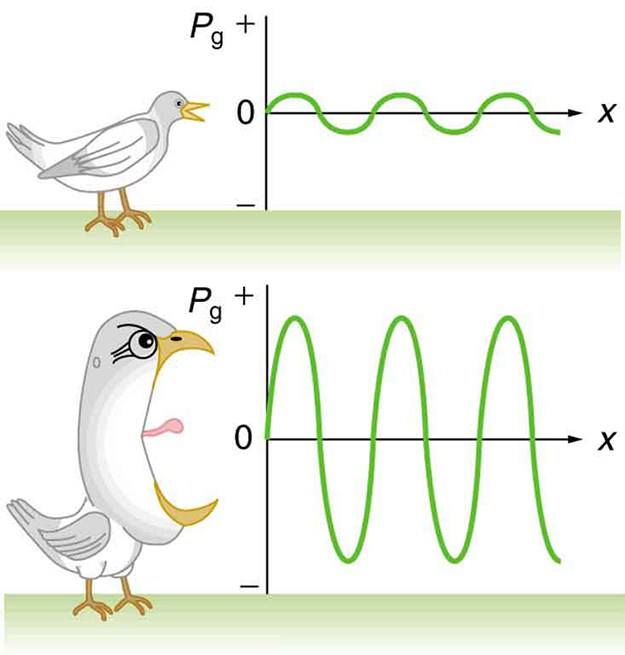
The pitch of a sound wave relates to the wave's _________________.
Amplitude
Frequency
Wavelength
Period
What is the Doppler Effect?
A change in frequency due to the relative motion of a wave source and an observer
When a wave overlaps with another wave
When a wave bounces off of another object
When a wave bends due to traveling through a different medium
An ambulance is driving towards you as you stand on the sidewalk. What happens to the pitch of the siren as it comes towards you?
It increases
It decreases
You are driving in a car and honk the horn at a person standing in the street. As you approach the person, what happens to the pitch of the horn according to you in the car?
It increases
It decreases
It stays the same because you are in the car moving with the sound.
Light can change color due to the Doppler Effect.
True
False
You are standing on the side of the road when a police car races past you with its siren on. After the police car passes you, what happens to the pitch of the siren?
It increases
It decreases
It turns red
An astronomer looks at a star in the night sky. Based on his calculations the star's light is shifting towards the color blue. What does this mean about the star?
It's moving towards the astronomer
It's moving away from the astronomer
It's not moving at all
A car is not moving but the horn is on. You run towards the car to investigate what's going on. As you approach the car, what happens to the frequency of the sound waves from the horn?
They increase
They decrease
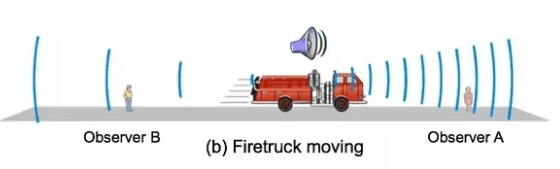
Look at the picture. Who is experiencing a higher pitched sound?
Observer A
Observer B
There's no difference
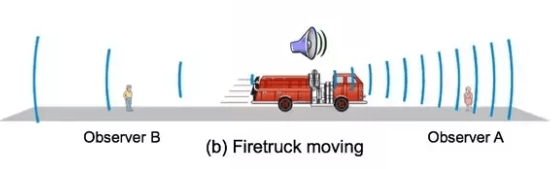
Look at the picture. Who is experiencing a lower pitched sound?
Observer A
Observer B
There is no difference

