
 Worksheets
Kinematics Review (up to Kinematics 1 equation)
Total questions: 82
Worksheet time: 1hrs 12mins
A vector tells the both the magnitude and the _______________.
Direction
Speed
Scalar
Velocity
A scalar quantity is always ____________.
Time
Number
Symbol
Letter
The ratio of distance and time is called ____________.
Velocity
Acceleration
Speed
Displacement
When a driver steps on the brakes of a car to slow it down it is called
Positive Acceleration
Negative Acceleration
Stopping
Negative Speed
____________is the total movement that you traveled along a path.
Displacement
Velocity
Speed
Distance
___________________is the overall change of position between your initial position and final position.
Distance
Displacement
Velocity
Acceleration
The speed that shows how fast an object is moving for an interval of time.
Instantaneous
Average
Velocity
Total
The speed something is moving at a given instance
Instantaneous
Average
Total
Speed
True/False A reference frame is the point from which you are looking at an object and its movement.
True
False
A change in rate of velocity over time is known as:
acceleration
average speed
constant speed
displacement
What is the equation for velocity?


What is this graph representing?
Constant Acceleration
Constant Velocity/Speed
Positive Acceleration
Negative Velocity/Speed


The data shows that the object...
is accelerating because the graph is curved.
is accelerating because the graph goes up.
is going a constant speed because the graph is curved.
is going a constant speed because the graph is linear.

What is the velocity of this object?
20 cm/s
200 cm/s
0.005 cm/s
0.05 cm/s


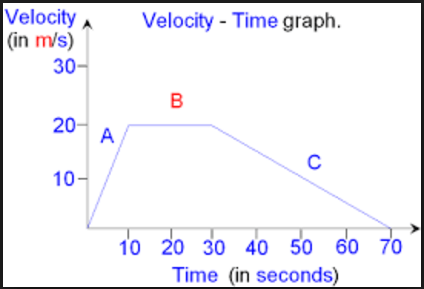




- What is the distance travelled from 0 to 70 seconds?
- What is the displacement from Tom's house at the end of 70s?
When analyzing a Position vs. Time graph, a greater slope means what?
nothing
larger displacement
greater amount of time
a greater velocity


Jermaine runs exactly 2 laps around a 400 meter track. What is the displacement?
800 m
400 m
0 m
200 m
1. Amy runs 2 miles south, then turns around and runs 3 miles north. What is displacement?
5 miles south
1 mile north
2 miles north
3 miles south

Two people walk across a parking lot. Their paths are shown in the image. Who traveled a larger distance?
Person A
Person B
They both went the same distance
Two people walk across a parking lot. Their paths are shown in the image. Who traveled with a larger displacement?
Person A
Person B
They both had the same displacement.

Stickdude traveled from A through B to C then D and back to A. What was his total distance traveled?
16 m
8 m
0 m
32 m
Stickdude traveled from A through B to C then to D and back to A. What was the magnitude of his total displacement?
16 m
8 m Northeast
0 m
32 m

Velocity is different from speed because...
Velocity is distance/time. Speed is displacement/time.
Velocity is speed in a certain direction and can be positive or negative.
Speed is velocity in a certain direction. Both can only be positive.
Velocity is how much speed changes over time.
Select the equation for acceleration.


Select the equation for speed


Select all the scenarios that represent acceleration of the car.


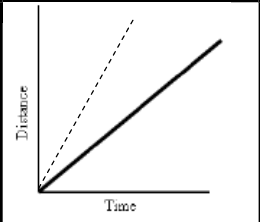
This chart represents the velocity of a motorcycle over time. Select the correct statement regarding the motorcycle's movement.
The motorcycle is speeding up.
The motorcycle has 0 acceleration.
The motorcycle is slowing down.
The motorcycle has constant acceleration.

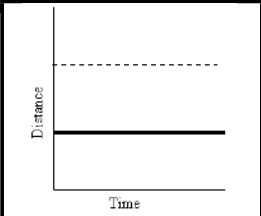
This chart represents the velocity of a bicycle over time. Select the correct statement regarding the bicycle's movement.
The bicycle has constant velocity.
The bicycle has constant speed.
The bicycle is accelerating.
The bicycle has 0 acceleration.

The image shows two cars with the same speed moving in different directions. What is true about the velocity of the cars?
Each car has the same velocity because the speeds are the same.
Each car has a different velocity because they are going in different directions.

A coffee filter begins falling at position 0 and lands at position -10. What is the coffee filter's displacement?
-10
0
10
20

A horse accelerates from a velocity of 0m/s to 20 m/s in 3 seconds. What is the acceleration of the horse?
60 m/s2
6.67 m/s2
0.15 m/s2
30 m/s2

A train decelerates from a velocity of 90 m/s to 80m/s in over 10 seconds. What is the train's acceleration?
-1 m/s2
1 m/s2
10 m/s2
-10 m/s2

An elevator moves from rest to 2 m/s over 8 seconds. What is the elevator's acceleration?
16 m/s2
-8 m/s2
0.25 m/s2
2 m/s2

A car begins at position x = 10 and travels to position x = -30. What is the car's displacement?
-40
40
10
30
An object moves at a constant speed of 6 m/s. This means that the object:
Increases its speed by 6 m/s every second
decreases its speed by 6 m/s every second
doesn't move
moves 6 meters every second
Which of the following is a vector quantity?
Speed
Velocity
Time
Distance
An object moves with a constant acceleration of 5 m/s2 . Which is TRUE?
The object's velocity stays the same.
The object moves 5 m every second
The object's acceleration increases by 5 m/s2 each second
The object's velocity increases by 5 m/s each second
A truck travels east with an increasing velocity. Correct direction of the car's acceleration?
→
←
↓
↑
Race car moving west begins to slow down after crossing finish line. Direction of acceleration?
←
→
↓
↑
An ice-skater accelerates from 12.5m/s to 25m/s in 6 seconds. what was the acceleration?
2.06 m/s2
206 m/s2
12.5 m/s2
20.6 m/s2
A ball rolls at 1.0 m/s then accelerates at 2.5 m/s2 for 3.0 s. How fast is it rolling now?
7.5 m/s
5.5 m/s
4.5 m/s
8.5 m/s
If a ball rolls from -5cm to 2cm, what is its displacement?
-3cm
3cm
7cm
2cm
A marble is speeding up, which of the following must be true?
it has uniform motion
it has a negative displacement
it has a negative acceleration
it has a positive acceleration
A balloon drifts 60m E for 8s, then 40m W for 7s. What is the distance traveled the first 8s?
60m
-60m
40m
-40m
A balloon drifts 60m E for 8s, then 40m W for 7s. What is the total displacement traveled?
100m
20m
-100m
-20m
A balloon drifts 60m E for 8s, then 40m W for 7s. What is the velocity during the first 8s?
7.5 m/s
0.13 m/s
-7.5 m/s
-0.13 m/s
A balloon drifts 60m E for 8s, then 40m W for 7s. What is the velocity during the next 7s?
0.17 m/s
5.71 m/s
-0.17 m/s
-5.71 m/s
A balloon drifts 60m E for 8s, then 40m W for 7s. The avg velocity for the entire trip is?
6.66 m/s
0.15 m/s
1.33 m/s
0.75 m/s
If a plane at rest reaches a velocity of 24 m/s in 3 seconds, what was its acceleration?
3 m/s2
72 m/s2
8 m/s2
Not enough information provided

