
 Worksheets
Fall Final Practice Test
Total questions: 85
Worksheet time: 1hrs 7mins
Name
Class
Date
1.
What is the formula for density?
a)
density = mass x volume
b)
density = mass / volume
c)
density = mass + volume
d)
density = mass - volume
2.
The tool used to measure the mass of a substance or object is a ______________.
a)
balance
b)
graduated cylinder
c)
ruler
d)
thermometer
3.
Jack has a rock. The rock has a mass of 14g and a volume of 2cm3. What is the density of the rock?
a)
7 mL
b)
7 g/cm3
c)
28 g/cm3
d)
1/7 g/cm3
4.

What is the volume of Object X?
a)
10.0 cm3
b)
15.0 cm3
c)
20.0 cm3
d)
25.0 cm3
5.

Put the liquids in order from most dense to least dense?
a)
4, 3, 2, 1
b)
1, 2, 3, 4
c)
3, 4, 2, 1,
d)
4, 3, 1, 2
6.
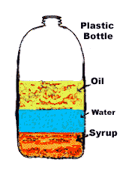
Which liquid is the least dense?
a)
oil
b)
water
c)
syrup
d)
plastic bottle
7.

Which box has a higher density?
a)
Box A
b)
Box B
c)
cannot be determined
d)
they are the same
8.
In general what is the most dense form of matter?
a)
solid
b)
liquid
c)
gas
d)
plasmas
9.

What is the volume of the fish?
a)
18.0 cm3
b)
6.0 cm3
c)
38.0 cm3
10.
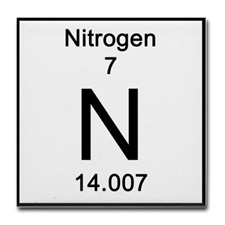
What is the number of protons that the element in this image contain?
a)
14
b)
7
c)
15
d)
18
11.

What is the atomic mass of "F"
a)
9
b)
18
c)
17
d)
19
12.
all matter is made of what
a)
energy
b)
atoms
c)
electrons
d)
compounds
13.
The positive particles of an atom are
a)
electrons
b)
positrons
c)
neutrons
d)
protons
14.
the central region of an atom where its neutrons and protons are is its
a)
nucleus
b)
electron cloud
c)
core
d)
center
15.
an atom with atomic number 6 would have how many protons
a)
6
b)
12
c)
3
d)
cannot be determined
16.
Which of the following is a positively charged subatomic particle found in the nucleus of an atom?
a)
Electron
b)
Proton
c)
Neutron
d)
Quark
17.
Which of the following is a subatomic particle with no charge that is found in the nucleus of an atom?
a)
Electron
b)
Proton
c)
Neutron
d)
Quark
18.
Where are electrons of an atom found?
a)
Nucleus
b)
Electron Cloud
c)
Some are in the nucleus and some in the electron cloud.
d)
They are moving everywhere.
19.
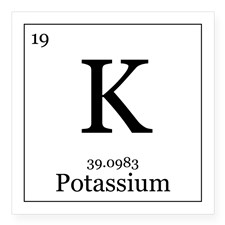
How many neutron are in the atom "K"?
a)
7
b)
2
c)
39
d)
12
20.

What is the number of protons that the element in this image contain?
a)
14
b)
7
c)
15
d)
18
21.

In which region would the nonmentals be found?
a)
1
b)
4
c)
3
d)
5
22.

In which region would the most reactive elements be found?
a)
1
b)
4
c)
5
d)
3
23.

In which region would the least reactive elements be found?
a)
1
b)
4
c)
3
d)
5
24.
The three main regions on the periodic table are ____________.
a)
solid, liquid, gas
b)
metals, nonmetals, meatlloids
c)
radioactive, man-made, poisonous
25.
Atoms can be seen with the naked eye.
a)
True
b)
False
26.
Something that is made up of only one kind of atom is known as _________________.
a)
a molecule
b)
a compound
c)
an element
d)
a proton
27.
What determines where an element is located on the periodic table?
a)
its atomic mass
b)
its atomic number
c)
its number of electrons
d)
they're arranged alphabeticaly
28.
A "group" is a ____________ on the periodic table.
a)
column
b)
row
29.
A "period" is a ____________ on the periodic table.
a)
column
b)
row
30.
Elements on the periodic table that are usually shiny, easily hammered into thin sheets or pulled into wires, and are good conductors of electricity are called _____________.
a)
metals
b)
nonmetals
c)
metalloids
d)
transition elements
31.
Elements on the periodic table that are often gases at room temperature, are poor conductors of electricity, and are good insulators are called _____________.
a)
metals
b)
nonmetals
c)
metalloids
d)
transition elements
32.
Elements on the periodic table that have physical and chemical properties of both metals and nonmetals are called _____________.
a)
metals
b)
nonmetals
c)
metalloids
d)
transition elements
33.
Helium, neon, argon, krypton, xenon, and radon are known as _____________.
a)
halogens
b)
noble gases
c)
metalloids
d)
transition elements
34.
The sum of the protons and neutrons in the nucleus of an atom
a)
Atomic Number
b)
Compound
c)
Electrons
d)
Mass Number (also called Atomic Mass)
35.
These elements are found along the zig-zag line on the periodic table.
a)
Metal
b)
Group
c)
Metalloid
d)
Nonmetal
36.

This picture represents which of the following?
a)
element
b)
compound
c)
mixture of elements
d)
mixture of compounds
37.

This picture represents which of the following?
a)
element
b)
compound
c)
mixture
38.

This picture represents which of the following?
a)
element
b)
compound
c)
mixture
39.
How many elements are represented in the compound?
Na2CO3
Na2CO3
a)
1
b)
2
c)
3
d)
4
40.
Which one can be found on the periodic table?
a)
Compound
b)
Element
41.
Is salt (NaCI) a compound or a element
a)
Compound
b)
element
42.
compounds are chemically bonded together
a)
False
b)
true
c)
I don't know?
43.
Any push or pull on an object
a)
Force
b)
Acceleration
c)
Speed
d)
Velocity
44.
• Equal and Opposite forces acting on an object which equals a net force of ZERO
• Results in NO change in motion
• Results in NO change in motion
a)
Balanced Forces
b)
Unbalanced Forces
45.
• Unequal forces acting on a object
• Net force causes a change in motion in the direction of the greater force
• Net force causes a change in motion in the direction of the greater force
a)
Balanced Forces
b)
Unbalanced Forces
46.
When forces are acting in the same direction you should ____ them to get the net force.
a)
add
b)
subtract
c)
multiply
d)
divide
47.
When forces are acting in the opposite direction you should ____ them to get the net force.
a)
add
b)
subtract
c)
multiply
d)
divide
48.
Object at rest will stay at rest and object in motion will stay in motion unless an unbalanced force acts on it
a)
Newton's 1st Law
b)
Newton's 2nd Law
c)
Newton's 3rd Law
49.
The Law of 'Inertia'
a)
Newton's 1st Law
b)
Newton's 2nd Law
c)
Newton's 3rd Law
50.
A ball on the floor stays there until someone kicks it
a)
Newton's 1st Law
b)
Newton's 2nd Law
c)
Newton's 3rd Law
51.
The amount of force needed to change the speed of an object depends on the mass of the object and the acceleration required (F=ma)
a)
Newton's 1st Law
b)
Newton's 2nd Law
c)
Newton's 3rd Law
52.
Law of 'Force & Acceleration'
a)
Newton's 1st Law
b)
Newton's 2nd Law
c)
Newton's 3rd Law
53.
More force is required to make a heavy car go faster than a lighter car
a)
Newton's 1st Law
b)
Newton's 2nd Law
c)
Newton's 3rd Law
54.
For every action there is an equal and opposite reaction
a)
Newton's 1st Law
b)
Newton's 2nd Law
c)
Newton's 3rd Law
55.
The Law of 'Action/Reaction'
a)
Newton's 1st Law
b)
Newton's 2nd Law
c)
Newton's 3rd Law
56.
When letting air out of a balloon: air goes one way and the balloon goes the other way
a)
Newton's 1st Law
b)
Newton's 2nd Law
c)
Newton's 3rd Law
57.
The distance traveled in a given unit of time (how fast I am going)
a)
Speed
b)
Velocity
c)
Acceleration
58.
I drove 60 miles in 1 hour
a)
Speed
b)
Velocity
c)
Acceleration
59.
Speed in a given direction
a)
Speed
b)
Velocity
c)
Acceleration
60.
I drove to the store at 65 miles per hour.
a)
Speed
b)
Velocity
c)
Acceleration
61.
A change in velocity (speeding up/slowing down/changing direction)
a)
Speed
b)
Velocity
c)
Acceleration
62.
The plane circled the landing strip at a constant speed.
a)
Speed
b)
Velocity
c)
Acceleration
63.

Describe the object's motion:
a)
Constant Positive Speed
b)
Acceleration
c)
No Motion
d)
Going Backwards
64.
Energy of motion (AKA mechanical energy):
The faster/heavier the object the more _______ energy it has
The faster/heavier the object the more _______ energy it has
a)
Potential
b)
Kinetic
65.
Stored energy in the forms of chemical, elastic, or gravitational (NOT in motion)
a)
Potential
b)
Kinetic
c)
Mechanical
66.

Energy can not be created or destroyed, ONLY transformed
a)
Law of Conservation of Energy
b)
Law of Gravity
c)
Law of Action-Reaction
d)
Law of Force and Acceleration
67.
Energy stored in chemical bonds and released when the bond is broken.
• Ex) Food, Fuel, Batteries
• Ex) Food, Fuel, Batteries
a)
Chemical Potential
b)
Gravitational Potential
c)
Elastic Potential
d)
Kinetic
68.
Stored energy due to an objects position or elevation
• 'The higher the object the greater the __________ energy'.
• 'The higher the object the greater the __________ energy'.
a)
Chemical Potential
b)
Elastic Potential
c)
Gravitational Potential
d)
Kinetic
69.
Stored Energy from stretching or compressing something.
Ex) Stretching a rubber band, compressing a spring
Ex) Stretching a rubber band, compressing a spring
a)
Chemical Potential
b)
Gravitational Potential
c)
Elastic Potential
d)
Kinetic
70.
The law that states that all object in the universe are attracted to each other according to their mass and distance
(more mass/less distance = more 'attraction')
(more mass/less distance = more 'attraction')
a)
Law of Gravity
b)
Law of Conservation of Energy
c)
Law of Action-Reaction
d)
Law of Inertia
71.
The tendency of an object to resist a change in motion
(more mass = more inertia)
(more mass = more inertia)
a)
inertia
b)
force
c)
friction
d)
mass
72.
A force that opposes motion between surfaces
a)
friction
b)
force
c)
gravity
d)
inertia
73.
Represents the ability to do work
a)
Energy
b)
Force
c)
Motion
d)
Acceleration
74.
It took 3.5 hours for a train to travel the distance between two cities at a velocity of 120 miles/hr. How many miles lie between the two cities?
a)
34 miles
b)
420 miles
c)
120 miles
d)
360 miles
75.
Shona cycles at an average speed of 8km/h. How far has she traveled if she cycles for 4 hours?
a)
55km
b)
32km
c)
43km
d)
32miles
76.
How much time did it take for an animal to run 20 miles if it ran at 10 miles/hour?
a)
2 hours
b)
200 hours
c)
0.5 hours
d)
30 hours
77.

The roller coaster has the most kinetic energy at position-
a)
W
b)
X
c)
Y
d)
Z
78.

What Newtons law does this picture represent
a)
Newtons 2nd law
b)
Law of gravity
c)
Newtons 1st law
d)
Newtons 5th law
79.
The unit label for force that we have been using in our f=ma formulas is:
a)
kg
b)
N
c)
m/s
80.
Which force is always pulling downward on objects
a)
support force
b)
friction force
c)
gravity
81.
Marie had a beaker with a small amount of baking soda. She added a few drops of pickle juice to the baking soda and observed fizzing and bubbling. Based on her observation, which of these can Marie determine about the new substance formed by mixing the baking soda and pickle juice?
a)
A chemical reaction produced a
solid.
b)
A chemical reaction produced
a gas.
c)
No chemical reaction took place.
d)
Only a physical change happened.
82.
Vanessa had a beaker with a small amount of baking soda. She added a few drops of vinegar to the baking soda and observed fizzing and bubbling. Based on her observation, which of these can Vanessa determine about the new substance formed by mixing the baking soda and vinegar?
a)
It was hot.
b)
It was a gas.
c)
It was magnetic.
d)
It was a conductor.
83.
The Best Friend's Club uses "invisible ink" to write notes to each other. The invisible ink is actually lemon juice that is clear when it dries on paper, but turns brown when a club member holds a burning candle under the paper. Once it is heated, it is never invisible again.
What type of change is occurring when the paper is heated?
What type of change is occurring when the paper is heated?
a)
chemical change
b)
elemental change
c)
physical change
d)
temperature change
84.
The Best Friend's Club uses "invisible ink" to write notes to each other. The invisible ink is actually lemon juice that is clear when it dries on paper, but turns brown when a club member holds a burning candle under the paper. Once it is heated, it is never invisible again.
What type of change is occurring when the paper is heated?
What type of change is occurring when the paper is heated?
a)
chemical change
b)
elemental change
c)
physical change
d)
temperature change
85.
Bubbles and fizzing can be seen instantly when baking soda is mixed with vinegar. The bubbles are evidence of which of the following?
a)
A gas is formed when baking soda and vinegar are mixed.
b)
Baking soda dissolves in vinegar when they are mixed.
c)
Vinegar turns into alcohol when it is mixed with baking soda.
d)
A precipitate is formed when baking soda and vinegar are mixed.
100 %

