
 Worksheets
Unit 2, Section 2 States of Matter
Total questions: 83
Worksheet time: 59mins
Name
Class
Date
1.
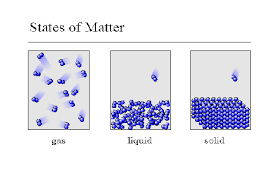
At higher temperatures
a)
particles in an object have less energy
b)
particles in an object move faster
c)
a gas contracts
2.
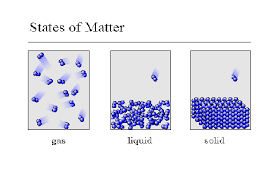
A gas
a)
has a definite shape but no definite volume
b)
has a definite volume but no definite shape
c)
has fast-moving particles
3.
Freezing
a)
Solid to gas
b)
Liquid to solid
c)
Gas to solid
d)
Liquid to gas
4.
Boiling
a)
liquid to gas
b)
gas to solid
c)
gas to liquid
d)
solid to liquid
5.
Which state of matter has tightly packed molecules?
a)
solid
b)
liquid
c)
gas
6.
Which state of matter has a definite shape?
a)
solid
b)
liquid
c)
gas
7.
What is happening when my ice cream changes from a solid to a liquid?
a)
freezing
b)
melting
c)
burning
d)
evaporation
8.
Define a liquid.
a)
Indefinite shape, indefinite volume
b)
Definite shape, definite volume
c)
Found in stars
d)
Definite volume, indefinite shape
9.
The state of matter that has no definite size or shape is
a)
Solid
b)
Liquid
c)
Gas
10.
Particles (molecules) in a ______________________ have more energy than the other states of matter.
a)
gas
b)
solid
c)
liquid
11.
Particles of a liquid
a)
are tightly packed together and stay in a fixed position.
b)
have no viscosity.
c)
decrease in volume with increasing temperature.
d)
are free to move around one another but still touch.
12.
What term describes a solid changing to a gas?
a)
Deposition
b)
Sublimation
c)
Evaporation
d)
Freezing
13.
Particles (molecules) in a ______________________ have more energy than the other states of matter.
a)
gas
b)
solid
c)
liquid
14.
What is condensation?
a)
gas to solid
b)
gas to liquid
c)
liquid to solid
d)
solid to liquid
15.
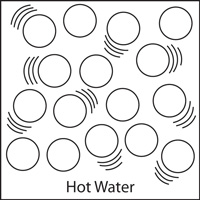
The speed of the molecules determines the _____.
a)
volume
b)
density
c)
pressure
d)
temperature
16.
Which has a greater distance between particles?
a)
Solid
b)
Liquid
17.
A chemical change
a)
doesn't really change much.
b)
creates a new substance
c)
is a change in the state of matter
18.
The slower the particles in a substance move,
a)
the colder it is.
b)
the warmer it is.
c)
the more energy it has.
d)
the less energy it has.
19.
Thermal energy is...
a)
heat energy.
b)
the energy of motion
c)
energy of nuclear processes.
d)
an indication of physical change.
20.
A physical change is...
a)
a change that doesn't change the identity
b)
a change that makes something new.
c)
a chemical reaction
21.

Which form of matter fills the space like it has in the balloon?
a)
liquid
b)
string
c)
solid
d)
gas
22.

The milk in the glass has volume and takes the shape of its container. Therefore, it is assumed that milk is a ______________.
a)
solid
b)
liquid
c)
gas
d)
plasma
23.

The molecules in the picture are tightly held together with little movement. They have shape and energy. Therefore, the picture represents _________.
a)
solid
b)
liquid
c)
gas
d)
plasma
24.
Molecules move quickest in which state of matter
a)
solid
b)
liquid
c)
gas
d)
solid, liquid and gas
25.
When the temperature of matter decreases the particles ...
a)
speed up and move farther apart
b)
speed up and move closer together
c)
slow down and move farther apart
d)
slow down and move closer together
26.
When the temperature of matter increases the particles...
a)
speed up and move closer
b)
speed up and move farther apart
c)
slow down and move closer together
d)
slow down and move farther apart
27.
Water can be a solid, liquid, and a gas.
a)
True
b)
False
liquid
liquid
28.
Molecules are closest together in a
a)
Solid
b)
Liquid
c)
Gas
d)
plasma
29.

If the tops were removed from the cylinders, the following would happen:
a)
The solid would fly out of the container
b)
The liquid would fly out of the container.
c)
The gas would fly out of the container.
d)
They ALL would fly out of the container.
30.

What does this picture represent?
a)
solid
b)
liquid
c)
gas
d)
plasma
31.

What does this picture represent?
a)
solid
b)
liquid
c)
gas
d)
plasma
32.

Which of the following statements is NOT true of all different types of matter?
a)
They are made of atoms and molecules
b)
The particles are always in motion
c)
The particles always move at the same speed
d)
They are made of particles that are too small to see
33.
What term describes a solid changing to a gas?
a)
Melting
b)
Sublimation
c)
Evaporation
d)
Freezing
34.

The steam coming off the pot of boiling water is an example of....
a)
a solid becoming a liquid
b)
a liquid becoming a solid
c)
a liquid becoming a gas
d)
a gas becoming a liquid
35.

A puddle of water seemed to disappear. The heat caused the water to -
a)
melt
b)
condense
c)
evaporate
d)
cool
36.

Which state of matter has particles arranged like this?
a)
solid
b)
liquid
c)
gas
37.
What happens to the particles when I add heat?
a)
The particles get bigger
b)
The particles get smaller
c)
The particles get slower
d)
The particles get faster
38.
Which of the following terms identifies the change from a liquid to gas?
a)
Vaporization
b)
Condensation
c)
Deposition
d)
Sublimation
39.
Which of the following terms identifies the change from a liquid to solid?
a)
Melting
b)
Condensation
c)
Vaporization
d)
Freezing
40.
When the temperature of matter increases the particles...
a)
speed up and move closer
b)
speed up and move farther apart
c)
slow down and move closer together
d)
slow down and move farther apart
41.
No Definite Shape and No Definite Volume
a)
Gas
b)
Liquid
c)
Solid
42.
Definite shape and a definite volume.
a)
Gas
b)
Liquid
c)
Solid
43.
No definite shape, but has a definite volume
a)
Gas
b)
Liquid
c)
Solid
44.
Phase change from a solid to a gas.
a)
sublimation
b)
deposition
c)
condensation
d)
evaporation
45.
Phase change from a solid to a liquid.
a)
melting
b)
sublimation
c)
boiling
d)
condensation
46.
Phase change from a liquid to a gas that only happens at the surface.
a)
evaporation
b)
boiling
c)
sublimation
d)
melting
47.
When the temperature of matter increases the particles...
a)
speed up and move closer
b)
speed up and move farther apart
c)
slow down and move closer together
d)
slow down and move farther apart
48.
When the temperature of matter decreases the particles ...
a)
speed up and move farther apart
b)
speed up and move closer together
c)
slow down and move farther apart
d)
slow down and move closer together
49.
Phase change from a gas to a liquid.
a)
condensation
b)
evaporation
c)
melting
d)
deposition
50.
The opposite phase of melting is
a)
freezing
b)
sublimation
c)
condensation
d)
deposition
51.
The phase change from water vapor to liquid water is known as...
a)
evaporation
b)
precipitation
c)
condensation
d)
sublimation
52.
5. What is it called when a solid turns directly into a gas?
a)
Sublimation
b)
Condensation
c)
Liquid
53.
Change from Gas to Solid is called........
a)
Sublimation
b)
Deposition
c)
Fusion
d)
condensation
54.
Change from Liquid to Solid is call......
a)
fusion
b)
Freezing
c)
sublimation
d)
evaporation
55.
change from liquid to gas is called....
a)
expansion
b)
evaporation
c)
condensation
d)
sublimation
56.
All changes in the state of matter of a substance requires
a)
vibration
b)
water
c)
permission
d)
energy
57.
What is deposition?
a)
Phase change from gas to solid
b)
phase change from liquid to solid
c)
Phase change from solid to gas
d)
Phase change from liquid to gas
58.
What is sublimation?
a)
phase change between solid and liquid
b)
pahse change from gas to solid
c)
phase change from solid to gas
d)
phase change from solid to solid
59.
Melting is ...
a)
liquid to solid
b)
solid to liquid
c)
solid to gas
d)
gas to liquid
60.
Boiling is ...
a)
liquid to gas
b)
gas to solid
c)
gas to liquid
d)
solid to liquid
61.
Freezing is...
a)
Solid to gas
b)
Liquid to solid
c)
Gas to solid
d)
Liquid to gas
62.
Pick all the exothermic phase changes
a)
melting
b)
freezing
c)
vaporization
d)
condensation
e)
sublimation
63.
Pick all the endothermic phase changes
a)
vaporization
b)
melting
c)
sublimation
d)
freezing
e)
condensation
64.
In a ______, atoms or molecules are very close together. They vibrate back and forth against each other.
a)
Solid
b)
Liquid
c)
Gas
65.

Which letter shows a solid?
a)
A
b)
C
c)
E
d)
-
66.
Which letter shows a liquid?
a)
A
b)
C
c)
E
67.
Which letter shows a gas?
a)
A
b)
C
c)
E
68.
Which letter shows melting?
a)
A
b)
B
c)
C
69.
Which letter shows freezing?
a)
A
b)
B
c)
C
70.
Which letter shows boiling/vaporization?
a)
A
b)
B
c)
C
d)
D
71.
Which letter shows melting?
a)
A
b)
B
c)
C
72.
Which letter shows condensation?
a)
A
b)
B
c)
C
d)
D
73.

What temperature is the melting point?
a)
40
b)
100
c)
140
74.
What temperature is the freezing point?
a)
40
b)
100
100
100
c)
140
140
140
75.
What temperature is the boiling point?
a)
40
b)
100
c)
140
76.
What temperature is the condensation point?
a)
40
b)
100
c)
140
d)
180
77.

What can be determined by measuring the speed of molecules?
a)
volume
b)
density
c)
pressure
d)
temperature
78.
Why does water NOT change temperature during boiling?
a)
Because the molecules of water take in all the heat to their nucleus
b)
Because heat is not the same thing as temperature
c)
Because adding heat doesn't ever change the temperature of water
d)
Because all of the energy is used to break the bonds that are found in the molecule
79.

According to this graph, what is the boiling point temperature of this substance? (in degrees)
a)
40
b)
70
c)
100
d)
140
80.
According to this graph, what is the melting point temperature of this substance? (in degrees)
a)
40
b)
70
c)
100
d)
140
81.
What is the melting point of water?
a)
0 degrees Fahrenheit
b)
100 degrees Celcius
c)
212 degrees Fahrenheit
d)
32 degrees Fahrenheit
82.
Why is the boiling point in Utah below 212 Fahrenheit?
a)
Because we have hard water (minerals in the water)
b)
Because water always boils at 100 degrees Celsius.
c)
Because Utah is located above sea level (lower atmospheric pressure)
d)
Because our water is cleaner than water in California
83.
Why does water NOT change temperature during phase changes?
a)
Because the molecules of water take in all the heat to their nucleus
b)
Because heat is not the same thing as temperature
c)
Because adding heat doesn't ever change the temperature of water
d)
Because all of the energy is used to overcome the attraction of molecules
100 %

