
 Worksheets
Module K Review
Total questions: 85
Worksheet time: 7hrs 5mins


To make this electromagnet stronger you could:
use less wire
have fewer wire coils around the nail
have more wire coils around the nail
use a plastic core
How do you increase the strength of an electromagnet?
Add a motor and/or light bulbs
Add more light bulbs and wire coils
Add more wire coils
Increase the voltage
A _______________ is a current-carrying coil of wire with many loops.
magnet
electromagnet
solenoid
compass
Increasing the number of coils in an electromagnet will _________ the power of the magnet.
decrease
increase
not affect
What three minerals are attracted to a magnet?
Gold, copper, cobalt
Cobalt, aluminum, silver
Iron, copper, aluminum
Iron, nickel, cobalt

In an electromagnet, coils of wire are wrapped around a magnetic object to generate a magnetic field. What the is relationship between number of coils and the strength of the magnetic field?
The more coils an electromagntic has, the stronger the magnetic field
The more coils an electromagntic has, the weaker the magnetic field
The larger the metal object, the stronger the magnetic field is
There is no relationship between number of coils and the strength of a magnetic field

These magnetic domains are:
strongly magnetized
slightly magnetized
unmagnetized

What would happen when two north poles of magnets are placed together?
The force will pull them together (attract).
The force will push them away from each other (repel).
The strength of the magnet is doubled.

What would happen when the opposite poles of magnets are placed together?
The force will pull them together (attract).
The force will push them away from each other (repel).
The strength of the magnet is doubled.
If you cut a magnet in half, what happens to the poles?
One half gets the North Pole, the other half gets the South Pole.
Both halves get only a South Pole.
Both halves get only a North Pole.
Both halves get a North pole and a South Pole.
The two poles are called the _______ poles
east and west
north and east
south and west
north and south
Unlike (opposite) poles _____, like (same) poles _____
repel, attract
connect, repel
attract, repel
repel, connect
A repelling force occurs between two charged objects when the charges of are of __________.
like signs
unlike signs
equal magnitude
unequal magnitude
An attracting force occurs between two charged objects when the charges are of _______________.
like signs
unlike signs
equal magnitude
unequal magnitude
What happens when a rubber rod is rubbed with a piece of fur, giving the rod a negative charge?
Negative charges are moved from the rod to the fur.
Negative charges are moved from the fur to the rod.
Negative charges are added to the rod and the fur remains neutral.
Positive charges are removed from the rod, and the fur remains neutral.

A balloon was rubbed with a piece of cloth. Which statement describes the charges shown?
Negative charges from the cloth were transferred to the balloon.
Balloons always have more negative charges than positive charges.
Negative charges appeared when the cloth was rubbed on the balloon.


The gravitational force between 2 objects increases when their distances do what?
Increase
(get farther apart)
Decrease
(get closer together)
Distance has no impact on gravity

Gravity is a
Contact Force
Myth
Non-contact Force
What two things determine the gravity of an object?
mass & weight
mass & distance
density & mass
volume & distance

A ____________ is a push or a pull on an object.
friction
force
magnet
gravity

What will the magnets in the picture do?
Attract
Repel
Neither attract nor repel
Both attract and repel

What will the magnets in the picture do?
Attract each other
Repel each other
Both attract and repel
Neither attract nor repel

Which of the diagrams shows the greatest gravitational force?
I
II
III
IV

Which of the diagrams shows the least gravitational force?
I
II
III
IV


When a cannon fires a cannonball we observe Newton's third law. Which is the reaction force?
The cannon moving forward
The cannon moving backwards
The cannonball moving backwards
The cannonball moving forward

How is this an example of Newton’s Third law?
Only the ball is using the head
They are both exerting an equal force on each other
Only the head is pushing the ball
If two people with the same mass collide, they experience the same amount of force.
True
False

When a heavy football player and a light one run into each other, who exerts more force
The light one
Their force are equal
The heavy one
Your friend kicks a soccer ball, and it stops a few feet from you. What needs to happen to it in order for it to return to your friend?
Friction has to be applied to the ball.
Force has to be applied to the ball.
Speed has to be applied to the ball.
Inertia has to be applied to the ball.


The picture is an example of Newton's...
1st Law
2nd Law
3rd Law


Isaac Newton stated for every action there is an
_________ and _________ reaction.
equal and same
equal and opposite
unequal and same
unequal and opposite
Forces come in pairs
Newton's 1st law
Newton's 2nd law
Newton's 3rd law
Law of conservation of momentum
You have 2 circular objects, and each has a positive charge near each other, but not touching. Which statement describes the force that is exerted on the objects due to their electric charge?
There is a force pushing both objects to the left.
There is a force pulling the objects toward each other.
There is a force pushing the objects away from each other.
There is no force on the objects due to their electric charge.


Based on the arrangement of the electric field lines in the diagram, what are the charges?
both charges are the same
the charges are opposite
they are neutral; no charge

Which diagram correctly shows the field lines between two like charges?
A
B
Both
Neither
A proton (positive charge) and electron (negative charge) are attracted to one another. This is due to...
Gravitational fields
Electrical fields
Magnetic fields
Track and field
When forces do not result in a change of motion, they are called __________.
balanced forces
unbalanced forces


Gravitational attraction between objects is greatest when their masses are....
Large
Small
Mass has no impact on gravity

When 2 large objects get close together, the gravitational attraction will....
Increase
Decrease

When 2 small objects get far apart, the gravitational attraction will....
Increase
Decrease

Which model has greater gravitational attraction.
model A
model B
both models have equal gravity
___ refers to how fast an object is moving.
Speed
Velocity
Acceleration
Motion
Which is an example of speed?
A car driving 55 miles per hour south.
A bicyclist traveling 10 meters per hour toward the next town.
A roller coaster is traveling 10 meters per second.
A rocket blasting off at 2,500 meters per second toward space.
Acceleration is a speeding up, slowing down or a change in direction. Is the following acceleration and if so, which one?
A swimmer has 10 meters left in the race and he is neck-in-neck with his competitor. He has a surge of adrenaline and pulls ahead to win.
Yes, this is acceleration since the swimmer starts to speed up to pull ahead.
Yes, this is acceleration since the swimmer uses the wall to change directions.
No, this is not acceleration since there is no speeding up, slowing down, or change in direction.
Acceleration is a speeding up, slowing down or a change in direction. Is the following acceleration and if so, which one?
A dancer is warming up. She turns on music with a good beat and does 10 pirouettes in a row perfectly on the beat. (pirouette is a body spin in ballet)
Yes, this is acceleration since the dancers is going a certain speed.
Yes, this is acceleration since the dancer is changing direction when she spins.
No, this is not acceleration since there is no speeding up, slowing down, or change in direction.
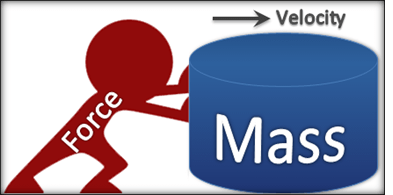
The picture is an example of Newton's...
1st Law
2nd Law
3rd Law
A(n) _____________ variable depends on or is changed by another variable.
dependent
independent
You want to know which brand of fertilizer is best for your plants.What is the dependent variable ________________.
The health of the plants
the type of fertilizer
You want to compare brands of paper towels, to see which holds the most liquid. Which is the dependent variable?
the brand of paper towel
the amount of water
What two things must you know to determine speed?
distance and direction
direction and time
speed and direction
time and distance

When a person pushes against the ground with their foot, the equal and opposite reaction force is
when they start to move forward
the ground pushing back on their foot

If the person is pushing backwards with the paddle, why do they move forward?
The person will actually move backwards, they need to paddle the other way
The water pushes back with an equal and opposite force
The person is pushing harder than the water
The water pushes back with a greater force than the person

If a person pushes down on a trampoline, why do they move back up into the air?
The trampoline pushes back with a greater force than the person
The trampoline pushes back with less force than the person
The trampoline pushes back with an equal and opposite force as the person

When the person pushes on the wall, and the wall pushes back, why does the person move and not the wall?
The wall has more mass
The person is pushing harder than the wall
The wall is pushing harder than the person
The skateboard is pushing on the person

When a small car pushes a big truck, the truck applies an equal and opposite force on the car.
False
True

