wayground logo

Free Printable Worksheets

NEW

Font size

S
M
L
XL
Worksheets

Thermal Energy Study Guide Ch. 5

Total questions: 80

Worksheet time: 2hrs 30mins

Name
Class
Date
1.
The kind of heat transfer that travels through space in electromagnetic waves is ______________________.
a)
insulation.
b)
Radiation
c)
Conduction
d)
Convection
2.
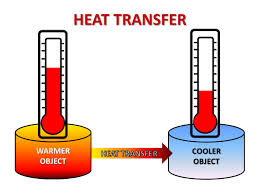
In heat transfer, heat always flows from the _______________ substance to the _______________ substance.
a)
Hotter to colder
b)
Colder to hotter
c)
Hotter to hotter
d)
Colder to colder
3.
The type of heat transfer that happens through direct contact of molecules or particles with each other is ___________________.
a)
Convection
b)
Conduction
c)
Radiation
d)
insulation.
4.
___________________ is the type of heat transfer that occurs in fluids, such as warm air rising and cold air sinking; creating wind.
a)
Convection
b)
Conduction
c)
Radiation
d)
insulation.
5.
Which statement is true?
a)
The quicker a molecule moves, the colder it is.
b)
The slower a molecule moves, the warmer it is.
c)
The quicker a molecule moves, the warmer it is
d)
The movement on molecule don�t affect its temperature
6.
Which statement is true?
a)
The quicker a molecule moves, the colder it is.
b)
The slower a molecule moves, the warmer it is.
c)
The quicker a molecule moves, the warmer it is
d)
The movement on molecule don�t affect its temperature
7.

Zoe and Abigail are conducting a science experiment. They place a hot cup of coffee and a cold glass of milk in contact. What happens to their thermal energy?

a)

Their thermal energies remain the same.

b)

Thermal energy passes from the cold milk to the hot coffee.

c)

Thermal energy passes from the hot coffee to the cold milk.

d)

Thermal energy passes back and forth equally between the coffee and the milk.

8.
Heat from warm sand at the beach moves through the atmosphere by what method of heat transfer?
a)
Convection
b)
Conduction
c)
Radiation
d)
insulation.
9.
Heat from warm sand at the beach moves through the atmosphere by what method of heat transfer?
a)
Convection
b)
Conduction
c)
Radiation
d)
insulation.
10.
Marcie played with her friends out in the cold, cloudy weather, wearing her wool hat. After the group had finished building snowmen and having snowball fights, Marcie went back inside to warm up and drink some hot chocolate. When she took her hat off, she realized that it was very warm. What happened?
a)
The radiant energy from the sun warmed up her hat and the hat kept that heat from the sun.
b)
�� Her hat was warm because wool fabric is warmer than other fabrics.
c)
The humidity outside made her hat warm.
d)
Conduction between Marcie�s warm body and the hat occurred and the hat remained warm because it is an insulator.
11.
Students in a science class performed an experiment with hot and cold water. They dyed the hot water red and the cold water blue. When the students layered the water, they noticed that the hot water rose to the top and the cold water sank. What was this demonstrating?
a)
Radiation
b)
Air Pressure
c)
Evaporation
d)
Density
12.
When you use a microwave, what is the main way that heat is transferred?
a)
Convection
b)
Conduction
c)
Radiation
d)
insulation.
13.
The handle of a metal spoon warms up when it is placed in a hot bowl of soup because of
a)
Convection
b)
Conduction
c)
Radiation
d)
insulation.
14.
Which of the following is NOT a conductor?
a)
oven mitt
b)
curling iron
c)
iron skillet
d)
copper pipe
15.
A large house being heated by heater warms a house when the air is circulating.
a)
Convection
b)
Conduction
c)
Radiation
d)
insulation.
16.
Which of the following is the best example of conduction?
a)
A light bulb warming a lampshade
b)
An egg cooking in a frying pan
c)
Water boiling in a pot
d)
Gases circulating in the atmosphere
17.
Which statement is true about radiation?
a)
Radiation is the transfer of heat through electromagnetic waves
b)
Radiation is the transfer of heat through direct contact.
c)
Radiation is more dangerous than conduction.
d)
Radiation is the transfer of heat through liquids and gases
18.
Which situation best represents convection?
a)
Heat from a campfire
b)
A hot air balloon taking off
c)
Touching a hot piece of metal
d)
Getting sunburned
19.
Which situation best represents conduction?
a)
Heat from a campfire
b)
A hot air balloon taking off
c)
Touching a hot piece of metal
d)
Getting sunburned
20.
Johnny accidentally grabbed the handle of the hot pot.
a)
conduction
b)
convection
c)
radiation
21.
A group of friends gather around a fire to stay warm.
a)
conduction
b)
convection
c)
radiation
22.

Which of the following is not a method for heat transfer

a)

Radiation

b)

Insulation

c)

Conduction

d)

Convection

23.

In which of the following state are the particles closest together?

a)

Fluid

b)

Gas

c)

Liquid

d)

Solid

24.
What is the definition of CONDUCTION?
a)
When heat is transferred from objects like rays of light or electromagnetically.
b)
a  hot liquid or air that  expands, becomes less dense, and rises or becomes more dense, and sinks.
c)
When heat transfers from objects that are touching.
d)
When heat transfers through the heater or AC in your house.
25.
What is the definition of CONVECTION
a)
When heat transfers through waves.
b)
When heat transfers from objects that are touching.
c)
a  hot liquid or air that  expands, becomes less dense, and rises or becomes more dense, and sinks.
d)
Heat traveling from the sun
26.
Which of the following is needed for convection to happen?
a)
Fluid/s
b)
Light in the form or rays
c)
Electromagnetic waves
d)
Fire
27.
Heat transfers from an area of ____temperature to an area of ___ temperature.
a)
high to low
b)
low to high
c)
high to high
d)
It can travel high to low and low to high. 
28.

a device that converts electric energy into thermal energy

a)

heating appliance

b)

thermostat

c)

refrigerator

d)

heat engine

29.

a device that uses electric energy to pump thermal energy from a cooler location to a warmer location.

a)

heating appliance

b)

thermostat

c)

refrigerator

d)

heat engine

30.

Most contain a bimetallic coil

a)

heating appliance

b)

thermostat

c)

refrigerator

d)

heat engine

31.

curiling irons, coffee makers, and clothes irons

a)

heating appliance

b)

thermostat

c)

refrigerator

d)

heat engine

32.

a device that regulates the temperature of a system

a)

heating appliance

b)

thermostat

c)

refrigerator

d)

heat engine

33.

kitchen refrigerators, toasters, coffee makers and ovens are equipped with these.

a)

heating appliance

b)

thermostat

c)

refrigerator

d)

heat engine

34.

a machine that converts thermal energy into mechanical energy

a)

heating appliance

b)

thermostat

c)

refrigerator

d)

heat engine

35.

Thermal energy from inside transfers to the coolant, keeping the inside cold

a)

heating appliance

b)

thermostat

c)

refrigerator

d)

heat engine

36.

Can not be created or destroyed

a)

Heat

b)

Metal

c)

Energy

37.

Coolant in a refrigerator moves ____ energy from one place to another

a)

Heat

b)

Electric

c)

Thermal

38.

Computers and cell phones get hot when you use them because ___ energy is always converted into ____ energy in an electronic device

a)

Heat;electric

b)

thermal;heat

c)

electric;thermal

39.

A coffee maker is an example of a device that converts electric energy into thermal energy

a)

Heat engine

b)

Heating appliance

c)

Refrigerator

d)

Thermostat

40.

To keep milk cold, you need to place it in a device that uses electric energy to pump thermal energy from a cooler location to a warmer location

a)

heat engine

b)

Heating appliance

c)

Refrigerator

d)

thermostat

41.
The temperature of a substance increases as___.
a)
the substance expands
b)
the average kinetic energy of its particles increases
c)
the substance's volume increases
d)
the substance's mass increases
42.
Water boils at 212⁰F, which is equivalent to__.
a)
273 K
b)
0⁰ C
c)
100⁰C
d)
37⁰C
43.
The boiling of water on the Farenheit, Celsius, and Kelvin scales is respectively,____.
a)
98.6⁰F, 37⁰C, 310K
b)
212⁰F, 100⁰C, 373K
c)
68⁰F, 20⁰C, 293K
d)
32⁰F, 0⁰C, 273K
44.
The lowest possible temperature is___.
a)
0⁰F
b)
0 K
c)
 0⁰C
d)
273 K
45.
If the particles of two substances have the same average kinetic energy, then___.
a)
the specific heats of the substances are identical 
b)
the particles will not react chemically
c)
the substances have equal thermal energies
d)
the substances have equal temperatures
46.
What does the average kinetic energy of an object's particles tell you?
a)
how hot the object is
b)
how cold the object is
c)
the temperature of the object 
d)
how fast the particles are moving
47.
In which state do particles move fastest and with little effect on each other?
a)
ice
b)
gas
c)
liquid
d)
solid
48.
If the particles in an object have more kinetic energy, what must be true?
a)
The object's temperature is lower
b)
The object's temperature is higher
c)
The object moves faster
d)
The object is heavier
49.
Water freezes at 32⁰F, which as the same as___ K.
a)
273
b)
0
c)
373
d)
100
50.
Scientists use either the ____ scale or the ____ scale.
a)
celsius, farenheit
b)
farenheit, kelvin
c)
kelvin
d)
celsius, kelvin
51.
Temperature____ as average kinetic energy decreases.
a)
increases
b)
decreases
c)
stays the same
d)
all of the above
52.
Heat is thermal energy that flows between objects that differ in___.
a)
temperature
b)
radiation
c)
thermal energy
d)
specific heat
53.
A measure of the average kinetic energy of the particles in an object
a)
temperature
b)
absolute zero
c)
thermal expansion
d)
none of these are the answer
54.
The total kinetic energy of a substance's particles
a)
thermal energy
b)
heat
c)
convection
d)
conduction
55.
The energy transferred between object's at different temperatures
a)
heat
b)
thermal energy
c)
radiation
d)
convection
56.
What happens to particles of a substance as its temperature increases?
a)
the average kinetic energy increases
b)
the average kinetic energy decreases
c)
the average kinetic energy stays the same
d)
nothing happens
57.
When you touch something that feels cold, 
a)
heat from your hand moves into the cold substance.
b)
coldness moves from the cold substance into your hand.
c)
it melts.
d)
it freezes.
58.
You're holding hands with your best friend.  Your friend's hands are REALLY warm and yours are really cold.  After a few minutes, this has changed.  How might you explain what happened?
a)
The cold energy from your hand transferred to your friend's hand through conduction.
b)
The heat energy from your friend's hand transferred to your hand through conduction. 
c)
The cold energy from your hand transferred to your friend's hand through convection.
d)
The heat energy from your friend's hand transferred to your hand through convection.
59.

If two objects have different temperatures, heat will flow from the warmer object to the cooler one UNTIL ____________

a)

one reaches a temperature of zero

b)

they both have an equal temperature

c)

one runs out of energy

60.

When a popsicle melts, the particles in the popsicle _____.

a)

gain thermal energy and speed up

b)

there are no particles in popsicles

c)

lose thermal energy and slow down

d)

stay the same

61.

Observe the diagram. Which statement is true about the kinetic energy of the molecules in the containers?

a)

The molecules are moving faster in Diagram A

b)

The molecules are moving slower in Diagram A

c)

The molecules are moving at the same rate in both diagrams

62.
A material that conducts heat poorly is called a(n)
a)
insulator.
b)
conductor.
c)
metal.
d)
radiator.
63.
The amount of energy required to raise the temperature of 1 kilogram of a substance by 1 kelvin is called its
a)
specific heat.
b)
heat transfer.
c)
change of state.
d)
melting point.
64.
A student lists three temperature measurements: 100°F, 100°C, and 100 K. Of the three measurements, 100 K is the highest temperature.
a)
True
b)
False
65.
Joints in train tracks are designed with extra space to allow for __________________ in hot weather.
a)
Conduction
b)
Insulation
c)
Thermal Energy
d)
Thermal Expansion
66.
Iron has a higher specific heat than silver. If 1 kg of iron and 1 kg of silver absorb equal amounts of heat, the temperature of the ____________________ will increase by a greater amount.
a)
Iron
b)
Silver
67.
Which is a better insulator?
a)
Glass
b)
Metal
c)
Wood 
d)
Tile
68.
Which is a better conductor?
a)
Wood
b)
Metal
c)
Carpeting
d)
Popcorn
69.

A material that conducts heat well is called a __________________.

a)

conductor

b)

convection

c)

radiation

d)

insulator

70.

The expanding of matter when it is heated is known as _____________ expansion.

a)

heat

b)

specific

c)

thermal

d)

cold

71.

Temperature is

a)

a constant value

b)

able to change based on surrounding energy conditions

c)

equal to heat

d)

a measurement of thermal energy

72.

After hot cocoa is poured into a cold mug, thermal energy from the _______ is transferred to the _______.

a)

hot cocoa; cold mug

b)

cold mug; hot cocoa

c)

air; hot cocoa

d)

Thermal energy does not get transferred.

73.
A tiny building block of matter is 
a)
Liquid
b)
atom
c)
Volume
d)
Gas
74.
What are the three states of matter?
a)
solid, volume, mass
b)
density, volume, mass
c)
solid, liquid, gas
d)
density, gas, volume
75.

In which state of matter will there be the LARGEST space between molecules?

a)

Solid

b)

Liquid

c)

Gas

76.

If particles are not locked in place and can slide past each other the substance is in a phase we call ____.

a)

solid

b)

liquid

c)

gas

77.

When you heat a sample of a solid, the particles that make up the solid

a)

get bigger

b)

lose mass

c)

move faster

d)

slow down

78.

If particles are locked in place the substance is in a phase we call _____.

a)

solid

b)

liquid

c)

gas

79.

When you heat a sample of gas, what happens to the particles that make up the gas?

a)

The particles move faster

b)

The particles break apart

c)

The particles get smaller

d)

The particles become more dense

80.

Molecules are always moving no matter what phase they are in: solid, liquid, gas.

a)

True

b)

False