
 Worksheets
8Ia-b and 8Fa-e Review
Total questions: 80
Worksheet time: 1hrs 5mins
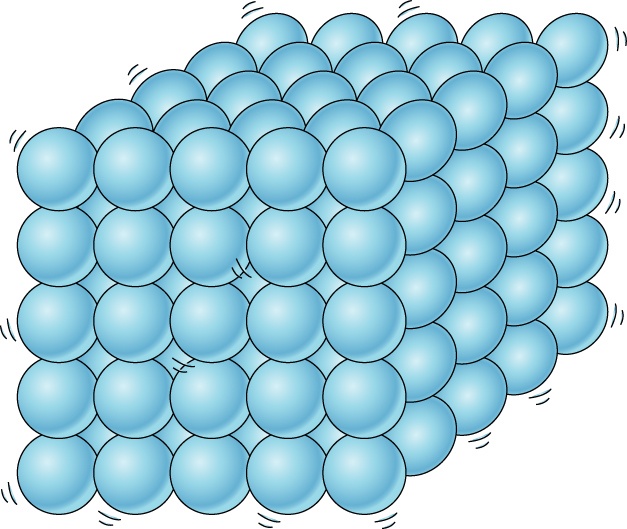
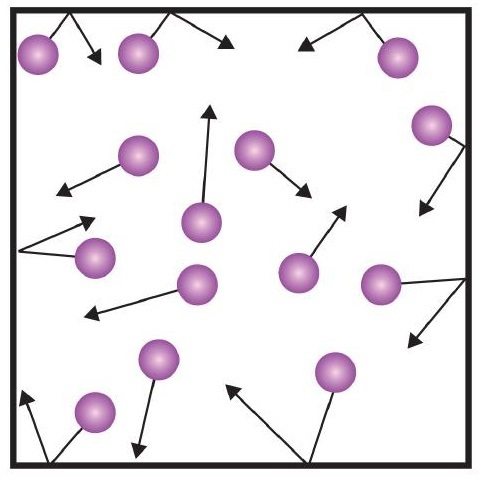
Which state of matter has particles that move the least/slowest?
solid
water
gas

Which state of matter has the weakest force between particles?
Solid
Liquid
Gas
What is the equation for density?
mass × volume
volume ÷ mass
mass ÷ volume
What is the volume of a cube which has sides 2cm long?
8cm3
4cm3
2cm3
What is a displacement can used for?
Measuring the mass of irregular shapes
Measuring the mass of regular shapes
Measuring the volume of irregular shapes
How do the particles in a solid move?
Randomly in all directions
Vibrate around a fixed point
They roll over one another
What causes the pressure that a gas exerts?
Collisions with the particles on the walls of the container
The charge of the particles
The size of the particles

Which of the following will not take the shape of a container?
Solid
Liquid
Gas
Plasma
The process when a gas turns into a liquid
Condensation
Sublimation
Freezing
Evaporation
The process when a solid turns into a liquid
Evaporation
Sublimation
Freezing
Melting
The process when a liquid turns into a gas
Evaporation
Melting
Condensation
Deposition
The process when a solid turns into a gas
Sublimation
Deposition
Evaporation
Melting
The process when a gas turns into a solid
Deposition
Weathering and Erosion
Super freezing
Sublimation
What is the term given to the temperature at which a solid turns into a liquid?
Boiling point
Melting point
Freezing point
Heating point
What is the term given to the temperature at which a liquid changes to a solid?
Melting point
Boiling point
Sublimation point
Freezing point
True/False: When a substance changes state, its mass also changes.
FALSE
TRUE
True/False: When a substance changes state, its density remains the same.
FALSE
TRUE

Which letter represents when the substance is a solid?
A
B
C
D
E

Which letter represents when the substance is a liquid?
A
B
C
D
E
According to Dalton’s theory, elements:
are always solids.
contain only one kind of atom.
can be split up into simpler substances.
contain at least two different kinds of atom.
Which of these diagrams shows the particles in a compound?


Which of the following always happens during a chemical reaction?
Compounds react and split up into free atoms.
Elements join together to make new elements.
Atoms are broken down into smaller particles.
The atoms in the reactants are rearranged to make the products.
Which of the following is a chemical change?


The main difference between a chemical change and a physical change is that in a chemical change you always get
a change of state.
heat given out.
a change in colour.
a new substance being formed.
Which of the following could have the formula XY2?


Which two elements in the periodic table below would have the most similar chemical properties?
1 & 4
2 & 3
1 & 6
5 & 6
Which of the following describes a group 1 element?
a very reactive metal
a very unreactive metal
a very reactive non-metal
a very unreactive non-metal

Where are most non-metals found in the periodic table?
A
B
C
D

Which of the following substances will be a liquid at 350 °C?
A
B
C
D
Which list contains three typical properties of non-metals?
good conductor of heat, brittle, low melting point
good conductor of electricity, strong, high melting point
poor conductor of heat, strong, high melting point
poor conductor of electricity, weak, low melting point
The elements were arranged in the periodic table in order of increasing:
density
reactivity
melting point
masses of atoms
Melting point: Chemical or Physical Property
Reacts with water: Chemical or Physical Property
TRUE or FALSE: "Matter cannot be lost even when a chemical reaction occurs."
TRUE
FALSE
A new substance is formed during which type of change?
Physical Change
Chemical Change
Matter is neither created or destroyed during a chemical change. It only changes forms.
Law of Conservation of Changes
Law of Conversation of Energy
Law of Conversation of Matter
Law of Conservation of Particles
Release of light, temperature change, sudden color change, sudden appearance of a solid, and gas given off are all evidence of what?
chemical change
physical change
matter disappearing
physical and chemical changes occurring
Process by which the atoms of one or more substances are rearranged to form different substances.
physical reaction
solubility
chemical reaction
oxidation
Cutting, crushing, melting, and boiling are all examples of what?
physical changes
chemical changes
messes
Law of Conservation of Particles
What happens to the atomic numbers as you move from left to right on the periodic table?
Increase
Decrease
Stay the same
Nothing
Two elements that have similar physical and chemical properties are most likely in the same...
period
row
group
In which group would an element that is very reactive most likely be located?
1
5
15
18
In which group would an element that is a gas most likely be located?
1
3
12
18
The number of protons in one atom of an element is that element’s
mass number.
balanced charge.
atomic number.
isotope.

The letter, C, is a ... of carbon.
Name
Chemical Symbol
Nickname
Pseudonym
Name this group: These metals are the most reactive.


Name this group: These metals are the second most reactive.


Who officially created the first periodic table?
Mendeleev
LaVoisier
Moseley
Dalton

why are alkali metals stored under oil
it make it more stronger
to keep air and water away from them
oil is insoluble
The smallest particle of an element; made of electrons, protons, and neutrons
Atoms
Elements
Molecules
Products
CH4
How many CARBON atoms are in this compound?
1
2
3
4
Example: H2
Al + O2 --> 2Al2O3
2C2H2 + 5O2 --> 4CO2 + 2H2O
Balance the following equation:
___ H2+ ___ O2→___ H2O
1, 1, 3
2, 2, 2
1, 2, 1
2,1, 2
Balance the following equation:
___ Mg+ ___ O2→___ MgO
1, 1, 3
2, 1, 2
1, 2, 1
2, 2, 2
Balance the following equation:
___ SeCl6+ ___ O2→___ SeO2+____Cl2
1, 1, 1, 3
2, 1, 2, 1
1, 2, 1, 2
2, 2, 2, 4

