
 Worksheets
Chapter 2 lesson 1 Property of matter
Total questions: 78
Worksheet time: 56mins
Regardless of size and amount, what physical property of matter will always be the same?
Mass
Volume
Density
Solubility
One of the following answer is not a physical property. Identify it.
Density
Reactivity
Conductivity
Mass
Someone added a powder chemical to a solution and started mixing it, after several minutes the person couldn’t see the particles of the powder in the solution. If the professor asked the person to classify this powder, how will the person classify it?
Insoluble
Soluble
Aqueous
Diluted
Someone did a classification of several materials into two classes. Classification 1: aluminum foil, copper and salt water; Classification 2: glass, plastic and rubber. Which physical property did the person used to classify the materials?
Conductivity
Magnetism
Solubility
Density

What physical property will be the best to distinguish one solution from the other in the following picture?
Melting Point
Color
Shape
Boiling Point
If Isaac boiled 20 liters of water at 100°C, at which temperature would he boil 10 liters of water?
10°C
20°C
50°C
100°C
Which of the following would explain a penny sinking into a water fountain?
The mass of the penny is more than the mass of the water.
The density of the penny is more than the density of the water.
The volume of the penny is more than the volume of the water.
The temperature of the penny is more than the temperature of the water.

Someone measures the mass and volume of four different liquids and pours them into a beaker. The liquids separate into different layers. According to the person's data above, which liquid would make up the bottom layer of the beaker?
blue
clear
red
yellow
If a planet's mass was cut in half, what would happen to a person's mass?
Increase because gravitational force increases.
Decrease because gravitational force decreases.
Decrease because gravitational force increases.
Nothing, mass is not affected by gravitational force.
A 10 kg toy on the Earth has a weight of approximately 20 lbs. What answer best represents the weight and mass of the same toy on the moon?
The mass would be less but the weight would remain the same.
The mass would become zero but the weight would be greater.
The mass would remain the same but the weight would be less.
The mass would be greater but the weight would remain the same.
What are the properties of matter?
physical & chemical
gas & solid
liqiud & compounds
What describes how an object looks, feels, or acts.
property
matter
physical property
A change that results in a new substance being formed.
physical
chemical
compound
Baking a cake is an example of what property of matter?
physical
chemical
mass
Burning paper is an example of what type of change?
chemical
physical
energy
What is volume?
The amount of space an object takes up
Matter
Mass
What is the measure of force of gravity on an object?
Length
Width
Weight
The measure of energy of motion of the particles of matter which feels as hot or cold something is.
Boiling Water
Ice
Temperature
Copper is sometimes used to make cooking pots and pans. Which physical property of copper best explain its use in cooking pots and pans?
Opaque
Good conductor of heat
Good conductor of electricity
Heavy
Which physical property of a material refers to the measure of how an electric current flows through easily?
Electrical Conductivity
Thermal Conductivity
Melting point and boiling point
Density
Solder is melted and used to attach electrical components on a circuit board. Which physical property of solder makes it suitable for doing this?
Low melting point
High boiling point
Low thermal conductivity
High electrical conductivity
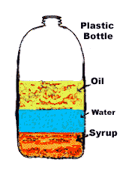

Look at this image.
Which object has the Highest density in water? How do you observe it?
The Ping Pong Ball because it floated on the lamp oil
The bolt because it has sunk to the bottom of the honey.
The cherry tomato because it suspend near the dish soap.

sharpening a pencil
physical change
physical property
chemical change
chemical property
size of an object
physical change
physical property
chemical change
chemical property
inflating a tire
physical change
physical property
chemical change
chemical property
freezing point
physical change
physical property
chemical change
chemical property
fragrance of a flower
physical change
physical property
chemical change
chemical property
This property of matter is the temperature at which a substance will turn into a gas.
melting point
boiling point
solubility
viscosity
This property of matter is the temperature at which a substance will turn into a liquid.
melting point
boiling point
solubility
viscosity
This property of matter is how easily a substance will dissolve in a liquid, such as water.
melting point
boiling point
solubility
viscosity

Is the following description an example of a physical or chemical property?
Physical Property
Chemical Property

Is the following description an example of a physical or chemical property?
Physical Property
Chemical Property

Is the following description an example of a physical or chemical property?
Physical Property
Chemical Property

Is the following description an example of a physical or chemical property?
Physical Property
Chemical Property
Is flammability an example of a physical or chemical property?
Physical Property
Chemical Property

Is honey an example of a homogeneous or heterogeneous mixture?
Homogeneous
Heterogeneous
Vocab: Anything that has mass and takes up space.
substance
atom
element
matter
Vocab: A characteristic that can be observed without changing the matter into another type of matter.
physical property
atom
element
chemical property
Vocab: Characteristics that describe something's ability to become something else.
physical property
atom
element
chemical property
Vocab: The basic unit from which all matter is made.
molecule
atom
element
compound
Vocab: Substances that are made up of only one type of atom.
molecule
atom
element
compound
Vocab: A group of two or more atoms held together by chemical bonds.
molecule
atom
element
compound
Vocab: A substance made of two or more elements that are chemically combined in a set ratio.
molecule
atom
element
compound
The abilities to dissolve in water and to conduct electricity are
natural properties
chemical properties
natural laws of matter
physical properties
A property determined without changing the identity of the substance is a...
chemical property
physical property
Which of the following is a physical property?
malleability
density
ductility
viscosity
Properties that you can observe with your five (5) senses are:
chemical properties
rental properties
nuclear properties
physical properties

___________ means how much a substance can be hammered flat or bent.
ductility
brittleness
luster
malleability
The shininess of an object is called...
density
viscosity
conductivity
luster
Select all that apply: the states or phases of matter are:
gases
molecules
liquids
atoms
solids
Which of the following is not a chemical property?
Complete this sentece: "Matter is anything that ...
the amount of matter in an object".
you can smell".
takes up space and has mass".
changes into liquid".
This property describes how easily a substance burns:
flammability
melting point
conductivity
reactivity
Which of the following is a chemical property?
color
density
reactivity
boiling point
Anything that has mass or takes up space.
mass
matter
volume
state
The amount of space something takes up.
volume
mass
weight
state
Measured in grams.
mass
volume
Measured using a graduated cylinder.
mass
volume
Whether something will sink or float.
mass
volume
density
solubility
sharpening a pencil
physical change
physical property
chemical change
chemical property
size of an object
physical change
physical property
chemical change
chemical property
freezing point
physical change
physical property
chemical change
chemical property
This property of matter is how easily a substance will dissolve in a liquid, such as water.
melting point
boiling point
solubility
viscosity
why does a cork float while a rock sinks when placed in water?
they are different states of matter
they are different sizes
they have different densities
they have different shapes

if the containers are A B C:
which of the containers contains a solid?
A
B
C
when marbles sink to the bottom of a beaker of water, it demonstrates:
marbles are solids and more dense than water
marbles are not soluble in water and less dense than water
Marbles are good conductors of energy

