wayground logo

Free Printable Worksheets

NEW

Font size

S
M
L
XL
Worksheets

8th Beyond Our World Review

Total questions: 73

Worksheet time: 1hrs 29mins

Name
Class
Date
1.

Scientists use the light-year to describe the relationships between objects in space. What does a light-year measure?

a)

the distance that light can travel in one year

b)

the brightness of light that travels through space

c)

the number of years it takes light to travel to Earth

d)

the time it takes light to travel 1 million km

2.

Astronomers use the light-year to describe the relationship between objects in space. For example, the Andromeda galaxy is 2.5 million ly from Earth. Which of the following units is most similar to the light-year?

a)

gram

b)

second

c)

kilometer

d)

degrees Celsius

3.

Distances between objects in space can be enormous. Which of the following distances is the longest?

a)

2.1 ly

b)

950,000 km

c)

9.5 trillion km

d)

1 million ly

4.

A light-year (ly) is the distance that light travels in one year. If a star is 3 ly from Earth, how long does it take light from that star to reach Earth?

a)

3 min

b)

3 h

c)

3 y

d)

3 ly

5.

The sun is much larger than the moon. However, as viewed from Earth, the sun and moon appear to be the same size. Why do the sun and moon appear to be the same size when viewed from Earth?

a)

The moon is much hotter than the sun.

b)

The moon is much denser than the sun.

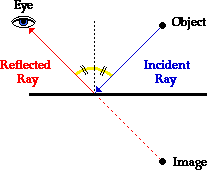
c)

The moon is much brighter than the sun.

d)

The moon is much closer to Earth than the sun.

6.

Which two objects in space are located farthest apart?

a)

Earth and Mars

b)

Earth and the sun

c)

Earth and the moon

d)

the Milky Way galaxy and the Andromeda galaxy

7.

Space exploration has advanced our knowledge of the universe. Which space journey would take the longest?

a)

a journey from Earth to the sun

b)

a journey from Earth to the moon

c)

a journey from Earth to a star in the constellation Centaurus

d)

a journey from Earth to the farthest planet in our solar system, Neptune

8.

Which object is closest to Earth?

a)

Barnard’s Star

b)

Planet Neptune

c)

Andromeda galaxy

d)

Triangulum galaxy

9.

Consider the color of the sun. Based on this color, what is the sun's approximate surface temperature?

a)

10,000-30,000

b)

6000-7500

c)

30000-60000

d)

<3500

10.

Felix examined several photos of stars. To compare their temperatures, he looked at the colors of the stars. He organized the photos in order from coolest to hottest. Which of these answers shows the correct order?

a)

red, yellow, white, blue

b)

white, blue, yellow, red

c)

yellow, white, blue, red

d)

blue, yellow, white, red

11.

Based on evidence in the table, which star would appear the dimmest from Earth’s surface?

a)

Star A

b)

Star B

c)

Star C

d)

Star D

12.

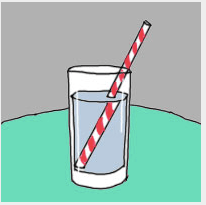
Why does the straw appear to be bent?

a)

light is reflected

b)

light is absorbed

c)

light is turned

d)

light is refracted

13.

What is the best explanation for Mickey seeing himself in the mirror?

a)

refraction

b)

absorbed

c)

reflection

d)

flipped

14.

What do we call a material that light can travel through?

a)

air

b)

water

c)

medium

d)

pathway

15.
When light bends it is ______
a)
Reflection
b)
Absorption
c)
refraction 
d)
optical density
16.
When light bounces back it is _____
a)
Reflected
b)
Refracted
c)
Absorbed
d)
Optical Density
17.
We see shadows because light travels in a __________________ line.
a)
curved
b)
straight
c)
rainbow
18.
a)
Reflection
b)
Refraction
19.
a)
Reflection
b)
Refraction
20.
All waves carry
a)
energy
b)
light 
c)
matter
d)
particles
21.
What do you see when water droplets refract and diffract sunlight?
a)
thunderstorm
b)
eclipse
c)
rainbow
d)
clouds
22.
What do we call the part of a compressional wave that is when the waves are squeezed together?
a)
compression
b)
rarefaction
c)
crest
d)
trough
23.
What do we call the part of a compressional wave that is spread a part?
a)
compression
b)
rarefaction
c)
crest
d)
trough
24.
Name the type of wave that matter moves at right angles to the direction of the wave?
a)
compressional waves
b)
mechanical waves
c)
transverse waves
d)
ultraviolet rays
25.
Why would a wave change direction?
a)
Because it kept traveling through the same medium
b)
Because it went from one medium to another
c)
the amplitude was too large
d)
the frequency was too small
26.
What is a repeating disturbance or vibration that transfers or moves energy from place to place?  
a)
Medium
b)
Wave
c)
Compression
d)
Rarefaction
27.
What kind of wave is pictured below?
a)
compressional wave
b)
transverse wave
c)
sound wave
d)
mechanical wave
28.
Which letter represents wavelength?
a)
A
b)
B
c)
C
d)
D
29.
Which letter represents the wave crest?
a)
A
b)
B
c)
C
d)
D
30.
Which letter represents the wave trough?
a)
A
b)
B
c)
C
d)
D
31.
Which letter represents amplitude?
a)
A
b)
B
c)
C
d)
D
32.
What is measured from crest to crest or trough to trough?
a)
Frequency
b)
Amplitude
c)
Wavelength
d)
Origin
33.
The number of waves that pass in a certain amount of time is called
a)
frequency
b)
wavelength
c)
crest
d)
amplitude
34.
Sound waves are...
a)
cool
b)
not cool
c)
transverse waves
d)
longitudinal waves
35.
The direction of a transverse waves is ____ to the disturbance/vibration. 
a)
equal
b)
less than
c)
at an acute angle
d)
at a right angle
36.
What does it mean to refract?
a)
bounce off
b)
to bend
c)
curve outward
d)
reflect
37.
A ray of white light passes through a prism.  On the other side of the prism, you see a rainbow.  What is this phenomenon called?
a)
Reflection
b)
Refraction
c)
Medium
d)
Dispersion
38.
Which electromagnetic waves have the highest frequencies and the shortest wavelengths?
a)
microwaves
b)
visible light
c)
gamma rays
39.
Which electromagnetic waves are used in ovens and cell phone communications?
a)
Infrared rays
b)
ultraviolet rays
c)
microwaves
40.
Which type of waves are used in broadcasting?
a)
radio waves
b)
infrared rays
c)
x-rays
41.
Electromagnetic waves that help your body produce vitamin D are called?
a)
ultraviolet rays
b)
x-rays
c)
gamma rays
42.
For waves in any medium, as the wavelength decreases, what happens to the frequency?
a)
It also decrease
b)
It stays the same
c)
It increases
43.
How much of the electromagnetic spectrum is made up of visible light?
a)
only a small portion
b)
a very l;arge portion
c)
about half
44.
Which electromagnetic waves allow us to diagnose & treat cancer?
a)
Gamma rays
b)
X-rays
c)
Ultraviolet rays
45.
The electromagnetic spectrum includes the complete range of electromagnetic waves placed in order of:
a)
increasing amplitutde
b)
increasing wavelength
c)
increasing frequency
46.
Which of the following lists the electromagnetic waves in order of increasing wavelength?
a)
X-rays, visible light, radio waves
b)
gamma rays, microwaves, UV rays
c)
infrared rays, radio waves, x-rays
47.
Which electromagnetic waves are used in devices such as heat lamps & TV remote controls?
a)
ultraviolet rays
b)
microwaves
c)
infrared rays
48.

Which color has the longest wavelength?

a)

Yellow

b)

Red

c)

Green

d)

Purple

49.

Quasars are extremely distant celestial bodies. Investigators using a special telescope determined that a certain quasar was emitting waves with a frequency of 1.41 x 10⁹ Hz. Using the electromagnetic spectrum provided, investigators were most likely using a telescope that detects -

a)

microwaves

b)

visible light

c)

x-rays

d)

gamma rays

50.

Black holes emit tremendous amounts of energy which result in astronomers using many different means of technology to gather information. Instruments such as the GALEX satellite and Spitzer Space Telescope use different parts of the electromagnetic spectrum to gather data about these strange celestial objects. To view black holes, the GALEX typically operates at a frequency of about 1.3 X 10¹⁵ Hz while the Spitzer Space Telescope operates at 2.2 X 10¹² Hz.

Which two portions of the electromagnetic spectrum are astronomers using to detect information about black holes?

a)

Ultraviolet and X-Ray

b)

Gamma Ray and X-Ray

c)

Ultraviolet and Infrared

d)

Infrared and Radio

51.

The Earth’s atmosphere allows some types of electromagnetic radiation through while others may be blocked or absorbed. Due to this, astronomers developed satellites and telescopes which orbit outside of Earth’s atmosphere. The Cosmic Background Explorer (COBE) satellite took measurements from 1989 to 1993 with an effort to gather information on the background temperature in space resulting from the Big Bang. This was the first step toward confirming data gathered in the 1960’s when an Earth-bound telescope picked up static in the frequency range of 3 x 10⁸ to 3 x 10¹¹ Hz.


Which portion of the electromagnetic spectrum were astronomers detecting?

a)

Microwave

b)

Ultraviolet

c)

X-Ray

d)

Infrared

52.
Which has the SHORTEST wavelength and, therefore, the highest frequency/most energy
a)
Radio waves
b)
Ultraviolet Rays
c)
Gamma Rays
d)
X-rays
53.
Which section of the spectrum is the ONLY one we can see?
a)
X-rays
b)
Visible Light
c)
Gamma Rays
d)
Ultraviolet Rays
54.
How are electromagnetic waves different from other waves? 
a)
They have very short wavelengths 
b)
They transmit energy instead of matter 
c)
They can travel through empty space
d)
They can change direction by reflection 
55.

What is the Order of the Electromagnetic System?

a)

Red,Yellow,Orange,Green,Blue,Indigo,Violet

b)

Red,Orange,Yellow,Green,Blue,Indigo,Violet

c)

Violet,Indigo,Green,Blue,Red,Orange,Yellow

d)

Violet,Blue,Red,Orange,yellow,green,Indigo

56.
Which part of the electromagnetic spectrum has high enough energy to cause damage to eyes and skin, and sometimes even cancer? 
a)
infrared light
b)
visible light
c)
ultraviolet light
d)
microwaves
57.
All electromagnetic waves have _________ wavelengths and ________ frequencies.
a)
different, similar
b)
different, different
c)
similar, similar
d)
similar, different
58.
A student placed a pencil in a cup of water.  The pencil appears broken because light-
a)
always travels in a straight line
b)
bends when it passes through water
c)
makes the water in the glass evaporate
d)
reflects the pencil on the water's surface
59.

When light hits an area and bounces back it is called:

a)

echo

b)

refraction

c)

reflection

d)

absorbing

60.

What happens when light hits a shiny or smooth surface?

a)

It disappears.

b)

It is refracted.

c)

It is absorbed.

d)

It is reflected.

61.

What is the angle of reflection equal to?

a)

The angle of refraction

b)

The angle of incidence

c)

The angle of absorption

d)

The angle of light

62.

What image show light being absorbed?

a)
b)
c)
63.
In General Sound waves travel the fastest in __________
a)
solid
b)
liquid
c)
Gas
d)
plasma
64.
travels through solids fastest because the molecules are closer together
a)
speed of sound
b)
wavelength
c)
frequency
d)
amplitude
65.
Material (matter) through which a wave travels
a)
medium
b)
Doppler Effect
c)
sound
d)
pitch
66.
A wave that requires a medium through which to travel
a)
mechanical wave
b)
chemical wave
c)
electromagnetic wave
d)
pitch
67.
The speed of a sound wave depends on
a)
the frequency
b)
the medium
c)
both air temperature and medium
d)
the air temperature
68.
What form of data do scientist prefer?
a)
Measurable data/empirical evidence
b)
Qualitative data
c)
Uncontrolled evidence
d)
Single trial data/evidence
69.
Describes the way the world works.
a)
law
b)
theory
c)
empirical evidence
d)
experiment
70.

A ___ is observed and describes in the natural world what appears to always be true.

a)

hypothesis

b)

theory

c)

law

71.

All the measurements and data scientists gather in support of a scientific explanation.

a)

empirical evidence

b)

explains

c)

evidence

72.

Happens under very specific conditions in nature.

a)

hypothesis

b)

theory

c)

law

73.

Which piece of evidence could be used to BEST support this claim:


High school students should be required to wear uniforms.

a)

When adding everything up, a school uniform could end up costing more than $200.

b)

A student reported, "Allowing us to wear our own clothes gives us a chance to show our unique style and independence."

c)

At one school that recently required students to wear uniforms, attendence rates went up, and behavior incidents went down.

d)

School uniforms can be ordered online .