
 Worksheets
Chemistry Unit Test 8th-grade
Total questions: 68
Worksheet time: 35mins

A combination of 2 or more substances that DO NOT form a new substance is called a ________.
compound
molecule
mixture
element
Which of the following chemical formulas represents a compound? (assume that the numbers are all subscripts
C3
O2
CH3CHO
H2
If an atom has 7 protons and 7 electrons what charge will it have?
-2
-1
0
+1
+2
If an atom gains two electrons what charge will it have?
-2
-1
0
+1
+2
Which of the following describes covalent bonds?
Bonds form because of opposite charges
Electrons are transferred between atoms
Electrons are shared to fill outer electron shells
Covalent bonds are magical
If an atom loses two electrons what charge will it have?
-2
-1
0
+1
+2
Which of the following describes covalent bonds?
Bonds form because of opposite charges
Electrons are transferred between atoms
Electrons are shared to fill outer electron shells
Covalent bonds are magical
What kind of bond forms when atoms exchange electrons?
ionic
artificial
covalent
univalent
What is the name for an ion with a negative charge?
onion
anion
cation
union
Which of the following cannot be broken down into something simpler?
A molecule
A compound
An element
A mixture
What is the name for an ion with a positive charge?
onion
anion
cation
union
Covalent bonds are between...
metals and metals
two or more nonmetals
sodium and chloride
metals and nonmetals
Ionic bonds are between...
nonmetals and nonmetals
carbon and oxygen
metals and metals
metals and nonmentals
Which one can be found on the periodic table?
compound
element

This diagram represents...
An element
A molecule
A compound
A mixture of elements and compounds

The vertical (up and down) columns in the Periodic Table are called
groups
towers
periods
atomic numbers


Where is most of the mass of an atom located?
the nucleus
the electron cloud
the space in between particles
in shells

What are the positively charged particles in an atom called?
Electrons
Neutrons
Protons
none of these

Which particle in the atom is neutrally (neither positive or negative) charged?
Proton
Electron
Neutron
Negatron

What two particles would you find in the nucleus of an atom?
Protons and electrons
Neutrons and electrons
Protons and neutrons
Electrons and negatrons
The smallest unit of an element that retains or keeps the properties of that element is called
A molecule
An atom
A proton
A neutron

The amount of _________ an atom has determines the name of the element.
protons
neutrons
particles
elements

Mass number is ______.
number of protons + electrons
number of neutrons + protons
number of electrons only
number of neutrons only

Isotopes are _______.
elements with the same atomic number and same mass
elements with different atomic number but same mass
elements with same atomic number but different masses
different elements with same number of electrons
The cloud-like space that electrons travel around:
nucleus
shell
neutrons
Oort cloud
Classification system for elements is called:
Elements
Periods
The Periodic Table of Elements
Families
The subatomic particles are called:
protons, nucleus and electrons
protons, electrons and neutrons
protons, positives and negatives
cloud, shell and quarks
What is the study of matter?
Chemistry
Biology
Earth Science
Physics
All matter is made of _____.
light
energy
cells
atoms
The electrons in the outermost shell (main energy level) of an atom; these are the electrons involved in forming bonds
alkali metals (group 1)
Halogens (Group 17)
atomic number
valence electrons
How many valence electrons and energy levels does (Pb) lead have?
4 valence electrons and 6 energy levels (orbitals)
6 valence electrons and 4 energy levels (orbitals)
5 valence electrons and 5 energy levels (orbitals)
5 valence electrons and 10 energy levels (orbitals)

What is the atomic mass?
58.693
28

How many protons and electrons does nickel have?
28
58.69

How many valence electrons does the element have?
1
2
3
4
What do the vertical columns on the periodic table tell us?
The number of orbitals
The number of valence electrons (electrons on the outer most shell)
Sodium (Na) is found in group __________.
1
2
3
4
What information does the subscript tell us in a chemical formula?
Amount of molecules
Amount of elements
Amount of compounds
What information does the coefficient tell us in an chemical formula?
Amount of molecules
Amount of atoms
Amount of elements
What is the coefficient in this chemical formula:
3H2O
1
2
3
4

ZnSO4: Identify the types of atoms.
Zinc
Sulfur
Oxygen
Silicon
Potassium
C4H8O: How many types of atoms?
4
8
12
3
True or False: All atoms are created or destroyed in a chemical reaction.
true
false
maybe


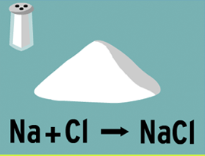
When sodium and chlorine combine to form sodium chloride, sodium chloride is the:
Originator
Reactant
Product
Produce
Law of conservation of mass states the amounts of atoms in the reactants and the products...
Increase
Decrease
Stay the same
No correct answer
Does the equation H2+O2 →H2O follow the Law of Conservation of Mass?
Yes, because the atoms are equal.
No, because more info is needed.
No, because there are more atoms in the product.
No, because there are more atoms in the reactant.

Element
Compound
Mixture

Element
Compound
Mixture

Element
Compound
Mixture


