wayground logo

Free Printable Worksheets

NEW

Font size

S
M
L
XL
Worksheets

Biology and Physics Grade 6

Total questions: 75

Worksheet time: 1hrs 17mins

Name
Class
Date
1.
How does friction affect speed?
a)
more friction decreases speed
b)
more friction increases speed
c)
less friction decreases speed
d)
less friction doesn't affect speed
2.
Friction is a force that acts in an ___________ direction of movement.
a)
similar
b)
opposite
c)
parallel
d)
west
3.
What does friction produce?
a)
light
b)
sound
c)
heat
d)
gravity
4.
 What is the unit called that measures force?
a)
weight
b)
meter
c)
Newton
d)
kilogram
5.
What is force?
a)
A force is a push or a pull upon an object resulting from the object's interaction with another object.
b)
something used in Star Wars 
c)
It is the amount of space between two points.
d)
It is Superman's power
6.
The piece of equipment to measure force is called...
a)
Spring Scale
b)
Triple Beam balance
c)
Force Scale 
d)
Pull Spring
7.
What is a net force?
a)
The total amount of force applied to an object.
b)
The amount of friction on an object.
c)
The amount of force a net could put on an object.
d)
The amount force applied to a net.
8.
What is kinetic energy?
a)
The force needed to slow an object down.
b)
The energy of motion
c)
Built up energy before it is released.
d)
The amount of energy between two surfaces.
9.
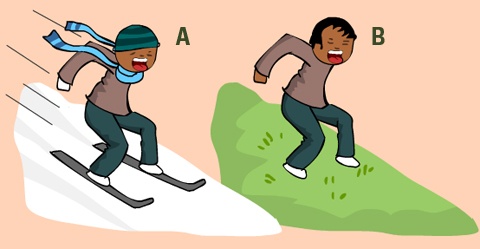
Why is it harder for the boy in Image B to get down the hill?
a)
Motion
b)
Friction
c)
Work
d)
Displacement
10.
Balanced or Unbalanced?
a)
Balanced 
b)
Unbalanced
11.
What force ultimately slows the roller coaster to a stop?
a)
Applied
b)
Normal
c)
Friction
d)
Magnetic
12.
Which best describes the force of gravity?
a)
a pulling force
b)
a pushing force
c)
a change in mass
d)
a change in speed
13.
James and Alex are kicking a ball back and forth. Alex kicks the ball in James’s direction, but the ball stops just before it reaches James. Which most likely caused the ball to stop?
a)
friction
b)
gravity
c)
change in mass of the ball
d)
change in shape of the ball
14.
a)
Series circuit
b)
Incomplete circuit
c)
Parallel circuit
d)
Power source
15.
What is an insulator?
a)
The area of a conductor through which a current is able to move
b)
A material which does not allow electricity to go through it
c)
The amount of devices which are in a circuit
d)
A battery or other device which provides energy for a circuit
16.
The flow of electricity through a conductor
a)
Battery
b)
Current
c)
Static electricity
d)
Switch
17.
A small device that stores energy in a chemical form
a)
Complete circuit
b)
Switch
c)
Power source
d)
Battery
18.
What is a conductor?
a)
A material that allows electricity to go through it
b)
The area of a conductor through which a current is able to move
c)
A battery or other device which provides energy for a curcuit
d)
When there is only one path for the electricity to flow
19.
a)
Parallel circuit
b)
Series circuit
c)
Incomplete circuit
d)
Switch
20.
Series circuit
a)
A material that allows electricity to go through it
b)
Only one pathway for the electricity to flow
c)
A device which provides energy for a circuit
d)
More than one path for the electricity to flow
21.
What is one problem with using a series circuit? 
a)
It has a lot of series. 
b)
If one goes down, they all go down! 
c)
It doesn't work properly.
d)
There are no problems. 
22.
This is an example of a _______ circuit
a)
open
b)
series
c)
parallel
d)
square
23.
What kind of circuit is this?
a)
Series
b)
Consecutive
c)
Parallel
d)
Training
24.
wood is a _____?
a)
conductor
b)
insulator
25.
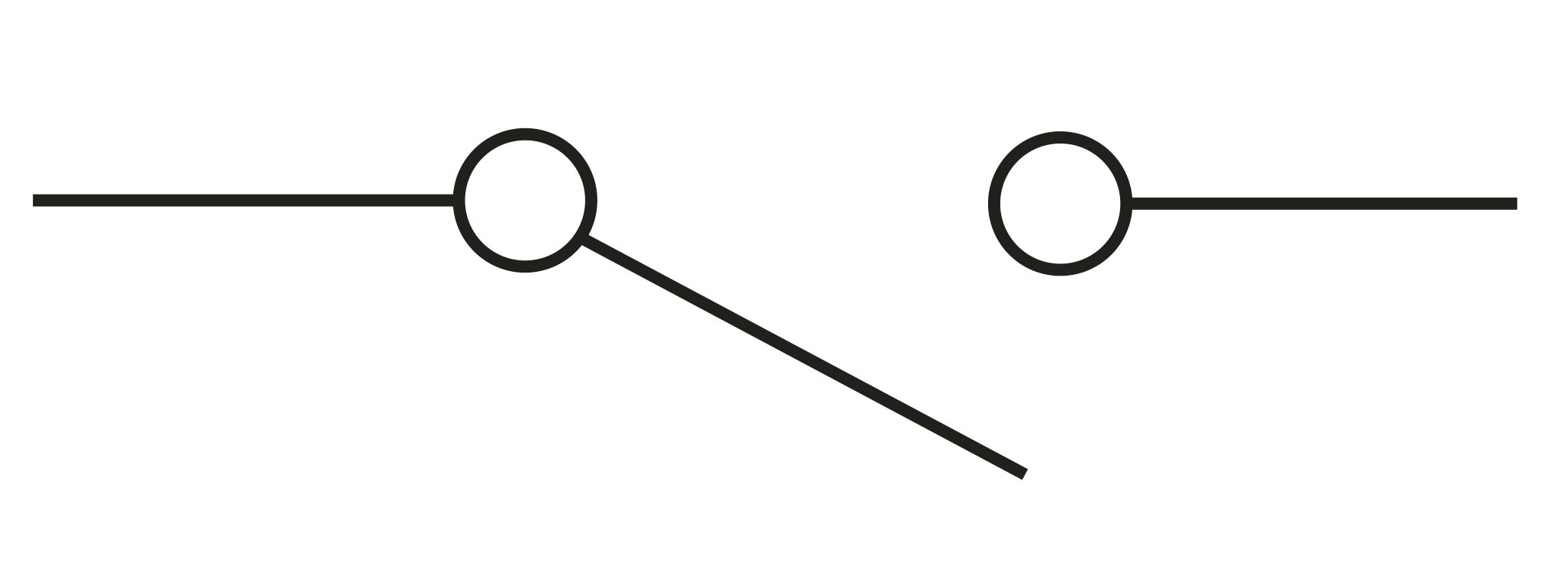
this is the symbol for a _____?
a)
switch
b)
light 
c)
battery
d)
wires
26.
Is a house in a good idea for a parallel circuit
a)
Yes 
b)
No
27.
What will happen if one light bulb is removed from this circuit?
a)
the other bulbs will go out
b)
the other bulbs will get dimmer
c)
the other bulbs will get brighter
d)
the battery will become stronger
28.

Why do electricians always wrap wires in plastic?

a)

Plastic comes in many different colors

b)

Plastic is a good electrical conductor

c)

Plastic makes the wires easy to bend

d)

Plastic is a good electrical insulator

29.

Which of these materials is a good conductor of electricity?

a)

Rubber

b)

Metal

c)

Newspaper

d)

Glass

30.

A penny is an example of

a)

An insulator

b)

an electron

c)

a proton

d)

a conductor

31.
Magnetism is....
a)
The part of the magnet where the force is the strongest
b)
A force created by magnets that pulls some metals
c)
To Pull towards
d)
An object able to pull some metals towards itself
32.
Poles are ....
a)
The part of the magnet where the force is the strongest
b)
A force created by magnets that pulls some metals
c)
To Pull towards
d)
An object able to pull some metals towards itself
33.
To attract means....
a)
The part of the magnet where the force is the strongest
b)
A force created by magnets that pulls some metals
c)
To Pull towards
d)
An object able to pull some metals towards itself
34.
To repel means....
a)
To push away
b)
A force created by magnets that pulls some metals
c)
To Pull towards
d)
An object able to pull some metals towards itself
35.
A magnet is...
a)
To push away
b)
A force created by magnets that pulls some metals
c)
To Pull towards
d)
An object able to pull some metals towards itself
36.
Do these magnets attract or repel?
a)
Attrack
b)
Repel
37.
What do magnets stick to?
a)
copper
b)
wood
c)
iron
d)
plastic
38.
Two north poles will attract.
a)
True
b)
False
39.
A north pole and a south pole will attract.
a)
True
b)
False
40.
Where is the force of attraction the strongest on a magnet?
a)
at the poles
b)
in the middle
c)
above the magnet
d)
below the magnet
41.
Iron, Nickel and cobalt are all __________________ materials
a)
Shiny
b)
poles
c)
magnetic
d)
cold
42.
What do the lines around this magnet represent?
a)
North Pole
b)
South Pole
c)
Magnetic Declination
d)
Magnetic Field
43.
As the distance between two magnets increases (they get farther apart), the force between them:
a)
Increases
b)
Decreases
c)
Stays the Same
44.
If you cut a magnet in half, what happens to the poles?
a)
One half gets the North Pole, the other half gets the South Pole
b)
Both halves get only a North Pole
c)
Both halves get only a South Pole
d)
Both halves get a North pole and a South Pole
45.
What kind of magnet can be turned on and off?
a)
refridgerator magnet
b)
electromagnet
c)
magnetite
d)
iron
46.
Why is the insect a consumer?
a)
It is eaten by a mouse.
b)
It can make its own food.
c)
It eats the plant.
47.
In the food chain pictured, the source of energy for the water plant is ______.
a)
Sun
b)
Water Plant
c)
Mayfly
d)
Trout
48.
In the food chain pictured, why is the plant a producer?
a)
The plant consumes the sun.
b)
The plant makes its own food.
c)
The plant is not a producer.
49.
Which picture would be first to show the flow of energy through the food chain.
a)
Snake
b)
Sun
c)
Carrot
d)
Rabbit
50.
Which picture would be second to show the flow of energy through the food chain.
a)
snake
b)
sun
c)
carrot
d)
rabbit
51.
Which picture would be third to show the flow of energy through the food chain.
a)
Snake
b)
Sun
c)
Carrot
d)
Rabbit
52.
Which picture would be fourth to show the flow of energy through the food chain.
a)
Snake
b)
Sun
c)
Carrot
d)
Rabbit
53.
What is a producer?
a)
an organism that gets energy from eating other organisms
b)
an organisms that uses sunlight to make its own food
c)
an organism that gets energy from eating dead organisms, non-living material or waste
d)
an organism that uses chemical energy to make its own food
54.
Bacteria and fungi typically serve what role in an ecosystem?
a)
herbivore
b)
carnivore
c)
omnivore
d)
decomposer
55.
What is this called?
a)
Food Web
b)
Food Chain
c)
Abiotic Factors
56.

Which of these is an organism that does not depend on another living thing for food?

a)

the Sun

b)

an insect

c)

a plant

d)

an animal

57.

What does the arrow point to in a food chain?

a)

only the plants in a food chain

b)

only the animals in a food chain

c)

the organism that gets the energy

d)

the organism that lives the longest

58.

What is a food chain?

a)

a diagram with animals only

b)

stages an organism goes through as it grows

c)

the place where an organism lives

d)

the path of energy in an environment

59.
Which of the following best describes the deer's role in the ecosystem?
a)
herbivore
b)
omnivore
c)
carnivore
d)
decomposer
60.
Which of the following best describes the wolf's role in this ecosystem?
a)
herbivore
b)
omnivore
c)
carnivore
d)
decomposer
61.
Which of the following best describes the blue bird's (in the middle) role in this ecosystem?
a)
carnivore
b)
omnivore
c)
herbivore
d)
decomposer
62.
_________ cannot make their own food, so they need to consume (eat) plants or animals.
a)
consumers
b)
producers
c)
decomposers
63.
_______are animals that eat only plants.
a)
herbivore
b)
carnivore
c)
omnivore
64.
_______ are animals that eat only animals (meat).
a)
herbivore
b)
omnivore
c)
carnivore
65.
_________ are animals that eat BOTH plants and animals. 
a)
omnivore
b)
carnivore
c)
herbivore
66.
what consumer group do YOU fit in?
a)
herbivore
b)
carnivore
c)
omnivore
67.

Adaptation:

Large, flat, padded feet.

a)

Stops sand getting in its eyes.

b)

Reduces heat energy loss during cold nights.

c)

Stops sand going up its nose.

d)

Prevents their feet sinking into the sand.

68.

Adaptation: Hump made of fatty tissue.

a)

Prevents their feet sinking into the sand

b)

Shade their eyes from the sun.

c)

An energy store.

d)

Allows heat energy loss during the day.

69.
Which is an adaptation that polar bears use to survive the cold Arctic. 
a)
They are big animals. 
b)
They love the cold snow.
c)
They have sharp claws and paws to walk on ice and find food. 
d)
Polar hibernate during the long cold winter. 
70.
What does camouflage mean?
a)
To be invisible. 
b)
You wear green like army men. 
c)
Animals are very colorful. 
d)
To blend in to your environment . 
71.
The amount of matter in an object is 
a)
pressure
b)
weight
c)
mass
d)
force
72.
What force causes objects falling near Earth's surface to slow down?
a)
Gravity
b)
Air Resistance
c)
Centripetal Force
d)
Newtons
73.

Weight is _________.

a)

the quantity of matter in an object.

b)

the measure of an object's inertia.

c)

the force exerted by gravity on an object's mass.

d)

equal to the mass of an object.

74.
The scientific unit of weight is
a)
Kg
b)
N
c)
pounds
d)
Kgm/s
75.
The scientific unit for mass is
a)
Kg
b)
N
c)
pounds
d)
ounces