
 Worksheets
6th Grade Life Science Review
Total questions: 70
Worksheet time: 55mins
All living things have only one cell.
True
False
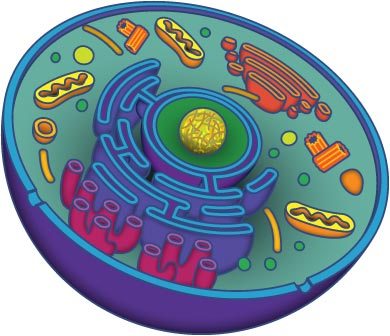
All cells -----
come from other dead cells
come from other living cells
crystallize out of the air

There are three parts to the cell theory. Which is NOT one of those parts?
All organisms are composed of one or more cells.
The cell is the basic unit of structure and organization in organisms.
Cells spontaneously arise from carbon and nutrients carried in the bloodstream.
All cells come from pre-existing cells.
Prokaryotes are _______________ and include ______________.
single cells, DNA but not a nucleus.
multiple cells, a nucleus with DNA
Eukaryotic cells have...
DNA but no nucleus.
a nucleus with DNA and organelles.
Eukaryotic cells can include ______________. *Select all that apply.
protists
plants
animals
fungi
One main difference between prokaryotic and eukaryotic cells is that...
only prokaryotic cells have cell walls
only eukaryotic cells have a nucleus
only prokaryotic cells have ribosomes
only eukaryotic cells have DNA
Which part of the cell allows material to pass in and out of the cell?
nucleus
cell membrane
cytoplasm
Chloroplast

Animals cells and plant cells are exactly the same.
True
False
Only ____________ cells have a cell wall instead of a cell membrane.
plant
animal
white blood
living
There are two classifications of cells-Prokaryotic and Eukaryotic.
True
False
What is the major difference between a Eukaryotic and Prokaryotic cell?
Eukaryotes have a nucleus.
Prokaryotes have a nucleus
Eukaryotes have a membrane.
Prokaryotes have sugars.
Which is more complex?
Prokaryotic Cell
Eukaryotic Cell
Prokaryotic cells are less complex and have only a few organelles.
True
False

Which of the cells are PROKARYOTIC (CHECK ALL THAT APPLY)?
1
2
3
4
The jelly-like fluid inside of the cell. It holds the organelles in place.
cytoplasm
chloroplasts
cell membrane
cytokinesis
Responsible for packaging, modifying, and moving substances from the cell.
mitochondria
Golgi apparatus
smooth ER
rough ER
Jelly bean shaped structures that break down food molecules and release energy.
chloroplasts
lysosomes
cytoplasm
mitochondria
The control center of the cell. It houses DNA.
nucleus
nucleolus
mitochondria
cell membrane
These are liquid filled spaces found in animal cells.
lysosomes
vacuoles
ribosomes
chloroplasts
These are round organelles that digest waste, old cell parts and food.
ribosomes
lysosomes
chloroplasts
vacuoles
This is a rigid structure that provides support to plant cells.
cell membrane
cell wall
cell gateway
central vacuole
These organelles contain green chlorophyll. They make food for plants.
lysosmes
chloroplasts
ribosomes
vacuoles
This stores water in plant cells.
chloroplasts
cell wall
lysosomes
central vacuole
These are protein builders. They are located on the rough ER.
vacuoles
lysosomes
mitochondria
ribosomes
What makes the rough ER rough?
lysosomes
vacuoles
chloroplasts
ribosomes
How many chloroplasts are found in an animal cell?
0
1 or 2
4 or 5
many
Which of these is not found in the animal cell and is found in the plant cell? Pick more than one
cell membrane
cell wall
chloroplast
cytoplasm
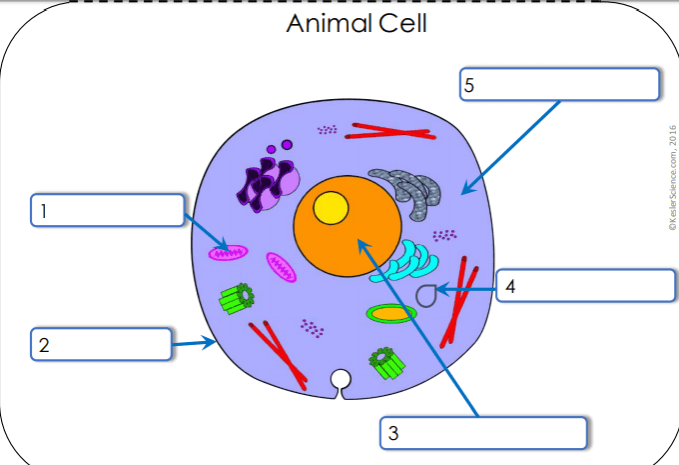
What is #2 in the diagram?
vacuoles
cell membrane
chloroplast
nucleus
What is #1 in the diagram?
nucleus
cell wall
cytoplasm
mitochondrion
What is #3 in the diagram?
vacuoles
cell membrane
chloroplast
nucleus
What is #4 in the diagram?
vacuoles
cell membrane
chloroplast
nucleus
What is #5 in the diagram?
nucleus
cell wall
cytoplasm
mitochondrion
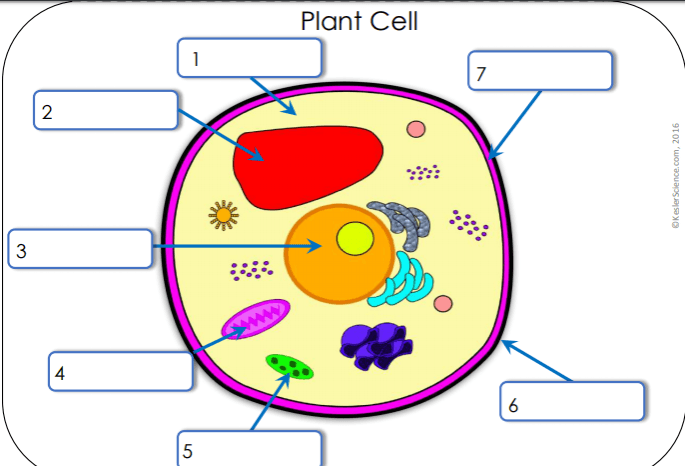
What is #1 in the diagram?
nucleus
cell wall
cytoplasm
mitochondrion
What is #2 in the diagram?
vacuoles
cell membrane
chloroplast
nucleus
In which cell type are chloroplasts found?
Animal Cell
Plant Cell
Both
Organisms made of one cell are known as
multicellular
unicellular
epithelial
epidermal
Which is an example of a multi-cellular organism?
frog
chlorella
fungi
bacteria
Which is an example of a single celled organism?
amoeba
chlorella
fungi
all of the above
What is the simplest and smallest part of matter?
Cells
Protein
Atoms
Molecules
A(n) ________ is formed when 2 or more elements combine chemically.
element
atom
lipid
compound
______ contains genetic information.
atoms
DNA
Lipi
_______ store energy and form cell membranes.
Carbohydrates
Proteins
Nucleic Acid
Lipids
What is the function of proteins?
provides quick energy
stores energy
helps with growth and repair of tissues
stores genetic information
What is the function of nucleic acid?
provides quick energy
stores energy
helps with growth and repair of tissues
stores genetic information
Which are examples of a carbohydrate?
glucose, pasta, bread
fats, oils, waxes
meats, enzyme, lactase, eggs
DNA, RNA
Which are examples of lipids?
glucose, pasta, bread
fats, oils, waxes
meats, enzyme, lactase, eggs
DNA, RNA
What is the most complex level of organization?
organs
organisms
animal cells
organ systems
What is an example of an organ?
plants
Nerve tissues
Liver
Digestive system
small bodies with a specific function within a cell

