
 Worksheets
Physics Final Exam Review
Total questions: 80
Worksheet time: 3hrs 31mins
If a net (unbalanced) force is applied to an object
the object moves with constant velocity
the object accelerates
the object remains stationary
its impossible to have a net force on an object
The mass of the object remains the same even if the object is taken to the moon, or Jupiter, or under water.
True
False
A 30 Newton force east is applied to a crate and a 10 Newton force west is applied to the same box. What is the net force on the box?
30 N east
10 N west
20 N east
40 N east
A tennis ball and a solid steel ball of the same size are dropped from the same height. In the absence of air resistance, which ball has the greater acceleration?
The steel ball
The tennis ball
Neither has any acceleration
They have the same acceleration
If a 25 kg box A is placed on a horizontal surface, and an identical box B is placed on a slide which has an angle of 32° from horizontal, how do the normal forces of the boxes compare?
the normal forces are the same and are both zero
the normal forces are the same and are non-zero
the normal force of box A is greater than the normal force of box B
the normal force of box B is greater than the normal force of box A
If the net force acting on a cart doubles, what happens to the cart’s acceleration?
it quadruples
it halves
it doubles
it quarters
Jane has a mass of 40 kg. She pushes on a 50 kg rock with a force of 100 N. What force does the rock exert on Jane?
400 N
500 N
-100 N
-500 N
Newton’s second law of motion is represented by:
a = mg
F = a Δ v
d = 1/2(g)t 2
F = ma
Your mass on Earth is 105 kg. On the imaginary planet Krypton, you weigh
1175 N. What is the acceleration of gravity on Krypton?
9.8 m/ s2
11.2 m/ s2
20 m/ s2
0.098 m/ s2
Sound waves cannot travel in
a vacuum
air
water
steel
A Doppler effect occurs when a source of sound moves
towards you only
away from you only
both towards and away from you
neither towards nor away from you
An unfortunate bug has a mass of 9.9 g, and collides with a car with a mass of 990 kg. How does the force on the bug compare with the force on the car?
The force on the bug is greater than the force on the car.
The force on the car is greater than the force on the bug.
The force on the bug and the force on the car are the same.
There is no force on either the bug or the car.
An unfortunate bug has a mass of 9.9 g, and collides with a car with a mass of 990 kg. How does the acceleration of the bug compare to the acceleration of the car during the collision?
The acceleration on the bug is greater than the acceleration on the car.
The acceleration on the car is greater than the acceleration on the bug
The acceleration on the bug and the acceleration on the car are the same.
There is no acceleration on either the bug or the car.

During which of the following time intervals is no net force applied to the object?
A - B
B - C
C - D
E - F

During which of the following time intervals in which there is a positive net force applied to the object?
A - B
B - C
D - E
F - G

During what time interval is the object moving with a constant velocity?
A - B
C - D
E - F
F - G
The horizontal component of a projectile’s velocity:
cannot be calculated
increases with time.
decreases with time.
remains unchanged the entire time.
Which of the following equations cannot be used to calculate the time it takes for an object to fall a given distance?
d = ½ gt 2
d = vit + ½ gt2
a = Δv/Δt
v = Δd/Δt
The vertical component of a projectile’s velocity:
cannot be calculated
decreases then increases with time.
decreases with time.
remains unchanged the entire time.
The pitch of a musical sound depends on the sound wave's:
wavelength
amplitude
frequency
speed
Sound is an example of
a longitudinal wave
a wave that can travel through a vacuum.
a transverse wave
a wave that does not transmit energy.
The vibrations of a transverse wave move
in the same direction as the wave travels.
at right angles to the direction of wave travel.
above and below the moving wave.
opposite to the direction of wave travel.
Sound travels fastest in
air
water
steel
sound travels the same speed in all of these

The amplitude of the wave in the diagram below is given by letter ______.
A
B
C
D

Indicate the interval which represents one full wavelength in the wave diagram below.
A - C
B - D
A - G
A - E
The speed of any wave depends upon
its energy
the medium through which it travels.
its angle of reflection.
its amplitude.
Which factor(s) affect the period of a pendulum?
mass of the bob only
amplitude of the swing and length of the string
length of the string and gravity
amplitude of the swing only

Which sketch below correctly shows what happens when waves A and B intersect.


Force is measured in:
Kg•m
Newton
Watt
Joule
Joe can easily lift an 80 N rock using a lever. If he pushes down with 10 N of force, the rock goes up 0.1 m. How far did his end of the lever move?
10 m
8 m
1 m
0.8 m
An object which has kinetic energy (KE) must be:
moving
falling
at rest
above the ground
A bow is drawn so that it has 40 J of PE. When fired, the arrow will ideally have:
Less than 40 J of KE
More than 40 J KE
40 J of KE
0 J of KE
A 2 kg mass has 40 J of PE. Approximately how far off the ground is it?
1 m
2 m
3 m
4 m
At the same moment that a baseball is thrown horizontally by a pitcher, a ring drops vertically off his hand. Which statement about the baseball and the ring is correct, neglecting air resistance?
They both hit the ground at the same time.
The ring hits the ground first.
The baseball hits the ground first.
Neither one hits the ground at all because there is no air resistance.

The diagram shows a 20 N force pulling an object of a hill at a constant rate of 2 m/s. What is the mechanical advantage of this ramp?
3
0.3
30
10
Refraction is caused by:
bending
displaced images
different wave speeds
more than one reflection
If a ray of light strikes the surface of water at the critical angle, the angle of refraction of that ray of light is:
180 °
90 °
45 °
not enough information to determine
A virtual image is:
upright
able to be projected on a screen
larger
inverted
An airbag and crumple zones are built into all new cars. What purpose do they serve?
They are expensive to install so car companies can charge more for their cars.
They are expensive to fix so car companies can charge more for repairs.
They increase the force needed to stop the car so the person inside is safer.
They increase the time it takes for the car to come to a stop so the person inside is safer.

The sketch below represents a ray of light traveling from medium x to air. What is the index of refraction for medium X?
0.5
2.0
1.7
0.58
Which of the following is a secondary color of light?
red
blue
green
yellow
If I shine cyan light on red paper, what color will you see?
red
black
cyan
violet
When light reflects off of a mirror, the angle of reflection is:
Equal to the angle of incidence
Half the angle of incidence
twice the angle of incidence
unrelated to the angle of incidence
The speed of light in a vacuum is:
3.0 x 10 8 m/s
2.5 x 10 8 m/s
3.0 x 10 10 m/s
1.0 m/s

This free body diagram represents an object that is:
sitting still on a table or surface
falling in the real world with air resistance
on a table moving rightward with constant velocity
on a table accelerating rightward
Energy is measured in:
Watts
Degrees Celsius
Newtons
Joules
Why is the sky blue?
It is reflecting the blue oceans
It is painted
The atmosphere scatters red light
The atmosphere scatters blue light

What type of nuclear change is shown?
nuclear fusion
nuclear fission
alpha decay
beta decay
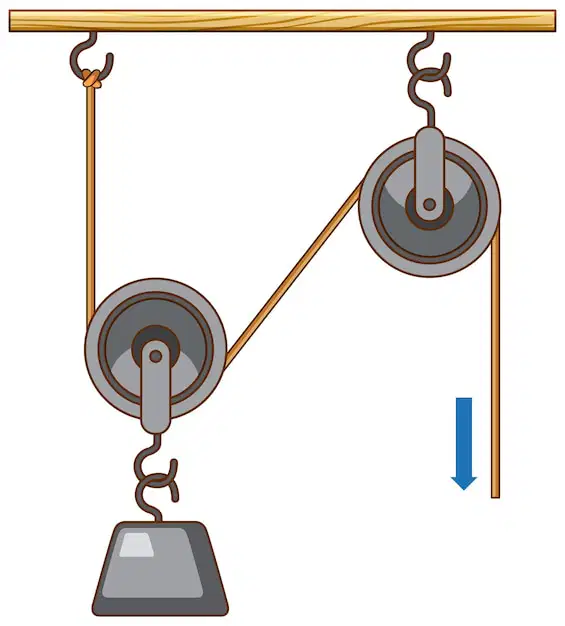
What is the mechanical advantage of the pulley system shown?
0
1
2
3
A 10 kg box sits on a 5 m high shelf. How much kinetic energy (KE) does it have?
0 J
5 J
10 J
500 J
A 10 kg box sits up on a 5 m high shelf. How much potential energy (PE) does the box have?
10 J
50 J
2 J
500 J
A vector quantity is a measure with
magnitude
direction
both magnitude and direction
a crazy supervillian
The formula v = ΔtΔd can be used
to find the speed of falling objects
to find the speed of objects with constant velocity
to find the speed of objects turning a corner
to find the height a projectile will reach.
True or False: a net force is required to keep an object moving.
true because because otherwise it would slow down
false because objects in motion tend to remain in motion
true because nothing moves without a net force
false because a net force would help it move at a constant velocity.
When a ball is dropped it falls with a constant velocity until it strikes the ground.
true
false
The acceleration of gravity is
dependent on the planet we are standing on only
equal to - 10 m/s 2 on Earth only
varying over time depending on how many people are on the ground.
dependant on the planet and equal to -10 s2m on Earth
The correct label for velocity in physics is:
m/s 2
kg/m
kg/m 2
m/s

If the angle of incidence shown at right is 45° and
the angle of refraction is 30°, which substance
has the larger index of refraction?
The top substance because going from a larger n to a smaller n refraction is away from the normal.
The bottom substance because because going from a smaller n to a larger n refraction is towards the normal.
The top substance because going from a larger n to a smaller n refraction is towards the normal.
The bottom substance because going from a larger n to a smaller n refraction toward the normal.
Energy of motion is called
kinetic energy
potential energy
thermal energy
gravitational energy
The correct formula for calculating the acceleration of an object is:
a = d/t
a = g(t)
a = Δv / Δt
a = (Δv)(Δt)
The total amount of energy in a system
is constantly changing
is constantly decreasing
remains constant
cannot be measured
Total Mechanical Energy (TME) means
potential energy only
kinetic energy only
nuclear energy only
potential energy + kinetic energy
A ball is dropped from a tall building and falls for 3 seconds. How fast is it moving?
3 m/s
10 m/s
30 m/s
impossible to determine with this information
To calculate how far a ball falls in 3 seconds you must use:
d = 1/2g t2
d = tΔv
d = (v)(t)
d = (a)(t)
Momentum is
mass in motion
time in motion
speed x time
60 s
Objects in motion tend to remain in motion, objects at rest tend to remain at rest is one way of describing:
mass
velocity
inertia
energy
When light reflects off a mirror:
it slows down
the angle of incidence is larger than the angle of reflection
the light passes through to the new medium
the angle of incidence is equal to the angle of reflection
Which of the following is a primary color of light?
magenta
cyan
yellow
green
Work is:
(mass)(distance)
(force)(mass)
(distance)(time)
(force)(distance)
Which of the following is a scalar (not vector) quantity?
time
velocity
displacement
acceleration
A real image is:
Always inverted
Always larger
Never able to be projected on a screen
Always upright
An object free falls for 3.0 seconds. How far will it fall?
30 m
45 m
9.0 m
125 m
An object in free fall:
falls at a constant 10 m/s
falls at 10 m/s until it reaches terminal velocity
accelerates at 10 m/ s2 until it reaches terminal velocity
accelerates at 10 m/ s2 until it strikes the ground
In the absence of a net force, a moving object will
continue moving with a constant velocity in a straight line.
stop moving
accelerate
decelerate
Plane mirrors can make:
virtual images that are larger than the object
both real and virtual images that are smaller than the object
real images of the same size as the object
virtual images of the same size as the object
Which of the following is not a ray of light you can use to find an image for a lens.
A ray of light that enters through the center of the lens passes through the lens unbent.
A ray that enters through the focal point passes through the lens unbent.
A ray that enters through the focal point refracts out parallel to the principal axis.
A ray of light that enters parallel to the principal axis refracts out through the focal point.

The lens shown causes light rays to:
come together as they pass through.
pass straight through unrefracted.
bounce back at the same angle.
spread apart as they pass through.
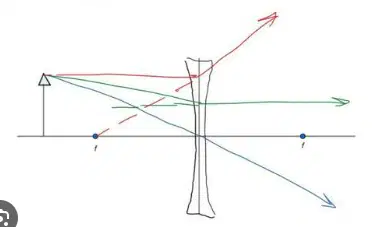
The image formed in the diagram above is:
Real and magnified
Real and smaller
Virtual and magnified
Virtual and smaller
A 2 cm tall light bulb is placed a distance of 4 cm from a
concave mirror having a focal length of 5 cm. Determine the
image distance.
0.04 cm
0.05 cm
20 cm
-20 cm
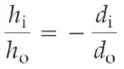
If the hi you calculate using the mirror/lens equation is negative, this means the image is:
smaller than the object
the same size as the object
real
virtual

