
 Worksheets
HPHS T1 Physics Midterm Review
Total questions: 86
Worksheet time: 1hrs 26mins
400 grams =____kilograms
0.4kg
4kg
40kg
40,000kg

32.9 km = ___________ cm
32,900
329,000
3,290,000
32,900,000
Which is the longest?
meter
kilometer
centimeter
milimeter

I would measure this bus in
centimeters
milimeters
kilometers
meters
How would you write 0.0005 in scientific notation?
50 x 10-5
5 x 10⁻⁴
5 x 10³
.5 x 103
Which of the following numbers is written in scientific notation?
20.35 x 10⁴
.2035 x 104
2035 4
2.035 x10⁴
Express the following in scientific notation:
.000457
457 x 106
457 x 10-6
4.57 x10⁴
4.57 x 10⁻⁴
Convert to scientific notation:
520,000,000
52 x 107
5.2 x 10⁻⁷
5.2 x 10⁸
0.52 x 10⁹
If the exponent is a negative number the original number was...
a really large number.
a really small number.
If the exponent is a positive number the original number was...
a really big number.
a really small number.
Convert this number into scientific notation:
0.068
6.9 x 10⁶
6.8 x 10⁻⁹
6.8 x 10⁻²
None of the above
Which value is the greatest?
5.0 x 10⁻⁹
5.0 x 10⁻⁴
5.0 x 10⁶
5.0 x 10⁸
Convert this number into scientific notation:
950,000
9.5 x 10⁵
9.5 x 10⁻⁹
9.5 x 10²
None of the above
8.317 x 10⁶
in standard form?
6.7×101
0.67
67
670
6.1


800
400
0
200
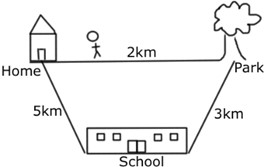
Jerry walked from home to school, then from the school to the park. What is his total distance?
2 km
5 km
8 km
10 km
Jerry walked from home to school, then from the school to the park. What is his total displacement?
2 km E
5 km N
8 km S
10 km W
82 meters N
18 meters N
18 meters S
82 meters S
A car drives 84 meters forward. It's displacement and distance would be the same magnitude.
True
False
Relative motion
the motion of an object in comparison to other objects in a specific frame of reference
the point of view used to measure the position and movement of objects
how fast something moves
the distance

Click on image to make it bigger.
A
B
C
D

You go on a hike on the blue path from point A to point B. (Click on image to make it larger)
What DISTANCE did you travel?
4.6 km
9.2 km
10.3 km
0 km

What is the creature's final displacement?
23 m
9 m
-9 m
-23 m
Negative displacement means the object is
moving to the right.
moving to the left.
slowing down.
negative displacement is not possible.

What distance did the creature travel?
7 m
3 m
-3 m
-7 m
What is the creature's final displacement?
7 m
3 m
-3 m
-7 m

What was the displacement of object B?


Find the distance Sara walks from A to B, B to C then C to D?
11 m
3 m
5 m
8 m
f a car moves 12 km North, 19 km East, and 12 km South, what is its displacement?
31 km
12 km
19 km, East
43 km, East
Tyler drives 50km north. Tyler then drives back 30km south. What was his displacement?
80 km
20 km south
20 km north
80 km north
Joey drives his Skidoo 7 kilometers north. He stops for lunch and then drives 5 kilometers south. What was his displacement?
(a)

This diagram shows how a ball on this pool table rolled to get to the pocket. The black line shows the actual path that the ball rolled.
What was the displacement of the ball when it fell into the pocket?
6 ft
7 ft
14 ft
5 ft

Harry has been on duty for 20 minutes. What distance has he traveled? (Hint: You will multiply the answer above by two!)
80 steps
100 steps
120 steps
160 steps

A jogger runs on the track shown in the figure above. What is the jogger's total distance after running a complete lap around the track?
100 m
130 m
160 m
260 m
A jogger runs on the track shown in the figure above. What is the jogger's displacement after running a complete lap around the track?
100 m
130 m
160 m
0 m
Which scenario would lead to a displacement of zero? There may be more than one answer!
Allison walks from home 50 meters to the store to buy a 2 liter of Dr. Pepper.
Jeremiah walks from the bus stop 20 meters to the park and then back to the bus stop.
Ricky runs 14 meters East from the school, but realizes he forgot his Chromebook and goes back.
Alaysia skips 10 meters to the end of the sidewalk.

How fast is this object going at 1 second?
20 cm/s
30 cm/s
-40 cm/s
When is this object stopped?
1 second
3 seconds
4 seconds
6 seconds
When does this object change direction?
1 second
2 seconds
3 seconds
4 seconds
Which graph shows an object that doesn't move in the beginning?


What is the total displacement?
+1m
+3m
+5m
-1m
True or False: This object changes direction.
True
False
Can't Tell from graph

This motion map shows an object...
not moving
moving with constant velocity
moving with changing velocity

This motion map shows an object...
not moving
moving with constant velocity
moving with changing velocity
Which of these velocity vs. time graphs shows an object changing direction?


On this graph, what is the acceleration between 5 seconds and 8 seconds of time.
8.3 m/s/s Right
-8.3 m/s/s Left
-8.3 m/s Left
8.3 m/s Right

One this graph what is the distance traveled by the object between 0 seconds and 5 seconds of time.
20 m
25 m
22.5 m
-20 m

According to the data in the graph, when is the object moving to the right with increasing velocity.
a
b
c
d
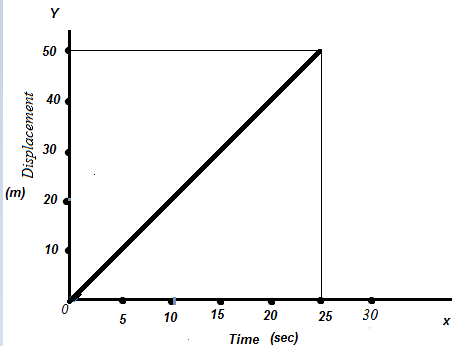
Find the velocity from the given graph.
2 m/s
21 m/s
100 m/s
-2m/s

Calculate the displacement traveled in section B. Hint: Remember the area under a v-t graph = displacement!
150 m
50 m
100 m
200 m
The area under a velocity-time graph represents __________.
displacement
velocity
acceleration
length x width
The slope of a velocity-time graph represents __________.
acceleration
displacement
speed
distance

Select the two correct statements that describe the object's motion.
The object is moving in the positive direction.
The object is moving in the negative direction.
The object is moving at a constant speed.
The object is speeding up.
The object is slowing down.
Calculate the distance travelled in section A.
(a)

Calculate the distance travelled in section C.
(a)

