
 Worksheets
Work Power Machines and Energy 2026
Total questions: 89
Worksheet time: 5hrs 10mins
The equation for work is
work = power x mass
work = power / time
work = force x distance
work = distance x time
The equation for POWER is
power = mass x time
power = work / time
power = time / work
power = work x time
The unit for work is
Watt
J/s
n*m
N*s
________________ is the rate at which work is done.
Power
Work
Force
Energy
The unit of power:
Joule
N*m
J/s
Second
How do you calculate power?
P = t/W
P = mgh
P = w * t
P = F*d/t
Person A and Person B are both using the same amount of work to lift something. Person A takes half as much time to do it. Who has greater power?
Person A
Person B
Which of the following would require the most power?
A mass of 10 kilograms lifted 10 meters in 10 seconds
A mass of 10 kilograms lifted 10 meters in 5 seconds
A mass of 5 kilograms lifted 10 meters in 5 seconds
A mass of 5 kilograms lifted 5 meters in 10 seconds
A car uses 2,500 Joules in 25 seconds. How much power was exerted?
62,500 W
100 W
62.5 W
10 W

The boy pulls down on the rope for 1 meter, and the box rises by one meter. How does this machine help the boy to do work?
by changing the direction of the applied force
by reducing total work done
by decreasing distance of the applied force
by reducing the effort force

Which ramp will require the least amount of effort force?
A
B
C
D

Jeff is a landscaping contractor and lifts a rock weighing 600 newtons by wedging a board under the rock. Jeff weighs 150 newtons and puts all of his weight on the lever. How much mechanical advantage did the lever provide to Jeff in lifting the rock?
0
2
4
8

This 2000 N weight is raised 1 meter by pulling 4 meters of rope. What force was required to pull the rope?
A lever us used to lift a box. In doing so, a 10 Newton effort force is required to lift a 10 kg box 0.2 meters above the ground. How far must you push the lever downward?
0.5 m
1 m
1.5 m
2 m
Simple machines reduce the amount of work needed to complete a task. True or False?
True
False
This 2000 N weight is raised 1 meter by pulling 4 meters of rope. What is the MA of the system?
1
2
4
8
Looking only at ramps C and D, which ramp will require the least amount of effort distance?
A
B
C
D
C and D require the same amount of effort distance.
Looking only at ramps C and D, which ramp will require the least amount of resistance distance?
A
B
C
D
C and D require the same amount of resistance distance.
Which of these is an example of a wedge (an inclined plane that moves)?
skateboard
broom
stairs
butter knife
You have just designed a machine that uses 900 J of work from a motor for 480 J of useful work the machine supplies. What is the efficiency of your machine?
53%
100%
83%
43%
What are the 6 simple machines we discussed in class?
wheel, hammer, spiral, stump, spike, cube
pulley, lever, wheel and axle, screw, inclined plane, wedge
ramp, bolt, circuit, wheel, block, spiral
wheel and socket, ramp, cube, screw, lever, spiral
You test a machine and find it exerts a force of 45 N (resistance) for each 5 N of force you exert (effort) operating the machine. What is the Mechanical Advantage of the machine?
10
11
9
5
Scissors are an example of which simple machine?
screw and wedge
pulley and screw
pulley and wedge
lever and wedge
How much work is done when a crate is pushed with 50 N of force for a distance of 15m?
750 J
3 J
65 J
650 J
You exert 640 J of work lifting a box in a time of 2 seconds. How much power is used to lift the box?
642 W
640 W
1280 W
320 W

An axe is an example of which simple machine?
Pulley
Wedge
Screw
Inclined plane

Simple machines usually make work easier by increasing what?
The distance over which work is done
The force needed to do work
The time required to do work
The acceleration of a massive object


The factor by which a simple machine makes doing work feel easier.
Input Force
Efficiency
Mechanical Advantage
This family of machines includes the Inclined Wedge and the Screw.
The Inclined Plane Family
The Lever Family
The Cactus Shadows Family


Bob (80 kg) uses 180 N of force to get him up the slope. The vertical distance is 2 m and the diagonal is 10 m. Calculate the work he does.
1600 J
160 J
3600 J
1800 J
A weight-lifter raises a 2000N weight through a vertical height of 2.0m in 0.80s. What useful power does he develop in doing this?
800 W
700W
4000W
5000W
distance = ?
force = 3N
time = 60 s
work = 225 J
You push against the back of your friends car that is stuck. You push and be become very tired, but the car does not move. Did you do work?
Yes, work was done
No, work wasn't done
If you increase your work and decrease your time, you will have
more power
less power
same amount of power
power rating can not be determined
Calculate the amount of work done if you lift a 50 kg box 5 m.
250 J
2500 J
5000 J
50,000 J
What period are you in?
Period 2
Period 3
Period 4
Period 5
Period 6
AS A ROLLER COASTER MOVES DOWN A HILL, POTENTIAL ENERGY IS CONVERTED INTO KINETIC ENERGY. WHAT IS TRUE ABOUT THE TOTAL ENERGY OF THIS SYSTEM?
ENERGY IS GAINED (CREATED) AS THE ROLLER COASTER MOVES
ENERGY IS LOST (DESTROYED) AS THE ROLLER COASTER MOVES
THE TOTAL ENERGY REMAINS THE SAME AS THE ROLLER COASTER MOVES
THE TOTAL ENERGY CONSTANTLY CHANGES AS THE ROLLER COASTER MOVES
What is potential energy?
moving energy
stored energy due to position
energy due to motion
mgh + 1/2 mv2
What is kinetic energy?
moving energy
potential energy
stored energy
renewable energy
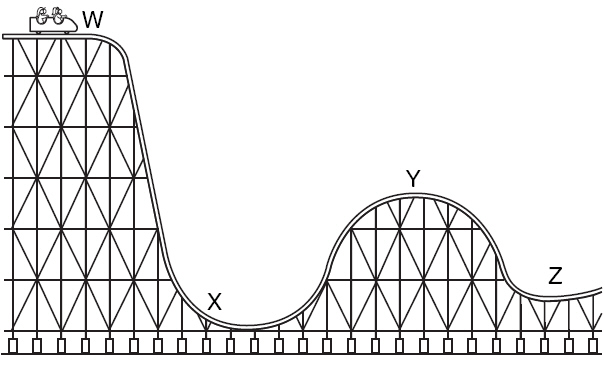
At which point is potential energy greatest?
W
X
Y
Z

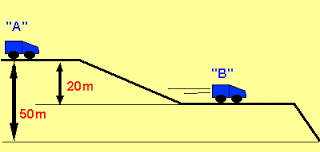
In diagram 2, if the mass of the car is 600 kg, what is the change in potential energy from point A to point B?
120,000
294,000
176,400 J
117,600 J
1. A ball has a 17 J of kinetic energy and its total energy is 25 J. If the ball has a mass of 3.2 kg, what is its height above the ground?
0.25 m
0.52 m
5.2 m
25 m

Using this Picture for all of the next questions, please answer the following. How much PE is present at 100 m?
15,000 J
20,000 J
35,000 J
50,000 J
0 J
How much KE is present at 100 m?
15,000 J
20,000 J
35,000 J
50,000 J
0 J
How much PE is present at 30 m?
15,000 J
20,000 J
35,000 J
50,000 J
0 J
How much KE is present at 30 m?
15,000 J
20,000 J
35,000 J
50,000 J
0 J
How much KE is present at 60 m?
15,000 J
20,000 J
30,000 J
50,000 J
0 J
How much TE is present at 60 m?
15,000 J
20,000 J
30,000 J
50,000 J
0 J

Calculate the mass of the skier.
about 500 kg
about 50 kg
about 1167 kg
about 119 kg

What do you notice about the TE throughout the whole ski jump?
It is the same as the GPE
It is the same as the KE
It is always different
It never changes

Calculate the speed of the skier as they reach the bottom of the hill
about 1373 m/s
about 140 m/s
about 37 m/s
about 12 m/s
How much kinetic energy (K) does a baseball with a mass of 0.143 kg have if it is travelling at a velocity of 41.1 m/s?
120.8 joules
89.7 joules
108.3 joules
156.6 joules
A 1.0 kg ball is stationary at the top of a hill that is 10.0 meters in height. The ball rolls down the hill. What is its gravitational potential energy at the bottom of the hill?
0 joules
98 joules
49 joules
38 joules
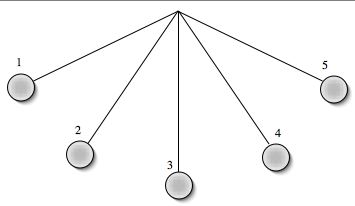
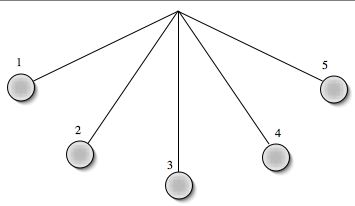

If a 3.2 Kg hammer was dropped from a construction building from a height of 40 meters, and hit a worker on the head. What velocity did the hammer hit is head? The worker is 1.8 meters tall
9.8 m/s
27.6 m/s
65.5 m/s
50 m/s

A pendulum is raised to a height and dropped. If the ball of the pendulum is .35 Kg and is traveling at 3.31 m/s at its lowest point, what was the height that it was dropped from
1.92 m
1.5 m
.75 m
.55 m
The unit for energy is _____________.

A car going twice as fast has ____ times the kinetic energy.
four
six
eight
ten

