wayground logo

Free Printable Worksheets

Font size

S
M
L
XL
Worksheets

Nuclear radioactivity

Total questions: 90

Worksheet time: 2hrs 52mins

Name
Class
Date
1.

When nuclei decay, massive amounts of __________ is released.

a)

energy

b)

electrons

c)

protons

d)

neutrons

2.
What is Half-life?
a)
The amount of time it takes for some of the nuclei in a sample of the isotope to decay
b)
The amount of time it takes for half the electrons in a sample of the isotope to decay
c)
The amount of time it takes for half the nuclei in a sample of the isotope to decay
d)
the amount of time it takes to double the nuclei in a sample of the isotope to decay
3.

What type of decay is shown here

23892U ---> 23490Th + 42He.

a)

alpha

b)

beta

c)

gamma

4.

Identify the type of nuclear decay shown here

21483Bi 0-1e + 21484Po

a)

alpha

b)

beta

c)

gamma

5.
When a nucleus undergoes nuclear decay by gamma rays, the atomic number of the element....
a)
remains the same
b)
  decreases by one.
c)
increases by one.
d)
increases by two.
6.
The type of radioactive particle that can be stopped by a sheet of paper is the ____.
a)
alpha particle
b)
beta particle
c)
gamma ray
d)
uranium
7.

Finish this equation

20983Bi--> _______ + 20581Tl

a)

42He

b)

0-1e

c)

y

8.
The most dangerous type of radiation is the ____. 
a)
alpha particle
b)
gamma ray
c)
beta particle
d)
uranium
9.
Solve this equation for alpha decay.
85209At = ___ + 24He
a)
83205Bi
b)
86209Rn
c)
81207Tl
d)
85208At
10.

Identify the missing substance in each of the following nuclear reaction.

_____→13756 Ba + 0−1 e

a)

13755Ba

b)

13757La

c)

13856Ba

d)

13755Cs

11.
In the symbol 20682Pb what does 206 stand for?
a)
Mass number
b)
Atomic number
c)
Atomic mass
d)
Number of protons
12.
The three types of nuclear radiation in increasing order of penetrating power are ____.  
a)
  alpha, beta, gamma 
b)
X ray, beta, gamma
c)
alpha, gamma, beta 
d)
X ray, gamma, beta 
13.
What is the symbol for an alpha particle?
a)
42He
b)
0-1e
c)
0+1 e
d)
10n
14.
Two or more nuclei combine to form one larger nucleus in the process of nuclear _____.
a)
Fusion
b)
Fission
c)
Tracing
d)
Decay
15.
This is an example of...
a)
Fission  reaction
b)
Fusion reaction
c)
Decomposition reaction
d)
Decay
16.
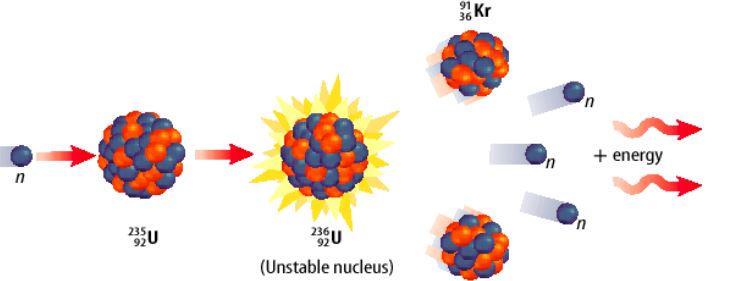
The splitting of a nucleus into smaller nuclei is
a)
fusion
b)
fission
c)
decay
d)
gamma radiation
17.
Solve this equation for beta decay.
2760Co = ___ + -10e
a)
2556Mn
b)
2860Ni
c)
2358V
d)
2759Co
18.
This is an example of ---
a)
Radioactive Decay
b)
Nuclear Fission
c)
Nuclear Fusion
d)
Fossil fuel reaction
19.
Name the instrument used to detect radioactivity.
a)
voltmeter
b)
ohmeter
c)
seismograph
d)
geiger counter
20.
What makes something radioactive?
a)
elements with an atomic number above 81
b)
an unstable nucleus
c)
contaminated sewage
d)
It decays over time
21.
An isotope of an element has the same number of _________, but a different number of _________.
a)
Protons, electrons
b)
Protons, neutrons
c)
Electrons, neutrons
22.
What is Half-life?
a)
The amount of time it takes for some of the nuclei in a sample of the isotope to decay
b)
The amount of time it takes for half the electrons in a sample of the isotope to decay
c)
The amount of time it takes for half the nuclei in a sample of the isotope to decay
d)
the amount of time it takes to double the nuclei in a sample of the isotope to decay
23.

Radioactivity can be harmful and cause disease because it affects _________.

a)

air

b)

water

c)

cells

d)

blood

24.
Radioactive tracers are useful in ____.
a)
calculating the ages of fossils 
b)
fueling nuclear reactions 
c)
determining medical problems 
d)
treating brain tumors 
25.

An alpha particle is made up of

a)

2 protons and 4 neutrons

b)

1 proton and 1 neutron

c)

2 protons and 2 neutrons

d)

4 protons and 2 neutrons

26.

Which type of nuclear radiation can be stopped by a sheet of paper?

a)

Alpha

b)

Beta

c)

Gamma

27.
What type of radioactive decay is shown here?
a)
Alpha decay
b)
Beta decay
c)
Gamma decay
28.

When a substance undergoes beta decay

a)

The atomic number increases by 1

b)

The atomic number decreases by 2

c)

The atomic number does not change

29.

Which type(s) of radiation is the most ionising?

a)

alpha

b)

beta

c)

gamma

d)

alpha and beta

e)

beta and gamma

30.

Which type(s) of radiation is a fast moving electron?

a)

alpha

b)

beta

c)

gamma

d)

alpha and beta

e)

beta and gamma

31.

Which type(s) of radiation can pass through paper?

a)

alpha

b)

beta

c)

gamma

d)

alpha and beta

e)

beta and gamma

32.

What change takes place to an atom during beta decay?

a)

A proton changes into a neutron

b)

A proton changes into an electron

c)

An electron changes into a neutron

d)

A neutron changes into a proton

33.

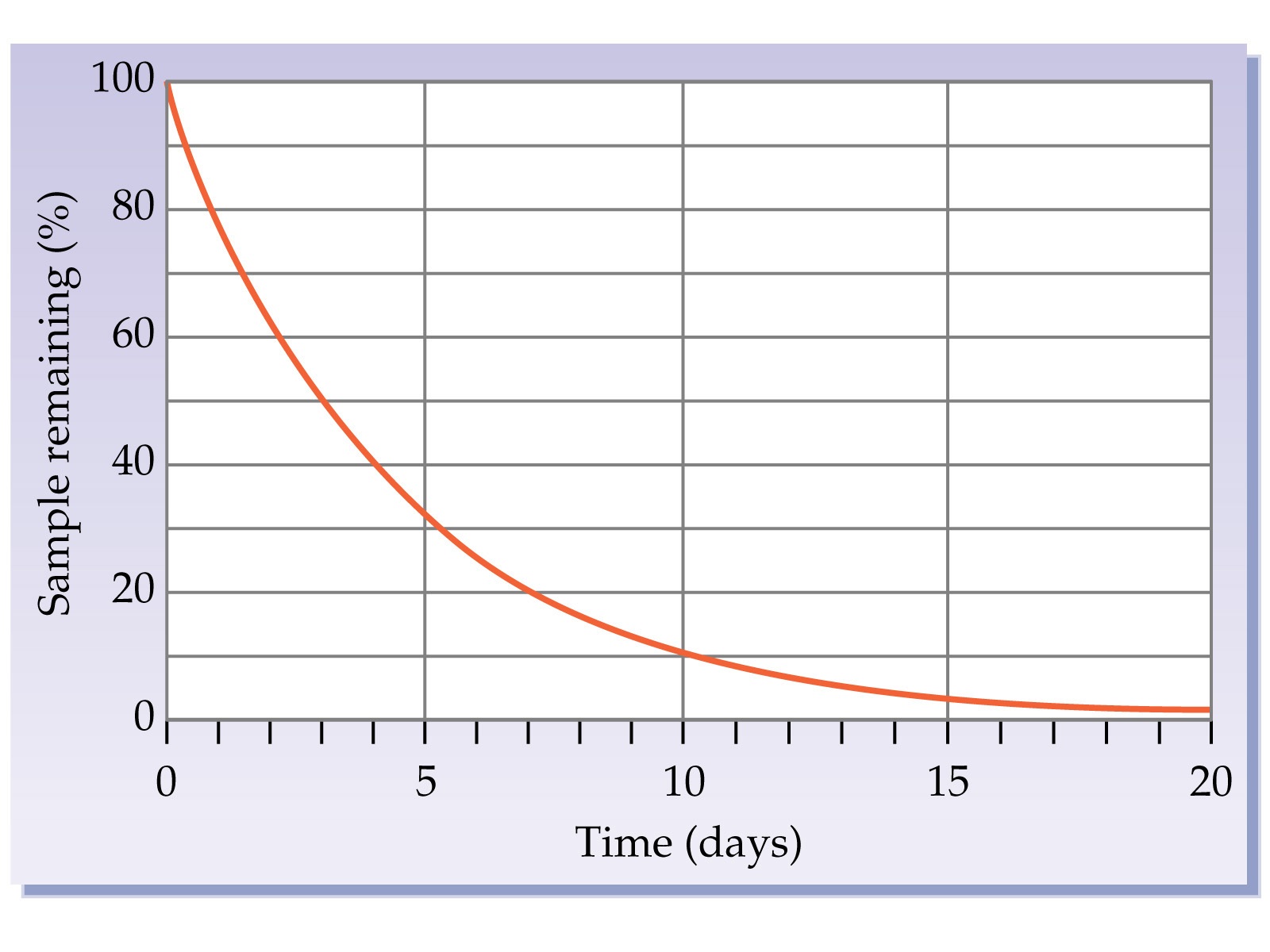
What is the Half Life of this isotope?

a)

3 days

b)

5 days

c)

8 days

d)

10 days

34.

The Half Life of Californium 252 is 5 years.

a)

TRUE

b)

FALSE

35.

The time it takes for a radioactivity level to drop by a half is is the sample's ___________________.

a)

quarter life

b)

whole life

c)

wonderful life

d)

half life

36.
_______________ is the process by which unstable atoms emit radiation until they become stable.
a)
Radiation
b)
Chemical Reaction
c)
Radioactive Decay
d)
Isotopes
37.
What is Half-life?
a)
The amount of time it takes for some of the nuclei in a sample of the isotope to decay
b)
The amount of time it takes for half the electrons in a sample of the isotope to decay
c)
The amount of time it takes for half the nuclei in a sample of the isotope to decay
d)
the amount of time it takes to double the nuclei in a sample of the isotope to decay
38.

The half-life of Zn-71 is 2.4 minutes. If one had 100.0 g at the beginning, how many grams would be left after 2.4 minutes has elapsed?

a)

100.0g

b)

50.0g

c)

12.5g

d)

8.5g

39.
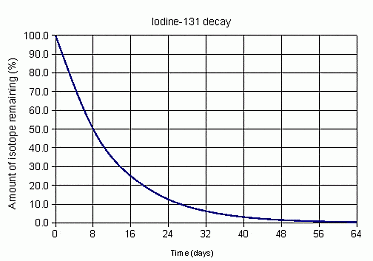
What is the half-life of iodine-131?
a)
32 days
b)
8 days
c)
16 days
d)
24 days
40.

A radioactive sample will lose half of its original radioactive nuclei after 1 half life.

a)

TRUE

b)

FALSE

41.

What is the half life of californium?

a)

1 year

b)

2.8 years

c)

3 years

d)

5 years

42.

Which particles are contained in the nucleus?

a)

Protons + Photons

b)

Protons + Neutrons

c)

Neutrons + Zutrons

d)

Electrons + Protons

43.

How many protons are in this atom?

a)

0

b)

6

c)

12

d)

18

44.

Atoms with the same number of protons, but different numbers of neutrons, are called...

a)

Isotopes

b)

Ions

c)

Atoms

d)

Nucleons

45.

What type of decay is shown here?

a)

Alpha

b)

Beta

c)

Gamma

d)

Photon

46.

What is the missing number?

a)

90

b)

92

c)

94

d)

96

47.

What are the missing two numbers?

a)

238

92

b)

238

90

c)

234

92

d)

234

90

48.

What is the half-life of the isotope in this graph?

a)

140 days

b)

200 days

c)

380 days

d)

400 days

49.

Identify the type of nuclear decay shown here

21483Bi 0-1e + 21484Po

a)

alpha

b)

beta

c)

gamma

50.

Finish this equation

20983Bi--> _______ + 20581Tl

a)

42He

b)

0-1e

c)

y

51.
Solve this equation for alpha decay.
85209At = ___ + 24He
a)
83205Bi
b)
86209Rn
c)
81207Tl
d)
85208At
52.

Identify the missing substance in each of the following nuclear reaction.

_____→13756 Ba + 0−1 e

a)

13755Ba

b)

13757La

c)

13856Ba

d)

13755Cs

53.
This is an example of...
a)
Fission  reaction
b)
Fusion reaction
c)
Decomposition reaction
d)
Decay
54.
Solve this equation for beta decay.
2760Co = ___ + -10e
a)
2556Mn
b)
2860Ni
c)
2358V
d)
2759Co
55.

Iodin-131 decays with half-life is 8 days to become Xenon-131. Calculate the mass of Iodin-131 after 24 days with a mass of 60g.

a)

7.5 g

b)

8.5 g

c)

12.5 g

d)

15.5 g

56.

A radioactive source emits radiation that can pass through a sheet of paper but not through thick aluminium. What does this show about the radiation?

a)

It is alpha-particles.

b)

It is beta-particles.

c)

It is gamma-rays.

d)

It is a mixture of alpha-particles and gamma-rays

57.

Which type of radiation has the greatest ionising effect?

a)

α-particles

b)

β-particles

c)

γ-rays

d)

all have the same ionising effect

58.

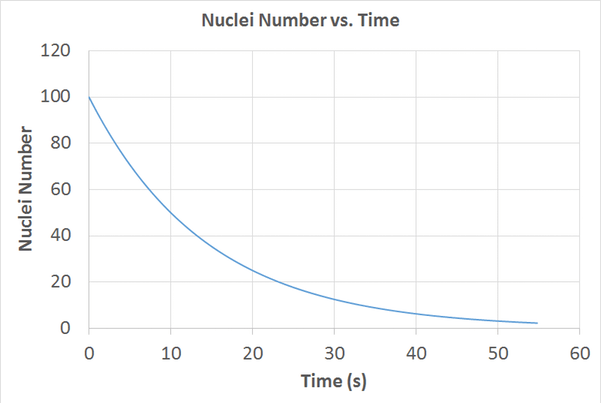
What is the Half life of this isotope?

a)

5 seconds

b)

10 seconds

c)

15 seconds

d)

20 seconds

59.
What is the half-life of iodine-131?
a)
32 days
b)
8 days
c)
16 days
d)
24 days
60.

The % of the parent isotope remaining after 1 Half Life.

a)

50%

b)

25%

c)

12.5%

d)

6.25%

61.

Alpha decay of radium-226, the most abundant isotope of radium.

a)
b)
c)
d)
62.

Radioactive decay of carbon-14, which is used in radiocarbon dating of previously living material.

a)
b)
c)
63.

Alpha decay of the artificially produced radioisotope that is used in smoke detectors.

a)
b)
c)
d)
64.

Copper-66 undergoes two beta decays.

a)
b)
c)
d)
65.
This particle determines what element you have - the elements identity.
a)
electron
b)
proton
c)
neutron
d)
valence shell
66.
Which particles make up the nucleus of an atom?
a)
protons and neutrons
b)
electrons and protons
c)
electrons, protons, and neutrons
d)
electrons and neutrons
67.
What is the number of protons that the element in this image contain?
a)
14
b)
7
c)
15
d)
18
68.
An element with a mass number of 11 and an atomic number of 5 has how many neutrons?
a)
11
b)
5
c)
6
d)
16
69.

An isotope of an element has the same number of _________, but a different number of _________.

a)

Protons, electrons

b)

Protons, neutrons

c)

Electrons, neutrons

d)

Neutrons, protons

70.

A radioactive nuclide has a ____ stable nucleus than a non-radioactive nucleus of the same element.

a)

more

b)

less

c)

identical

d)

small

71.
What makes something radioactive?
a)
elements with an atomic number above 81
b)
an unstable nucleus
c)
contaminated sewage
d)
It decays over time
72.
Negatively charged particles emitted from a nucleus at a high speed are ____ .
a)
protons
b)
neutrons
c)
electrons
d)
protons and neutrons
73.
In order of most to least penetrating radiation we have
a)
Alpha , Beta,  Gamma
b)
Beta , Gamma , Alpha
c)
Gamma, Beta, Alpha
d)
Gamma, Alpha, Beta
74.

Which type of radiation releases an electron?

a)

Alpha radiation

b)

Beta radiation

c)

Gamma radiation

d)

Theta radiation

75.

Which particle has a negative charge

a)

Alpha

b)

Electron

c)

Proton

d)

Neutron

76.

What is an isotope

a)

An atom with the same number of neutrons different number of protons

b)

An atom that has lost or gained an electron

c)

An atom with the same number of protons, different number of neutrons

d)

An atom with the same number of electrons and different neutrons

77.

What is half life

a)

Time taken for a radioactive atom to decay be 1/4

b)

Time taken for a radioactive atom to decay by 1/3

c)

Time taken for a radioactive atom to decay by 1/2

d)

Time taken for a radioactive atom to decay by 1/5

78.

Which is an alpha particle

a)

Fast moving electron

b)

4 2 He nuclei

c)

fast moving positron

d)

EM wave

79.

The centre of an atom is called

a)

the electron

b)

the proton

c)

the nucleus

d)

the neutron

80.

What stops beta radiation

a)

Paper

b)

Air

c)

Glass

d)

Aluminium 3mm or thicker

81.

What type of decay is shown here

23892U ---> 23490Th + 42He.

a)

alpha

b)

beta

c)

gamma

82.

Identify the type of nuclear decay shown here

21483Bi 0-1e + 21484Po

a)

alpha

b)

beta

c)

gamma

83.
When a nucleus undergoes nuclear decay by gamma rays, the atomic number of the element....
a)
remains the same
b)
  decreases by one.
c)
increases by one.
d)
increases by two.
84.
The type of radioactive particle that can be stopped by a sheet of paper is the ____.
a)
alpha particle
b)
beta particle
c)
gamma ray
d)
uranium
85.
The three types of nuclear radiation in increasing order of penetrating power are ____.  
a)
  alpha, beta, gamma 
b)
X ray, beta, gamma
c)
alpha, gamma, beta 
d)
X ray, gamma, beta 
86.

__________________ is the process in which two or more smaller nuclei combine to create a larger, more stable nuclei.

a)

Nuclear Decay

b)

Nuclear Fission

c)

Nuclear Fusion

d)

None of the above

87.

What is the major drawback to fission power?

a)

Radioactive Waste

b)

CO2 Emissions

c)

SO2 Emissions

d)

All of the Above

88.

___________ starts the fission of a uranium atom.

a)

Energy

b)

Protons

c)

One Neutron

d)

All of the above

89.
Hydrogen is the primary fuel
a)
Fission
b)
Fusion
c)
Radioactive Decay
90.
Very high temperature and pressure required
a)
Fission
b)
 Fusion
c)
Radioactive Decay