
 Worksheets
Magnetism
Total questions: 85
Worksheet time: 4hrs 15mins
The direction of magnetic field developed around a current -carrying conductor can be easily found by the use of
right hand thumb rule
left hand thumb rule
Fleming's left hand rule
Fleming's right hand rule
If a charged particle does not experience any force in a magnetic field, then..
A) it is stationary
B) it moves in the direction parallel to magnetic field
both A and B
it moves perpendicular to the field
A beam of alpha particles enters a chamber moving along the magnetic field. The force acting on them is
maximum and perpendicular to the magnetic field
maximum and along the magnetic field
minimum and perpendicular to the magnetic field
zero
Induced current found to be highest when coil moves
at an angle of 45 degree
at angle of 20 degree
parallel to magnetic field
right angle to magnetic field
The direction of the force on a current-carrying wire placed in a magnetic field depends on
the direction of the current
the direction of the field
the direction of current as well as field
neither the direction of current nor the direction of field
A straight wire of length 0.5m and carrying current 1.2A is placed in uniform magnetic field of induction 2T, applied perpendicular to the length of the wire. The force on the wire is
2.4 N
1.2 N
3.0 N
2.0 N
Two particles X and Y having equal charges, and accelerated through same potential and enters the uniform magnetic field describing circular paths of radii R1 and R2. The ratio of their masses of X and Y is :
(R1 / R2) 1/2
R2 / R1
(R1 / R2) 2
(R1 / R2)
The Right Hand Rule relates the variables:
Current, Magnetic Field and Magnetic Force
Current, Magnetic Field and Electrical Force
Charge on object 1, Charge on object 2 and distance
Magnetic Field, Magnetic Force and Electrical Force
NAME THE RULE WHICH RELATES THE DIRECTION OF ELECTRIC CURRENT & THE DIRECTION OF ACCOMPANYING MAGNETIC FIELD DUE TO CIRCULAR COIL CARRYING CURRENT
FLEMING'S LEFT HAND RULE
FLEMING'S RIGHT HAND RULE
RIGHT HAND THUMB RULE
NONE OF THE ABOVE
SI unit of magnetic dipole moment is-
A.m2
Am
A / m
m/A
A current I is flowing east to west in a long wire kept in east west direction. Find magnetic field in a horizontal plane at a distance of d north from the wire.
vertically downwards
vertically upwards
towards north
toward south
what current must flow in an infinitely long straight wire to produce a magnetic field of 4 ×10⁵ T at 8 cm from the wire?
1.6 A
16 A
.16 A
160 A
Biot Savart law states
Magnetic field has a net outward flow
Magnetic field has no net outward flow
Magnetic field and electric field are normal to each other
Total magnetic flux coming out of a surface is total current enclosed

At the centre of which of the following four circular rings the magnetic field is the strongest for equal magnitude of current?
Loop 1
Loop 2
Loop 3
Loop 4
Magnetic field inside a long solenoid carrying current is
same at all points (uniform)
different at poles and at the centre
zero
different at all points
The magnetic field lines due to a straight wire carrying a current are
straight
circular
parabolic
elliptical
A straight wire of length 0.5m and carrying current 1.2A is placed in uniform magnetic field of induction 2T, applied perpendicular to the length of the wire. The force on the wire is
2.4 N
1.2 N
3.0 N
2.0 N
If a long copper rod carries a direct current, the magnetic field associated with the current will be
only inside the rod
only outside the rod
both inside and outside the rod
neither inside nor outside the rod
A vertical wire carrying a current in the upward direction is placed in a horizontal magnetic field directed towards north. The wire will experience a force directed towards
east
west
north
south

A current carrying wire lies between the poles of
two magnets, as shown. What is the direction of the force on the wire?
Into the plane of the paper
Out of the plane of the paper
Towards the N-pole
To the right

The diagram shows a current-carrying wire in a horizontal magnetic field.
Which arrow shows the direction of the force experienced by the wire?
A
B
C
D
A current-carrying wire of length 50 cm is
positioned perpendicular to a uniform magnetic field.
If the current is 10.0 A and it is determined that there
is a resultant force of 3.0 N on the wire due to the
interaction of the current and field, what is the
magnetic field strength?
6.7 E -3 T
1.8 E -3 T
0.6 T
1.5 T
A 2.0 m wire segment carrying a current of
0.60 A oriented parallel to a uniform magnetic field of
0.50 T experiences a force of what magnitude?
0
0.15 N
0.30 N
6.7 N

A wire is lying horizontally in the north-south
direction and the horizontal magnetic field is toward
the east. Some positive charges in the wire move
north and an equal number of negative charges move
south. The direction of the force on the wire will
EAST
WEST
INTO THE PAGE
OUT OF THE PAGE
What is the magnetic force exerted on a 3.50 𝑚 length of wire carrying a current of 1.20 𝐴 perpendicular to a
magnetic field of 0.890 𝑇?
6.5 N
4.25 N
3.74 N
1.75 N
What does the thumb indicate in flemings left hand rule?
Force
Motion
Current
Magnetic field direction

A negatively charged particle is moving to the
right, directly above a wire having a current flowing
to the right, as shown in the figure. In which direction
is the magnetic force exerted on the particle?
into the page
out of the page
downward
upward

A beam of positively charged alpha particles
enters the magnetic field between the poles of a
magnet.
In which direction is the magnetic force on the beam?
Down the page
Into the page
Up the page
Out of the page
A 2.0 m wire segment carrying a current of
0.60 A oriented parallel to a uniform magnetic field of
0.50 T experiences a force of what magnitude?
0 N
0.15 N
0.30 N
6.7 N
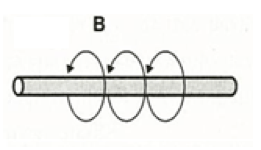
1) A wire carries a current, creating a magnetic field around itself as shown. The current in the wire is:
A. Directed to the right
A. Directed to the left
A. Equal to the magnetic field
In the same direction as the magnetic field
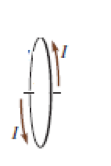
1) The magnetic field inside the coil shown below is directed:
Into the page
Out the Page
To the left
Towards the bottom of the page
1) A solenoid with 500 turns, 0.10 m long, carrying a current of 4.0 A and with a radius of 102 m will have what strength magnetic field at its center?
31 x 10 – 4 T
62 x 10 – 4 T
125 x 10 – 4 T
250 x 10 – 4 T
Solenoid #1 has a length L, cross-sectional area A, and N turns. Solenoid #2 has a length 2L, cross-sectional area 2A, and 2N turns. Which solenoid has the greater magnetic field at its center when equal currents are going through them?
#1
#2
Both have the same magnetic field.
Since it depends on the values of A and L, none of the above are correct
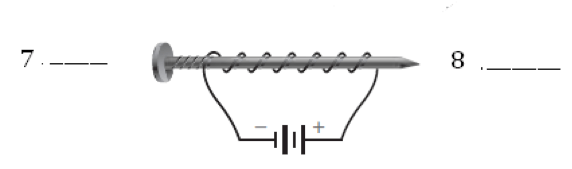
1) In the figure, using the right hand rule around a solenoid, which of the below statements is correct:
North Pole is 7 and South pole is 8
North Pole is 8 and South Pole is 7
There is no magnet, so no north or south
The current is flowing in the direction from 7 to 8
1) Two long parallel wires 40 cm apart are carrying currents of 10 A and 20 A in the opposite direction. What is the magnitude of the magnetic field halfway between the wires?
1.0 x 10^-5 T
2.0 x 10^-5 T
3.0 x 10^-5 T
4.0 x 10^-5 T
1) There are four coils of wire being used as electromagnets. They all have the same size and are made up of the same material but have a different number of loops. Which coil will produce a magnetic field with the maximum strength when the same amount of current passes through all coils?
a coil having 25 loops
a coil having 30 loops
a coil having 45 loops
a coil having 50 loops

1) A straight wire carries a current inside the paper. What is the direction of the magnetic field at point P?
Points to the right
Points to the left
Points to the top of the page
Points to the bottom of the page
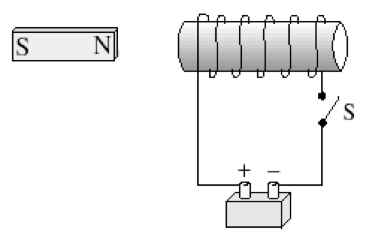
1) A bar magnet is at rest, next to a fixed electromagnet. In which direction will the bar magnet move when switch S is closed?
to the left
to the right
up the page
down the page
1) A 3.25 A current is moving through a loop with 5 turns. What is the radius of the loop that produces a magnetic field of 3.4 x 10^-4 T at its center?
0.03 m
0.25 m
0.50 m
0.75 m

Two parallel wires of length 2 m are separated by 40 cm. If the magnetic force between the two wires is 2 ×10^-6 N and the current in the second wire is twice the current in the first one.
1) Which of the following is true concerning the force between the two wires:
The magnetic force is a repulsion between wires
The magnetic force is an attraction between the wires

Two parallel wires of length 2 m are separated by 40 cm. If the magnetic force between the two wires is 2 ×10^-6 N and the current in the second wire is twice the current in the first one.
How much is the current I in the first wire?
1A
2A
3A
4A
1) What is the magnitude of the magnetic field at the core of a 120-turn solenoid of length 0.50 m carrying a current of 2.0 A?
2.4 × 10– 4 T
4.8 × 10– 5 T
1.2 × 10– 6 T
6.0 × 10– 4 T
1) Two long, parallel wires each carry the same current I in the same direction. Is the total magnetic field at the point midway between the wires:
Zero
Directed into the page
Directed out of the page
Directed to the left
1) Solenoid A has length L and N turns, solenoid B has length 2L and N turns, and solenoid C has length L/2 and 2N turns. If each solenoid carries the same current, rank by the strength of the magnetic field in the center of each solenoid from largest to smallest.
A, B, C
A, C, B
B, C, A
C, A, B
1) Which of the following actions would double the magnitude of the magnetic force per unit length between two parallel current-carrying wires? Choose all correct answers.
Double one of the currents.
Double the distance between them.
Double both currents.
None of the above

1) A wire carries current I directed to the right as shown in the figure below. What is the direction of the magnetic field generated by the wire at point A?
To the right
To the left
Toward the wire
Into the page
1) What is the magnitude of the magnetic force per unit length between a pair of parallel wires separated by 2 m if they carry each a current of 3 A?
A.
1.8 x 10⁻⁶ N/m
9 x 10⁻⁷ N/m
4.5 x 10⁻⁷ N/m
3 x 10– 7 N/m
The force exerted on a current-carrying wire
located in an external magnetic field is directly
proportional to which of the following?
I. Current strength
II. Field strength
III. Length of the wire
I only
II only
I and II only
I, II and III

Are the magnetic field lines in the picture correct?
Yes, because they point from north to south.
No, because they point from north to south (they're supposed to go the other way).
Yes, because the North pole is on the left in all pictures.
No, because the North pole is on the left in all pictures (it's supposed to be on the right).
A 2.0 m long wire carrying 10 A of current moves through an 6.0 T magnetic field. What is the magnetic force acting on the wire?
10 N
120 N
0.5 N
2 N
A 6.0 C charge with a mass of 0.20 kg is moving with a speed of 2.5 m/s. It enters into a magnetic field of 3.0 T and begins to move in a circle. What is the radius of curvature of the path the charge follows in this field?
45.0 m
.028 m
.139 m
36 m
Two long parallel wires carry currents in opposite directions. The top wire carries a current to the left, while the bottom wire carries a current to the right. The wires are not touching. Do the wires attract each other or repel?
Attract
Repel

In what direction is the electric current flowing according to right hand rule 2?
Up
Down
Left
Right

In the diagram above, a wire carrying an electron current into the page, as denoted by X, is placed in a magnetic field. The magnetic field exerts a force on the wire toward point
A
B
C
D

Describe the direction the charge gets deflected at in the diagram above
up
down
left
right

Describe the direction the charge gets deflected at in the diagram above
out of the page
into the page
left
right

Describe the direction the charge gets deflected at in the diagram above
out of the page
into the page
left
right

Describe the direction the charge gets deflected at in the diagram above
up
down
into the page
no deflection
A 2 C charge moving at 15 m/s enters into a magnetic field of strength 5 T. What is the maximum force experienced by this charge?
150 N
150 N into the page
360 N
360 N out of the page
A 5 C charge moving at 6 m/s toward the bottom of the page encounters a 12 T magnetic field pointed toward the right of the page. What is the magnetic force acting on the charge?
150 N
150 N into the page
360 N
360 N out of the page
A positive charge moving toward the bottom of the page encounters a magnetic field pointed toward the right of the page. What direction does the charge get pushed?
up
down
into the page
out of the page
A 5 C charge moving at 3 m/s toward the right of the page encounters an unknown magnetic field. The charge experiences a force of 30 N upwards. What is the magnetic field strength on the charge?
450 T right
2.0 T out of the page
2.0 T into the page
450 T left
A positive charge moving toward the right of the page encounters an unknown magnetic field. The charge experiences a force up the page. What direction is the magnetic field?
into the page
out of the page
up
down
A solenoid with 500 turns, 0.10 m long, carrying a current of 4.0 A and with a radius of 10-2 m will have what strength magnetic field at its center?
31 x 10 – 4 T
62 x 10 – 4 T
125 x 10 – 4 T
250 x 10 – 4 T
A beam of electrons travels at 6.0×10⁶ m/s through a uniform magnetic field of 6.5×10⁻¹ T at right angles to the field. How strong is the force acting on each electron?
= 6.25×10⁻¹³ N
= 2.65×10⁻¹³ N
= −6.25×10⁻¹⁰ N
= 2.655×10⁻¹⁰ M
A 75 cm of straight wire carrying a 9.0 A current is in a uniform magnetic field oriented at right angles to the wire. The force acting on it is 1.2 N. What is the strength of the magnetic field (B)? HINT: F=I.L.B
= 0.18 N
= 0.18 T
= 0.18 Cm
= 0.18
Magnetic force on a conductor carrying a current = 1.32 N, current = 4 A, length = 3.88 m, magnetic flux density = ?
0.0851 T
1.17 T
0.317 T
0.106 T
A wire has a current travelling through towards the left. If it is in a magnetic field directed downward, what direction will the wire experience a force?
Up
down
out of page
into page
Tesla is the unit of
magnetic flux density of a uniform field when the magnetic flux is 1 weber passing through unit area.
magnetic flux density of a uniform field normal to wire carrying current of 1 A, giving force per unit length of 1 N m–1.
charge when 1 coulomb passes a point in 1 s.
magnetic flux density of a uniform field normal to velocity of charge of 1 C, giving a force per unit velocity of 1 N m–1.
The coils of wire on an electromagnet are usually wound on ferrous core.
Which of the following statement is incorrect of magnetic material.
Ferrous material for example iron does not retain its magnetism when no current flows.
Ferrous material concentrates the magnetic flux thus increasing the magnetic field strength greatly.
Steel use in electromagnet becomes a permanent magnet.
Copper and aluminium are other examples of ferrous materials.

I
III
I, II
I, III

I
III
I, II
II, III

QR, thickness ST
PS, thickness ST
QR, thickness SR
PS, thickness SR

A
B
C
D
An ion of mass m and charge q enters a region of uniform magnetic field acting perpendicularly to the original line of flight. The resulting path is
circular and of radius proportional to q/m
linear and perpendicular to the original path
circular and of radius proportional to m/q
curved with a displacement from the original line of flight proportional to m/q

2.5x10⁻⁴N, direction R
2.5x10⁻⁴N, direction P
2.5x10⁴N, direction R
2.5x10⁴N, direction P

1.7x10⁻² T
6.0x10⁻² T
6.0 T
17 T
An a-particle travelling with a speed of 1.5x10⁶ms-1 enters a region of uniform magnetic field of flux density 2.2mT. What is the radius of the path of the a-particle.
3.5m
14m
26m
28m
Explain the use of a uniform electric field and a uniform magnetic field for the selection of the velocity of a charged particle. Which of the following could not possibly be an explanation.
Uniform magnetic field going into the page.
Negative charged particle entering the field normally.
Electric force is upwards and magnetic force is downwards and balanced for no deflection.
The electric field can also be parallel to the magnetic field.

6.6× 10⁻²⁶u
40u
80u
4000u

0.10mm
50mm
65mm
0.01mm x 50mm

5.1 × 10⁻⁷ V
5.1 × 10⁻⁴ V
5.1V
5.1-7V

3.6x10²T
2.8x10⁻³T
2.8x10⁻⁵T
3.6x10⁴T

A
B
C
D

b) based on the diagram above, choose the direction of the forces that act on the sides AB and CD of the coil.
AB:UPWARD;CD:DOWNWARD
AB:DOWNWARD;CD:UPWARD

